The Human Family Tree: Meet the Other Humans Who Once Walked the Earth
Human evolution is a story of branching populations, shared landscapes and occasional interbreeding. Fossils and ancient DNA reveal a family far richer than a ladder.
For much of our evolutionary history, being human did not mean belonging to the only human population on Earth. Different relatives occupied Africa, Eurasia and Southeast Asian islands, sometimes overlapping for hundreds of thousands of years. Some met and had children. Others are known from a handful of teeth or bones.
Human evolution is a branching process, not a march from an ape to a modern person. Humans are apes, and living chimpanzees are our relatives, not our ancestors. Homo sapiens is the only surviving human species, but many extinct relatives were cousins rather than direct ancestors. The existence of this diversity is much more secure than every proposed connection between its branches. Smithsonian: human fossil evidence and classification
READING FOUR MILLION YEARS OF HUMAN HISTORY
The timeline below compares approximate evidence ranges, not precise birth and extinction dates. A fossil establishes presence at a place and time; it rarely tells us when a lineage began or ended. Some bars summarize fossils, others include genetic evidence or a disputed taxonomic grouping. Read each row's qualification before comparing them. Overlap in time does not establish contact in the same landscape.
Approximate evidence ranges
Select a row to read its evidence. Hatched bars mark special dating or classification cautions.
Thousands of years ago. Older on the left, present on the right.
Australopithecus afarensis
Approximate conventional fossil range; its ends are not exact origin or extinction dates.
Bars do not prove continuous occupation, contact or an exact extinction date. The full data table remains available in either view.
Read all dates, qualifications and sources
| Group | Evidence range (thousand years ago) | Qualification and sources |
|---|---|---|
| Australopithecus afarensis | ≈ 3,850 → 2950 | Approximate conventional fossil range; its ends are not exact origin or extinction dates. Source 1 |
| Homo habilis | ≈ 2,400 → 1400 | Approximate conventional fossil range; its ends are not exact origin or extinction dates. Source 1 |
| Homo erectus | ≈ 1,890 → 108 | Broad erectus grouping. Young endpoint uses the younger limit of the Ngandong deposit estimate, 117–108 thousand years. Source 1Source 2 |
| Homo heidelbergensis | ≈ 700 → 200 | Broad traditional classification, not a universally accepted single lineage or lifespan. Source 1 |
| Neanderthals | ≈ 400 → 40 | Broad fossil range; characteristic Neanderthal anatomy developed gradually. Source 1 |
| Denisovans | ≈ 250 → 32 | Envelope combines sediment DNA at 250–170 thousand years and a rib layer at 48–32 thousand years. Not continuous occupation or an extinction estimate. Source 1Source 2 |
| Homo floresiensis | ≈ 100 → 60 | Liang Bua skeletal remains only, 100–60 thousand years. Tools and older Mata Menge relatives are excluded. Source 1 |
| Homo naledi | ≈ 335 → 236 | Dated Dinaledi assemblage, 335–236 thousand years. The species may have existed outside this window. Source 1 |
| Homo luzonensis | ≈ 67 → 50 | Published minimum-age estimates around 67 and 50 thousand years. Hatched connector is not a bounded lifespan. Source 1 |
| Homo sapiens | ≈ 300 → Present | Rounded first fossil appearance about 300 thousand years ago to the present; origins were gradual. Source 1Source 2 |
PRESDA Data Graphics · Sources reviewed October 2, 2026
A FAMILY TREE WITH BRANCHES AND CONNECTIONS
The diagram is a deliberately simplified relationship guide, not a dated pedigree. Dashed branches indicate unresolved placements, not proven ancestor-descendant links. The best-supported later grouping connects Neanderthals and Denisovans more closely to each other than to Homo sapiens. Interbreeding adds connections across those branches, so even a tree cannot capture the entire history. Smithsonian: ancient DNA and Neanderthals
Schematic, not to scale. Ten selected groups, not all known hominins. Vertical order is not a time axis.
Earlier hominin populations
- Australopithecus afarensis
Early Homo and later branches: exact ancestry unresolved
- Homo habilis
- Homo erectus
- Homo floresiensis
- Homo naledi
- Homo luzonensis
- H. heidelbergensis: disputed grouping
Common ancestral populations of the three later lineages
- Homo sapiens
Shared Neanderthal–Denisovan ancestry
- Neanderthals
- Denisovans
Documented interbreeding across branches
- Neanderthals ↔ Homo sapiens
- Denisovans ↔ Homo sapiens
- Neanderthals ↔ Denisovans
Connections show evidence of gene flow, not its frequency or all directions. A tree alone cannot represent this history.
PRESDA Data Graphics · Sources reviewed October 2, 2026
AUSTRALOPITHECUS AFARENSIS: WALKING BEFORE LARGE BRAINS
Australopithecus afarensis lived in eastern Africa roughly 3.85 to 2.95 million years ago. Lucy, the approximately 3.2-million-year-old skeleton found at Hadar in Ethiopia in 1974, helped establish that upright walking preceded the large brains of later Homo. Laetoli footprints in Tanzania and the Dikika child add different kinds of evidence about movement and development.
These hominins combined habitual two-legged walking with climbing adaptations, including long arms and curved fingers. Brain volumes were generally below 500 cubic centimetres. Smithsonian reconstructions place average female and male stature around 1.05 and 1.51 metres, respectively, but body estimates and the degree of sex difference remain debated. No tool tradition can be assigned to every member of this species. A. afarensis may lie near the ancestry of Homo, but calling Lucy our proven direct ancestor goes beyond the evidence. Smithsonian: Australopithecus afarensis
HOMO HABILIS: THE LIMITS OF THE HANDY-MAN LABEL
Homo habilis is conventionally dated to about 2.4 to 1.4 million years ago in eastern and southern Africa. Discoveries at Olduvai Gorge in Tanzania led to its naming in 1964. Its relatively small face and teeth accompanied long arms and a modest body, with published stature estimates around 1.0 to 1.35 metres. The fossils assigned to this label are not all equally complete or uncontroversial. Smithsonian: Homo habilis
Cranial-capacity estimates span approximately 500 to 800 cubic centimetres, depending on specimen and reconstruction. Habilis is associated with early stone-tool use, but association is not exclusive authorship. Brain volume alone cannot reveal language, intelligence or an individual's social life. Natural History Museum: Homo habilis anatomy
Stone tools from Lomekwi in Kenya date to about 3.3 million years ago, before the usual habilis range. Their makers are unidentified. Nor did habilis simply turn into erectus and vanish: their fossil ranges overlap. That overlap rules out a tidy replacement ladder, although it does not by itself exclude an ancestral relationship between some populations. Nature (2015): Lomekwi stone tools
HOMO ERECTUS: A LONG AND WIDESPREAD HISTORY
Homo erectus, broadly defined, appears around 1.9 million years ago and includes African and Asian populations. Some researchers separate early African fossils as Homo ergaster. Java discoveries beginning in the nineteenth century, the Zhoukoudian fossils in China and the Turkana Boy skeleton in Kenya made this a central part of human evolutionary research.
Longer legs and shorter arms relative to the torso gave erectus more familiar terrestrial body proportions. Museum summaries give approximate brain volumes of 550 to 1,250 cubic centimetres and stature around 1.4 to 1.8 metres, illustrating substantial variation. Acheulean handaxes appear in parts of its archaeological world from about 1.76 million years ago, but not all populations used identical tools. Evidence for fire must be evaluated site by site rather than assigned automatically to the whole species. Smithsonian: Homo erectus Natural History Museum: Homo erectus anatomy
The youngest well-dated erectus fossils at Ngandong, Java, occur in deposits estimated at 117,000 to 108,000 years old. This dates their last known local occurrence, not a documented final death of the species. Erectus-related populations probably contributed to later human diversity, but the exact branching pattern remains unresolved. Nature (2020): dating the Ngandong Homo erectus fossils
HOMO HEIDELBERGENSIS: A NAME UNDER DEBATE
Homo heidelbergensis takes its name from the Mauer jaw, found near Heidelberg in Germany in 1908. In a broad traditional usage, it covers large-brained Middle Pleistocene humans from approximately 700,000 to 200,000 years ago in Europe and Africa, with possible Asian assignments. Robust jaws and brow ridges are common, but the included specimens differ. The Smithsonian gives approximate stature averages of 1.57 metres for females and 1.75 metres for males under this broad classification. Body and brain averages change when researchers change the membership of the group. Smithsonian: Homo heidelbergensis, broad classification
The disputed issue is whether these fossils form one species, several regional lineages, or parts of the early Neanderthal and sapiens histories. Nuclear DNA from approximately 430,000-year-old Sima de los Huesos remains in Spain places those individuals on the Neanderthal side of the family. It also establishes that Neanderthal and Denisovan populations had diverged before that time. A diagram that labels every later lineage as a proven child of heidelbergensis would conceal this uncertainty. Nature (2016): nuclear DNA from Sima de los Huesos
Middle Pleistocene people made sophisticated stone tools and, at some sites, wooden hunting weapons. Assigning a tool assemblage to a named species requires more than matching its date to a broad taxonomic range. The safest interpretation separates the archaeological achievement from disputed ownership of the fossil label.
NEANDERTHALS: CLOSE RELATIVES WITH THEIR OWN HISTORY
Neanderthals occupied Europe and parts of western and central Asia. A broad fossil range is about 400,000 to 40,000 years ago, with characteristic anatomy developing gradually. The 1856 Neander Valley discovery gave them their name. Stocky bodies, large nasal regions and powerful limbs distinguish many specimens; Smithsonian estimates average stature around 1.55 metres for females and 1.64 metres for males. Smithsonian: Homo neanderthalensis
Their cranial capacities overlap and sometimes exceed those of living humans, with museum summaries reporting roughly 1,200 to 1,750 cubic centimetres. That is not an intelligence ranking. Neanderthals manufactured prepared-core tools, hunted, processed varied foods and used fire. Evidence for care of injured individuals and some intentional burials challenges caricatures of brutish isolation, while particular claims about symbolism still require scrutiny of dates and context. Natural History Museum: Neanderthal anatomy and ancestry
Ancient DNA transformed this relationship from a comparison of shapes into a test of shared ancestry. Many people with substantial ancestry outside Africa carry roughly 1 to 2 percent Neanderthal-derived DNA. This is an estimate of inherited genomic segments, not a percentage of personality or a measure of how human someone is. Neanderthal ancestry also occurs in African populations through complex population movements, including migration back into Africa. Smithsonian: ancient DNA and Neanderthals
Studies published in 2024 placed a major shared period of Neanderthal gene flow into ancestors of present-day non-Africans around 47,000 years ago, extending over several millennia. They also traced differing fates of inherited variants, including losses after interbreeding. This does not mean that every encounter occurred at that date, that there was only one encounter, or that genetic models can identify the social circumstances of those relationships. Max Planck (2024): timing of Neanderthal gene flow
DENISOVANS: A GENETIC DISCOVERY GAINS A FOSSIL FACE
Denisovans were first recognized through ancient DNA from Denisova Cave in Siberia, with the landmark genome report published in 2010. They are a genetically identified lineage closely related to Neanderthals, not simply a universally agreed Latin species name. Their genetic contribution to living people demonstrated a wider history than the cave alone could reveal. Nature (2010): the Denisovan genome
Sediment DNA places Denisovans at Denisova Cave in deposits dated approximately 250,000 to 170,000 years ago. At Baishiya Karst Cave on the Tibetan Plateau, a rib identified by proteins came from a layer dated about 48,000 to 32,000 years ago. These evidence windows do not provide a precise origin or extinction date, and the timeline's connecting bar does not imply continuous occupation across Asia. Nature (2021): Denisova Cave sediment DNA Nature (2024): Denisovans at Baishiya Karst Cave
In 2025, mitochondrial DNA recovered from dental calculus linked the Harbin cranium, more than 146,000 years old, to Denisovans. The skull had previously been named Homo longi. Linking an individual to a genetic lineage does not automatically settle how every related Asian fossil should be named. We can now discuss cranial anatomy from an identified specimen, but cannot turn one skull into a reliable average Denisovan face, brain volume or body size. Cell (2025): Denisovan DNA from the Harbin cranium
A September 2026 Nature study used ancient proteins to identify additional Denisovan remains from Southwest China, including Bianfu Cave material. This expands the molecularly supported fossil record and geographic picture. The authors explicitly note that available genetic and protein data remain too sparse to characterize these populations and their contributions to modern genomes precisely. Nature (September 2026): Denisovan remains from Southwest China
Butchered animal remains and bone processing at Baishiya illuminate subsistence on the Tibetan Plateau. Yet a cave used by different populations at different times cannot assign every ornament or tool to Denisovans merely because Denisovan DNA was found somewhere inside it. Context, dating and association remain essential. Nature (2024): Denisovans at Baishiya Karst Cave
INTERBREEDING: WHAT SURVIVES IN US
Denisovan-related ancestry varies greatly among living populations. Research has described several percent in Papuan-related populations, with commonly cited estimates around 4 to 6 percent, and smaller contributions in many Asian populations. These values depend on samples and methods. Evidence for multiple divergent Denisovan contributions argues against treating them as a single uniform population. Cell (2019): multiple Denisovan ancestries in Papuans
One striking example involves an EPAS1 gene region associated with high-altitude adaptation in Tibetans, linked to Denisovan-like ancestry. An inherited variant can be beneficial in a particular environment without making every archaic variant beneficial. The effect belongs to a biological context, not a simple story of a superior or inferior population. Nature (2014): Denisovan-like DNA and Tibetan altitude adaptation
The clearest family-level evidence is Denisova 11. A study published in 2018 showed that this individual had a Neanderthal mother and a Denisovan father. It directly demonstrates reproduction between the lineages. It does not tell us whether their communities shared a language, how they understood identity, or how common such families were across Eurasia. Nature (2018): a Neanderthal mother and Denisovan father
Genetic inference depends on what survives and what is sampled. Cold environments tend to preserve DNA better than hot, wet ones; a few sequenced individuals cannot represent every population. A genomic divergence estimate is not the date someone suddenly became a new species. Mitochondrial DNA follows one maternal line, while nuclear DNA combines many ancestral paths. The absence of a detected contribution is not proof that two groups never met.
HOMO FLORESIENSIS: SMALL BODIES, LARGE QUESTIONS
Homo floresiensis was discovered at Liang Bua on the Indonesian island of Flores in 2003. The best-known skeleton, LB1, stood roughly a metre tall and had a brain of about 400 cubic centimetres. Its distinctive combination of skull, limb and foot features is not simply a scaled-down modern human. Stone tools accompanied the island's small-bodied hominin record. Smithsonian: Homo floresiensis
Revised dating places the Liang Bua skeletal remains at approximately 100,000 to 60,000 years ago and associated stone artefacts at about 190,000 to 50,000 years ago. Those are different kinds of evidence and should not be silently merged. The timeline uses the skeletal range. Earlier tiny fossils at Mata Menge, around 700,000 years old, show a much deeper island history; a 2024 study supports early body-size reduction and an erectus-related origin, while evolutionary placement remains debated. Nature (2016): revised Liang Bua chronology Nature Communications (2024): small-bodied hominins at Mata Menge
HOMO NALEDI: AN ANATOMICAL MOSAIC
Homo naledi remains were discovered in South Africa's Rising Star cave system in 2013 and described in 2015. The original assemblage combined a small brain, about 465 to 560 cubic centimetres in the reconstructed crania, with human-like feet and hands retaining strongly curved fingers. An estimated stature around 1.45 metres describes the reconstructed body pattern, not every individual. eLife (2015): discovery and anatomy of Homo naledi
Dating of the Dinaledi remains to roughly 335,000 to 236,000 years ago showed that this anatomical combination survived near the time early sapiens appears in the African record. Small brains and some ancestral-looking features therefore do not automatically indicate great geological age. Naledi's position within Homo remains uncertain, and no distinctive stone-tool industry is securely attached to the Dinaledi assemblage. eLife (2017): dating Homo naledi
Claims that naledi deliberately buried its dead and made engravings have generated sustained debate. Updated burial arguments and published critiques should be read as competing interpretations, not collapsed into an established account of ritual. In 2026, enamel-protein research on specimens representing at least 20 individuals found no convincing male markers in the sampled material. That finding concerns the sample; it does not by itself establish burial customs or resolve the species' ancestry. eLife (2025): proposed Homo naledi burials PaleoAnthropology (2025): critique of burial evidence Cell (2026): enamel proteins from Homo naledi
HOMO LUZONENSIS: A FEW BONES, A DISTINCTIVE COMBINATION
Homo luzonensis was named in 2019 from teeth and fragmentary limb bones from Callao Cave on Luzon in the Philippines. The evidence includes minimum age estimates around 67,000 and 50,000 years. The mix of dental features and curved finger and toe bones differs from other recognized Homo samples, but remains are sparse. No skull permits a brain-volume estimate, and a reliable whole-body height cannot be reconstructed from the available pieces.
Its exact ancestry, route to Luzon and relationship to other island hominins remain unknown. Earlier archaeological evidence of hominins on the island cannot automatically be assigned to luzonensis. Likewise, a curved bone can inform a functional interpretation without proving the full pattern of an individual's daily behaviour. The timeline marks the published minimum-age evidence, not a securely bounded species lifespan. Nature (2019): Homo luzonensis from Callao Cave
HOMO SAPIENS: AFRICAN ORIGINS, MANY CONNECTED POPULATIONS
Homo sapiens emerged in Africa by around 300,000 years ago. Our species typically combines a relatively rounded braincase, smaller face and a chin, but these features did not all appear together in a single first person. The Smithsonian gives a modern average brain volume of about 1,300 cubic centimetres. Body size varies widely, and brain volume is not a boundary that cleanly separates us from every extinct relative. Complex tools, social learning and symbolic practices have histories that accumulated across populations and periods. Smithsonian: Homo sapiens
The Jebel Irhoud fossils in Morocco, reported with new evidence in 2017, combine relatively modern facial anatomy with a more elongated braincase. They help undermine an origin story restricted to one small East African birthplace. Fossils identify a mosaic of traits, not a photograph of a moment when an earlier species became ours. Nature (2017): Jebel Irhoud and African human origins
Genetic modelling also supports a more connected African story. A 2023 Nature study found that interacting ancestral populations could explain patterns in present-day genomes without requiring one long-isolated ancestral source. Such models are testable reconstructions, not a completed map of every ancient population. Different histories can sometimes fit similar data, especially where old African DNA is scarce. Nature (2023): a structured model of African origins
OUT OF AFRICA DID NOT HAPPEN JUST ONCE
Earlier Homo populations had dispersed beyond Africa long before sapiens. Our own species also made multiple movements, with earlier excursions distinguished from the later expansion that contributed most ancestry to living populations outside Africa. A 2025 study linked widening ecological flexibility within Africa, beginning around 70,000 years ago, to the context preceding that major expansion. It does not establish one universal route or departure day. Nature (2025): ecological expansion before dispersal from Africa
By the later Pleistocene, sapiens, Neanderthals, Denisovans and island lineages occupied a world of overlapping human populations. Geography matters as much as chronology: living at the same time is not evidence of face-to-face contact. Where ancient genomes reveal interbreeding, the case for actual biological contact is much stronger than overlap alone.
WHAT RECENT DISCOVERIES CHANGE
Ancient proteins now reach specimens that preserve little usable DNA. In May 2026, researchers reported enamel proteins from six roughly 400,000-year-old Chinese Homo erectus specimens. A shared variant led them to propose that erectus-related populations contributed to Denisovan ancestry. This is a molecularly informed hypothesis, not a complete erectus genome or a settled new branch of the family tree. Nature (May 2026): proteins from Chinese Homo erectus
Together with the Harbin work, the September 2026 Denisovan identifications and the naledi protein study, these results show why older textbook diagrams need revision. Better evidence can connect a genetic lineage to a fossil, narrow an age estimate or challenge an anatomical assumption. It need not resolve every species boundary at once.
WHY DID THE OTHER LINEAGES DISAPPEAR?
There is no single demonstrated cause covering every extinct human lineage. Climate and habitat changes, small or fragmented populations, competition and interbreeding are possible contributors whose importance differs by place and period. Comparative research tests such explanations, but the last known fossil is not a death certificate for an entire species. Fossil sampling and classification also influence reconstructed extinction patterns. Nature Ecology & Evolution (2024): hominin diversity and extinction
For Neanderthals and Denisovans, surviving ancestry means that population disappearance was not the disappearance of every genetic contribution. For naledi, floresiensis and luzonensis, the evidence is much thinner. Claims that sapiens universally exterminated its relatives, or prevailed simply through a larger brain, exceed what the record establishes.
WHAT THE FAMILY TREE STILL CANNOT TELL US
We do not know the precise ancestry of every named species, the full range of Denisovan populations, or the languages and identities of extinct communities. Fossils rarely preserve behaviour directly, and a species name is a scientific hypothesis about variation and relationships. Changing one classification does not overturn the evidence that human evolution occurred.
The most defensible human family tree is therefore unfinished. It records branching, coexistence and exchange without turning living people into different evolutionary grades. Everyone alive today belongs to Homo sapiens. Our surviving differences are variations within that shared species, not steps on a ladder.
For more on the limits of ancient genomes, read our guide to de-extinction. Our account of Bajau diving adaptations explores how evolution continues within living human populations.
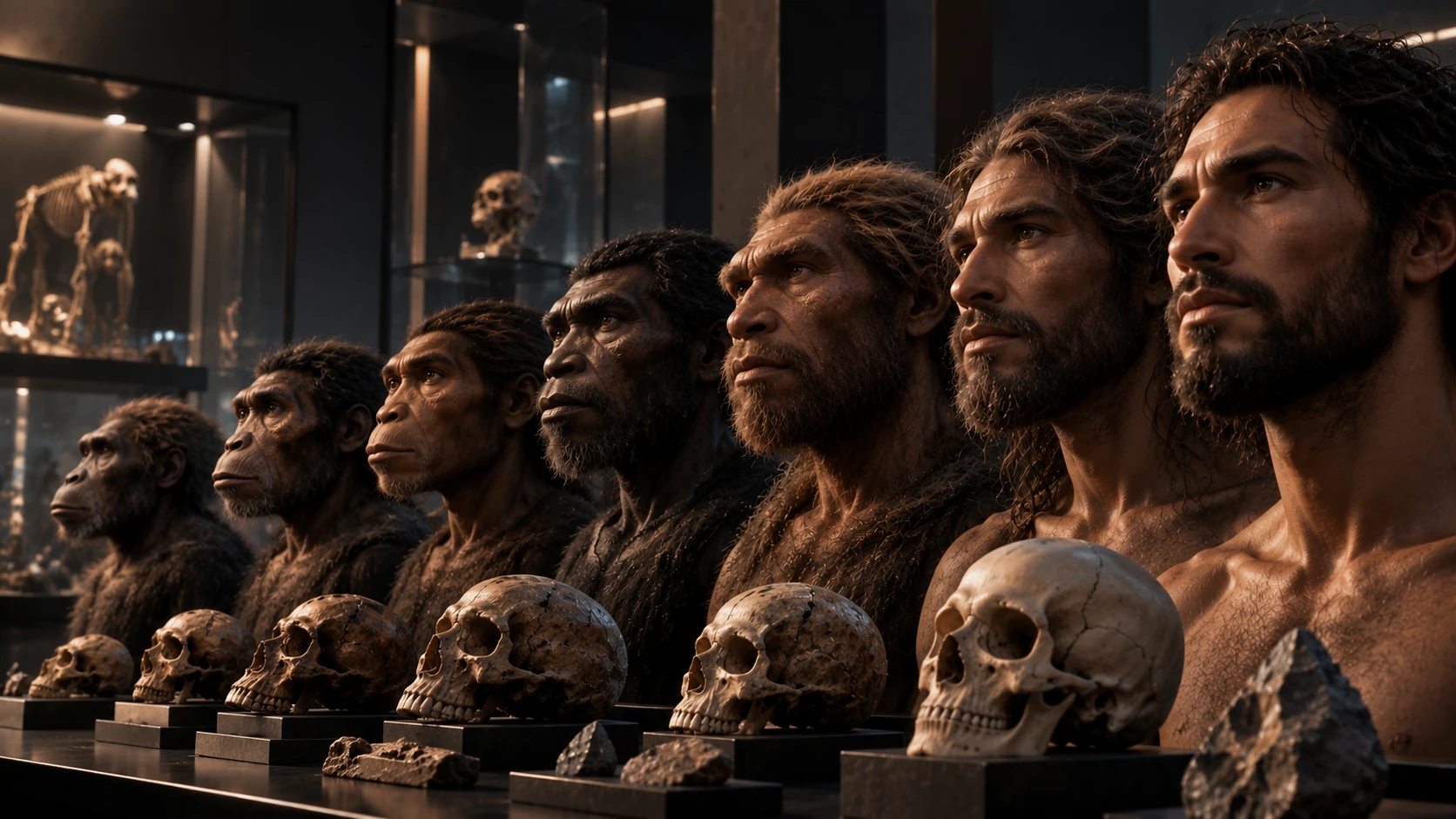
Editorial note: sources and recent developments were reviewed through October 2, 2026. The hero image is an AI-generated museum-style illustration. Its faces, bodies and arrangement are not scientifically exact reconstructions, and the row must not be read as a linear evolutionary sequence.
FAQ
Frequently Asked Questions
Did humans evolve from today's apes?
Humans are apes. We share ancestors with living chimpanzees and other apes; we did not descend from the species living beside us today.
Were Neanderthals our ancestors or cousins?
They were a related lineage that interbred with Homo sapiens. They are evolutionary cousins and contributed some ancestry to many living people.
How many human species existed?
There is no universally agreed total because fossil classifications and species boundaries are disputed. The ten groups in this article are a selection, not a complete census.
Does a larger brain mean a more advanced human?
No. Cranial volume is one anatomical measurement, not a direct measure of intelligence, language or cultural complexity.
PRESDA Dispatch
Stay Informed. Stay Aware.
A sharp briefing across AI, gaming, sport, business, world affairs, paparazzi, and lifestyle.