ANIMAL TESTING: THE HIDDEN COST OF SCIENTIFIC PROGRESS
Animal research has shaped medicine, but at a cost. Explore its benefits, welfare concerns, scientific limits, alternatives and FDA developments in 2025–2026.
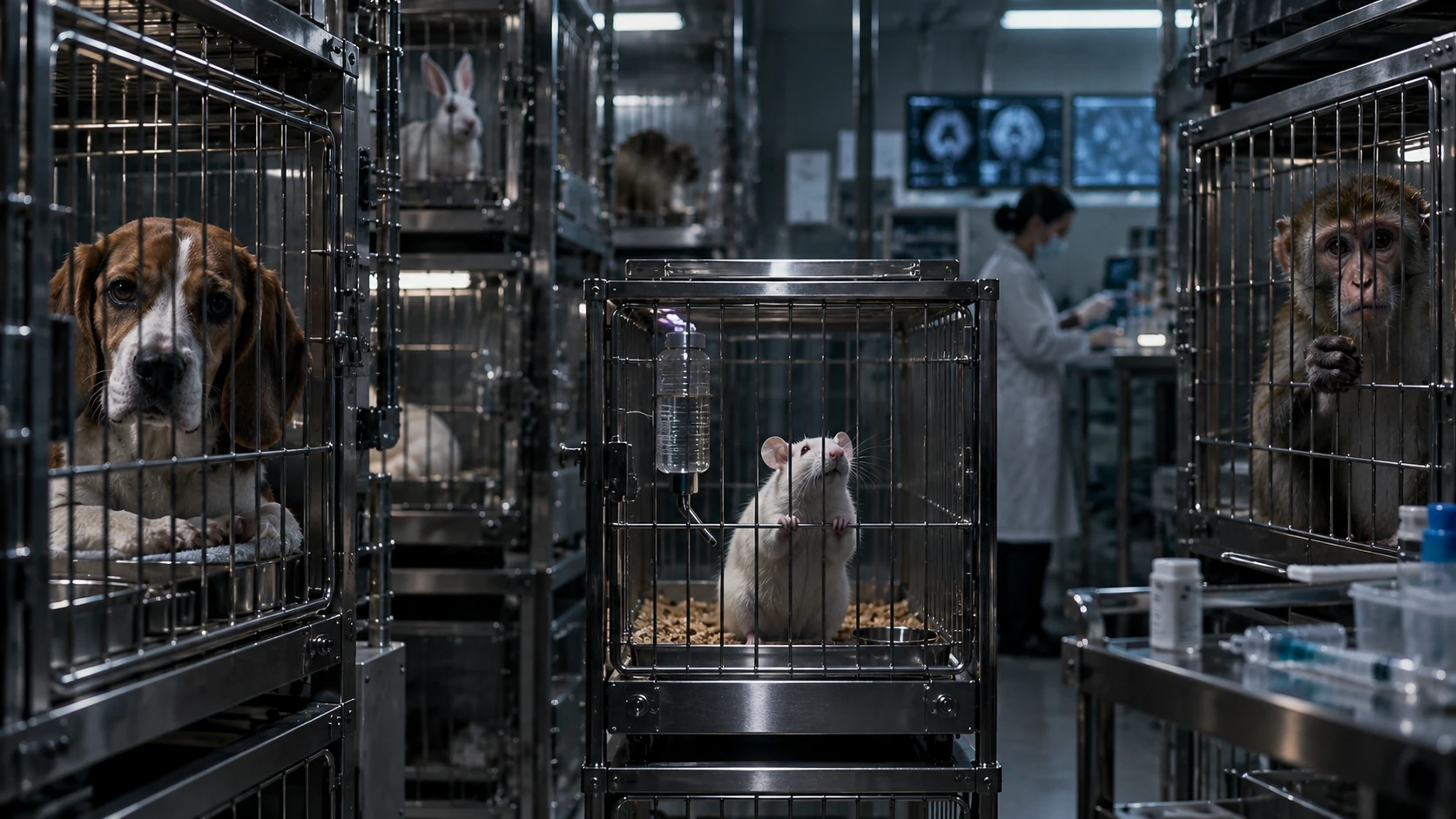
AI-generated conceptual illustration supplied for PRESDA. This imagined scene is not a photograph of an actual facility and does not establish representative research conditions.
A medicine reaches a patient in a small package. The work behind it rarely fits inside the label: discarded compounds, cell cultures, computer models, clinical volunteers and, often, animals. Some of those animals helped answer questions that changed medicine. Others endured procedures whose promise never became a treatment. The history of animal experimentation contains both realities, and neither can honestly be edited out.
Animal testing is not one practice. A mouse carrying a genetic alteration, a rabbit in a safety study and a primate in infectious-disease research can serve very different purposes. The central questions are therefore specific: what is this experiment expected to reveal, how well can its results apply to people, what will the animal experience, and could a less harmful method provide the answer?
From anatomy to lifesaving treatments
Experiments on animals long predate modern pharmaceuticals. A historical review by Nuno Henrique Franco traces their place in ancient anatomy and physiology, and the expansion of experimental medicine associated with figures such as Claude Bernard in the nineteenth century. Opposition developed alongside the science. Disagreement was never only about whether experiments produced knowledge; it also concerned whether producing that knowledge justified inflicting harm. Franco: historical perspective
Insulin provides a documented example of benefit without requiring a triumphalist account. In 1921, researchers in Toronto demonstrated that pancreatic extracts could lower blood glucose in dogs with experimentally induced diabetes. The development of usable insulin required further purification and human treatment in 1922, involving Frederick Banting, Charles Best, John Macleod and James Collip. Animal experiments were an important part of that sequence, alongside earlier research, chemistry and clinical work. NIDDK: discovery and development of insulin
The history of polio research is similarly interconnected. Monkeys and tissue cultures both contributed to the work that preceded and supported vaccine development. Historical scholarship documents the connection between the rhesus-monkey trade and the growing role of cultured cells. The lesson is not that one method alone delivered vaccination. It is that progress often emerges from combinations of approaches, and that replacement technologies can develop within an animal-dependent research system. Polio research, monkeys and tissue culture
Why researchers still use animals
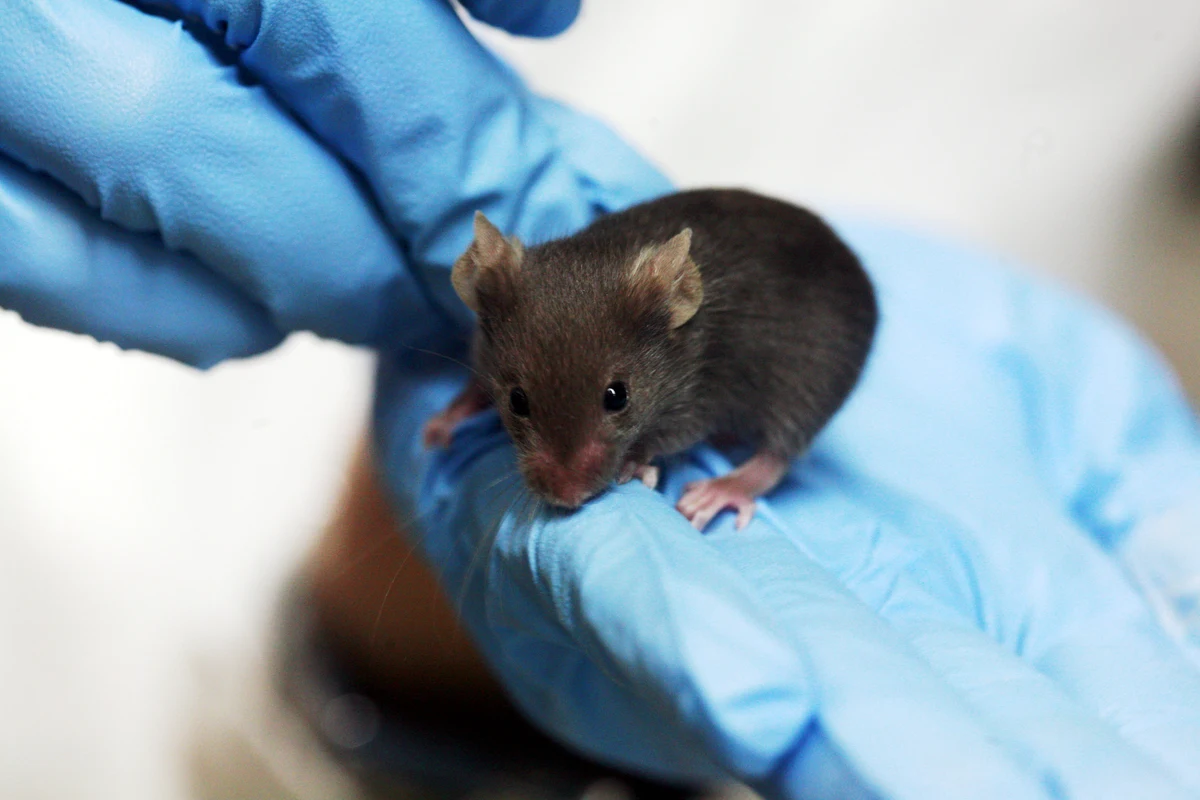
Laboratory mouse photographed by Rama in 2008. The image illustrates a research species; its record does not establish a specific experiment.
Rama / Wikimedia Commons / CC BY-SA 2.0 France
CC BY-SA 2.0 France. Resized and converted to WebP by PRESDA without further cropping or color alteration. This resized image remains available under CC BY-SA 2.0 France.
Living organisms connect processes that are difficult to reproduce together: circulation, metabolism, immune responses, hormonal signaling and behavior. Researchers may need to understand where a drug travels, how it is broken down, whether exposure damages an organ or how a disease unfolds over time. NIH requires applicants to explain why their chosen animals are appropriate and why the work cannot instead use alternatives. A species is a model for a particular question, not a miniature human. NIH: why animals are used
Mice and rats are used extensively in genetics, disease mechanisms and toxicology. Rabbits have been used in antibody production and safety testing; dogs in selected pharmacology and toxicology programs; nonhuman primates in some neuroscience and infectious-disease studies. Fish, including zebrafish, support developmental and genetic research. These examples do not mean each species is required for every medicine. Choosing a model must depend on biological relevance, the question and available alternatives, rather than familiarity alone. Animal models: a brief history
Drug development also contains different kinds of questions. A treatment might affect a disease mechanism yet prove unsafe at the necessary dose. A vaccine candidate may provoke an immune response without providing sufficient protection. Nonclinical studies inform decisions about whether and how to begin human trials, but they cannot guarantee a favorable outcome in people. Research involving animals, regulatory safety testing and routine product testing should not be treated as interchangeable categories. FDA: animal welfare, testing and research
What the numbers actually measure
There is no complete, harmonized global census of laboratory animals. A peer-reviewed study by Katy Taylor and Laura Rego Alvarez estimated 79.9 million animals used in scientific procedures worldwide in 2015. Its broader estimate of 192.1 million also included categories such as animals killed for tissues, breeding-related use and animals bred but not used. These are modeled historical estimates, not a verified 2026 headcount. The authors were affiliated with an animal-protection organization, and the extrapolation assumptions deserve attention alongside the result. Taylor and Alvarez: global estimate
Official regional data provide a different measure. A European Commission report published in 2026 records 7.97 million animals used for the first time in procedures in the European Union in 2023, 4.9% fewer than in 2022. That number is not a worldwide total, does not count every repeated use as a new animal and is not directly comparable with the broad 192.1 million estimate. Year, geography and counting rules belong beside the number. European Commission: 2018–2023 statistics
US figures require another caution. USDA reporting instructions exclude laboratory rats and mice of the genera Rattus and Mus bred for research, as well as research-bred birds, from the relevant Animal Welfare Act reporting. A total drawn from those reports therefore cannot represent all animals used in American research. Absence from that reporting system should not be confused with absence from all oversight: NIH-supported vertebrate research has additional requirements. USDA: reporting instructions
The cost experienced by an animal
An experiment's burden may include pain from procedures, induced illness, repeated handling, restraint or restrictions on normal behavior. Severity varies substantially. An observation study and a disease model are not morally or biologically identical, and a photograph cannot establish what happened in a particular laboratory. At the same time, describing suffering as a variable does not make it less consequential to the animal experiencing it.
Under US Public Health Service standards, institutional animal-care committees review protocols. Procedures causing more than slight or momentary pain or distress require appropriate sedation, analgesia or anesthesia unless a scientific exception is justified in writing. Humane endpoints can limit suffering by ending an experiment before a predetermined deterioration. These are safeguards, not a declaration that all approved research is painless, or that euthanasia removes the ethical cost of an animal's use. NIH OLAW: protocol review criteria
The ethical disagreement remains substantive. A benefit-based position may permit carefully justified harm for an important health goal. An animal-rights position can reject using sentient beings as instruments even when a benefit is plausible. Between those positions are disagreements about severity, necessity, species and how uncertain future benefits should be weighed. Ethical review cannot settle every philosophical question, but it should make the trade-offs explicit rather than hide them behind a promise of progress. Ethical frameworks in animal research
Where animal models fail to predict people
Shared biology is useful precisely because it is incomplete. Species differ in metabolism, immune signaling and the way disease develops. An induced condition in a young, genetically similar laboratory population may capture only part of a human illness shaped by age, other diseases and years of exposure. A model can illuminate a mechanism while performing poorly as a predictor of treatment benefit. Translational and reproducibility challenges
Study design creates another layer of uncertainty. Inadequate sample sizes, lack of randomization or blinding, and incomplete reporting can undermine results regardless of species. NC3Rs promotes experimental-design tools and ARRIVE reporting guidance to address these problems. A poorly designed experiment wastes more than money: it consumes animals without producing the reliable knowledge invoked to justify their use. NC3Rs: rigorous and reproducible research
Clinical failure rates should also be handled carefully. A drug that does not reach approval may fail for efficacy, safety or other reasons after many stages of selection. The percentage of candidates that fail cannot simply be read as the percentage of animal experiments that were wrong. Conversely, an animal result should never be presented to patients as proof that an experimental treatment will work. Human evidence remains indispensable, a distinction also central to assessing medical cannabis claims.
Cosmetics: a different regulatory landscape
The European Union's cosmetics testing and marketing bans reached their final implementation stage on 11 March 2013. They concern testing for cosmetics purposes, not a universal prohibition on every animal study involving a substance that might also appear in cosmetics. This distinction is essential when interpreting claims about an ingredient's history. European Commission: cosmetics testing ban
Under the separate REACH chemicals framework, safety information may still be required for worker or environmental protection, with animal testing as a last resort when appropriate alternatives are unavailable. In the United States, federal cosmetics law does not specifically require animal testing, according to the FDA. These different systems show why a cosmetics ban, a drug-development requirement and a “cruelty-free” label cannot be assumed to mean the same thing across borders. ECHA: cosmetics and REACH FDA: cosmetics and animal testing
The 3Rs: changing the experiment
Replacement, Reduction and Refinement, formulated by William Russell and Rex Burch in 1959, provide a practical framework. Replacement seeks methods that avoid animal use. Reduction means obtaining robust information with fewer animals, including better design and sharing data. Refinement improves procedures and care to minimize pain, distress and lasting harm. Using too few animals to answer a question reliably is not successful reduction; simply calling a procedure humane is not evidence of refinement. NC3Rs: the 3Rs
These principles can change decisions before an experiment begins. Could existing evidence answer the question? Could a human-cell assay screen out unsuitable compounds first? Can a less invasive measurement replace repeated sampling? Is a stopping point defined? They also turn ethical intent into assessable practice. A laboratory's commitment is more meaningful when it can show what it replaced, what it reduced and how the animals' experience improved.
Human biology on a laboratory chip
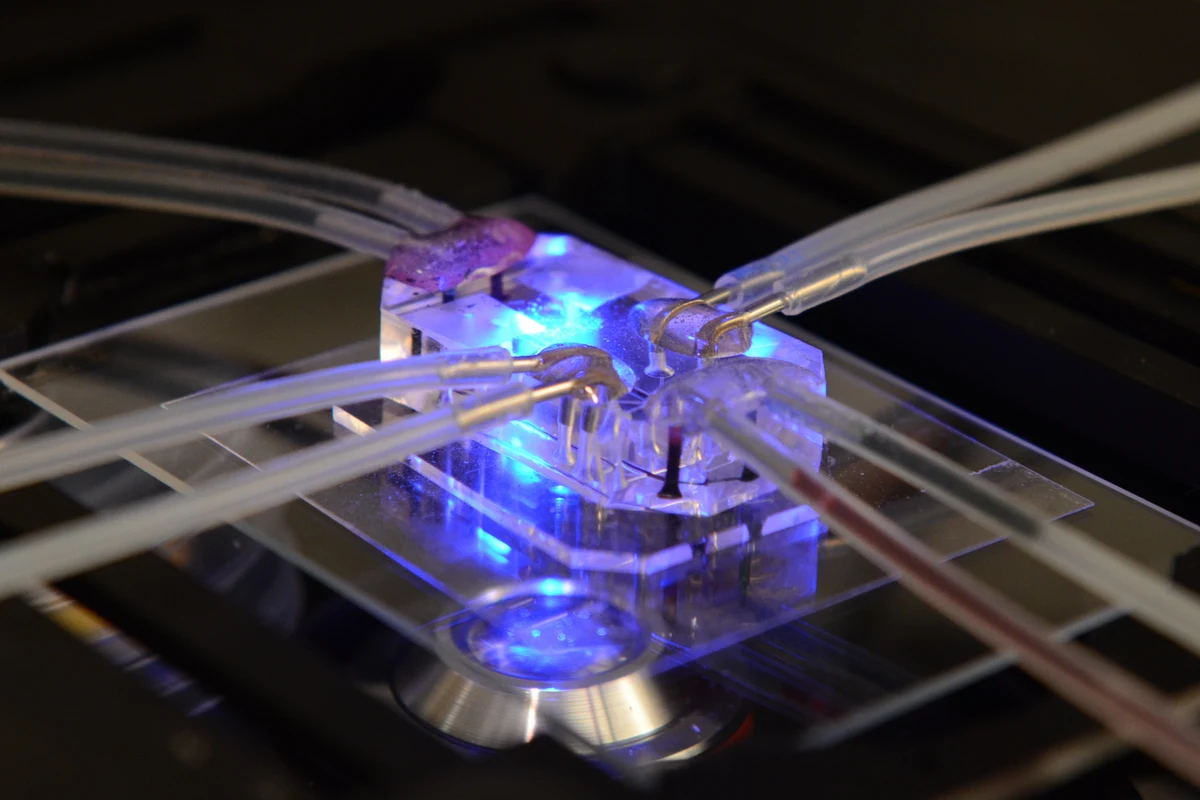
An authentic photograph of a Wyss Institute lung-on-a-chip device. Such systems reproduce selected tissue functions, not an entire human lung or body.
Wyss Institute, Harvard University / NIH-NCATS / Wikimedia Commons / CC BY 2.0
CC BY 2.0. Resized and converted to WebP by PRESDA without further cropping or color alteration.
Cell cultures make it possible to examine responses in controlled conditions. Organoids organize cells into three-dimensional structures that reproduce selected features of tissue. Organs-on-chips add engineered channels and environments that can support fluid flow and mechanical forces. NIH's tissue-chip program develops human-cell platforms for disease modeling and drug screening, including situations in which animal models do not adequately mirror human pathology. NIH NCATS: tissue chips
These approaches also have limits. Organoids may lack mature cell functions, integrated blood vessels or a complete immune system. A chip representing one tissue is not a whole person, and linking several chips creates new challenges in scale and validation. Researchers must establish what a model reproduces and what it omits. Human origin is an advantage for some questions, not an automatic certificate of predictive accuracy. Organoids-on-chips: applications and challenges
Computational models and AI can help organize evidence, predict selected properties and prioritize experiments. Their reliability depends on training data, uncertainty estimates and the intended use. A model that performs well on familiar compounds may not generalize to unfamiliar biology. Alternatives should be compared against relevant human outcomes and reproducibility standards, rather than judged only by whether they resemble an animal test. Our feature on artificial womb research explores another technology whose promise depends on respecting the boundary between a model and a clinical result.
What the FDA changed in 2025 and 2026
On 10 April 2025, the FDA announced a roadmap to reduce, refine or potentially replace animal testing in drug development, initially emphasizing monoclonal antibodies. It encouraged new approach methodology data and described a planned pilot for selected developers. This was a direction for regulatory change, not an announcement that every animal study had ended. FDA: April 2025 roadmap announcement
On 18 March 2026, the agency issued draft guidance on validating new approach methodologies. Its principles include a defined context of use, relevance to human biology, technical reliability and fitness for the regulatory decision. The FDA's April 2026 progress report also described initiatives involving monoclonal-antibody testing and recombinant alternatives to horseshoe-crab-derived endotoxin reagents. Draft recommendations, reported milestones and proven clinical improvements are different kinds of evidence. FDA: March 2026 draft guidance FDA: April 2026 progress report
The September 22, 2026 Federal Register then published a direct final rule replacing specified references to animal tests with broader nonclinical-testing terminology. As of this article's October 16 review, its stated effective date is February 4, 2027, subject to the rule's comment and withdrawal process. It adds no new requirements and does not ban animal studies. Calling it an already effective universal phaseout would misstate both its timing and its scope. Federal Register: nonclinical testing terminology
Can animal testing eventually be replaced?
Some questions can already be answered without whole-animal experiments; others still lack adequately validated substitutes. Replacement will therefore proceed by purpose and endpoint, not by a single machine replacing every laboratory species. The relevant test is whether a method supplies dependable information for the decision being made. NIH's 2025 move to prioritize human-based technologies signals investment in that transition, rather than proof that it is complete. NIH: human-based research technologies
The strongest case for change does not require denying insulin's history or dismissing patients' needs. It requires asking whether an experiment justified yesterday is still necessary today, and whether a better method could protect both animals and people. Scientific progress deserves more than a count of discoveries. It also deserves an honest account of the lives used to make them, and a sustained effort to need fewer of those lives in the future.
FAQ
Frequently Asked Questions
What is this PRESDA article about?
Animal research has shaped medicine, but at a cost. Explore its benefits, welfare concerns, scientific limits, alternatives and FDA developments in 2025–2026.
Which category does this story belong to?
This story is part of PRESDA's Science coverage.
Who published this article?
ANIMAL TESTING: THE HIDDEN COST OF SCIENTIFIC PROGRESS was published by PRESDA Editorial on PRESDA.
PRESDA Dispatch
Stay Informed. Stay Aware.
A sharp briefing across AI, gaming, sport, business, world affairs, paparazzi, and lifestyle.