DOLLY: THE CLONED SHEEP WHO CHANGED SCIENCE FOREVER
How Dolly was cloned from an adult cell, what 277 reconstructed eggs meant, and what research reveals about her health, aging and scientific legacy.
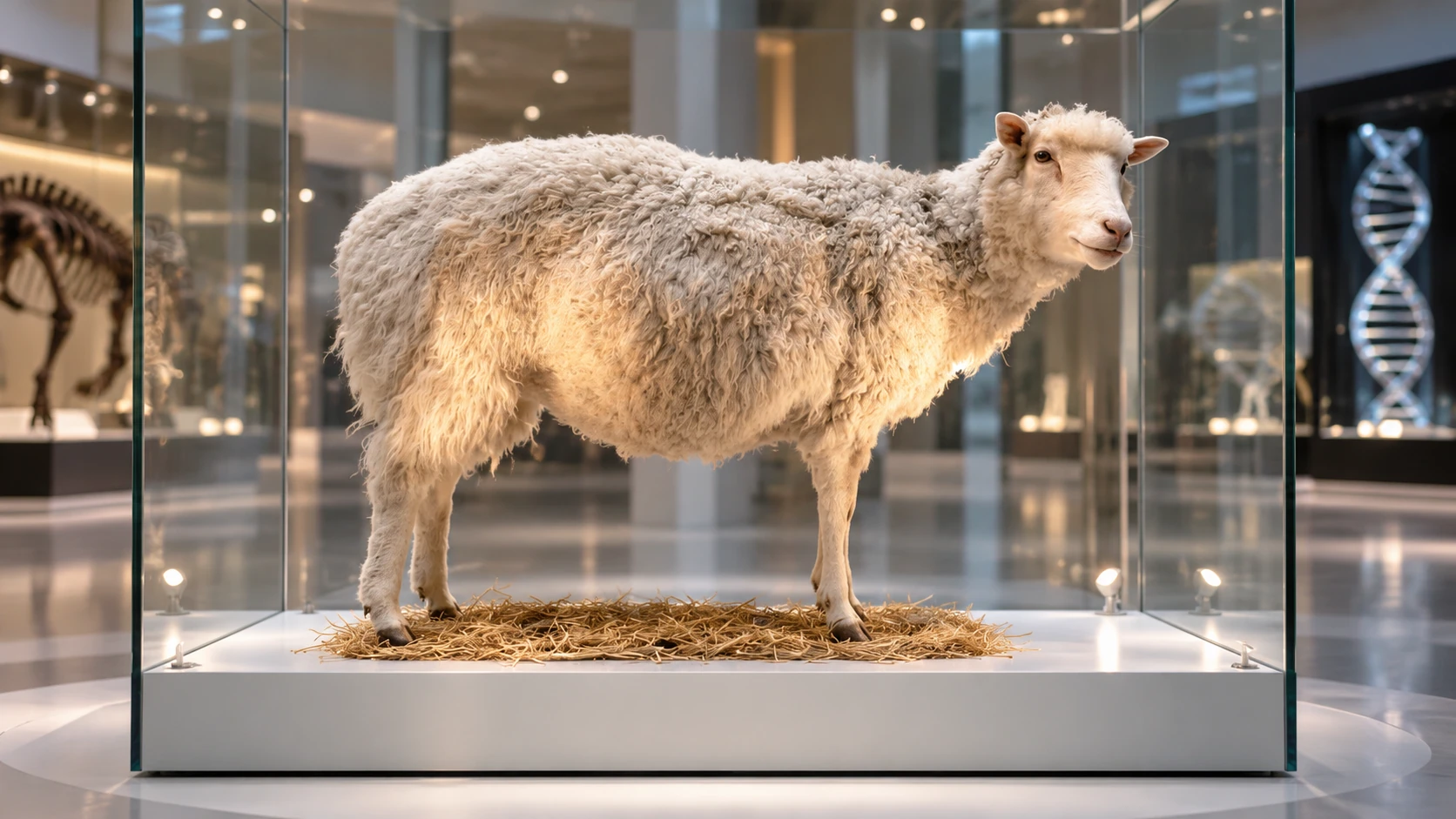
AI-generated artistic reconstruction supplied for PRESDA. This is not a genuine photograph of Dolly or her museum exhibit.
A white-faced lamb born in Scotland on 5 July 1996 carried a question much larger than herself: could the nucleus of a cell from an adult animal help build an entirely new animal? Dolly supplied a living answer. Her significance lay neither in an unusual appearance nor in a futuristic machine, but in the history of the cell from which she had been made.
Dolly was the first mammal cloned from an adult somatic cell, a body cell rather than an egg or sperm. She was not the first cloned animal, or even the first cloned sheep. That distinction matters: her achievement was to show that an adult mammalian cell’s nucleus could be reprogrammed to support development. The breakthrough was extraordinary without the myths that subsequently gathered around it. Roslin Institute: Dolly’s life
A laboratory, a flock and a difficult question
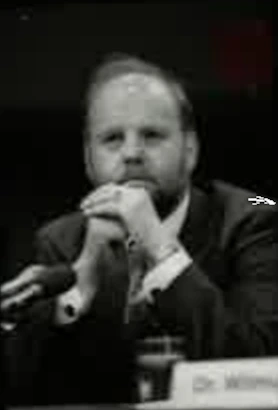
Ian Wilmut at a Senate hearing on cloning, 12 March 1997. Archival photograph by Cathy Shaw, extracted from a Congressional Quarterly contact sheet. Its small original resolution is preserved without enlargement.
Cathy Shaw / Congressional Quarterly / Library of Congress
Public domain. Resized and converted to WebP by PRESDA. Full composition preserved. Reuse follows the individual license stated here.
At the Roslin Institute near Edinburgh, researchers working with biotechnology company PPL Therapeutics were investigating ways to produce genetically modified livestock. Ian Wilmut and Keith Campbell became the names most closely associated with Dolly, but her creation depended on a broader team. The 1997 Nature paper lists Wilmut, Angelika Schnieke, Jim McWhir, Alexander Kind and Campbell. Embryology, veterinary surgery, cell culture and daily animal care all belonged to the experiment. Wilmut and colleagues: Nature, 1997
This was not science beginning from nothing. Earlier nuclear-transfer experiments had produced amphibians, and sheep had already been cloned using embryonic cells. Roslin’s Megan and Morag, born in 1995, demonstrated the usefulness of cultured embryonic cells. Dolly took the work across another boundary: the donor material came from an adult animal. Calling her simply the first clone erases the discoveries that made her possible. University of Utah: the history of cloning
How a mammary cell became a lamb
The method is called somatic cell nuclear transfer, or SCNT. Researchers removed the nuclear genetic material from an unfertilized egg and fused the egg with a cultured donor cell. For Dolly, that cell came from mammary tissue of a six-year-old Finn Dorset ewe. An electrical pulse helped bring the cells together and initiate development. An embryo that progressed sufficiently could then be transferred into a surrogate ewe. NCBI: evidence for genomic equivalence
The egg was indispensable. It supplied cellular machinery capable of resetting much of the donor nucleus’s developmental program. A mammary cell does not normally behave like an embryo; its identity depends substantially on which genes are active and how its DNA is regulated. Nuclear transfer challenged that identity without requiring a new set of nuclear genes. Coordinating the donor cell’s cycle with the recipient egg was an important part of the team’s approach. Review: nuclear-transfer reprogramming
Three animals contributed different things: the Finn Dorset supplied the donor cell, a Scottish Blackface supplied the egg, and another Scottish Blackface carried the pregnancy. Dolly’s nuclear DNA came from the donor cell, while the egg also contributed mitochondrial genetic material. A clone is therefore not a photocopy of an entire life. Development, environment and experience still matter; reproducing a nuclear genome does not reproduce memories or personality. Roslin Institute: cloning explained
What the famous number 277 actually means
The adult-cell experiment involved 277 successfully fused, reconstructed egg–cell combinations. Twenty-nine embryos reached stages suitable for transfer to the uteruses of 13 recipient ewes, and one live lamb resulted: Dolly. These are different stages with different denominators. The figure does not mean 277 pregnant sheep, or 276 lambs born and lost. It describes the steep attrition between cellular reconstruction and a live birth. National Bioethics Advisory Commission: Cloning Human Beings, 1997
That distinction does not make animal welfare irrelevant. Low developmental efficiency raises questions about egg collection, embryo manipulation, surrogate animals and unsuccessful pregnancies across cloning programs. But ethical scrutiny becomes stronger when its numbers are accurate. The appropriate question is what happened at each stage, not which version of the story sounds most alarming. PRESDA’s investigation of animal testing and its ethical costs explores that wider tension between scientific aims and animal experience.
February 1997: a private birth becomes public history
Dolly was born months before the world heard her name. The public announcement came on 22 February 1997; the Nature paper appeared on 27 February. Keeping those dates separate prevents a common confusion between the experiment, its announcement and its formal publication. A lamb already living at Roslin suddenly became a symbol of humanity’s ability to intervene in reproduction. National Museums Scotland: Dolly’s story
Retrospective interviews with the researchers reveal a collective, uncertain enterprise rather than an inevitable triumph. Laboratory work, practical expertise and the care of animals connected the idea to the result. The public response, however, rapidly moved from sheep to hypothetical human copies. Scientific possibility, technological readiness and moral acceptability were being discussed together, although they were different questions. Nature’s oral history, republished by Scientific American
A famous sheep still lived a sheep’s life
Dolly remained at Roslin, living with other sheep rather than becoming a solitary laboratory curiosity. She reproduced through ordinary mating with a Welsh Mountain ram called David and produced six lambs. Her first, Bonnie, arrived in 1998. This established that an animal produced by adult-cell nuclear transfer could grow into a fertile adult. Her offspring were the products of sexual reproduction, not clones of Dolly. Roslin Institute: Dolly’s life
Fertility did not answer every health question. A single successful animal could demonstrate a possibility while leaving uncertainty about how often the technique worked, what went wrong in other embryos and whether survivors faced particular risks. Dolly’s fame made her an unusually visible individual. It also made every illness vulnerable to being treated as a verdict on cloning itself.
Arthritis, lung disease and the end of her life
In 2001 Dolly developed arthritis. Treatment with anti-inflammatory medication improved her clinical signs, but its cause was not established. In February 2003, coughing prompted investigation. A scan revealed extensive lung tumors associated with a viral disease of sheep. She was euthanized on 14 February 2003, aged six and a half. Her final illness was not simply arthritis becoming fatal, and her age alone cannot explain its cause. National Museums Scotland: medical history
The lung disease was associated with jaagsiekte sheep retrovirus, which had affected other sheep in the flock. It is important to distinguish an infectious disease from a demonstrated consequence of nuclear transfer. Dolly’s death deserved investigation, but the sequence “she was cloned, then she became ill” does not by itself establish that cloning caused the illness. Roslin Institute: Dolly’s life
Was Dolly born old?
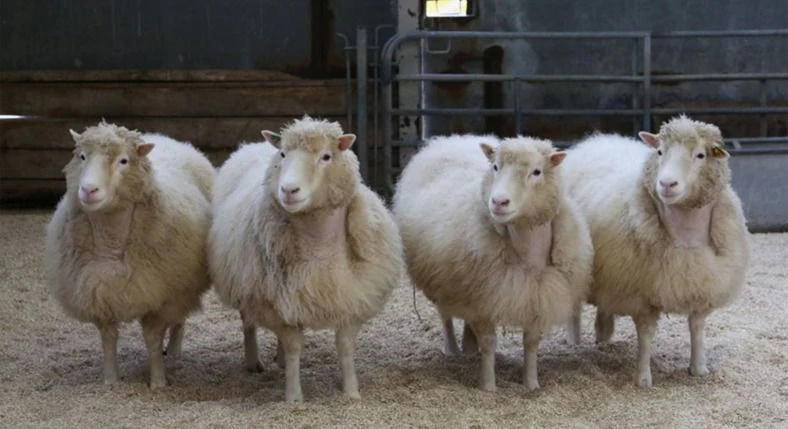
Four Finn Dorset clones from the mammary-cell line that produced Dolly, photographed for the 2016 aging study. These are later cloned sheep, not Dolly or her naturally conceived offspring. Authentic research photograph, Figure 1.
Kevin D. Sinclair et al. / Nature Communications (2016), Figure 1
CC BY 4.0. Resized and converted to WebP by PRESDA. Full composition preserved. Reuse follows the individual license stated here.
The worry had a biological basis worth examining. Telomeres, protective structures at chromosome ends, can shorten as cells divide. Researchers found relatively short telomeres in Dolly, raising questions about whether the donor cell’s history had carried forward. But telomere length is not a simple clock that assigns an animal the donor’s age at birth. Different cloned animals have shown different telomere patterns; one measurement cannot establish the aging of an entire organism. Roslin Institute: cloning and health
A 2016 study assessed 13 cloned sheep aged seven to nine, including four derived from the same mammary-cell line that produced Dolly. Their metabolic, cardiovascular and musculoskeletal assessments gave no evidence of a general premature-aging syndrome in this cohort. These were surviving animals in a relatively small study, not proof that every cloning attempt was safe. The four adult Finn Dorsets were themselves survivors of a larger group of cloned lambs, an important qualification when interpreting the encouraging results. Sinclair and colleagues: healthy aging of cloned sheep
In 2017, researchers examined preserved skeletons of Dolly and other sheep associated with the Roslin story. They found no abnormal pattern of osteoarthritis suggesting an exceptional cloning-related process. The original clinical records were unavailable, and studying bones does not reproduce an animal’s pain history or reveal every soft-tissue change. The conclusion was narrower than “Dolly never had arthritis”: her skeleton did not support the popular claim of extraordinary joint aging. Corr and colleagues: radiographic assessment
The real Dolly in a museum
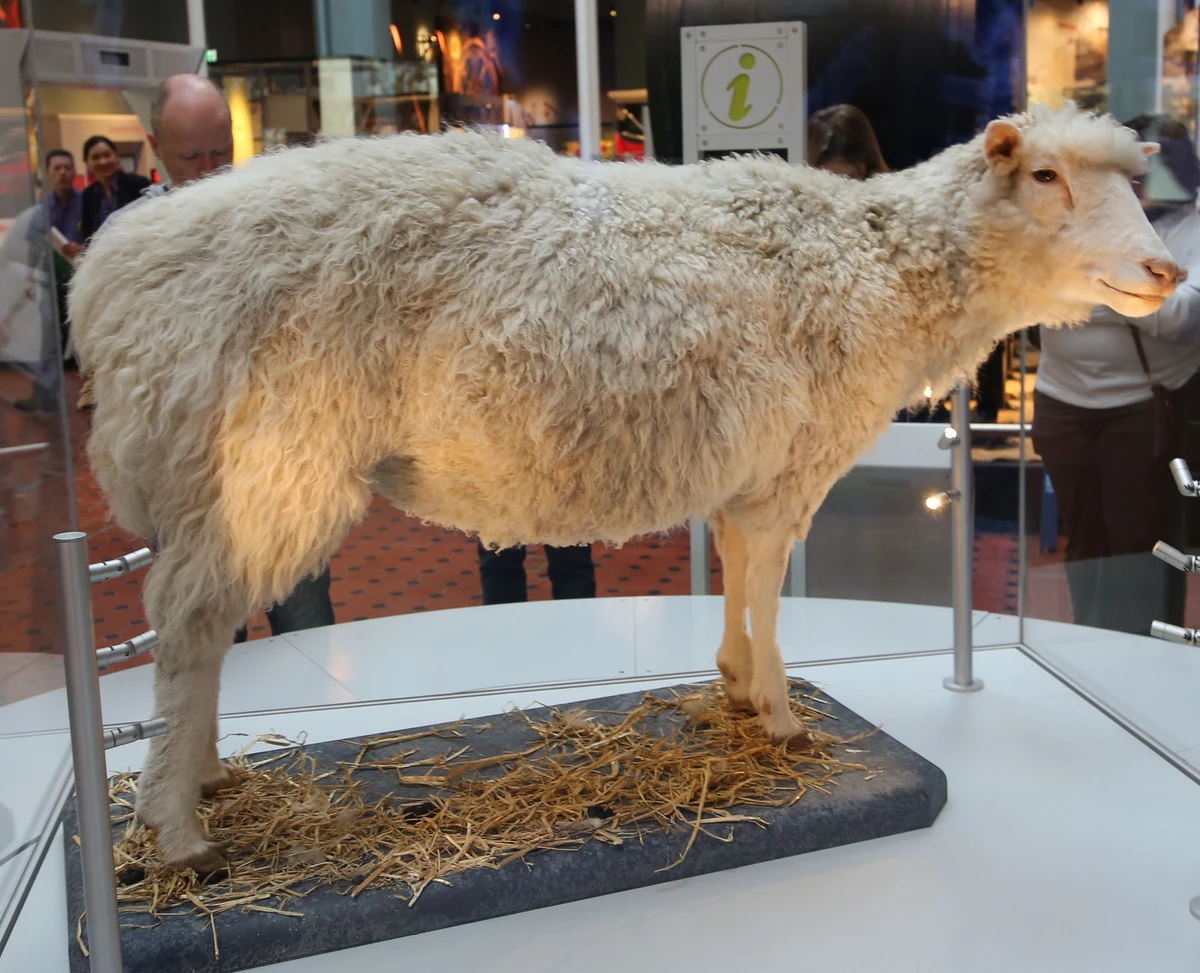
The real Dolly’s preserved remains on museum display, photographed by Geni. This is an authentic photograph of the taxidermied sheep, not an image of Dolly alive. The source description and camera metadata disagree on the date, so no capture date is asserted here.
CC BY-SA 4.0. Resized and converted to WebP by PRESDA. Full composition preserved. Reuse follows the individual license stated here.
Dolly’s preserved body entered the collections of National Museums Scotland after her death. The museum also holds material that allows the story to extend beyond a single celebrated specimen. In 2023 it announced the acquisition of a fleece and equipment donated by embryologist William Ritchie, including glass pipettes and an electrical fusion machine. Some tools had been made in Roslin’s own workshop. National Museums Scotland: fleece and laboratory equipment
Those objects return the breakthrough to its physical scale: a sheep, delicate instruments, careful hands and a long sequence of biological uncertainties. The authentic museum photograph reproduced here documents Dolly’s preserved remains. The opening image is an artistic reconstruction, not a historical photograph or an accurate record of the gallery. Keeping that distinction visible is part of telling her history honestly.
A legacy larger than making another sheep
Dolly belongs to the history of cellular reprogramming, not just reproductive cloning. John Gurdon’s earlier amphibian work and Shinya Yamanaka’s later experiments demonstrated different routes to reconsidering mature-cell identity. In 2006 Yamanaka’s team showed that introducing a small set of factors could produce induced pluripotent stem cells from mouse cells. Gurdon and Yamanaka received the 2012 Nobel Prize in Physiology or Medicine. Dolly was a landmark in this larger history, not the sole origin of stem-cell science. Nobel Assembly: the science of reprogramming
In 2013, researchers reported human embryonic stem-cell lines derived through somatic cell nuclear transfer. This was research on cells, not the birth of a cloned human. The distinction separates reproductive cloning, which seeks an animal or person, from work intended to obtain cells for studying development or disease. Neither a stem-cell line nor a promising laboratory result is automatically a proven medical treatment. Tachibana and colleagues: human stem cells and nuclear transfer
What should happen next?
Animal cloning can be used to reproduce selected genetic backgrounds and to support research involving genetic modification. Yet copying a genome is not the same as editing it. Nor is either procedure equivalent to choosing an embryo after IVF. These technologies raise overlapping questions about welfare and responsibility while doing different things biologically. PRESDA’s guide to IVF, embryo selection and genetics explains another part of that landscape. NHGRI: cloning fact sheet
Human reproductive cloning is not an established clinical treatment. The International Society for Stem Cell Research places implantation of human embryos produced by nuclear reprogramming for reproductive purposes among prohibited research activities in its guidelines. Professional guidance is not identical to every country’s law, but its position makes clear how far a successful sheep experiment remains from an acceptable human reproductive service. ISSCR: research boundaries
Dolly’s future significance need not depend on anyone producing a human copy. The more enduring question is how cells acquire an identity, how that identity can change, and how knowledge of those processes can be used responsibly. Her story contains both an astonishing success and a warning about interpreting success too broadly. She changed what scientists knew a cell could do. She did not remove their obligation to ask what they should do next.
FAQ
Frequently Asked Questions
What is this PRESDA article about?
How Dolly was cloned from an adult cell, what 277 reconstructed eggs meant, and what research reveals about her health, aging and scientific legacy.
Which category does this story belong to?
This story is part of PRESDA's Science coverage.
Who published this article?
DOLLY: THE CLONED SHEEP WHO CHANGED SCIENCE FOREVER was published by PRESDA Editorial on PRESDA.
PRESDA Dispatch
Stay Informed. Stay Aware.
A sharp briefing across AI, gaming, sport, business, world affairs, paparazzi, and lifestyle.