NASA WANTS TO CONNECT THE MOON WITH 5G
NASA’s new lunar communications contract funds development and demonstrations through 2028. Here is what 5G could do on the Moon, and what remains unproven.
A rover disappears behind a ridge. An astronaut moves toward a crater. A scientific instrument needs to send its measurements home. On the Moon, reliable communication will be part of the infrastructure that makes exploration possible, as essential to coordinated operations as power and transport.
NASA’s latest step is a development contract for lunar 5G with integrated Wi-Fi 6. Announced on September 30, 2026, the approximately $38 million award goes to Modulate Space Corporation for work supporting Glenn Research Center in Cleveland. It funds technology development and demonstrations, not an already operating lunar broadband service. NASA: September 30, 2026 contract announcement
THE CONTRACT AND ITS TWO CLOCKS
The firm-fixed-price award covers a compact 5G network-in-a-box and a later integrated surface-network flight demonstration. The laboratory work period runs from October 1, 2026 to January 31, 2028; the lunar demonstration work period runs from November 30, 2026 to December 31, 2028. These are contract performance periods, not a published launch schedule or a guarantee that a permanent Moon base will be connected by their end. NASA: September 30, 2026 contract announcement
NASA is the customer, Glenn the named research center and Modulate Space the awardee. The earlier federal procurement notice identifies the company as Modul8, formerly Nokia Bell Labs’ Space Communication Solutions. Earlier Nokia lunar projects are relevant heritage, but their budgets and partners should not be folded into this new award. NASA’s release does not identify a launch provider or a lander for the new flight demonstration. SAM.gov: lunar 5G procurement notice NASA: September 30, 2026 contract announcement
Chronological milestones and contract work periods, not confirmed launch dates. No permanent 5G service is established by these events.
- March 2025: 4G hardware powered on during IM-2; intended cellular call not completed
- September 30, 2026: NASA announces approximately $38 million award
- October 1, 2026 to January 31, 2028: network-in-a-box development and laboratory work period
- November 30, 2026 to December 31, 2028: integrated lunar network and flight demonstration work period
Sources: NASA 2026·Nokia IM-2
PRESDA Data Graphics
A SMALL NETWORK FOR A VERY LARGE LANDSCAPE
A network-in-a-box brings the functions needed to run a private cellular network into a compact package. Instead of every nearby instrument maintaining its own separate Earth link, surface devices could exchange information locally and aggregate traffic through a shared connection home. NASA’s research treats cellular and Wi-Fi links as complementary parts of a surface architecture. NASA: GEM lunar communications research paper
Suit radios, rover terminals and science equipment would be the network’s users. A lander or rover could host network equipment; a more extensive settlement might eventually need fixed infrastructure. Those are architecture concepts, not a finalized map of lunar towers. Local processing would allow nearby machines and people to exchange data without routing every interaction through Earth. NASA Johnson: terrestrial wireless demonstrations NASA: GEM lunar communications research paper
WHAT 5G AND WI-FI 6 EACH DO
5G belongs to the cellular standards developed by 3GPP. In the lunar research context, cellular networking is being examined for mobility and wider surface coverage. Wi-Fi 6 is the generation associated with IEEE 802.11ax, a wireless local-area-network standard. It offers a different access technology for nearby devices. Neither label alone specifies the range, resilience or data rate a lunar installation will achieve. NASA Glenn: Lunar 5G research IEEE: 802.11ax / Wi-Fi 6 standard
The distinction is about network design, not a contest in which one technology makes the other obsolete. A habitat’s nearby equipment and a rover traveling across terrain have different connection needs. Antenna placement, radio frequencies, obstacles, available energy and terminal design will shape performance. Ordinary terrestrial peak-speed advertising is not evidence of guaranteed lunar throughput. NASA: GEM lunar communications research paper
EARTH IS STILL MORE THAN A SECOND AWAY
A lunar cellular link is not a 5G tower sending ordinary mobile signals directly to a smartphone on Earth. The surface network needs a separate space communications connection, direct to Earth or through suitable relay infrastructure. The two layers solve different problems: local connectivity and transport across space. NASA: GEM lunar communications research paper
Light takes about 1.3 seconds to travel one way between Earth and the Moon. A round trip therefore begins at roughly 2.6 seconds before processing and network delays. Faster local radios cannot remove that physical limit. Voice conversations, ground-directed operations and applications must accommodate it; immediate safety decisions cannot depend on an instantaneous response from Earth. NASA: Earth-Moon and Mars communications delay
Simplified research concept, not the awarded system’s final design. Local links exchange data in both directions; the Earth connection is a separate layer.
- Astronaut suit radios
- Rover terminals
- Science instruments
↕ Local 5G + Wi-Fi 6
Surface network equipment
↕ Separate space communications link
Earth mission operations
About 1.3 seconds one way to Earth; roughly 2.6 seconds round trip before other delays. Faster local radios cannot remove light-time.
PRESDA Data Graphics
WHAT HAS ACTUALLY BEEN DEMONSTRATED
NASA Johnson has tested terrestrial prototypes that send video, audio and telemetry across a private 5G network to simulated mission control. Field work and laboratory simulations help examine mobility and software before flight. Glenn’s GEM testbed combines real radio hardware with modeled propagation conditions. These are valuable demonstrations on Earth, not proof of continuous lunar service. NASA Johnson: terrestrial wireless demonstrations NASA: GEM lunar communications research paper NASA: lunar communications field tests
The earlier IM-2 mission provides an important boundary. In March 2025, Nokia’s 4G/LTE equipment reached the lunar surface aboard Intuitive Machines’ Athena lander and powered up. Nokia reported a 25-minute operating window and equipment telemetry returned to Earth, but no first cellular call: power limitations and cold prevented the intended terminal-to-network connection. Telemetry through the lander’s Earth link must not be described as a successful lunar cellular call. Nokia: March 2025 IM-2 results
That mission was 4G heritage, not the completion of the new 5G contract. As of this article’s October 7 verification, the new award remains a development and demonstration program. Its announcement provides no evidence of an operational lunar 5G network. NASA: September 30, 2026 contract announcement Nokia: March 2025 IM-2 results
THE MOON IS NOT AN OUTDOOR TELECOMS SITE
Radiation, vacuum and severe temperature changes complicate electronics and thermal design. NASA describes surface temperatures reaching about 127°C in full sunlight and falling to about −173°C in darkness, with still colder permanently shadowed regions. Those are environmental examples, not the certified operating range of the contracted equipment. NASA: Moon environment facts
Dust creates another engineering problem. Abrasive regolith can interfere with mechanisms and surfaces, so connectors, deployment systems and thermal protection need careful design. A clean laboratory radio test cannot reproduce every effect of repeated exposure to lunar dust. NASA: lunar dust engineering risks
Terrain and power are equally decisive. Ridges and crater walls can interrupt radio paths. At the south pole, low sunlight angles and prolonged shadows complicate solar generation and thermal survival. Network placement must therefore be coordinated with energy supply and exploration routes. IM-2 showed how a functioning radio can still lose its mission when power and temperature conditions fail. NASA: lunar south-pole environment Nokia: March 2025 IM-2 results
ARTEMIS, SCIENCE AND A FUTURE BASE
The practical goal is sustained surface activity: astronauts coordinating with rovers, instruments delivering measurements and science teams receiving richer context from the field. Better local connectivity could reduce isolated communications arrangements and support shared infrastructure as activity expands. NASA’s Lunar 5G research sits within preparation for Artemis operations. NASA Glenn: Lunar 5G research
Useful performance is more than maximum download speed. Exploration needs predictable coverage, efficient use of power and dependable delivery of different kinds of information. A camera feed and a safety message have different priorities. PRESDA’s analysis is that a scalable network must be judged by whether it supports the operation reliably, not simply whether a radio can transmit under favorable conditions. NASA: GEM lunar communications research paper
WHAT THE MOON COULD TEACH US ABOUT MARS
Lunar work could help engineers test surface-network architecture, mobility and autonomy before more distant exploration. NASA’s wireless research explicitly considers lessons relevant to Mars. That is a potential transfer of engineering knowledge, not an announced Martian deployment or a claim that lunar hardware can be reused without modification. NASA Johnson: terrestrial wireless demonstrations
Mars adds communication delays of several minutes to more than twenty minutes one way, depending on the planets’ positions. Local coordination and decisions become even more important. Our feature on the engineering behind Mars ambitions examines the broader gap between a settlement vision and demonstrated capability. NASA: Earth-Moon and Mars communications delay
WHAT TO WATCH NEXT
The meaningful next steps are laboratory results, a confirmed flight arrangement, environmental qualification and a lunar test that demonstrates real connections between surface users. The award’s performance periods describe the work NASA is buying; they do not settle the deployment date, coverage footprint, service availability or eventual operating cost. NASA: September 30, 2026 contract announcement
NASA wants the Moon connected because more exploration means more people, machines and measurements that must work together. The headline is an ambition backed by a contract. The network itself still has to be developed, tested and proven in the place where it is meant to operate.
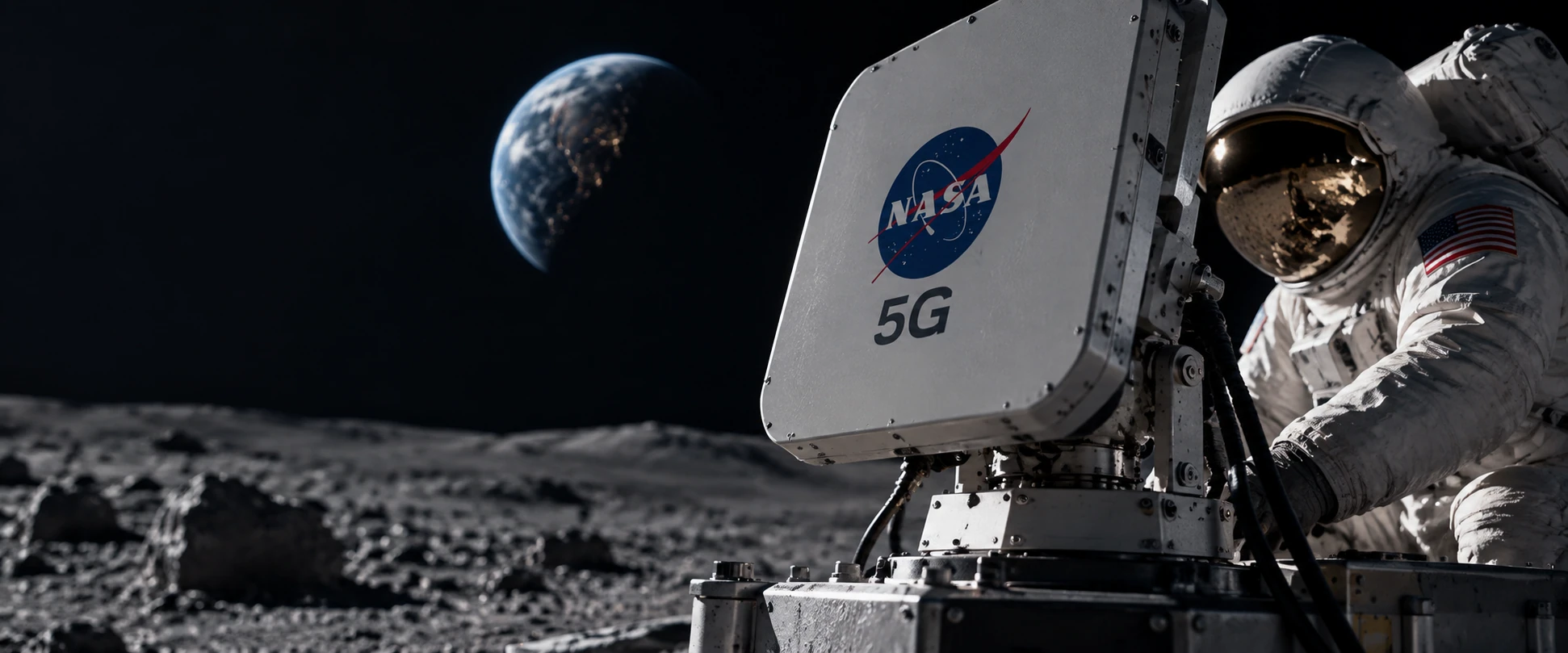
The hero is an AI-generated conceptual illustration. Its NASA-marked equipment and astronaut are artistic elements, not a photograph of an actual mission or the contracted hardware.
FAQ
Frequently Asked Questions
Is a lunar 5G network operating now?
The new NASA contract funds development and demonstrations, not an operating service. The earlier 2025 lunar 4G equipment test did not complete the intended cellular call.
When is NASA’s lunar 5G demonstration scheduled?
The contract gives a lunar demonstration work period from November 30, 2026 to December 31, 2028. That period is not a confirmed launch date.
Will lunar 5G eliminate the delay to Earth?
No. Light takes about 1.3 seconds one way between Earth and the Moon. Local wireless networks cannot remove that physical delay.
PRESDA Dispatch
Stay Informed. Stay Aware.
A sharp briefing across AI, gaming, sport, business, world affairs, paparazzi, and lifestyle.