VOYAGER’S GOLDEN RECORD: THE MESSAGE HUMANITY SENT INTO SPACE
Explore the Voyager Golden Record: its 1977 launch, 115 images, greetings in 55 languages, music and instructions for a hypothetical distant listener.
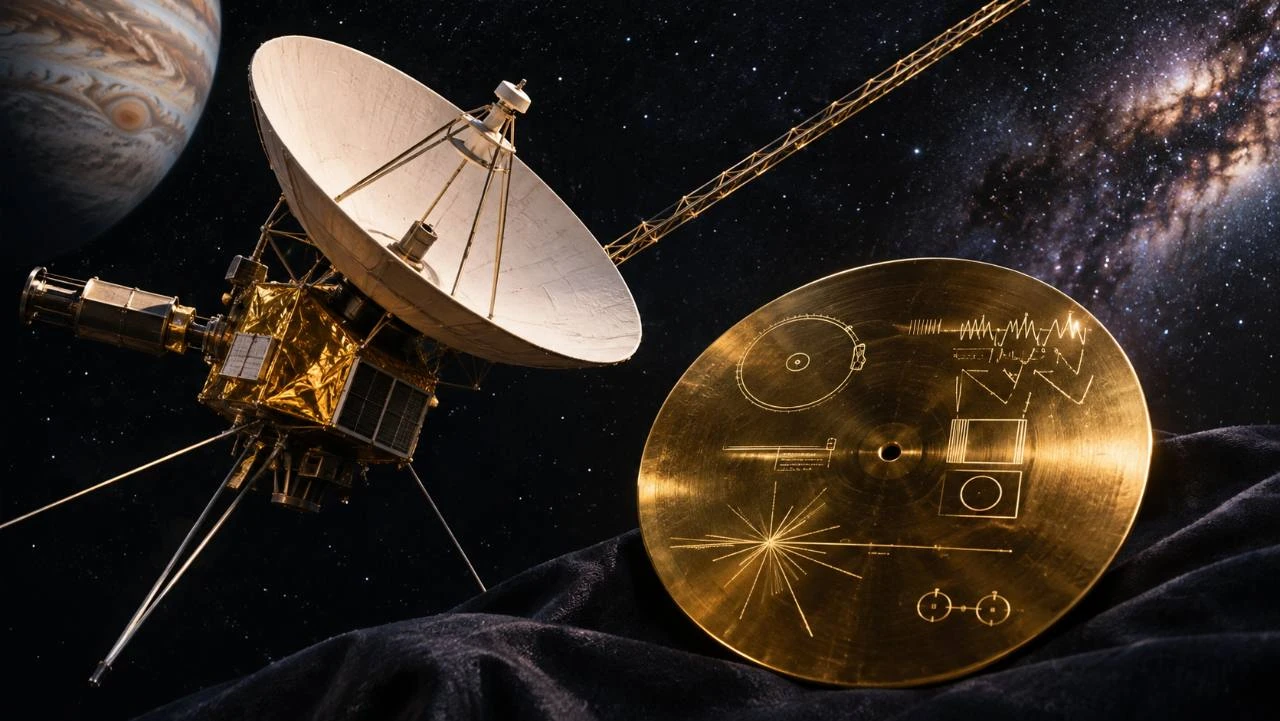
AI-generated editorial illustration supplied for PRESDA. The spacecraft, enlarged disc, rocky foreground, Jupiter and star field form an imagined montage, not a NASA photograph or a scene encountered by Voyager. The disc combines artistic versions of motifs from the actual instruction cover; scale and placement are not literal.
In 1977, humanity sent two robotic explorers towards the giant planets, each carrying something with no scientific instrument’s usual job description: a record of Earth for a possible listener elsewhere. Voyager 2 launched on August 20, followed by Voyager 1 on September 5. Their Golden Records were physical objects attached to the spacecraft. They did not broadcast an album into space. They carried a carefully chosen portrait of life, waiting for an encounter that was never guaranteed. NASA: Voyager mission overview and launch chronology
What is the Golden Record?
Each spacecraft carries a 12-inch, gold-plated copper phonograph record. The package includes a protective aluminium cover and equipment for playback. Its information is analog: sounds can be reproduced from the grooves, while recorded signals encode pictures. The name can suggest a solid-gold disc or a modern digital archive, but neither description is correct. A hypothetical finder would need to recover and interpret a physical recording system. NASA: Golden Record contents and analog encoding
Who chose humanity’s introduction?
NASA assigned the selection to a committee chaired by Carl Sagan. Ann Druyan, Frank Drake, Timothy Ferris, Jon Lomberg and Linda Salzman were among the people with central creative, technical and organising roles. Calling it Sagan’s record alone misses that collaborative work. It was also a selection made by particular people in the 1970s, not a referendum of the entire planet or a complete catalogue of human experience. NASA: Golden Record contents and analog encoding
Images, greetings and the sounds of Earth
NASA describes a selection of 115 images, ranging across science, landscapes, animals and human activities. They are encoded as signals, not printed as a tiny photographic album on the gold surface. The choice tries to establish common ground before presenting unfamiliar details: bodies, environments, quantities and daily life. The pictures reveal what the makers hoped could be communicated, while also exposing the difficulty of explaining anything without shared conventions. NASA: the 115-image selection
Spoken greetings in 55 languages add many human voices rather than a single universal speech. Their meanings depend on language, tone and context, things an unknown recipient might not share. That limitation does not make them pointless. They give the message warmth and variety for human listeners too. The record can be understood both as a communication experiment and as a historical expression of how people wished to introduce themselves. NASA: greetings in 55 languages
The sound selections include the natural world and human activity, while the musical programme spans cultures and periods. NASA lists Bach and Beethoven alongside Chuck Berry, Blind Willie Johnson and music from numerous other traditions. The diversity is intentional, but no finite playlist can stand for everyone. Listening today invites two responses at once: admiration for the ambition and curiosity about whose experiences could not fit within the selection. NASA: sounds and music on the record
How could a stranger play it?
The instruction cover is a separate part of the package. Its diagrams show the record and stylus, explain timing through a transition of the hydrogen atom and describe how to reconstruct images. A pulsar map locates the Solar System relative to 14 pulsars. These are proposed bridges from physics to interpretation, not proof that another intelligence would decode them correctly. Even a message based on nature requires a reader able to recognise its assumptions. NASA: how to read the Golden Record cover
Beyond the planets is not the end of the story
Voyager 1 crossed the heliopause into interstellar space in 2012; Voyager 2 followed in 2018. That boundary marks the outer extent of the solar-wind bubble, not the end of every region gravitationally associated with the Sun. Their records are passive cargo. The eventual loss of electrical power would not erase the grooves or consume the message. Preservation and discovery are nevertheless different questions: an object can endure without ever being found. NASA: the Voyager interstellar mission
A message to ourselves as well
The Golden Record’s lasting power is not a demonstrated conversation with extraterrestrial life. It is the decision to imagine one, then make an object carefully enough to carry that hope. Its music, greetings and pictures belong to a particular moment, yet its central question remains open: what would we choose if asked to explain Earth? The record makes that question tangible, somewhere between engineering, cultural history and an act of imagination.
Related reading: Our universe, from its beginnings to its possible futures.
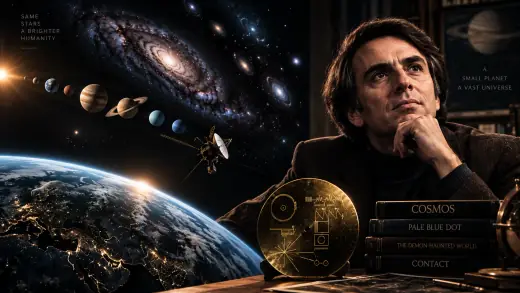
Related reading: Carl Sagan and the public imagination of the cosmos.
FAQ
Frequently Asked Questions
What is the Voyager Golden Record made of?
It is a 12-inch copper phonograph record plated with gold, carried with a protective cover and playback equipment.
How many languages and images does it contain?
NASA describes 115 images and spoken greetings in 55 languages, alongside sounds and music.
Was the Golden Record broadcast as a radio message?
No. It is a physical recording attached to each spacecraft. Recovering and playing it would require a hypothetical encounter with the probe.
Are the instructions engraved on the same surface as the sounds?
The symbolic instructions are on the protective cover. The record itself stores analog sounds and image signals.
PRESDA Dispatch
Stay Informed. Stay Aware.
A sharp briefing across AI, gaming, sport, business, world affairs, paparazzi, and lifestyle.