NASA Invites the Public to Send Their Names to Saturn's Moon Titan
How to send your name to Titan on NASA's Dragonfly: the January 2027 deadline, digital boarding pass, launch timeline and science behind the mission.
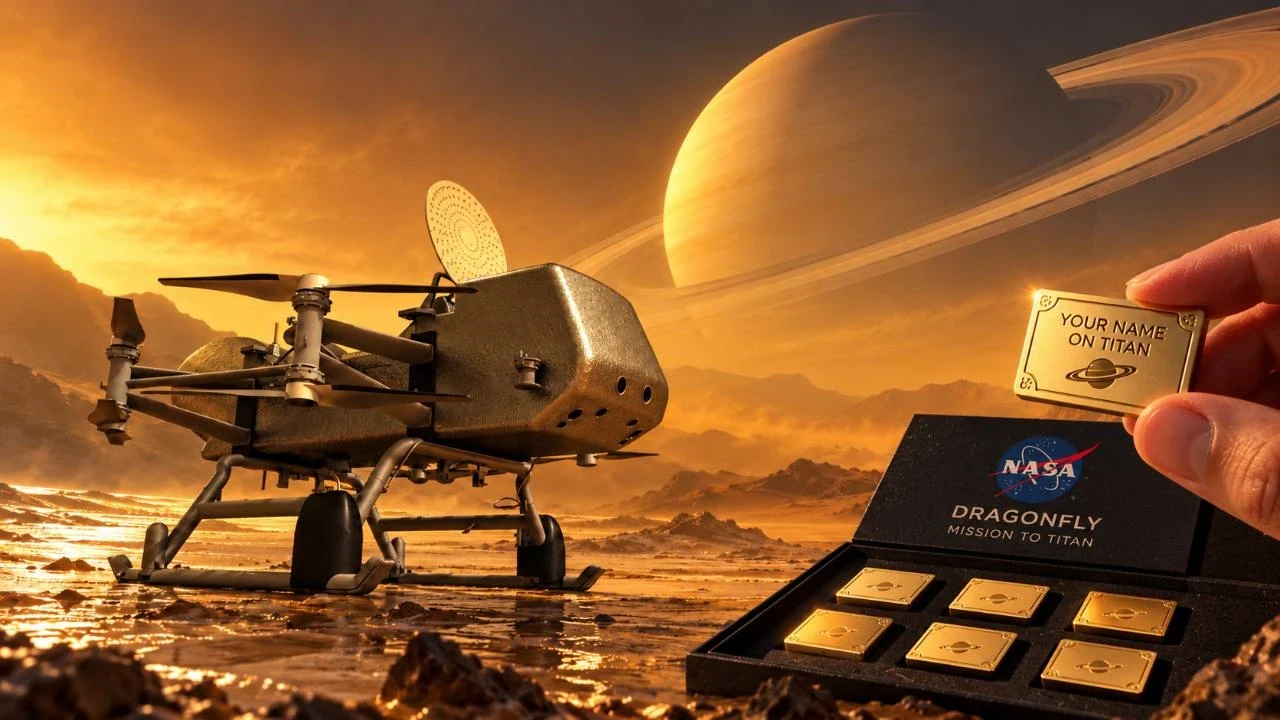
AI editorial illustration: an imagined Dragonfly scene, not an official NASA photograph or a technical reconstruction. The sky, spacecraft details and name plaques are conceptual; the campaign carries names on a microchip. Credit: PRESDA.
NASA is offering an unusually distant destination for a familiar act: writing your name. Its Journey to Titan campaign, announced on October 29, 2026, will carry members of the public's names on a microchip aboard Dragonfly, the rotorcraft being built to explore Saturn's largest moon. Participants receive a personalized digital boarding pass. The registration deadline is January 15, 2027, at 11:59 p.m. EST. NASA's campaign announcement
Behind that small keepsake sits a much larger scientific ambition. Dragonfly is intended to move between landscapes on Titan, examining the chemistry that can precede life. A name on the spacecraft offers a personal connection to that investigation; the discoveries will depend on instruments, engineering and years of work still ahead.
How to send your name to Titan
Start with the registration link published by NASA, enter the first name, last name and email address requested by the form, then save the personalized digital boarding pass offered by the campaign. Use NASA's announcement as the reference for the correct destination and deadline. The closing time, 11:59 p.m. EST on January 15, corresponds to 04:59 UTC on January 16, 2027. The keepsake is digital; the names travel together on a microchip. It is not a passenger reservation or a promise of a separate engraved plaque. NASA's registration form
The deadline and the launch are different dates
Registration closes long before the spacecraft leaves Earth. NASA's current mission overview lists launch no earlier than July 2028 and arrival in late 2034. Those are planning dates, not completed milestones. The planned surface investigation lasts 3.3 years, with flights between sites including dunes and the Selk impact crater region. NASA also offers the campaign's boarding passes in Spanish. Dragonfly mission overview
For families and classrooms, the boarding pass can therefore become the beginning of a long project: follow assembly and testing, locate Titan in the Saturn system, and compare predictions with eventual measurements. The registration countdown should not be confused with a spacecraft already approaching its destination.
Why Titan is worth the journey
Titan combines familiar landscape processes with profoundly unfamiliar materials. It has clouds, rain, rivers and lakes, but its surface liquids include methane and ethane. A substantial atmosphere surrounds this moon, making it very different from the airless world orbiting Earth. NASA identifies Titan as the only moon in our solar system with a thick atmosphere. Its weather and carbon-rich environment give scientists another place to examine how planetary chemistry works. NASA's guide to Titan
That resemblance to Earth has limits. A river-shaped feature does not make a landscape habitable for humans, and the word organic refers to carbon chemistry, not automatically to living organisms. The important comparison concerns processes: how materials circulate, react and accumulate under different conditions. Titan offers a natural setting in which researchers can examine those questions beyond the particular history of Earth.
The difference between habitability and life
Dragonfly's principal investigator, Elizabeth Turtle of the Johns Hopkins Applied Physics Laboratory, emphasizes that the mission investigates chemistry before biology rather than serving as a direct life-detection expedition. Finding compounds of biological interest would be scientifically valuable without proving that organisms made them. The mission's value does not depend on an announcement of alien life. It lies in learning which chemical steps a complex environment can accomplish. NASA on Dragonfly's purpose
A laboratory that changes its own address
A fixed lander can study its immediate surroundings in extraordinary detail. Dragonfly adds the ability to compare places. Titan's dense atmosphere and low gravity favor flight, allowing the spacecraft to cross terrain that could constrain a wheeled rover. The aim is to carry scientific instruments between locations rather than interpret an entire world from a single patch of ground. Dragonfly spacecraft and instruments
Sampling, chemistry and context
The planned payload links several kinds of evidence. DrACO acquires surface samples and transfers material to DraMS, the mass spectrometer that analyzes chemical composition. DraGNS investigates elemental composition, while DragonCam provides images that place samples in their landscape. These measurements answer different questions: what material is present, which chemical compounds it contains, and how its surroundings may explain its history. NASA's instrument descriptions
NASA also plans atmospheric observations, surface monitoring and seismic studies. A sample's meaning changes when its location, environment and geological setting are known. Comparing measurements from the air with observations after landing helps connect a local chemical result to a broader landscape. That combination is what makes mobility scientifically useful, beyond the spectacle of a flying machine on a distant moon. Dragonfly's science objectives
Why the Selk crater region matters
Selk is an impact structure roughly 80 kilometers across. NASA says the site may once have brought liquid water and organic materials together for extended periods after an impact. Its frozen remnants could preserve clues to reactions relevant to prebiotic chemistry. This is a scientific rationale to investigate, not a declaration that life developed there. The crucial task is to measure what remains and test competing explanations for it. NASA on Selk crater
Power for a dim and demanding destination
Sunlight is limited at Titan, so Dragonfly will use a Multi-Mission Radioisotope Thermoelectric Generator alongside its battery. NASA describes this as the same general power-system type used by the Curiosity and Perseverance Mars rovers. The choice supports a mission that must operate far from the strong sunlight available near Earth. Flight, scientific work and communications all depend on careful energy management. NASA's power-system explanation
What a name on Dragonfly really represents
The campaign puts an accessible human gesture beside a difficult scientific undertaking. It does not turn a participant into an astronaut, buy a piece of Titan or guarantee a discovery. It gives people a reason to follow a mission whose questions extend far beyond the moment of registration. A saved boarding pass may outlast several school years before Dragonfly is expected to arrive.
For another example of how spacecraft are designed around difficult destinations, read PRESDA's guide to BepiColombo's journey to Mercury. Our Copernicus feature traces the much earlier shift in thinking that helped make worlds beyond Earth objects of systematic investigation. BepiColombo: Europe and Japan's mission to Mercury Copernicus and Earth's place in the universe
Reporting note: dates and participation details reflect NASA's October 29 announcement and mission pages checked for this article. The hero is an AI editorial illustration, not an official NASA photograph or a technical reconstruction of Dragonfly, Titan's sky or the name microchip. Follow NASA's linked campaign for any subsequent changes.
FAQ
Frequently Asked Questions
What is this PRESDA article about?
How to send your name to Titan on NASA's Dragonfly: the January 2027 deadline, digital boarding pass, launch timeline and science behind the mission.
Which category does this story belong to?
This story is part of PRESDA's Science coverage.
Who published this article?
NASA Invites the Public to Send Their Names to Saturn's Moon Titan was published by PRESDA Editorial on PRESDA.
PRESDA Dispatch
Stay Informed. Stay Aware.
A sharp briefing across AI, gaming, sport, business, world affairs, paparazzi, and lifestyle.