BepiColombo: Europe and Japan's Mission to Mercury
ESA and JAXA's BepiColombo approaches Mercury. Explore the two orbiters, the planned November 2026 capture, April 2027 science and the planet's unsolved puzzles.
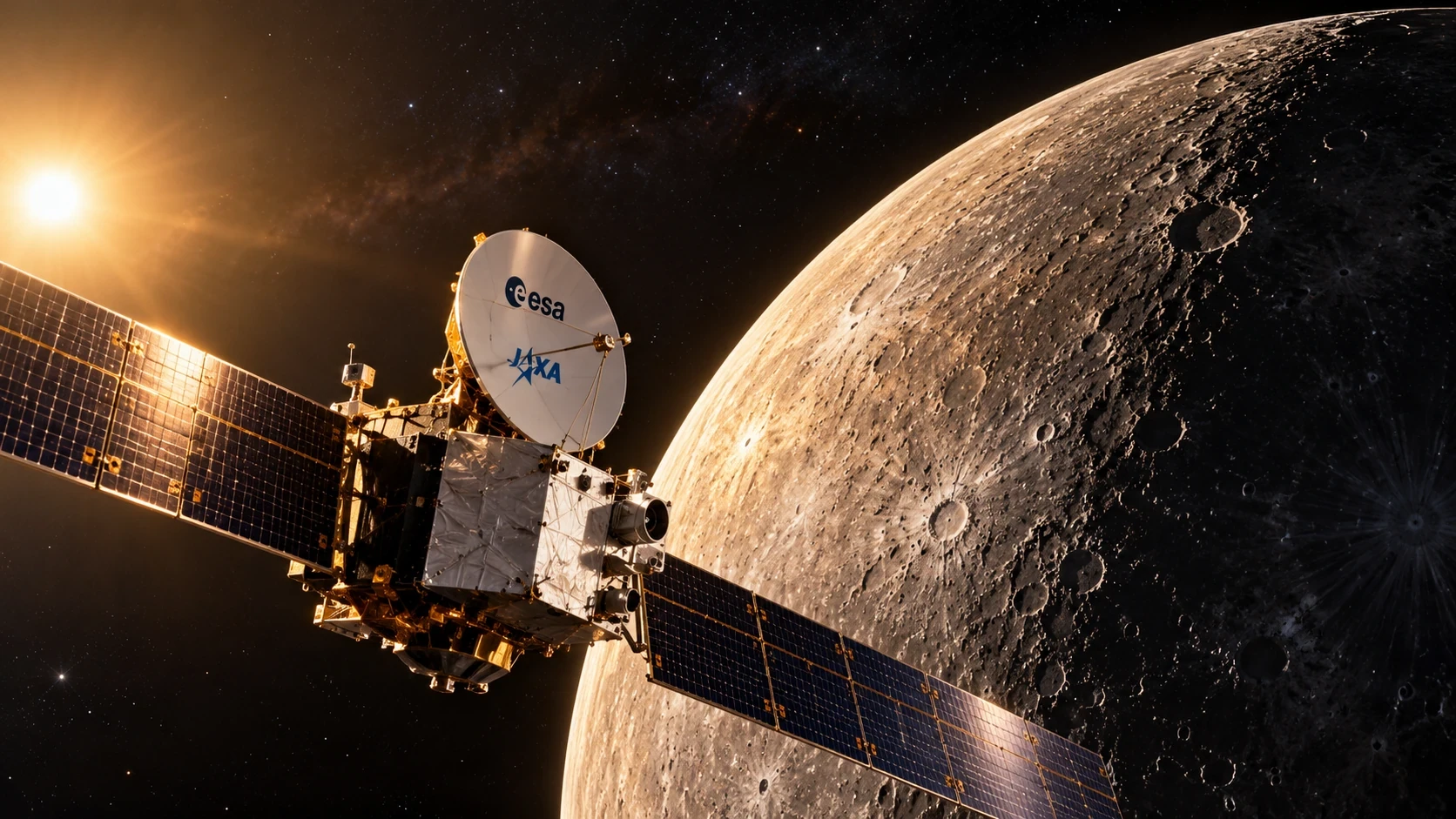
PRESDA · AI-generated concept illustration; not an ESA/JAXA photograph or an engineering-accurate depiction of BepiColombo.
Mercury looks close to the Sun and far from everyday experience. Reaching it is not simply a matter of pointing a spacecraft inward: the vehicle must lose enough orbital energy to remain beside a small planet deep in the Sun's gravitational field. BepiColombo's long journey is an exercise in controlled arrival, not a race across the shortest distance.
As of 27 October 2026, the joint European Space Agency and Japan Aerospace Exploration Agency mission is approaching Mercury, not yet operating in its final science orbits. ESA's arrival updates schedule capture for 21 November 2026, separation of the two scientific orbiters for 9–10 December and routine science from April 2027. These are planned milestones, not completed achievements. ESA: latest arrival updates
One mission, two complementary observatories
BepiColombo carries ESA's Mercury Planetary Orbiter, or MPO, and JAXA's Mercury Magnetospheric Orbiter, known as Mio. MPO will investigate the planet's surface, composition and interior; Mio will examine its magnetic environment and surrounding plasma. Using two observatories makes it possible to study different parts of an interacting system rather than expecting one spacecraft to measure everything from one position. NASA: BepiColombo mission overview
What Japan's Mio brings
JAXA describes Mio as an observatory for Mercury's magnetosphere and space environment, built to withstand intense solar exposure. Its instruments investigate magnetic fields, particles, waves and dust. That work connects a rocky planet to the solar wind around it: Mercury is not merely a cratered object, but a body continuously interacting with its star. JAXA: Mio
What Europe's MPO brings
ESA's instrument list includes imaging systems, spectrometers, a laser altimeter, a magnetometer and a radio-science experiment. Their different measurements can connect the shape of the surface with its materials, gravity and magnetic properties. A photograph can show a feature; a coordinated set of measurements can test explanations for how that feature formed. ESA: mission factsheet
Why getting nearer the Sun takes so long
The mission launched on 20 October 2018 from Europe's Spaceport on an Ariane 5. Its route combined propulsion with nine planetary flybys: one of Earth, two of Venus and six of Mercury. These encounters reshaped the trajectory rather than serving as sightseeing stops. The final Mercury flyby occurred on 8 January 2025.
A spacecraft departing Earth already carries Earth's motion around the Sun. It cannot become a Mercury orbiter merely by falling inward; arrival speed and direction must be suitable for capture. Solar-electric propulsion and repeated gravity assists allow the mission to change that motion gradually. The difficulty is matching an orbit, not simply covering kilometres. Spanish Space Agency: BepiColombo's approach
Where the mission stands in October 2026
ESA reports that the Mercury Transfer Module separated successfully on 3 September 2026. This was the propulsion and power element used during the interplanetary cruise. Its departure marked a transition in the mission, while the two scientific orbiters remained together for the next phase. A successful separation should not be confused with successful Mercury orbit insertion.
Capture is the beginning of another sequence
The planned 21 November capture is followed by further manoeuvres and the deployment of separate orbiters. April 2027 is the published target for routine science. A responsible mission timeline therefore distinguishes arrival, separation and scientific operations. Describing the spacecraft as already delivering a full orbital survey in October would skip several difficult steps that still lie ahead.
The puzzles Mercury leaves unresolved
Mercury has an unusually large metallic core, a heavily cratered surface and a thin exosphere rather than a substantial atmosphere. NASA describes surface temperatures reaching about 430°C in sunlight and falling to about minus 180°C at night. These are planetary surface conditions, not a claim that every spacecraft component experiences the same temperature. NASA: Mercury facts
Ice on a scorched planet
NASA's MESSENGER mission established that Mercury's polar deposits are predominantly water ice. Permanent shadow allows some polar locations to remain very cold even on a planet so near the Sun. The juxtaposition is not a contradiction: sunlight exposure and local topography matter, rather than a single temperature applying everywhere. BepiColombo can build on that earlier work instead of being credited with discovering the ice before its orbital science begins.
Reading the planet and its surroundings together
The two-orbiter design is especially useful for distinguishing changes across space from changes over time. An instrument seeing a variation alone may struggle to determine whether the environment changed or the spacecraft entered a different region. Complementary observations can help resolve that ambiguity. They will also place surface measurements in the context of the charged particles and magnetic fields surrounding Mercury.
A successor, not the first visitor
Mariner 10 flew past Mercury three times in 1974–1975. MESSENGER orbited it from 2011 to 2015. BepiColombo is the third mission to visit the planet and, if capture succeeds, will become the second mission to orbit it. Its name honours Italian mathematician and engineer Giuseppe “Bepi” Colombo, whose work helped explain Mercury's rotation and informed planetary mission design.
When will BepiColombo start answering its biggest questions?
Routine science is planned for April 2027, after the arrival and orbit-adjustment sequence. Flyby observations already have value, but they are not equivalent to sustained measurements from the intended science orbits. Future findings will need calibration, analysis and publication; reaching an orbit does not instantly settle a planet's history.
BepiColombo's promise is a more connected explanation of Mercury: rock, interior, magnetic field and solar environment considered together. For readers interested in how scientists distinguish an observation from a deeper historical inference, our guide to dating the oldest living trees explores the same discipline on Earth.
FAQ
Frequently Asked Questions
What is this PRESDA article about?
ESA and JAXA's BepiColombo approaches Mercury. Explore the two orbiters, the planned November 2026 capture, April 2027 science and the planet's unsolved puzzles.
Which category does this story belong to?
This story is part of PRESDA's Science coverage.
Who published this article?
BepiColombo: Europe and Japan's Mission to Mercury was published by PRESDA Editorial on PRESDA.
PRESDA Dispatch
Stay Informed. Stay Aware.
A sharp briefing across AI, gaming, sport, business, world affairs, paparazzi, and lifestyle.