Orangutan Mothers Arrange Playdates for Their Babies
A 15-year study of wild Bornean orangutans links mothers’ movements to infant play. Explore the evidence, feeding costs and limits of the playdate comparison.
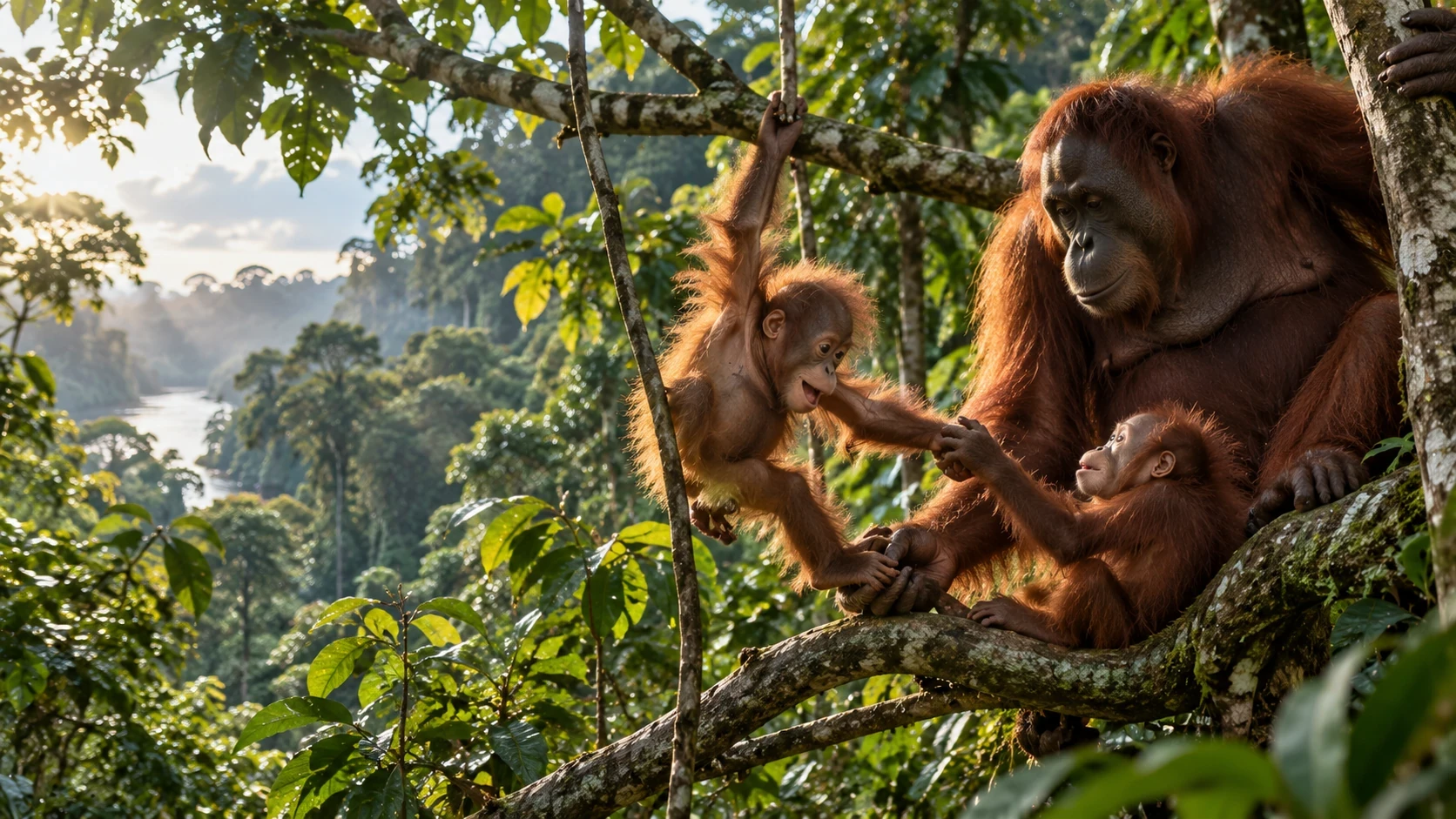
PRESDA · AI-generated editorial illustration; this imagined scene is not a photograph of the study animals or a documented family.
For a young orangutan, finding someone to play with is not as simple as joining a group. A mother and her dependent offspring often travel and feed away from other mothers. A meeting with another youngster can therefore depend on an adult changing where she goes, and spending time she might otherwise use to eat.
A study published in PNAS on 6 October 2026 provides evidence that wild Bornean orangutan mothers do precisely that. Researchers analysed 15 years of observations, approximately 32,600 hours, from 31 mother-offspring pairs at Tuanan in Central Kalimantan, Indonesia. Mothers' ranging patterns increased opportunities for young to encounter peers. “Playdates” is a useful shorthand for the finding, provided it is not mistaken for proof of human-style appointments. Jacobson and colleagues, PNAS
What the study actually found
Mothers whose offspring were closer in age overlapped more in their use of forest space, and those youngsters played together more often. The analysis accounted for relatedness and fruit availability, two alternative explanations for why particular animals might occupy the same places. That makes the result more informative than a collection of appealing photographs of infants wrestling.
The journey matters as much as the encounter
The movement pattern extended beyond the day of play. Mothers travelled farther on surrounding days, moving towards another mother's core area before a play encounter and towards their own afterwards. On play days, they also spent less time feeding. Together, these results support the interpretation that mothers help create social opportunities rather than merely happening upon them. They do not reveal an animal's private thoughts or demonstrate a shared plan between two mothers.
Why fifteen years of observation were needed
The field programme at Tuanan began in 2003. According to the Max Planck Institute of Animal Behavior, the work brought together researchers from that institute, the University of Zurich, Universitas Nasional and Rutgers University. First author Odd Jacobson and senior author Maria van Noordwijk combined movement information with the characteristics of neighbouring mother-infant pairs. Max Planck research account
A single encounter cannot tell a researcher whether an animal sought company, followed food or crossed a neighbour's path by chance. Repeated observations make comparison possible: who meets whom, how old their young are and what happens before and after the meeting. Duration is part of the evidence, not merely an impressive statistic attached to the study.
Rare does not mean trivial
The researchers' public summary reports infant peer play on about six percent of follow days, with roughly 20 minutes of play on days when it occurred. Those figures describe this observational sample, not a universal timetable for every orangutan. They also explain why short field visits could miss the pattern: an important behaviour need not occupy much of the day.
A different kind of maternal investment
Maternal care is easy to picture as milk, transport or protection. This research adds another possibility: access to suitable social partners. A mother may incur a cost in extra movement and reduced feeding time while her offspring gains an opportunity unavailable during solitary travel. “Energetic cost” here should be read alongside the measured behavioural evidence, not as a claim that each playdate's calories were directly counted.
There is an important unresolved step. The study does not establish that the young who played more subsequently survived better, reproduced more successfully or became more intelligent. Coauthor Sri Suci Utami Atmoko identifies that long-term payoff as an open question in the team's account. Benefits that seem plausible are hypotheses to test, not results to add to the headline.
Solitary is not the same as unsocial
Bornean orangutans, Pongo pygmaeus, are one of three recognized orangutan species, alongside Sumatran and Tapanuli orangutans. Their living wild range is restricted to Borneo and Sumatra. These distinctions matter because a result from one Bornean population should not automatically be attributed to every orangutan in every habitat. WWF: orangutan species and range
The word solitary describes a pattern of daily association, not an absence of relationships. Knowing neighbouring animals and occasionally meeting them can coexist with spending much of the day apart. The study invites readers to replace the simple opposition between “group animal” and “loner” with a more useful question: how does this animal obtain the social contact it needs?
What the finding means for conservation
WWF identifies habitat loss and fragmentation, hunting and other human pressures as threats to Bornean orangutans, which are critically endangered. Their slow reproduction makes losses difficult to replace. Forest conservation is consequently about maintaining conditions for complete lives, not merely retaining enough trees for a photograph of an adult ape. WWF: Bornean orangutans
It is reasonable to ask whether disrupted movement routes could also disrupt opportunities for young to meet. That is an implication worth investigating, not a measured result of this play study. Separating conservation relevance from a demonstrated causal effect helps the research remain useful without asking it to prove more than it does.
Do orangutan mothers really arrange playdates?
The evidence supports maternal movements that facilitate play with neighbouring young, particularly those of similar age. It does not show calendars, negotiated appointments or a human parenting philosophy. The headline works as an analogy; the scientific achievement lies in detecting a consistent behavioural pattern and identifying its costs and unanswered questions.
A familiar word can open a door to unfamiliar biology. What follows should be more careful than the metaphor: decades of fieldwork, individually known animals and an account of care that includes social opportunity. For another example of why definitions change a natural-history story, read about the world's oldest living trees.
FAQ
Frequently Asked Questions
What is this PRESDA article about?
A 15-year study of wild Bornean orangutans links mothers’ movements to infant play. Explore the evidence, feeding costs and limits of the playdate comparison.
Which category does this story belong to?
This story is part of PRESDA's Science coverage.
Who published this article?
Orangutan Mothers Arrange Playdates for Their Babies was published by PRESDA Editorial on PRESDA.
PRESDA Dispatch
Stay Informed. Stay Aware.
A sharp briefing across AI, gaming, sport, business, world affairs, paparazzi, and lifestyle.