Copernicus: The Man Who Challenged Earth's Place in the Universe
Explore Copernicus's life, his 1543 book, heliocentrism, the limits of circular orbits and the evidence behind a scientific revolution.
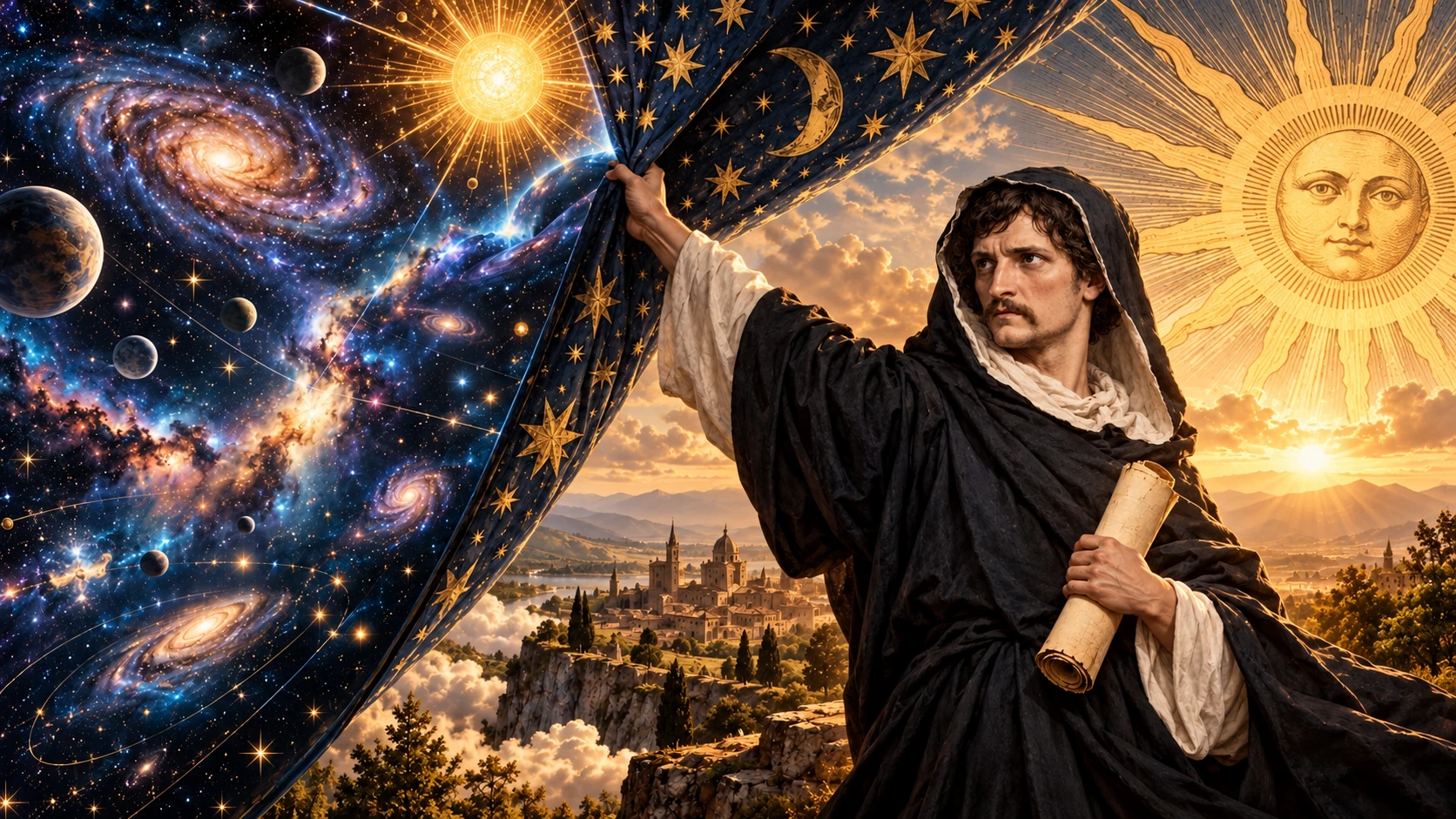
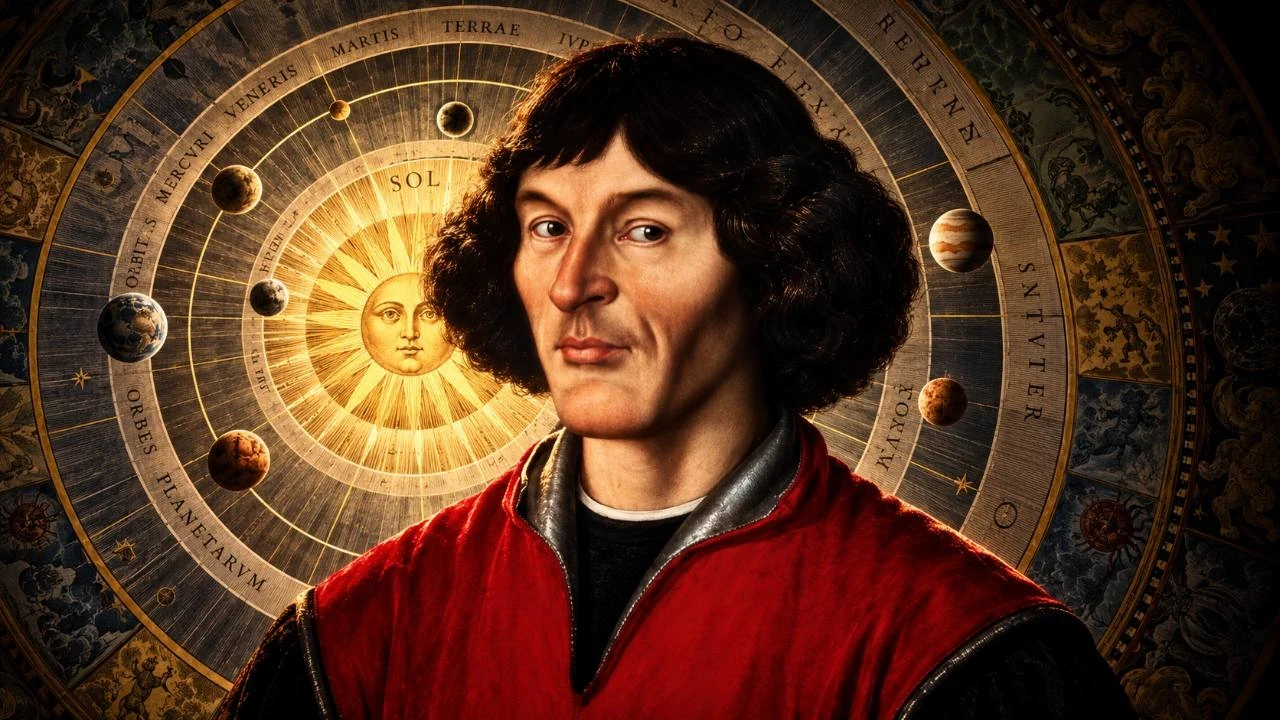
PRESDA AI-generated editorial illustration inspired by historical portraits. The background is a conceptual design, not a facsimile of Copernicus's 1543 diagram or an accurate planetary chart.
The most unsettling part of Copernicus's astronomy was not a new object in the sky. It was a new role for the observer. Earth, apparently steady beneath human feet, could itself be moving. In De revolutionibus orbium coelestium, published in Nuremberg in 1543, Nicolaus Copernicus placed Earth among the planets orbiting the Sun and gave it a daily rotation. The proposal changed the questions astronomy could ask, even though it did not immediately settle them. University of Glasgow: the 1543 book
Who was Nicolaus Copernicus?
Born in Toruń on February 19, 1473, Copernicus was a subject of the Polish crown. He studied in Kraków and later in Italy, including canon law and medicine, and worked as a cathedral canon in Warmia. His responsibilities included administration as well as intellectual work. The familiar picture of an astronomer isolated from ordinary obligations misses a life in which accounts, church affairs and scholarly investigation competed for time. Stanford Encyclopedia of Philosophy: Copernicus
He did not need a telescope to formulate his system. The decisive issue was how observations and inherited mathematical techniques should be organized. Changing the arrangement of the heavens also changed the interpretation of motions that people had watched for centuries.
What does heliocentric mean?
Heliocentric means Sun-centered. In Copernicus's planetary arrangement, Earth rotates and travels around the Sun, while the Moon travels around Earth. The familiar daily passage of the heavens can then be explained by Earth's turning. That was a profound change from treating a stationary Earth as the reference point for the entire cosmos. ESA's historical account identifies both daily rotation and the planets' apparent backward motion as central problems his scheme addressed. ESA: Copernicus and the moving Earth
Why Mars seems to move backward
Imagine watching a slower runner while overtaking them on an inside track. Relative to your changing position, the runner seems to shift backward against the background, although both of you continue forward. Earth's faster orbit gives a useful starting analogy for Mars's apparent retrograde motion. The explanation moves part of the problem from Mars to our own viewpoint. It is an analogy for relative motion, not a claim that planetary orbits are running tracks.
The order of the planets became part of one connected arrangement. The period and apparent motion of each world could be considered in relation to Earth's orbit. This coherence was one of the system's strongest attractions.
A revolutionary model with real limitations
Copernicus did not deliver the modern solar system in finished form. He retained circular motion and combinations of circles. NASA's account of Kepler explains why the assumption of circular orbits caused difficulties, especially for Mars. Later, using Tycho Brahe's observations, Johannes Kepler described elliptical planetary orbits. Copernicus's breakthrough could therefore be both foundational and incomplete. NASA: orbits and Kepler's laws
Nor were all earlier astronomers simply incompetent. The University of Oklahoma's history-of-science exhibition emphasizes that Ptolemaic astronomy was neither hopelessly inaccurate nor merely an absurd tangle. In 1543, direct evidence for Earth's motion was limited. Copernicus offered a powerful reorganization of the problem, not an instantly decisive demonstration that every contemporary had to accept. University of Oklahoma: the evidence in 1543
Why skepticism was not just stubbornness
If Earth moves, why do people not feel it in the expected way? How should its motion fit the physics then available? Such questions required more than redrawing a diagram. Judging the proposal fairly means recognizing the distance between a mathematically attractive arrangement and a physical account supported by increasingly discriminating observations.
Modern astronomy also does not place the Sun at the center of the whole universe. The historical model and its modern descendants should not be confused. The durable change was Earth's status as a moving world, not the preservation of every boundary Copernicus assigned to the cosmos.
How the book reached its readers
Copernicus circulated an earlier outline, the Commentariolus, before the great book. Georg Joachim Rheticus later encouraged publication and introduced the system in the Narratio prima of 1540. Copernicus died on May 24, 1543. The memorable story that a printed copy reached his deathbed is often repeated, but ESA explicitly notes that it may be a myth. It need not carry the weight of the historical narrative. ESA: outline, publication and death
The printed book itself offers firmer evidence. Cambridge's history-of-science resource describes surviving annotated copies and the networks through which readers studied it. Publication did not simply transmit a conclusion. It created something that mathematicians could mark, teach, compare and dispute. University of Cambridge: Copernicus's book and its readers
Religion, controversy and a misleading martyr story
Copernicus was not executed for his astronomy. His book was dedicated to Pope Paul III, and its early reception cannot be reduced to an immediate, uniform ban. In 1616, long after his death, it was placed on the Index pending correction; instructions for correction followed in 1620. Cambridge documents that later censorship, which belongs to a different stage of the controversy. Stanford: dedication and early reception Cambridge: censorship and corrections
The distinction matters when comparing him with Giordano Bruno. Their careers, arguments and encounters with religious authority were different. Compressing them into one familiar story produces drama at the expense of explanation.
What survives of the Copernican revolution?
A theory need not be final to alter the direction of science. Copernicus made the observer's moving platform part of astronomy's central problem. Kepler revised the geometry; Newton supplied a new account of motion and gravity. The strength of that inheritance lies in its capacity for correction.
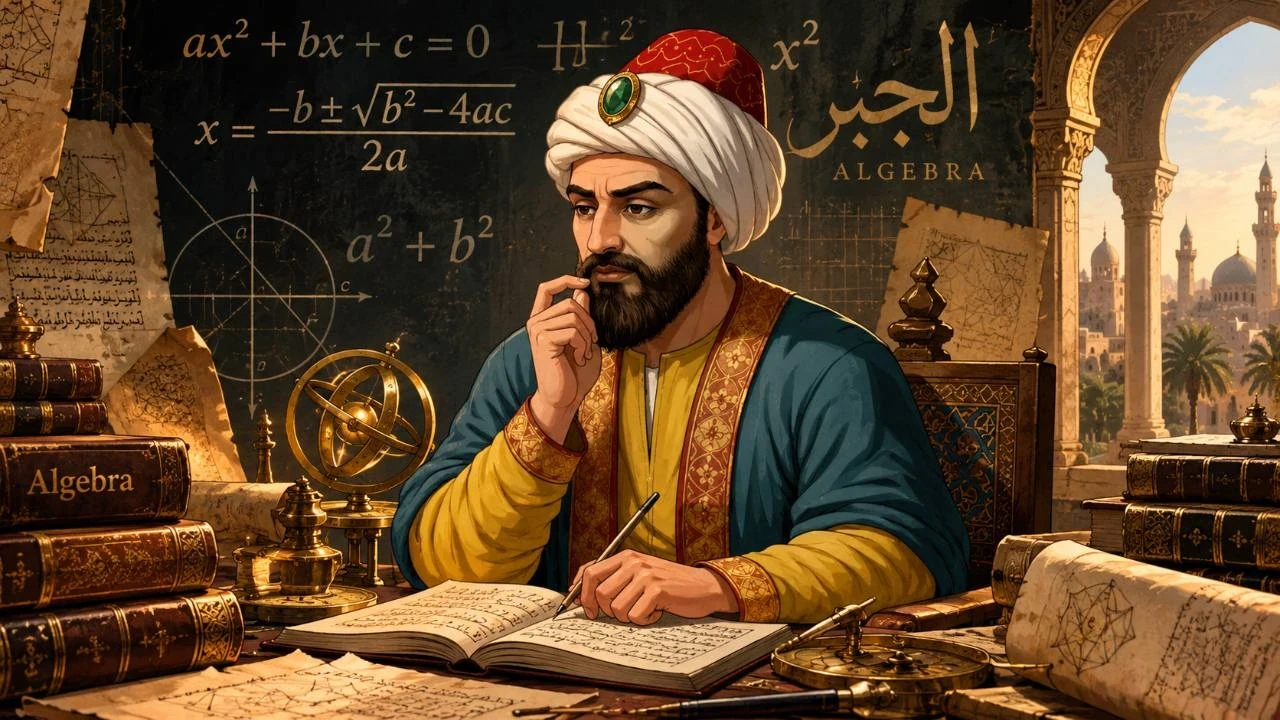
Alongside al-Khwarizmi's systematic algebra, the story shows how a new mathematical organization can make familiar problems look different. Copernicus did not remove humanity from knowledge of the universe. He helped make our position within it something to investigate.
FAQ
Frequently Asked Questions
What is this PRESDA article about?
Explore Copernicus's life, his 1543 book, heliocentrism, the limits of circular orbits and the evidence behind a scientific revolution.
Which category does this story belong to?
This story is part of PRESDA's Science coverage.
Who published this article?
Copernicus: The Man Who Challenged Earth's Place in the Universe was published by PRESDA Editorial on PRESDA.
PRESDA Dispatch
Stay Informed. Stay Aware.
A sharp briefing across AI, gaming, sport, business, world affairs, paparazzi, and lifestyle.