GIORDANO BRUNO: THE PHILOSOPHER BURNED AT THE STAKE FOR HERESY
Explore Giordano Bruno’s life, infinite universe, heresy trial and legacy, separating documented history from the myth of a trial solely for heliocentrism.
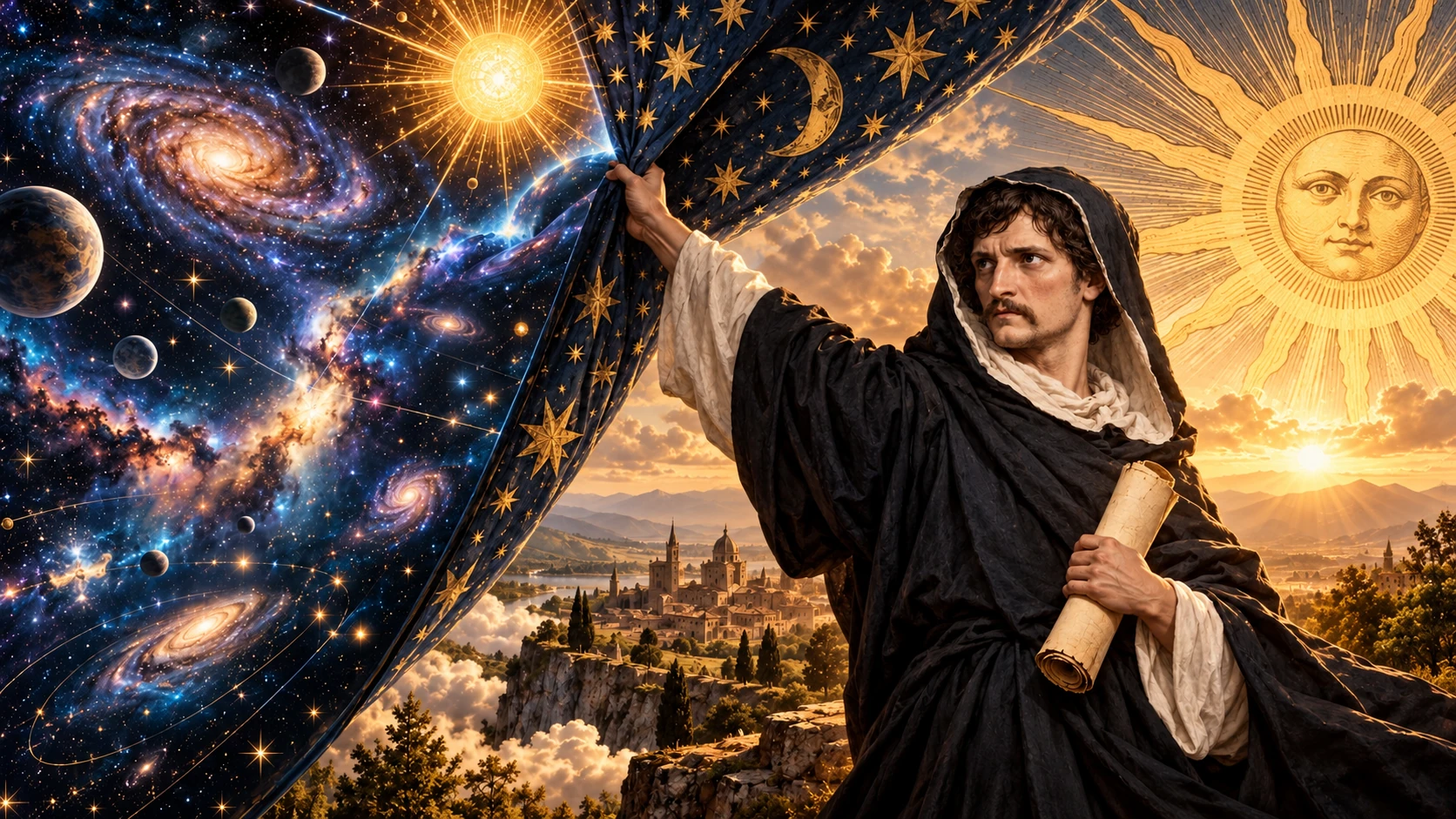
AI-generated symbolic illustration supplied for PRESDA. The portrait, celestial imagery and scene are artistic inventions, not a historical likeness, scientific diagram or record of an actual event.
Rome, February 17, 1600. In Campo de’ Fiori, Giordano Bruno was burned at the stake after a heresy trial. The man who had imagined a universe without an enclosing boundary ended his life under the authority of a tribunal that demanded limits on what he could affirm. The contrast is powerful enough without invented last words, imagined conversations or a simplified charge sheet.
Bruno was condemned for multiple theological and philosophical beliefs, not simply for saying that Earth moves around the Sun. His cosmology mattered, but it belonged to a much wider challenge to Christian doctrine. Nor can historians reproduce a complete, securely preserved list of the final eight propositions he was ordered to renounce. Stanford Encyclopedia of Philosophy
Before the heretic: a young Dominican
Born Filippo Bruno in 1548 at Nola, near Naples, he took the name Giordano when he entered the Dominican order in 1565. He became a priest in 1572. His education was religious as well as philosophical: the later dissenter had learned to argue within the institution he would leave. University of St Andrews
It is tempting to make every childhood detail predict the final confrontation. That produces a satisfying legend and unreliable biography. An adult's account of his beginnings is already an interpretation, particularly when it survives through testimony given to inquisitors. Bruno's intellectual life is better approached through what he studied, wrote and defended than through a fictional childhood of solitary rebellion.
In Naples, questions about religious images, prohibited reading and doctrine drew suspicion. His departure from the convent in 1576 began a long period of movement. The issue was not a sudden discovery that the Earth was round, something educated Europeans already knew. Bruno's disagreements concerned the authority of teaching and the permissible interpretation of belief. Treccani: Giovanni Aquilecchia’s biography/)
Europe as classroom, refuge and battlefield
Bruno's itinerary passed through Geneva, Toulouse, Paris and London, then through German lands and Prague. Teaching, publication and patronage were ways to keep working. He sought audiences capable of supporting an independent thinker, while polemical exchanges repeatedly made those relationships difficult. The freedom of the wandering scholar came with a dependence on other people's hospitality, institutions and money. J. Lewis McIntyre: historical biography, 1903
In Paris, his reputation was connected to the art of memory. On the Shadows of Ideas appeared in 1582, with techniques for arranging images and associations so that knowledge could be recalled. For Bruno, such techniques belonged to a larger inquiry into mind and reality. His fascination with memory explains why a prospective pupil might invite him across Europe; he was not travelling as a telescope-bearing astronomer.
London provided an especially productive setting. With support from the French ambassador Michel de Castelnau, Bruno published The Ash Wednesday Supper in 1584. Its five dialogues went beyond Copernicus's finite cosmos toward an infinite universe containing innumerable systems. Library of Congress: the 1584 edition
Books that refused to stay in one discipline
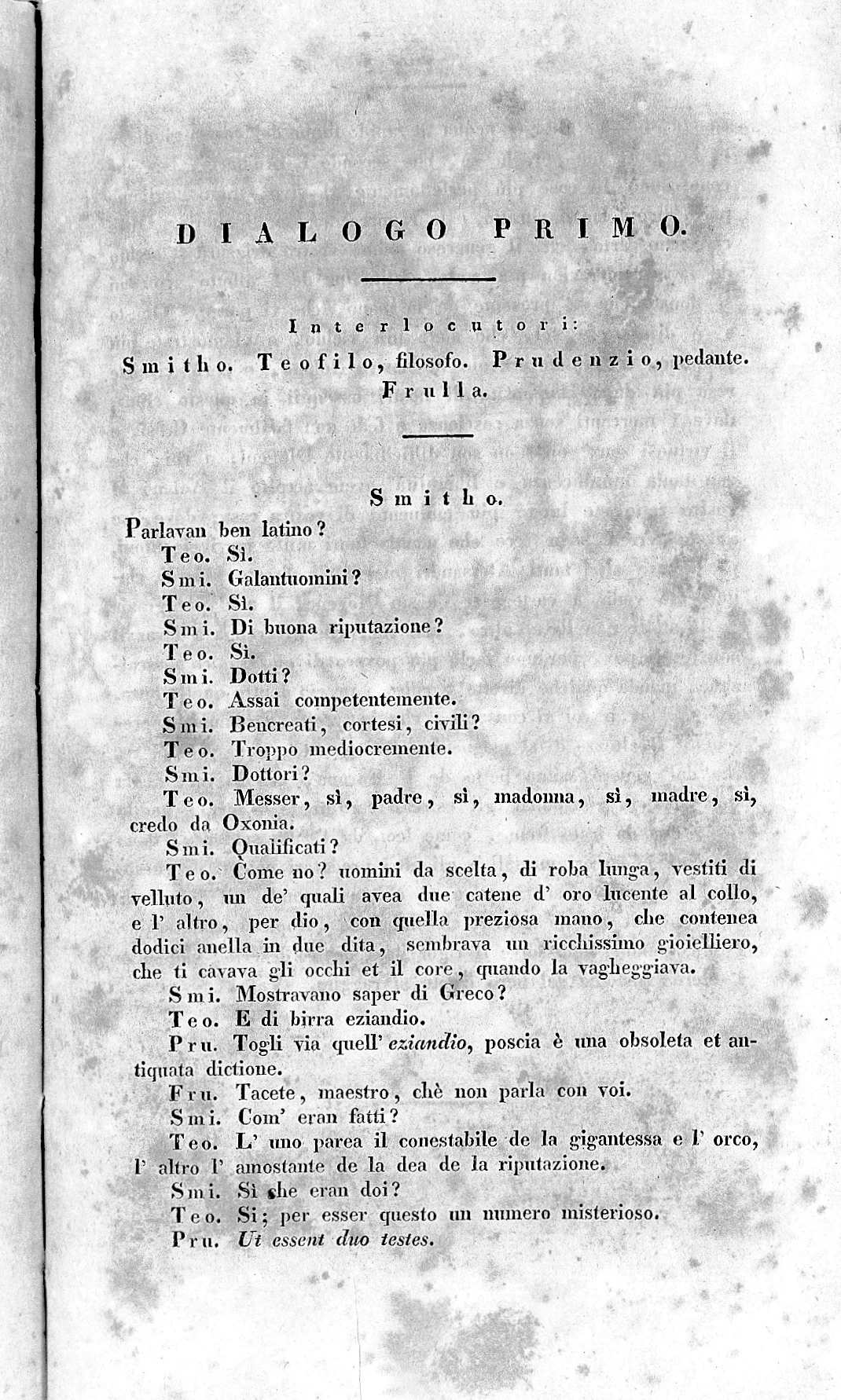
Opening of The Ash Wednesday Supper in Opere, edited by A. Wagner, 1830. Wellcome Library, London, L0015153. This is a later edition of the dialogue first published in 1584, not its original printing.
Giordano Bruno, Opere, edited by A. Wagner (1830) / Wellcome Library, London / Wikimedia Commons
CC BY 4.0. Resized and converted to WebP by PRESDA. Full composition preserved. Reuse follows the individual license stated here.
The opening page reproduced here comes from an 1830 edition, not the original printing. Its list of speakers is a useful reminder of Bruno's method. A dialogue can stage disagreement, ridicule an opponent and allow an argument to develop through competing voices. Reading one speaker's statement as an isolated declaration by the author can flatten that literary design.
His Italian works include On the Cause, the Principle and the One, On the Infinite Universe and Worlds, The Expulsion of the Triumphant Beast and The Heroic Frenzies. Cosmology, metaphysics, moral reform and poetic desire overlap. These were not separate careers accidentally collected in one person: Bruno tried to rethink the relationship between nature, thought and the divine. Bruno’s works and reception
The range can disorient a modern reader expecting either science or religion. Renaissance natural philosophy did not observe our departmental boundaries. Bruno's vocabulary includes ancient wisdom, soul, matter and magic alongside arguments about celestial motion. The task is to understand those connections before deciding which ideas resemble later knowledge and which belong firmly to his own time.
What did an infinite universe mean?
Copernicus had rearranged the planetary system around the Sun. Bruno pushed the question outward: why should that arrangement exhaust creation? He imagined other suns and other worlds, with no final shell enclosing everything. Moving Earth away from the privileged centre was one step; removing the unique centre of the whole was another. This distinction makes his cosmology more radical than a mere endorsement of heliocentrism.
His reasoning was philosophical. An unlimited divine power, he argued, should not be represented by a creation restricted to one finite world. The universe's immensity expressed abundance rather than divine absence. Nature was not an empty stage on which a distant deity occasionally acted. It was bound up with the manifestation of divine power. McIntyre's historical exposition follows these arguments through Bruno's writings, although its celebratory language needs to be read critically.
That vision is not an early photograph of the universe we observe today. Recognizing other stars as suns is different from detecting planets around them. Bruno did not establish an observational census of exoplanets, prove that life exists elsewhere or demonstrate the physical infinity of space. His achievement was to enlarge the range of imaginable worlds, not to supply evidence that every part of his picture was correct.
Nor was his interest confined to enormous distances. Later work examined the minimum and attempted to remake mathematics around it. Recent scholarship traces how his treatment of infinity and mathematical objects changed across his writings. He was developing a philosophy, not delivering a finished version of modern physics. Science in Context: mathematics and infinity
Why cosmology became theology
For Bruno, changing the universe also changed humanity's relationship with God. The contrast between an imperfect earthly realm and a superior celestial one could no longer be taken for granted. His philosophical account of transformation challenged inherited divisions between different kinds of being. Cambridge: Cause, Principle and Unity
These questions reached far beyond planetary diagrams. Disputes involved the Trinity, Christ, the soul and religious authority. A modern separation between astronomy and theology cannot simply be projected onto the proceedings. At the same time, calling everything theology must not erase the significance of Bruno's worlds. Historian Alberto A. Martínez argues that belief in many worlds was a major issue in the case. That is a scholarly argument about its weight, not proof that no other beliefs mattered. Annals of Science: the heresy of many worlds
Venice: hospitality becomes captivity
Bruno returned to Italy in 1591. In Venice, the nobleman Giovanni Mocenigo wanted instruction in his techniques. Their relationship collapsed, and in May 1592 Mocenigo denounced him to the Inquisition. A private patron had become the route into public prosecution. Italian digital libraries: return and arrest
There is no need to turn the invitation into a proven international trap. The documented sequence is dramatic enough: return, instruction, denunciation, arrest. Historians must distinguish what an accuser alleged from what the accused admitted, and both from what a later reader wishes had happened. Inquisition records preserve speech under unequal conditions, not a neutral transcript of ordinary life.
Venice did not immediately surrender its prisoner. Negotiations over jurisdiction preceded his transfer to Rome in 1593. His confinement and proceedings then stretched across years. The cosmopolitan author who had crossed borders seeking readers was now dependent on interrogations, written defences and the decisions of officials controlling his future. The older documentary narrative collected by McIntyre makes the duration of that process painfully clear.
A trial with gaps in the record
The surviving materials do not permit a seamless reconstruction of every hearing. Some evidence comes through summaries and later discoveries, and the complete final set of eight propositions is missing. A popular list presented as the exact original indictment can therefore promise more certainty than the archive supplies. Missing evidence calls for restraint, not imaginative completion.
Bruno's conduct also resists the simplest heroic script. There were negotiations, qualified concessions and written arguments, followed by a final refusal to recant. Survival and intellectual conviction were not necessarily opposite motives at every stage. We should not invent his private calculations, but neither should we erase the effort to defend a position while seeking a way out.
The eventual condemnation treated him as an obstinate heretic. Ecclesiastical judgment led to his delivery to secular authorities and execution in Campo de’ Fiori on February 17, 1600. Describing that institutional sequence is more accurate than a story in which an abstract entity called science was put on trial. It also makes the exercise of power concrete: particular authorities condemned a particular person for beliefs he would not finally abandon.
The execution and the images made afterward
The nineteenth-century engraving below is an authentic historical illustration, but not an eyewitness record of 1600. Its own caption stresses the plurality of worlds, showing how later generations framed Bruno's death. It documents the memory of the event as well as an artist's representation of it. Neither this engraving nor the symbolic hero should be mistaken for direct visual evidence of the execution.
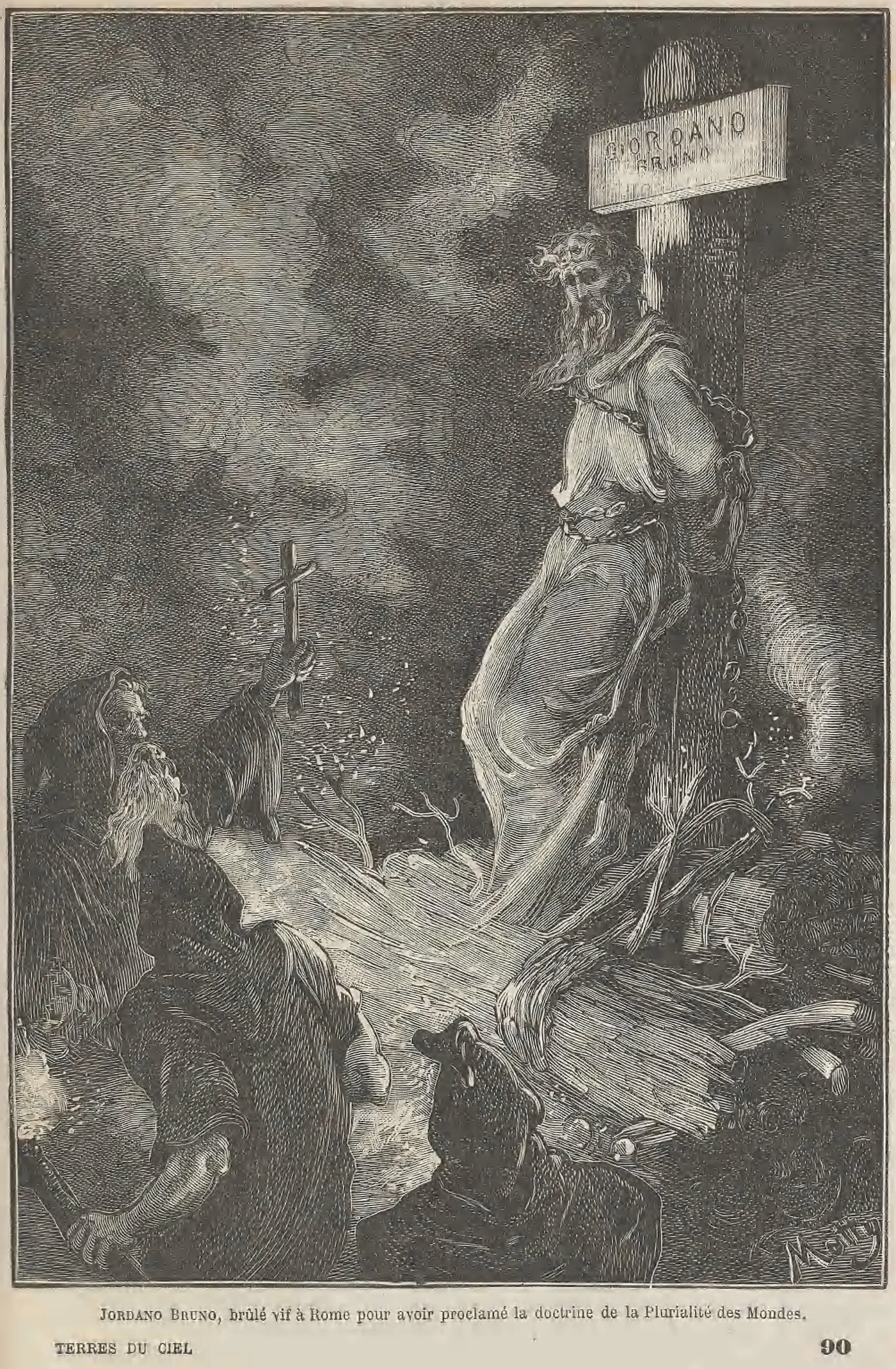
Bruno’s execution as imagined in an engraving published in Camille Flammarion’s Les Terres du ciel, 1884. A nineteenth-century interpretation, not an eyewitness image of 1600. Its original caption foregrounds the plurality of worlds; the trial involved multiple beliefs.
Public domain. Resized and converted to WebP by PRESDA. Full composition preserved. Reuse follows the individual license stated here.
Famous last words travel easily because they compress a complicated life into a line. This account does not build its argument on them. No imagined inner monologue is needed to recognize the cruelty of execution for belief. Historical precision does not weaken that judgment; it prevents the victim from being replaced by a more convenient fictional character.
Bruno and Galileo were not the same case
Bruno's execution preceded Galileo's trial of 1633 by more than three decades. Their cases shared questions about authority and permissible inquiry, but differed in their arguments, proceedings and outcomes. Galileo was not burned at the stake. For the separate history, read PRESDA's Galileo and the Church.
Nor should the telescope become a prop in Bruno's biography. His cosmological arguments belonged to an earlier intellectual setting. Treating him as Galileo before Galileo obscures both men: it strips Bruno of metaphysics and makes Galileo's observational and mathematical work seem interchangeable with philosophical speculation. Comparison helps only when it preserves the differences it reveals.
From condemned author to public monument
In 1889, Ettore Ferrari's monument to Bruno was erected in Campo de’ Fiori. Rome's heritage authority dates its inauguration to June 9. The public commemoration transformed the site of punishment into a statement about freedom of thought. Rome’s cultural heritage authority
That transformation was itself historical. A statue is not simply the past speaking unchanged; it is a later society deciding what to honour. Bruno became a figure through whom people could argue about secular government, religious power and the rights of inquiry. His afterlife should therefore be studied alongside his life, rather than allowed to rewrite it.
His relevance to philosophy lies in questions that remain unsettling: can inherited categories contain reality, how does the mind organize knowledge, and what follows when humanity loses its privileged cosmic location? Influence need not mean that later thinkers accepted his entire system. An argument can matter because it changes the questions, even when its proposed answers are rejected.
The freedom to be wrong
Bruno does not have to be a flawless prophet of modern science to deserve remembrance. The strongest defence of intellectual freedom protects difficult, mistaken and unfashionable thinking as well as ideas that later win approval. A person's right not to be killed for a belief cannot depend on whether posterity eventually validates that belief.
The stake ended a life, not the need for judgment. We can admire Bruno's imaginative reach without endorsing every doctrine, recognize the theological dimensions of his trial without excusing persecution, and resist a myth without diminishing a tragedy. His enduring challenge is not merely to look farther into the heavens. It is to ask what a society will permit a human being to think.
FAQ
Frequently Asked Questions
What is this PRESDA article about?
Explore Giordano Bruno’s life, infinite universe, heresy trial and legacy, separating documented history from the myth of a trial solely for heliocentrism.
Which category does this story belong to?
This story is part of PRESDA's Lifestyle coverage.
Who published this article?
GIORDANO BRUNO: THE PHILOSOPHER BURNED AT THE STAKE FOR HERESY was published by PRESDA Editorial on PRESDA.
PRESDA Dispatch
Stay Informed. Stay Aware.
A sharp briefing across AI, gaming, sport, business, world affairs, paparazzi, and lifestyle.