DOSTOEVSKY: THE MAN WHO FACED DEATH AND EXPLORED HUMAN DARKNESS
From a mock execution and Siberian prison to five major novels: explore Dostoevsky’s life, guilt, freedom, faith and influence on modern thought.
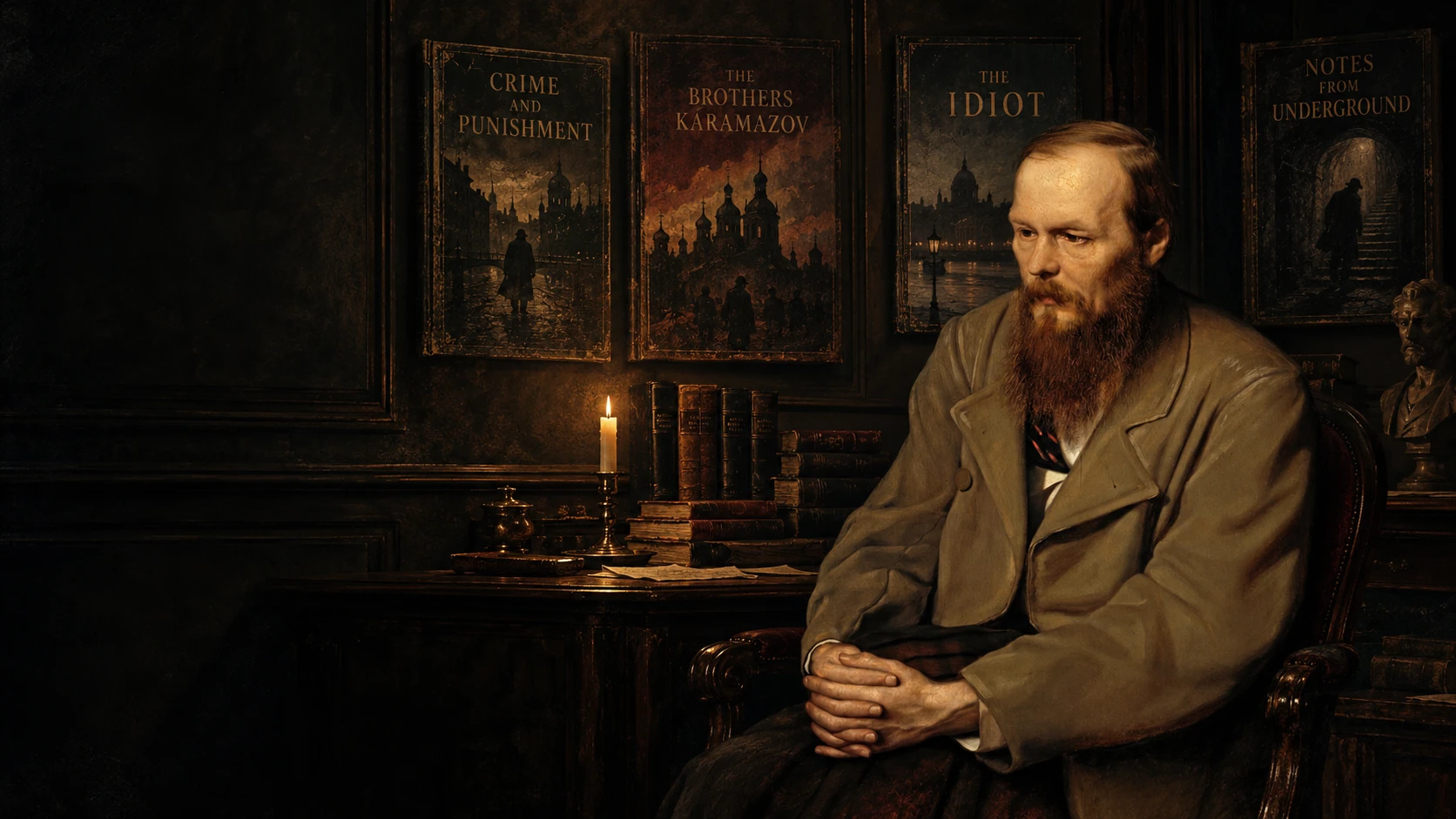
Artistic reconstruction supplied for PRESDA. The portrait, study and book-cover designs are editorial illustrations, not an archival scene or authentic historical editions. Full image composition preserved.
On 22 December 1849, by the Julian calendar then used in Russia, Fyodor Dostoevsky stood on Semyonovsky Square in St Petersburg under a sentence of death. The execution would not take place. Nicholas I had already commuted the punishment, but the reprieve was to be announced only when preparations appeared complete. The state had arranged for condemned men to believe that their lives were ending. Dostoevsky was twenty-eight. Dostoevsky Museum: chronology
It is tempting to make everything that followed unfold from that morning: the murderers, the confessions, the arguments with God. Yet an extraordinary event is not a complete explanation of a writer. Dostoevsky’s imagination also grew from books, family relationships, imprisonment, illness, deadlines and the ordinary humiliations of needing money. His achievement was to make ideas feel as consequential as actions. In his novels, a theory can enter a room with the force of a weapon.
Fyodor Dostoevsky, born in Moscow in 1821 and dead in St Petersburg in 1881, became one of literature’s most searching interpreters of guilt, freedom and self-deception. His five great works considered here are not interchangeable journeys into misery. Each stages a different experiment: a crime justified by an idea, goodness exposed to cruelty, a mind resisting reason, politics becoming possession, and a family turning into a tribunal on faith. What follows includes discussion of their plots and endings.
A childhood beside a hospital
Dostoevsky’s father was a doctor at Moscow’s Mariinsky Hospital for the Poor. The family’s setting brought professional respectability close to material hardship, although it would be too neat to derive every later fictional sufferer from a childhood encounter. His mother died in 1837. He subsequently trained at the military engineering school in St Petersburg, served briefly as an engineer and left the service in 1844 to pursue literature. Dostoevsky Literary Memorial Museum, Semey: biography
His debut, Poor Folk, appeared in 1846 and attracted enthusiastic support from the critic Vissarion Belinsky. Written as an exchange of letters, it gave narrative space to people whose social importance seemed negligible. The concern would survive the changes in Dostoevsky’s politics: what does it feel like to be seen as someone who does not count? Literary recognition arrived early. A secure livelihood did not automatically follow it.
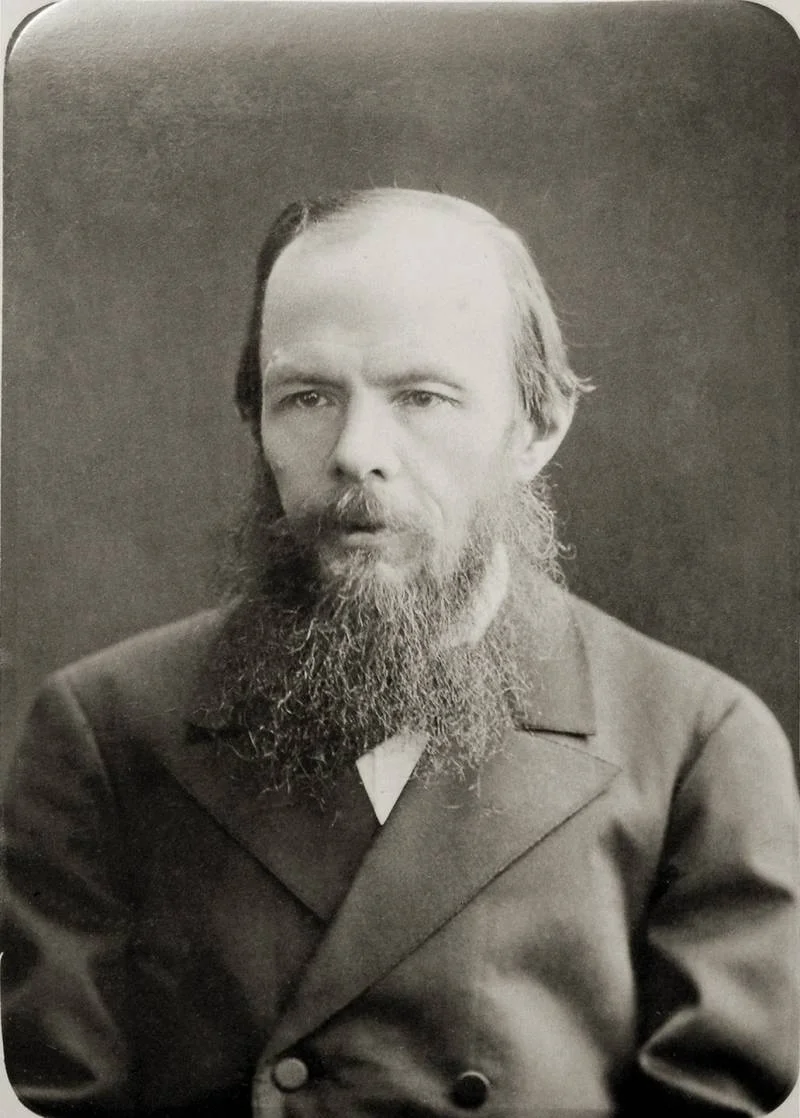
Dostoevsky photographed by Constantin Shapiro in 1879. Authentic studio photograph, not the reconstructed scene used in the hero.
Constantin Shapiro, 1879 / Wikimedia Commons
Public domain. Resized and converted to WebP by PRESDA. Full composition preserved. Reuse follows the individual license stated here.
Arrest, the scaffold and Siberia
He attended the Petrashevsky circle, where participants discussed social reform and forbidden ideas. Arrested in 1849, he was imprisoned in the Peter and Paul Fortress. The proceedings included his involvement with Belinsky’s prohibited letter to Gogol, a text attacking religious and political reaction. The mock execution was not a narrow escape caused by an unexpected change of heart on the square. Its terror depended on concealing an already decided commutation.
From 1850 to 1854 he endured penal labor in Omsk, followed by military service in Semipalatinsk, now Semey in Kazakhstan. His return to civilian and literary life was gradual. Siberia did not simply pause an established career; it broke its continuity and placed him among men whom educated society usually discussed from a distance.
The House of the Dead transformed prison experience into literature through a fictional narrative framework. Its crowded barracks, punishments, petty economies and complicated relationships refuse the comfort of treating prisoners as a single moral species. Cruelty exists beside ingenuity, pride beside vulnerability. The narrator encounters people whose crimes do not tell him everything about them. Reading the book as a shaped work, rather than an unedited prison diary, matters to understanding its achievement. The House of the Dead: primary text
That attention to people who resist classification runs through the later novels. Legal guilt can be clear while motive remains tangled. A respectable explanation can conceal vanity. A person capable of harm can also be capable of tenderness. These are not excuses for violence; they are challenges to the fantasy that naming an offense finishes the work of understanding a human being.
Epilepsy, money and the labor of writing
Dostoevsky lived with epilepsy, and seizures recur in his fiction. Modern neurologists have proposed different retrospective classifications using correspondence, recollections and literary descriptions. Those materials cannot provide the equivalent of a modern clinical examination. A 2013 review by neurologist Ivan Iniesta considers both the illness and its literary transformation; other studies disagree about its precise origin and type. The responsible conclusion is that epilepsy shaped his experience, not that a particular brain mechanism explains his genius. Progress in Brain Research: epilepsy in Dostoevsky
His financial difficulties were similarly concrete. The deaths of his first wife, Maria, and his brother Mikhail in 1864 were followed by responsibilities and debts. Publishing ventures and creditors added pressure. Roulette losses made an unstable position worse. Gambling was not a colorful accessory to creativity: it could consume money that a household needed and repeatedly turn hope into another emergency. Research on his gambling reconstructs this pattern, while proposed neurological explanations remain hypotheses. Research review: gambling and epilepsy
In 1866, with a punishing publishing deadline approaching, the stenographer Anna Snitkina helped him complete The Gambler. They married the following year. Her contribution was professional as well as personal: transcription, organization, publishing work and, later, preservation of his archive. The museum’s exhibition about Anna and Fyodor draws on her diary, memoirs and their correspondence. A story that calls her merely the suffering wife misses much of the work that helped make the books possible. Dostoevsky Museum: Fyodor and Anna
The manuscript was therefore not produced by a disembodied intellect. It belonged to a world of advances, contracts, childcare, illness and assistance. That material history changes the familiar image of the solitary genius. It does not diminish the work; it restores the people and labor around it. Anna’s own achievements have become a substantial subject of scholarship, including Andrew D. Kaufman’s biography, The Gambler Wife. University of Virginia: Anna Dostoyevskaya
Notes from Underground: freedom against the formula
Published in 1864, Notes from Underground introduces an unnamed narrator who cannot leave his own explanations alone. He argues, retracts, anticipates objections and turns apparent honesty into another defense. His target is the belief that human behavior can be organized around rational advantage. If a system claims to know what is best for him, he may choose injury simply to prove that the choice remains his. Notes from Underground: primary text
This is not an uncomplicated celebration of independence. The narrator’s insistence on freedom repeatedly becomes cruelty and humiliation, including in his treatment of Liza. He can expose the limitations of a theory without becoming a trustworthy guide to living. Washington State University’s study guide stresses the essential distinction between Dostoevsky and his Underground Man. A character who speaks intensely is not automatically the author’s authorized spokesman. Washington State University: reading the Underground Man
The unsettling modernity lies in the rhythm of self-justification. Intelligence does not cure resentment; it supplies resentment with better arguments. The reader is placed inside a mind that recognizes its own evasions and continues evading. Self-awareness, the novella suggests, is not the same achievement as change.
Crime and Punishment: the theory and the person it kills
In Crime and Punishment, serialized in 1866, the impoverished former student Raskolnikov murders a pawnbroker and her sister. He tries to imagine himself among exceptional people entitled to cross ordinary moral boundaries. Poverty is part of his situation, but the novel does not reduce the crime to an empty wallet. Pride, isolation and the wish to test an idea are implicated too. Crime and Punishment: primary text
The central suspense is less about discovering the killer than watching him fail to live with what he has done. Conversations become interrogations even before the law catches up. Sonya offers a relationship that his theory cannot contain, while Porfiry’s questioning makes his own explanations unstable. The novel separates the wish to appear extraordinary from the capacity to bear responsibility. Its ending opens the possibility of renewal without pretending that confession instantly completes an inner transformation.
A distinctive moral pressure comes from the collision between abstraction and presence. Raskolnikov can arrange people into categories in thought; actual lives refuse to remain categories. The reader is asked not only whether his reasoning is valid, but what happens when reasoning is used to make another person disposable. That question travels well beyond the nineteenth-century city in which the novel is set.
The Idiot: can goodness survive society?
The Idiot, published in 1868–1869, reverses the experiment. Prince Myshkin returns to Russia after treatment abroad. His candor and compassion expose the calculations of the society around him, yet he is not protected by his goodness. Nastasya Filippovna and Rogozhin draw him into a world of possession, shame and destructive passion. His epilepsy also makes bodily vulnerability central to the story. The Idiot: primary text
Myshkin’s accounts of execution bring the question of time close to the author’s own biography. But the novel is more than experience disguised as plot. It asks whether pity can become confused with love, whether helping someone can fail to recognize what that person needs, and whether innocence has the resources to oppose violence. Compassion matters profoundly; it is not a magical instrument that reliably repairs a damaged world.
The title captures a social judgment rather than a clinical diagnosis. A person who will not compete according to ordinary rules may be called foolish by people whose cleverness is morally compromised. Yet Dostoevsky does not turn this opposition into an easy victory for innocence. The catastrophe leaves the reader with the difficulty of doing good, not a reassuring certificate of its inevitable success.
Demons: when ideas become instruments of power
Demons, serialized in 1871–1872 and also translated as The Devils or The Possessed, moves from private torment into political conspiracy. Pyotr Verkhovensky manipulates a revolutionary circle, while Stavrogin becomes a troubling center of fascination. The novel examines how vanity, secrecy, fear and the need to belong can make people available to a project of coercion. Ideas matter, but so do the appetites of those claiming to serve them. Demons: primary text
Its satire is sharpest when lofty language conceals mundane domination. A movement may promise liberation while making obedience its immediate demand. Reading that mechanism today does not require treating the novel as a prediction of every later dictatorship, or assuming that all movements for reform share the same destiny. Dostoevsky’s political judgments were situated and partisan. The fiction’s continuing power lies partly in its account of how public principle can be appropriated for private control.
The surviving manuscript pages also complicate the image of effortless prophecy. Drafting, revision and drawing are visible on the paper. These were made works, not visions delivered intact. Their arguments gained force through artistic decisions: who speaks, who interrupts, which motives remain concealed and when the reader discovers them.
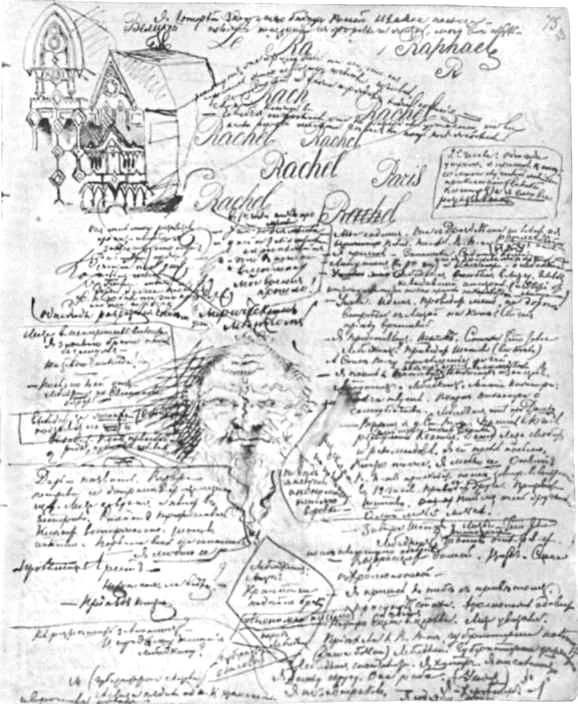
A manuscript page associated with Demons, 1870–1871, with handwriting and drawings by Dostoevsky. The archive’s modern upload date is not the date of the manuscript.
Fyodor Dostoevsky, 1870–1871 / Wikimedia Commons
Public domain. Resized and converted to WebP by PRESDA. Full composition preserved. Reuse follows the individual license stated here.
The Brothers Karamazov: a family argues with God
The Brothers Karamazov, serialized in 1879–1880, combines a father’s murder with questions no courtroom can settle. Dmitri, Ivan and Alyosha embody different pressures of appetite, intellect and faith, without remaining simple allegorical labels. Smerdyakov complicates the distribution of responsibility still further. The book distinguishes committing an act from encouraging, wishing for or intellectually preparing the world in which it becomes possible. The Brothers Karamazov: primary text
Ivan’s protest against the suffering of children gives doubt tremendous moral force. In his Grand Inquisitor story, freedom itself becomes the disputed burden: would people exchange it for security and authority? Alyosha and the elder Zosima offer another emphasis, responsibility to others and active love. The novel does not conduct this argument as a tidy debate followed by the author’s answer sheet. Its ideas are tested through attachment, loss, action and failure.
Here the difficulty of Dostoevsky’s faith becomes especially clear. To say that he was a Christian writer does not mean his unbelievers receive weak arguments. A belief that cannot hear the accusation against it would be dramatically uninteresting. His fiction lets the accusation speak, then asks what forms of life might answer it. That is different from proving that every instance of suffering serves a beneficial purpose.
Faith without an uncomplicated saint
Religious conviction, guilt and the possibility of renewal run through these works. Suffering can break a character’s self-sufficiency, but it can also brutalize, isolate or destroy. Treating pain as an automatic route to wisdom would misread their variety. Their moral imagination returns to relationship: the limits of pride, the difficulty of accepting help and the obligation to see another person as more than an obstacle or instrument.
An honest portrait must also acknowledge the limits of the author’s sympathy. His journalism contains Russian nationalist and anti-Jewish arguments. Scholarship on the 1877 Jewish Question essay examines the disturbing coexistence of calls for rights with hostile generalizations about Jews. Literary greatness does not neutralize those prejudices. Keeping them visible prevents admiration from becoming exemption from criticism. Cambridge: Dostoevsky, Jews and national identity
Literature, psychology and the existential inheritance
Dostoevsky’s influence reaches beyond subjects into narrative form. His characters argue as if their explanations are essential to their survival. Mikhail Bakhtin’s influential account of polyphony describes the importance of distinct, interacting voices in these novels. Later scholarship also asks where dialogue breaks down into domination or violence. The useful insight is that a novel can stage competing consciousnesses without reducing every voice to an illustration of one proposition. Cambridge scholarship: Dostoevsky and Bakhtin
Nietzsche explicitly praised Dostoevsky’s psychological insight in Twilight of the Idols. That admiration did not make them philosophical allies on every question, especially Christianity. The connection is most illuminating as an encounter between different thinkers interested in motive, moral judgment and self-deception. PRESDA’s discussion of Nietzsche, solitude and intellectual independence offers a related path into those questions. Nietzsche: Twilight of the Idols
Dostoevsky also belongs to the literary background of existential thought. The Stanford Encyclopedia of Philosophy places his fiction within its exploration of freedom, anxiety and responsibility. Calling him a precursor is more accurate than enrolling him in a twentieth-century school he never joined. His characters make freedom difficult: choice can be destructive, and the desire to escape responsibility can be as powerful as the desire to claim it. Stanford Encyclopedia of Philosophy: existentialism
His psychological importance is similarly literary before it is clinical. A novelist can reveal persuasive patterns of shame, ambivalence or rationalization without establishing an experimentally tested theory of the mind. Readers recognize themselves in a character; that recognition is an experience, not a diagnosis. His work remains valuable precisely because it gives contradictory motives time and language, rather than resolving them into a label.
The life ends; the questions do not
Dostoevsky died on 9 February 1881 in the Gregorian calendar, 28 January in the Russian calendar of his time. The later novels had brought him a public standing far removed from his years as a convict. But the familiar portrait of the bearded writer should not turn that life into an inevitable ascent. Survival, collaboration and work remained part of the story, alongside suffering.
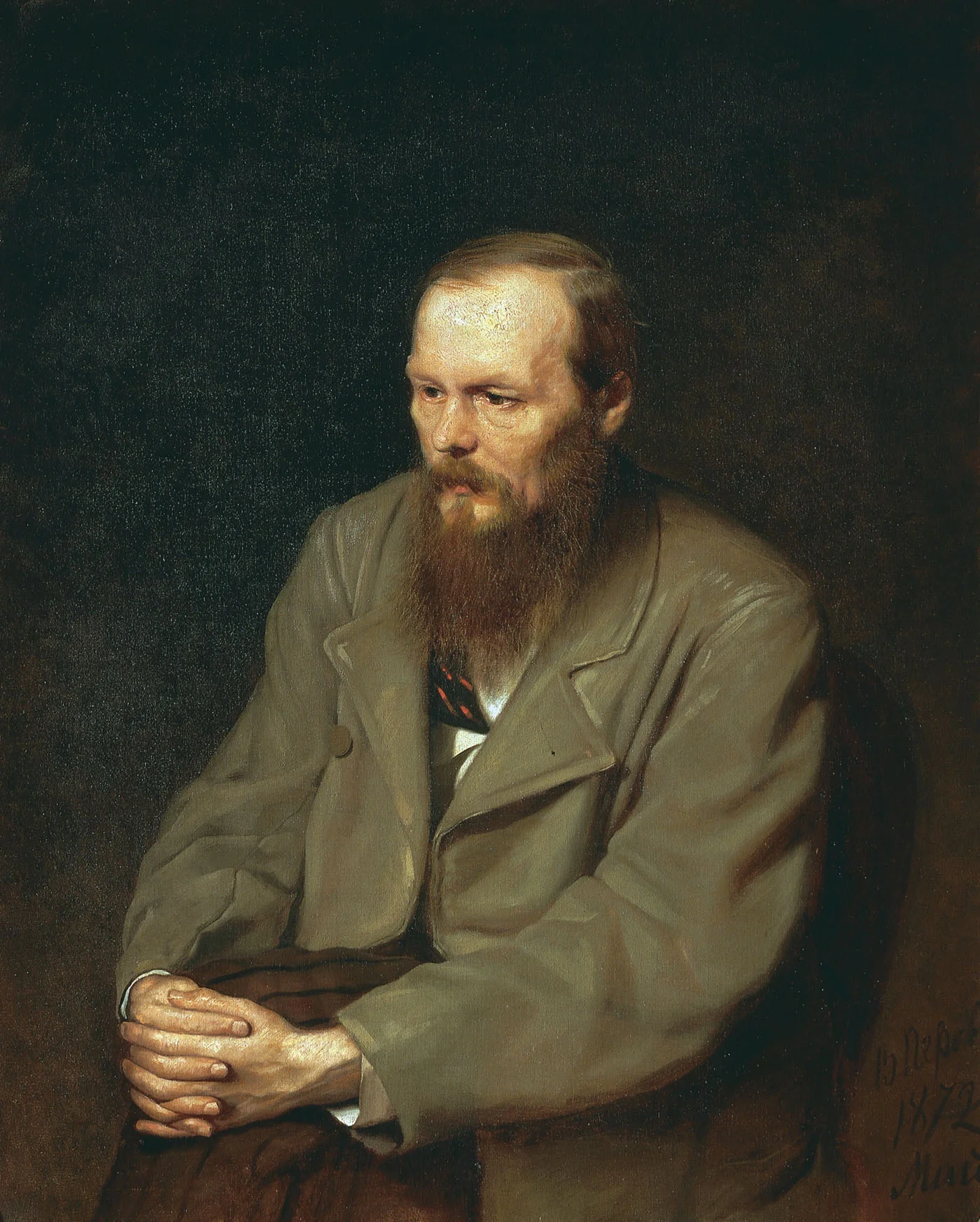
Vasily Perov’s Portrait of Fyodor Dostoevsky, 1872, State Tretyakov Gallery. Reproduction of an authentic historical painting, not a photograph or a newly generated portrait.
Vasily Perov, 1872 / State Tretyakov Gallery / Wikimedia Commons
Public domain. Resized and converted to WebP by PRESDA. Full composition preserved. Reuse follows the individual license stated here.
The approved opening artwork imagines a candlelit study and literary cover designs. It is an artistic reconstruction, not evidence of the author’s room or historical editions. The supporting portrait photograph, Perov painting and manuscript reproduction are separately identified archival materials. That distinction belongs to the larger question of photography and visual authenticity: an image can illuminate a story without documenting the scene it depicts.
What makes Dostoevsky endure is not that he discovered a single hidden truth about human darkness. It is that he refused to let one explanation finish a person. We can defend freedom while fearing it, desire love while punishing those who offer it, and mistake a sophisticated excuse for an honest account. His novels make those contradictions audible. They leave us with a demanding possibility: understanding ourselves may begin when we stop insisting that we are already understood.
FAQ
Frequently Asked Questions
What is this PRESDA article about?
From a mock execution and Siberian prison to five major novels: explore Dostoevsky’s life, guilt, freedom, faith and influence on modern thought.
Which category does this story belong to?
This story is part of PRESDA's Lifestyle coverage.
Who published this article?
DOSTOEVSKY: THE MAN WHO FACED DEATH AND EXPLORED HUMAN DARKNESS was published by PRESDA Editorial on PRESDA.
PRESDA Dispatch
Stay Informed. Stay Aware.
A sharp briefing across AI, gaming, sport, business, world affairs, paparazzi, and lifestyle.