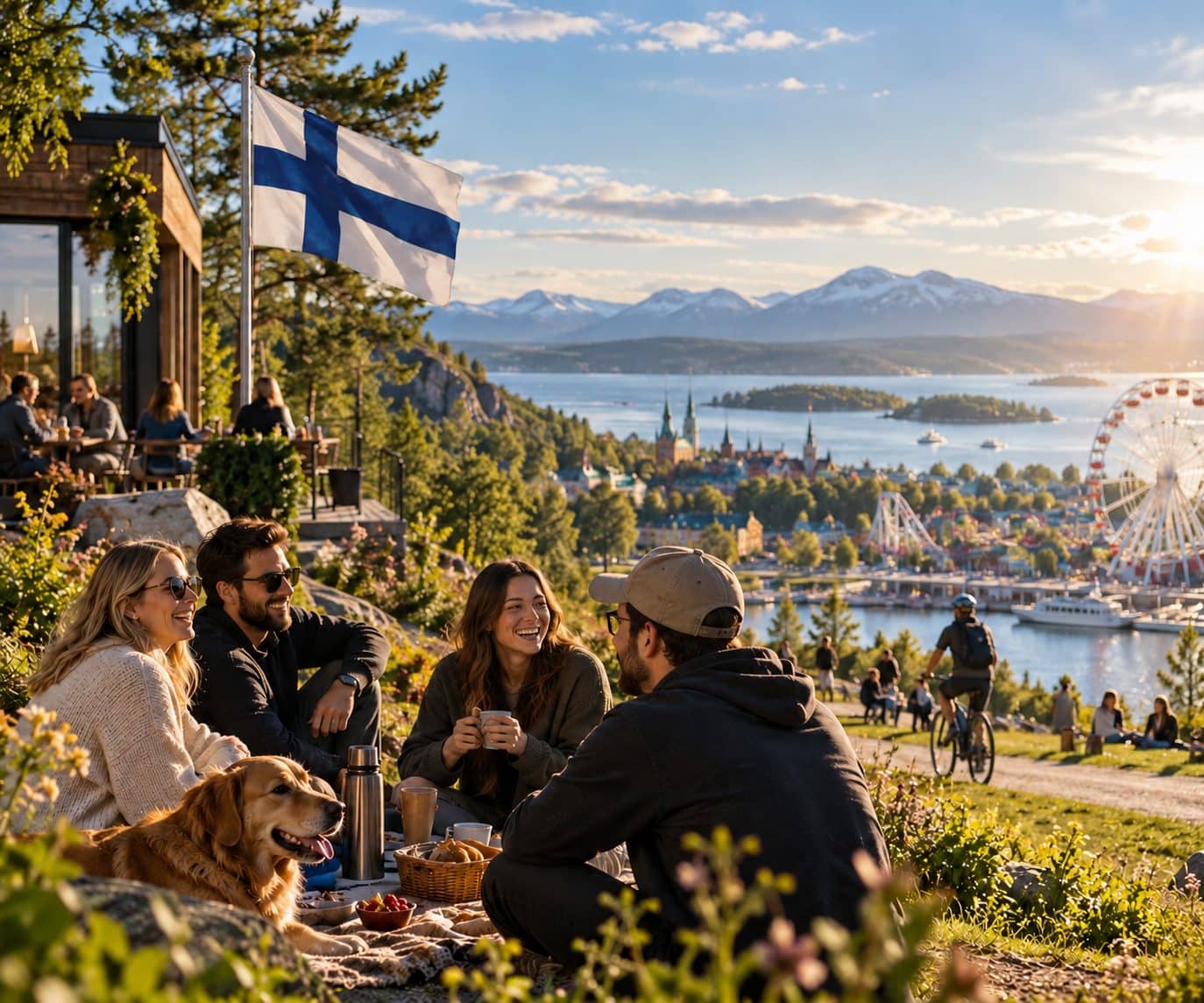
THE HAPPIEST COUNTRIES IN THE WORLD - AND WHY THEY KEEP WINNING
Finland is No. 1 for the ninth year in a row. But the world's happiest countries reveal something deeper: happiness is not simply about wealth - trust, social support, health, freedom and everyday quality of life matter too.
Finland is the happiest country in the world again.
According to the World Happiness Report 2026, Finland ranks No. 1 for the ninth consecutive year with a life-evaluation score of 7.764.
That does not mean Finns walk around smiling every minute of every day.
The ranking is not a measurement of constant joy.
It measures how people evaluate their lives as a whole.
That distinction matters because the world's happiest countries reveal something deeper than mood.
They point toward trust, social support, health, freedom, security and everyday quality of life.
A country can be wealthy and still struggle with loneliness, weak institutions or public dissatisfaction.
A country can be cold, quiet or emotionally reserved and still score highly when people feel their lives are broadly working.
So the real question is not simply which country won.
It is why the same countries keep appearing near the top. For more PRESDA explainers on life, society and wellbeing, read why people trust AI like a friend and anti-aging and human longevity science.
THE WORLD'S HAPPIEST COUNTRY
Finland's 2026 score is 7.764, placing it first in the World Happiness Report ranking.
This is Finland's ninth consecutive year at No. 1.
The result has become familiar enough that it can sound almost automatic.
But the report is not saying Finland is perfect.
It is not saying every Finnish person is happier than every person elsewhere.
It is saying that, on average, people surveyed in Finland gave higher overall life evaluations than respondents in other countries over the measured period.
The ranking uses Gallup World Poll responses averaged across 2023, 2024 and 2025.
That three-year average helps reduce the noise of one unusually good or bad survey year.
Finland's repeated success raises the central question of the article: why do some societies make ordinary life feel more secure, more trusted and more manageable?
THE TOP 10 HAPPIEST COUNTRIES IN 2026
The official World Happiness Report 2026 top 10 is clear.
1. Finland - 7.764.
2. Iceland - 7.540.
3. Denmark - 7.539.
4. Costa Rica - 7.439.
5. Sweden - 7.255.
6. Norway - 7.242.
7. Netherlands - 7.223.
8. Israel - 7.187.
9. Luxembourg - 7.063.
10. Switzerland - 7.018.
These scores are life-evaluation averages, not emotional happiness scores from a single day.
They should also be read carefully because close rankings can have overlapping confidence ranges.
In 2026, Iceland, Denmark and Costa Rica sit very close together.
The table-like ranking is useful, but it should not be treated as a perfect league table of human wellbeing.
HOW DO YOU MEASURE HAPPINESS?
The World Happiness Report uses life evaluations from the Gallup World Poll.
The central measure is the Cantril Ladder.
Respondents are asked to imagine a ladder from 0 to 10.
Zero represents the worst possible life for them.
Ten represents the best possible life for them.
They then evaluate where they stand now.
This is why the ranking is better understood as life satisfaction or life evaluation rather than simple cheerfulness.
The report uses three-year averages for the main ranking.
According to the report methodology, roughly 1,000 responses are typically gathered annually per country and weighted to create representative national averages.
Researchers then use several explanatory factors to help understand why life evaluations differ between countries.
Those factors include GDP per capita, social support, healthy life expectancy, freedom to make life choices, generosity and perceptions of corruption.
Important: the ranking itself is not calculated by adding those six factors together.
The ranking comes from people's own life evaluations.
The six factors help explain patterns in those evaluations.
WHY FINLAND KEEPS WINNING
Finland's success is often explained with stereotypes: saunas, forests, quiet people, winter resilience and coffee.
Some of those details may be culturally recognizable.
They are not, by themselves, a scientific explanation.
The more useful picture is broader.
Finland performs strongly on social trust, institutional reliability, social support, freedom, public services, health and relatively low perceived corruption.
Those conditions do not guarantee happiness for every individual.
They may, however, make daily life feel less fragile.
If a person becomes ill, loses work, needs education, relies on public systems or faces uncertainty, the surrounding social environment matters.
The World Happiness Report identifies statistical relationships between these explanatory factors and national life evaluations.
It does not prove that one single factor causes Finland's ranking.
Finland keeps winning because several pieces appear to work together: material security, trust, autonomy, institutions and social support.
THE NORDIC PATTERN
Finland is not alone.
In 2026, Finland, Iceland, Denmark, Sweden and Norway occupy five of the first six positions.
That Nordic pattern has become one of the most recognizable features of the World Happiness Report.
The explanation is not simply high taxes.
Nor is it just national wealth.
Nordic countries tend to combine prosperity with relatively strong public institutions, social safety nets, personal freedom, high social trust and a sense that people have someone to count on.
Those conditions can influence how people experience risk.
Economic anxiety, illness, family pressure and job insecurity feel different when people believe systems and communities will not abandon them completely.
The Nordic model is not identical across all countries.
But the repeated high rankings suggest that wealth becomes more powerful for wellbeing when it is paired with trust and social security.
COSTA RICA CHANGES THE STORY
Costa Rica is one of the most important stories in the 2026 ranking.
It ranks fourth, with a life-evaluation score of 7.439.
The World Happiness Report describes this as Costa Rica's highest position and the highest ranking achieved by a Latin American country in the report.
That matters because it challenges a lazy assumption: that the happiest countries must simply be the richest northern economies.
Costa Rica is not a Nordic welfare state.
Its position points toward the importance of social connection, life evaluation and quality of life factors that cannot be reduced to GDP alone.
This does not mean money is irrelevant.
It means money is not the whole story.
Costa Rica's rise makes the ranking more interesting because it forces a wider question: what social conditions help people feel that life is going well, even outside the richest economies?
DOES MONEY BUY HAPPINESS?
Money matters.
Economic security matters enormously, especially when basic needs are uncertain.
A society where people cannot reliably afford food, housing, health care, education or safety will usually face major wellbeing challenges.
But national wealth alone does not determine the happiest countries in the world.
GDP per capita is one explanatory factor used by researchers.
It is not the ranking itself.
A wealthy society can still struggle with loneliness, polarization, weak trust, poor health outcomes or a feeling that life is becoming harder to manage.
That is why happiness and wealth have a complicated relationship.
Money can reduce hardship.
It can expand choice.
It can fund public services and private security.
But if people do not trust each other, lack support, feel unsafe or believe institutions are failing, wealth may not translate cleanly into higher life evaluations.
TRUST: THE INVISIBLE INGREDIENT
Trust is hard to photograph but easy to feel when it disappears.
Do people believe they can rely on others?
Do they believe public institutions are broadly competent and fair?
Do they feel they have someone to call in a crisis?
Social support is one of the major explanatory factors used in the World Happiness Report.
It matters because crises are rarely experienced in isolation.
Unemployment, illness, family stress, financial trouble and uncertainty all become less frightening when a person has reliable support.
Trust also reduces everyday friction.
If people expect corruption, dishonesty or abandonment, ordinary life requires more emotional energy.
A high-trust society may not feel dramatic.
That may be precisely the point.
It can make life feel more stable.
HEALTH, FREEDOM AND CONTROL OVER LIFE
Healthy life expectancy is another explanatory factor in the report.
The issue is not only how long people live.
It is whether they can expect more years of life with functional health.
Health affects work, family, independence, mobility and dignity.
Freedom to make life choices also matters.
People generally evaluate life differently when they feel trapped compared with when they feel they have agency.
Autonomy is not the same as unlimited choice.
It means people feel they can make meaningful decisions about their own lives.
The report treats freedom as one explanatory factor, not a magic answer.
But together with health and support, it helps explain why life satisfaction depends on more than income.
WHY SOME RICH WESTERN COUNTRIES ARE FALLING
The 2026 report includes a striking pattern among English-speaking countries.
New Zealand ranks No. 11.
Ireland ranks No. 13.
Australia ranks No. 15.
The United States ranks No. 23.
Canada ranks No. 25.
The United Kingdom ranks No. 29.
The report notes that this is the second consecutive year with no English-speaking country in the global top 10.
That does not produce one simple political explanation.
The pattern reflects broader pressures in life evaluations across several Western industrial societies.
Housing costs, loneliness, mental-health pressures, institutional trust, inequality, social connection and generational stress may all be part of the conversation.
But PRESDA does not treat any one factor as proven to explain the whole decline.
The ranking is a warning sign, not a complete diagnosis.
THE YOUNG HAPPINESS PROBLEM
The 2026 World Happiness Report pays close attention to young people's wellbeing.
It reports large declines among young people in countries including the United States, Canada, Australia and New Zealand compared with the 2006-2010 period.
Social media is part of the discussion, but it should be handled carefully.
The report presents a complex evidence base.
Some research finds associations between certain forms of social media use and lower wellbeing.
But effects vary by platform, type of use, age, context and methodology.
It would be too simple to write that social media causes unhappiness as a universal fact.
The report also highlights an interesting distinction: platforms or uses designed around social connection can show different relationships with wellbeing than algorithmically curated content platforms.
That matters because the issue is not merely screen time.
It is what people are doing, what platforms reward and how online life affects sleep, comparison, attention, friendship and self-image.
HAPPINESS IS NOT THE SAME AS BEING HAPPY ALL THE TIME
The word happiness can be misleading.
A person can be stressed on Monday and still believe their life, taken as a whole, is good.
A person can experience sadness, grief, frustration or a long winter and still report a high life evaluation.
The World Happiness Report distinguishes overall life evaluation from momentary emotion.
Positive affect matters.
Negative affect matters.
But the headline ranking is about how people judge their lives overall.
This is essential to understanding Finland.
Finland's No. 1 ranking does not mean constant cheerfulness.
It means respondents, on average, rate their lives highly on the Cantril Ladder.
WHAT THE HAPPIEST COUNTRIES HAVE IN COMMON
The strongest societies in the ranking tend to combine several conditions.
Material security.
Health.
People to rely on.
Freedom.
Trust.
Functional institutions.
Social connection.
These are not a universal mathematical formula.
Culture, history, geography, inequality, politics and personal circumstances all matter.
But the happiest countries in the world suggest that wellbeing is more durable when people feel both materially secure and socially supported.
A society can build roads, offices and skyscrapers while still failing to build trust.
The World Happiness Report keeps reminding readers that quality of life is not only infrastructure.
It is also relationship, confidence and dignity.
THE BIGGER LESSON
The lesson of the happiness rankings is not that everyone should move to Finland.
Nor is it that governments can manufacture happiness.
The deeper lesson is that quality of life depends on more than economic output.
A society may become richer without necessarily becoming more satisfying to live in.
The countries near the top suggest that what happens between people, trust, support, freedom and security, can matter alongside what appears in economic statistics.
Perhaps the world's happiest countries are not places where people feel joy every moment.
They may simply be places where more people believe that life, taken as a whole, is working.
FAQ
Frequently Asked Questions
What is the happiest country in the world in 2026?
Finland ranks No. 1 in the World Happiness Report 2026 with a life-evaluation score of 7.764, its ninth consecutive year at the top.
How is the World Happiness Report ranking calculated?
The main ranking uses Gallup World Poll life evaluations based on the Cantril Ladder, averaged across 2023-2025 for the 2026 report.
Does the ranking measure whether people smile all day?
No. It measures overall life evaluation, not constant positive emotion. People can experience stress or sadness while still judging their lives positively.
Why does Finland keep ranking first?
Finland's high ranking is associated with strong social support, trust, reliable institutions, freedom, health, public services and relatively low perceived corruption. No single factor explains the full result.
Why is Costa Rica important in the 2026 ranking?
Costa Rica ranks No. 4 in 2026, its highest-ever position and the highest ranking achieved by a Latin American country in the report.
Does money buy happiness?
Income and economic security matter, especially when basic needs are insecure. But national wealth alone does not determine happiness rankings; trust, support, health and freedom also help explain life evaluations.
Are young people becoming less happy?
The 2026 report highlights large declines in young people's wellbeing in several English-speaking countries compared with 2006-2010, while noting that social media evidence is complex and varies by use, platform and context.
PRESDA Dispatch
Stay Informed. Stay Aware.
A sharp briefing across AI, gaming, sport, business, world affairs, paparazzi, and lifestyle.