Kintsugi: Japan's Art of Repairing Broken Things
Discover how kintsugi repairs ceramics with lacquer and gold, its tea-culture history, the legends behind it and why traditional craft differs from quick repair kits.
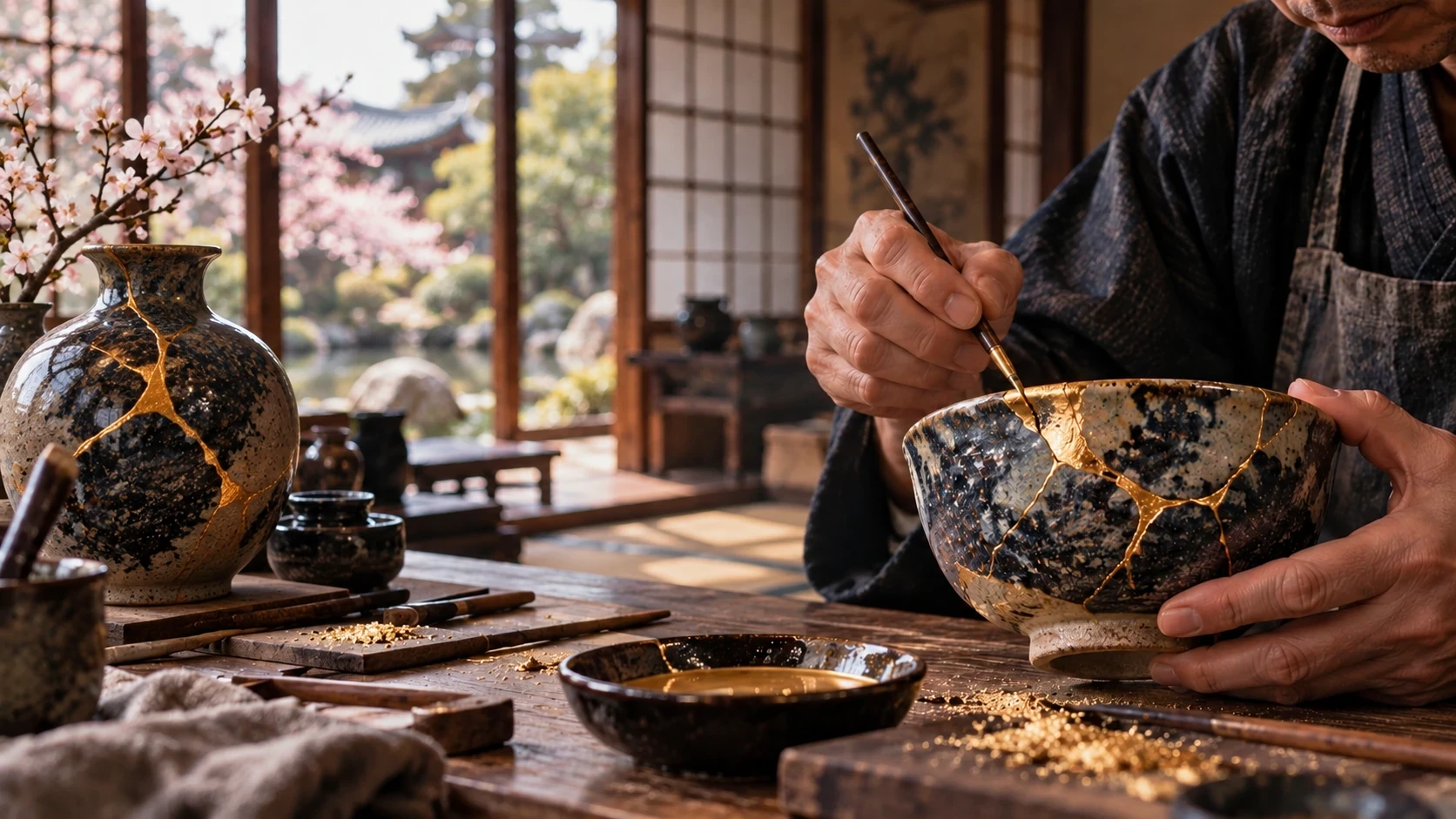
PRESDA · AI-generated editorial illustration of an imagined artisan and workshop; not a documented restoration or named craftsperson.
A repaired bowl can hide its break, or make the break part of what the eye follows. Kintsugi takes the second approach. A fine seam crosses the glaze, interrupts an old pattern and records the point at which someone decided that an object was worth keeping. The result is beautiful, but its foundation is skilled repair rather than decoration alone.
Kintsugi is a Japanese ceramic-repair technique using urushi lacquer, finished with powdered gold. The lacquer joins and supports the fragments; gold makes the repair visible. It is therefore misleading to describe the method simply as gluing pottery with molten gold. Smithsonian's account places the technique within a much older practice of using plant-resin lacquer as an adhesive. Smithsonian: Golden Seams
What does kintsugi mean?
The term is commonly translated as “joining with gold.” Related repairs can use silver, lacquer without metal, or replacement fragments from another ceramic object. The visible seam is one possibility within a broader vocabulary of repair, not a rule requiring every crack to become a bright gold line. Japan House London: kintsugi
That distinction changes how a repaired object is judged. The important questions include how the fragments meet, whether missing material is supported and how the new work relates to the original vessel. A shiny line by itself says little about the repair's quality, materials or suitability for use.
A history connected to tea, with an uncertain beginning
Kintsugi is associated with Japan's tea culture and the continued appreciation of valued bowls after damage. Japan House places its emergence in the Muromachi period, 1336–1573, while noting that the exact origins are unknown. Smithsonian curator Louise Allison Cort's account likewise describes uncertainty about the beginning of golden repairs. A tradition can be centuries old without having a reliably documented inventor. Smithsonian Research: Golden Seams
The shogun story is a legend, not a founding certificate
A familiar tale credits shogun Ashikaga Yoshimasa with inspiring a new repair method after disliking the metal staples used to mend a bowl sent to China. Japan House explicitly treats this as a later anecdote. It conveys a contrast between visible forms of repair, but should not be presented as a verified account of a particular workshop inventing kintsugi on a known day.
The larger historical point is more durable than the legend. A repaired vessel could continue to be appreciated, and the intervention could become part of that appreciation. The object did not have to pretend that nothing had happened to it. That is a change in how a repair is seen, rather than a claim that every repaired bowl automatically gains financial value.
What the craft actually involves
Traditional work proceeds through joining, filling, curing, smoothing and finishing. The fragments must first make structural sense together. Missing areas require attention before a surface can become continuous enough to finish. Gold is a late, visible stage in a longer process; it cannot compensate for a poorly fitted joint beneath it.
Urushi is a material, not just a colour
The Japan Kogei Association describes urushi as sap collected from the lacquer tree and processed for different layers and decorative work. Its hardening depends on suitable conditions, including temperature and humidity. The association gives approximately 25°C and 70 percent relative humidity as typical conditions. This is why a traditional repair involves controlled curing rather than simply leaving ordinary glue to dry on a desk. Japan Kogei Association: urushi work
Why a short workshop is not the whole process
Japan House's introductory workshop openly uses shortcuts so participants can complete an object within a short session; it also specifies powdered brass for that offering. That transparency is useful. A class can introduce principles without reproducing every stage, material or timescale of a traditional commission. Ask what you will actually use, what remains to cure afterwards and what the finished object is intended for. Japan House: introductory workshop
Modern kits and the questions worth asking
Products sold as kintsugi kits are not all equivalent. The V&A shop, for example, lists a modern repair kit with adhesive and a gold-coloured mixture. Its existence illustrates the difference between a contemporary activity inspired by the appearance of kintsugi and a commission specified in traditional lacquer and precious-metal powder. Neither label tells the full story without a materials list. V&A: repair kit
Before using a repaired piece for food or drink, obtain explicit guidance for the complete repair system and intended use. Do not infer suitability from a gold colour, the word natural or the appearance of a cured surface. Follow the maker's instructions on heat, washing and curing. Uncured urushi can cause allergic skin reactions, as V&A conservation guidance notes, so beginners should learn material handling from a qualified instructor rather than improvise from a photograph. V&A Conservation Journal
Beyond the slogan about beautiful imperfections
Kintsugi is often discussed alongside wabi-sabi and as a metaphor for resilience. Those interpretations can be meaningful without reducing a varied Japanese craft tradition to one national philosophy or presenting ceramic repair as a proven psychological treatment. A repaired bowl is an object with a material history; any personal analogy belongs to the person making it.
Is every broken object a candidate?
Not necessarily. Its condition, intended use, historical significance and the reversibility of an intervention all deserve consideration. For an antique or irreplaceable object, consult a conservator before applying a kit. Keep fragments safely, document what broke and discuss whether repair, stabilization or display is the appropriate goal. Breaking an intact piece merely to create golden seams is unnecessary to appreciate the craft.
Kintsugi's most useful lesson may be practical: keeping something can demand time, expertise and a clear account of what has changed. The seam makes care visible. That attention to maintained beauty also runs through Chefchaouen's living streets, where a striking appearance is renewed through work rather than preserved by photographs alone.
FAQ
Frequently Asked Questions
What is this PRESDA article about?
Discover how kintsugi repairs ceramics with lacquer and gold, its tea-culture history, the legends behind it and why traditional craft differs from quick repair kits.
Which category does this story belong to?
This story is part of PRESDA's Lifestyle coverage.
Who published this article?
Kintsugi: Japan's Art of Repairing Broken Things was published by PRESDA Editorial on PRESDA.
PRESDA Dispatch
Stay Informed. Stay Aware.
A sharp briefing across AI, gaming, sport, business, world affairs, paparazzi, and lifestyle.