PERFUME: HOW SCENT BECAME A SYMBOL OF BEAUTY, POWER AND LUXURY
From ancient rituals and royal courts to Grasse, modern chemistry and designer bottles, perfume became an invisible language of beauty and status. Its story is as complex as the scents we remember.
A perfume can announce someone before they enter a room, then remain after they have left. It is an unusually intimate luxury: bought in a bottle, experienced in the air, and sometimes remembered years after the bottle is empty. A trace of jasmine or a familiar powdery warmth can make a place or a person suddenly feel close again.
Long before fragrance became a designer accessory, people burned aromatic materials, infused oils and carried precious scents across trade routes. They offered them to gods, prepared bodies with them, scented their surroundings and used them to distinguish rank. The history of perfume is therefore also a history of religion, commerce, chemistry, agriculture and human self-presentation.
There is no securely identifiable person who invented perfume. Different societies developed ways to capture and use aroma, and their practices changed through exchange. The modern spray bottle is one result of that long history, not its inevitable destination.
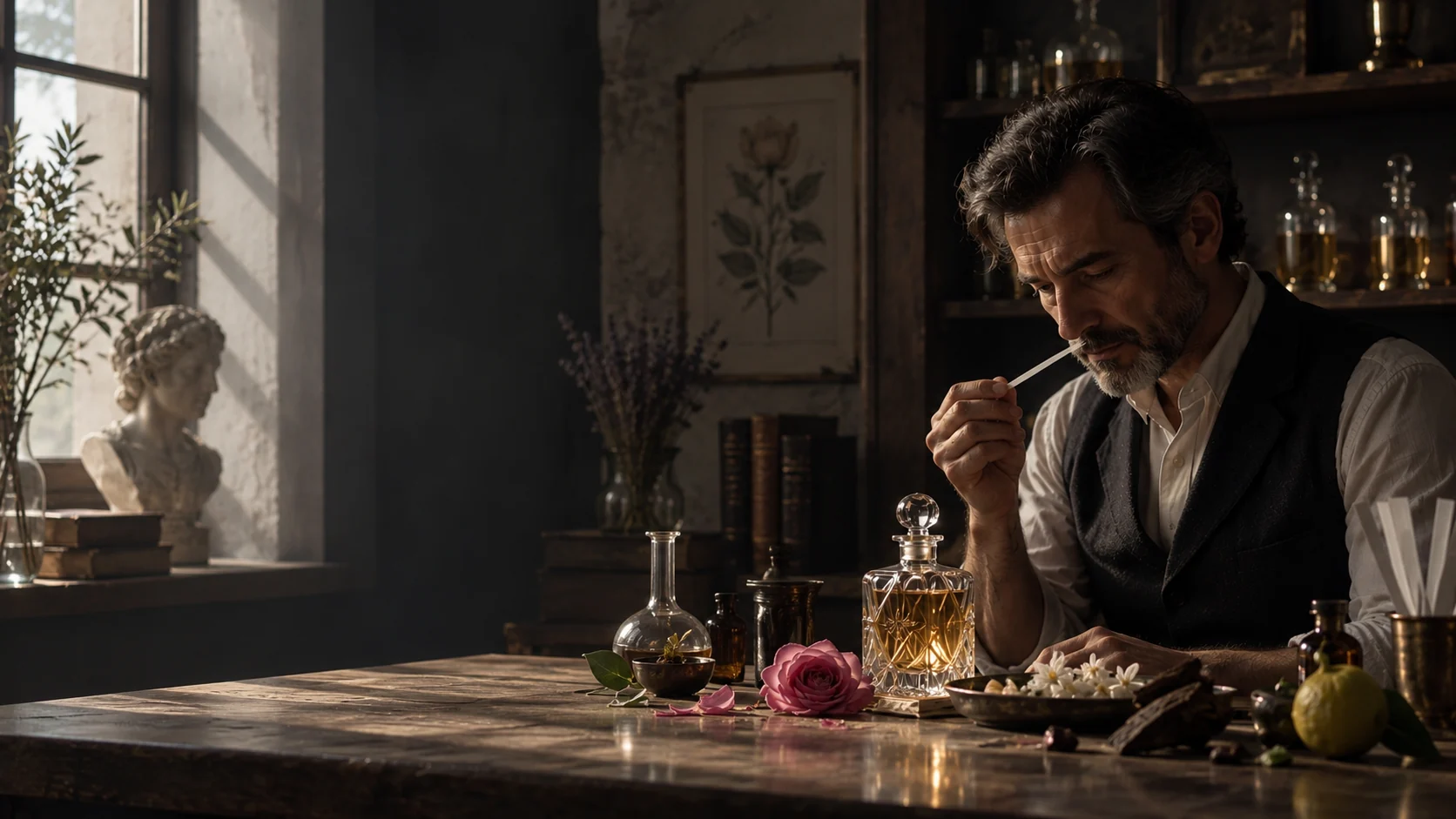
The supplied hero is a conceptual editorial illustration of a perfumer at work, not a historical photograph. Historical dates and contemporary industry information in this article were checked in September 2026; disputed origin stories are identified as such.
Before the Bottle: The Earliest Evidence of Perfumery
The archaeological record preserves containers and equipment more readily than smells. A vessel may have held an aromatic preparation, but its shape alone cannot tell us every ingredient or exactly how the contents were used. Written recipes, plant remains, chemical analysis and the context of an excavation provide different kinds of evidence.
One important early production site is Pyrgos-Mavroraki in Cyprus, associated with perfume-making around 2000 BCE. Research by Italy’s National Research Council describes scented preparations made within a wider Bronze Age production complex, with olive oil playing an important role. The site offers unusually tangible evidence of organized aromatic manufacture. It should not be treated as proof that nobody made perfume earlier or elsewhere. CNR’s account of the Pyrgos discoveries.
The distinction is useful throughout fragrance history: the oldest surviving workshop, the earliest written recipe and the first named practitioner are different claims. The survival of evidence depends on excavation, preservation and interpretation, not just on who acted first.
Mesopotamia and Tapputi: A Name Survives the Scent
Tapputi, often rendered Tappūtī-bēlat-ekalle, is among the earliest perfumers known by name. A Middle Assyrian tablet from Assur, in present-day Iraq, attributes a perfume recipe to her expertise. Historian Eduardo A. Escobar dates the tablet to approximately 1230 BCE in a modern translation and analysis.
Its instructions describe a technically demanding craft involving aromatic oil, heating, soaking and repeated filtration. They reveal controlled procedures and skilled labor, rather than someone casually dropping flowers into a jar. Escobar also places Tapputi within a wider tradition of women who processed aromatics and helped organize production.
Calling her “the inventor of perfume” erases that surrounding expertise. Even “the first chemist” is a modern label applied retrospectively. The stronger claim is that her name and knowledge survived in a sophisticated written record of Assyrian perfumery. Tapputi’s tablet in Women in the History of Science, UCL Press.
Ancient Egypt: Fragrance Between the Human and Divine
In ancient Egypt, aromatic substances belonged to religious practice, bodily care and elite life. Incense transformed the atmosphere of temples; scented oils and ointments accompanied beauty rituals and funerary preparations. These uses overlapped because bodily care, sacred order and social identity were not neatly separated into modern categories.
Many preparations used fats or oils to retain scent. Burning resins produced another form of fragrance entirely: an atmosphere rather than a substance applied to skin. The Rosicrucian Egyptian Museum’s account of perfumery explains these oil-based and solid preparations, alongside temple incense.
Objects also reveal how fragrance communicated status. The Metropolitan Museum of Art holds an elaborately decorated Egyptian perfume bottle from the Amarna period, shaped as a ritual vessel and inlaid with a royal figure. The container and its associations mattered as well as the material inside it. Luxury packaging has a much longer history than the department-store counter.
Greece and Rome: Fragrance Enters the Marketplace
Greek and Roman societies used aromatic oils in contexts ranging from worship and burial to bathing, exercise and personal adornment. Perfume was part of bodily life, but also a traded product whose materials and containers connected distant regions.
The International Perfume Museum in Grasse describes the expansion of non-religious uses in Greece and the importance of glass containers to Roman distribution. Containers could be attractive, practical and valuable in their own right. A surviving Hellenistic glass perfume bottle at The Met makes that relationship visible.
The broader museum history of ancient perfumery shows fragrance moving between sacred and everyday settings. As in the wider history of Roman luxury, what people consumed could express refinement, wealth and access to trade.
Persia and the Medieval Islamic World: Knowledge in Motion
Persian and Arabic-speaking societies developed rich traditions of perfumed oils, rosewater, incense and aromatic medicines. Fragrance circulated through courts, households, religious life and commercial networks. This history cannot be reduced to a brief bridge between classical antiquity and France.
The ninth-century scholar al-Kindi wrote about perfume preparation and distillation. Encyclopaedia Iranica describes a broad technical literature involving floral waters and aromatic mixtures, including work by al-Zahrawi. Such texts demonstrate accumulated knowledge, experimentation and the movement of ingredients across regions. Iranica’s history of perfume.
What Ibn Sina Actually Contributed
The Persian physician and philosopher Ibn Sina, known in Latin Europe as Avicenna, is associated with advances in distillation and the medicinal use of rose preparations. Scholarship on the cultural history of the rose places his contribution within existing medical and aromatic traditions, rather than at the beginning of perfume itself. Academic discussion of rose distillation and Ibn Sina.
Distillation uses differences in volatility: heating creates vapor, which is then cooled and collected. Depending on the material and method, this can produce an aromatic water and an essential-oil fraction. Apparatus and techniques developed over long periods. It is inaccurate to say that Ibn Sina invented perfume, and too simple to assign the entire invention of distillation to him. Earlier practice and other scholars’ contributions are essential to the story.
Medieval Europe and the Legend of Hungary Water
Aromatic knowledge developed in Europe through trade, local practice and the translation of medical and technical works. The Grasse museum highlights Arabic texts translated in the milieu of Salerno and the wider spread of distillation knowledge. Iberia and Mediterranean exchange were important settings for such encounters, as explored more broadly in PRESDA’s history of al-Andalus.
Perfume was not yet confined to the category of beauty. Aromatic preparations could be presented as remedies or protection against unhealthy air. Those historical beliefs should not be mistaken for modern evidence that fragrance prevents infection. The International Perfume Museum’s historical overview.
Hungary Water is often cited as an early European alcohol-based perfume, usually associated with rosemary and a Hungarian queen. Popular accounts give the year 1370 and describe miraculous rejuvenation. Fragonard’s museum collections preserve this story as part of perfume lore, explicitly framing the queen’s transformation as legend. Fragonard’s account of scent containers and Hungary Water.
The exact origin, date and royal attribution are uncertain. It is safer to describe Hungary Water as an important name in the history of European aromatic spirits than as a securely documented moment when “modern perfume was invented.” A memorable legend is not the same thing as a contemporary record.
Renaissance Courts: Scent as Status and Power
Renaissance Europe made fragrance part of the presentation of an elite body and household. Scent could be worn, carried in a small object or released into a room. Ingredients arriving through expensive trade networks connected personal adornment to wealth and access.
Pomanders are a revealing example. These containers held aromatic materials and could be worn as ornaments. A German pomander preserved at The Met combines the history of scent with that of metalwork and jewelry. The carrier itself could advertise status even when its contents were invisible.
In later French court life, perfumed gloves, fans, sachets and scented preparations formed part of an elaborate culture of appearance. The Château de Versailles documents fragrant gardens and artisans supplying increasingly sophisticated products. Versailles and the perfumer’s garden.
Perfume’s political force rarely required a formal declaration. The ability to surround oneself with costly materials, specialist labor and controlled environments was itself a demonstration of position. The popular claim that Europeans used perfume only because they never washed reduces a complex history of grooming, medicine and social distinction to a caricature.
Why Grasse Became a Perfume Center
Grasse did not become famous for fragrance through flowers alone. Its leather industry, including the practice of scenting gloves, created a commercial setting in which aromatic expertise could develop. Growing and processing perfume plants became increasingly important alongside composition and trade.
UNESCO recognizes three connected forms of knowledge in the Pays de Grasse: cultivating perfume plants, understanding and processing natural materials, and composing fragrances. Its account traces these practices to at least the sixteenth century in an economy long associated with tanning. UNESCO’s recognition of Grasse perfumery skills.
Local growing conditions supported an agricultural landscape of roses, jasmine, tuberose and other fragrant plants. Access to cultivated materials and the skills to process them reinforced one another. The International Perfume Museum’s gardens preserve examples of this regional plant heritage. Grasse also became a place for processing materials sourced beyond the region; its importance was never limited to what grew immediately outside the town.
The region’s importance grew from an entire chain of expertise: growers, harvesters, extraction workers, traders and perfumers. Paris supplied another kind of concentration: fashion, customers and brand prestige. The museum’s history describes these complementary roles. A perfume capital needs knowledge, infrastructure and buyers as well as fragrant fields.
Eau de Cologne: A Fresh Style Travels Across Europe
Eau de Cologne is associated with the Italian-born perfumer Giovanni Maria Farina, also known as Johann Maria Farina, and the business established in Cologne in 1709. The Farina Fragrance Museum preserves the house’s history and its connections to European customers.
The style emphasized a fresh, citrus-led aromatic character. Bergamot became particularly important, helping give cologne a distinctive brightness. The name eventually traveled far beyond one maker and one city. Today it can describe a historical fragrance style, a relatively light concentration, or, especially in everyday American English, men’s fragrance more generally.
Those meanings should not be collapsed. “Cologne” does not establish that a scent is biologically masculine, and a bottle bearing the word need not reproduce an eighteenth-century formula.
Industrial Chemistry and the Birth of Modern Perfumery
During the nineteenth century, chemistry expanded what perfumers could create. Materials such as synthetic vanillin, coumarin and ionones made recognizable odor effects available in new ways. Synthesis could reproduce a molecule found in nature or offer a new aromatic possibility; it did not simply manufacture inferior substitutes for flowers.
Vanillin evokes a major part of vanilla’s smell. Coumarin brings a sweet, hay-like character. Ionones helped make violet-like effects available to perfumers. A historical review of industrial fragrance chemistry places these developments within the growth of an increasingly sophisticated chemical industry.
Houbigant’s Fougère Royale, from the 1880s, helped establish a family of fragrances built around an imaginative aromatic composition rather than a literal extract of a fern. Guerlain’s Jicky, created in 1889, combined natural materials with synthetic vanillin and coumarin. Guerlain’s account of Jicky describes the role of those molecules.
The modern perfumer could now compose an atmosphere that had never existed as a single plant. Nature remained indispensable, but the palette was no longer bounded by what could be economically harvested and extracted.
François Coty: Selling the Whole Experience
François Coty founded his business in 1904 and helped bring together fragrance creation, recognizable presentation and large-scale commercial ambition. The scent, its name, bottle and advertising could operate as one experience. Coty’s own corporate history documents the company’s origins and expansion.
His collaboration with René Lalique, beginning in 1907 according to the glassmaker’s history, made the container a powerful part of that offer. Lalique’s historical timeline shows how perfume and decorative arts became closely connected.
Coty did not invent attractive packaging or commercial perfumery. His importance lies in helping develop a scalable modern relationship between composition, visual identity and aspiration. Buyers could purchase not merely an aromatic mixture but a named object carrying a promise about taste and identity.
Chanel No. 5, Aldehydes and the Designer Era
Chanel No. 5 was created in 1921 by perfumer Ernest Beaux for Gabrielle Chanel. Its famous aldehydic character helped give a floral composition a more abstract, radiant impression. Aldehydes are a chemical class, not one ingredient with one universal smell; individual members can smell very different.
No. 5 was not the first perfume to contain synthetic materials. Nor should the often-repeated story of an accidental overdose of aldehydes be presented as established fact. A University of Bristol chemistry account explains the importance of these molecules while noting competing origin stories.
Even an iconic name can cover different compositions. Chanel dates the original to 1921 but identifies the Eau de Parfum as Jacques Polge’s 1986 reinterpretation of Beaux’s work. That is a useful reminder that concentration versions are not necessarily the same formula with different amounts of alcohol. Chanel’s description of No. 5 Eau de Parfum.
Christian Dior brought a similar integration of clothing and scent to his new fashion house in 1947 with Miss Dior. The fragrance made the designer’s aesthetic available in another form: something worn on the body without being a garment. Dior’s history of the couturier-perfumer.
Designer fragrance could reach people who would never buy couture. That broader accessibility did not end exclusivity; it gave fashion houses another way to organize it, with different products, prices and levels of distribution.
Celebrity Fragrances, Niche Houses and Global Luxury
Celebrity fragrance made identification with a public figure part of the product. Elizabeth Taylor became a major example: her fragrance career included Passion and White Diamonds, the latter launched in 1991. Her official archive records the fragrances and their industry recognition. She was influential, but should not be simplistically labeled the first celebrity ever connected with perfume.
Niche perfumery offered another emphasis: a fragrance-centered identity, distinctive creative direction or attention to the perfumer. Editions de Parfums Frédéric Malle, launched in 2000, prominently credited the people composing its fragrances. The house’s account of its perfumers illustrates that approach. “Niche,” however, is not a guarantee of independence, artisanal manufacture or superior ingredients.
The Estée Lauder Companies’ acquisition history records Le Labo in 2014 and Editions de Parfums Frédéric Malle in 2015. Corporate acquisition records show how specialist identities and large-group ownership can coexist.
Today the business combines global ingredient suppliers, fragrance-development companies, fashion licenses, independent brands, retailers and international luxury groups. L’Oréal’s 2025 annual report on its luxury division illustrates the importance of fragrance collections and specialist houses. This is a global commercial system, even when a bottle evokes a private workshop or a single flower field.
Eight Ingredients That Tell the Story
Rose: A Flower With Many Histories
Rosewater and rose preparations have long belonged to Persian and wider Islamic aromatic traditions, while rose also became fundamental to European perfumery. There is no single universal “rose smell”: species, cultivation and processing matter. A fragrance can use natural rose extracts, individual aroma molecules or both to create an interpretation. Kew’s account of rose diversity includes research into the diversity of rose fragrance.
Jasmine: The Labor Behind a Floral Impression
Jasmine connects perfume to cultivation, careful harvesting and extraction. Its odor is more complex than a generic idea of sweetness. Modern jasmine absolutes are commonly made using solvent extraction and subsequent processing with alcohol. IFF’s technical description of Egyptian jasmine absolute documents one such process. The word “natural” does not mean the material entered the bottle unchanged from the flower.
Bergamot: The Brightness of Cologne
Bergamot oil comes from the peel of a citrus fruit and became central to the cologne tradition. Calabria in southern Italy remains a major source. Modern producers can further process the oil, including reducing furocoumarins associated with phototoxicity. IFF’s bergamot sourcing and processing description shows how an old material is adapted to contemporary use.
Oud: Asian Wood, Middle Eastern Traditions, Global Influence
Oud is associated with agarwood: resin-rich wood produced by certain trees, especially Aquilaria and Gyrinops species, in response to injury and biological stresses. The raw material originates in Asian forests and plantations; its long-standing importance in Middle Eastern incense and perfume reflects trade and cultural practice, not a purely Arabian botanical origin.
Agarwood chips can be heated for their aroma, while oil is used in perfumery. TRAFFIC’s study of agarwood use and trade documents these uses and conservation pressures. Middle Eastern appreciation of oud has helped shape international demand and the oud-themed collections of global houses.
Global products such as Tom Ford’s Oud Wood show how the vocabulary moved into international luxury collections. An “oud” note on a perfume description does not establish that the bottle contains rare natural agarwood oil. It may describe an accord, a combination of materials creating an oud-like effect. Origin, grade and documentation matter more than the word alone.
Musk: From an Animal Material to a Broad Scent Family
Historical deer musk came from the musk gland of male musk deer. Its value contributed to exploitation, while animal welfare and wildlife conservation changed expectations around its use. Today, musky effects are widely created with synthetic ingredients, which can smell clean, powdery, warm or skin-like. “White musk” does not mean a substance extracted from a white animal.
CITES has explicitly described the fragrance industry’s broad move away from animal-derived materials toward alternatives, while emphasizing wildlife-trade responsibilities. CITES on fragrance and conservation. This shift should not be rewritten as a claim that every animal ingredient is universally prohibited or that every synthetic musk has an identical environmental profile.
Ambergris: A Marine Material Surrounded by Myths
Ambergris forms in the digestive system of sperm whales and can be found floating or washed ashore. The familiar nickname “whale vomit” is an oversimplification of a more complicated biological process. Weathering changes its odor, and it has historically been valued in perfumery. The Natural History Museum’s explanation separates the substance from its popular mythology.
Rules differ by jurisdiction. In the United States, NOAA states that ambergris may not be collected, kept or sold because it comes from an endangered marine mammal. Finding it on a beach does not create a universal legal exemption. NOAA guidance on protected-species parts. Modern perfumers can use alternative materials for ambergris-like effects. Ambergris is also different from fossil amber and from the warm “amber” accords described in perfume marketing.
Vanilla: An Orchid, Curing and Chemistry
Vanilla comes from the fruit of orchids, especially Vanilla planifolia, with origins in tropical America. Cultivation, pollination and curing are part of the work behind the familiar aromatic material. Kew’s vanilla profile explains the plant behind the flavor and fragrance.
Vanillin captures an important element of vanilla’s odor, but a natural vanilla extract contains a more complex mixture. Synthetic and biotechnology-based routes can provide aromatic ingredients without requiring every bottle to depend on a crop of cured pods. A vanilla note is therefore not proof of natural vanilla extract, just as the presence of synthetic vanillin is not evidence of poor workmanship.
Sandalwood: A Precious Wood Under Pressure
Sandalwood has long been used in fragrance, incense and cultural practices, particularly in Asia. Its valued aromatic material comes from the wood rather than a flower. Different species and sources are not interchangeable, and overexploitation has affected parts of the genus. Kew’s botanical overview of Santalum records those pressures.
Contemporary perfumery draws on managed supplies, different sandalwood species and synthetic sandalwood odorants. Givaudan’s Javanol ingredient description provides one example of an engineered sandalwood-like material. A woody impression can be composed without implying that a rare tree was harvested for it.
Natural, Synthetic and Ethical Are Different Questions
Natural and synthetic materials are both chemicals. A molecule’s origin does not automatically establish its safety, artistic value or environmental impact. Natural extracts may contain substances that cause sensitization; synthetic ingredients also require assessment. The FDA describes fragrance formulas as mixtures of natural and synthetic ingredients and notes that some people are sensitive to fragrance. FDA guidance on fragrance in cosmetics.
Ethical assessment asks additional questions: Was wildlife legally sourced? Were workers treated fairly? What land, water, energy and processing inputs were required? Was a sustainability claim independently supported? Replacing an animal material can address one problem without automatically resolving every environmental question.
IFRA standards can prohibit, restrict or specify conditions for using particular materials. They are an industry system of safety standards, not a substitute for the laws of every country or for a finished-product safety assessment. IFRA’s explanation of applying its standards. Conservation controls, safety requirements and changing availability can all influence reformulation over time.
How a Perfumer Actually Constructs a Fragrance
Creation often begins with a brief: an idea, intended audience, product type, performance goal and budget. A perfumer selects materials and builds accords, adjusting proportions until the whole produces the intended effect. The craft depends on learning the character of individual materials and what happens when they are combined.
A formula is weighed and evaluated through successive trials. Smelling strips allow comparison; evaluation on skin reveals another aspect of the experience. The work also involves stability, compatibility with packaging, safety requirements and reproducible manufacture. A beautiful laboratory trial must still function as a product. IFRA’s explanation of fragrance manufacture.
An ingredient list and a marketing note pyramid answer different questions. “Leather,” “sea air” or “oud” may describe a constructed effect rather than a literal material. The perfumer works with proportions and interactions, not merely a shopping list of attractive smells. Adding more costly ingredients does not automatically improve the relationship between them.
Top, Heart and Base Notes
Top notes describe the opening impression, often involving relatively volatile materials. Heart notes describe the developing central character. Base notes describe longer-lasting effects that contribute to the later impression, or drydown.
This is a useful model, not three sealed compartments opening in sequence. Materials overlap from the beginning. Evaporation, concentration, interactions and how strongly a substance is perceived all affect the changing scent. Research modeling fragrance evaporation and permeation on skin illustrates why the experience evolves over time rather than following a rigid timetable.
Parfum vs Eau de Parfum, Eau de Toilette and Cologne
These terms generally suggest concentration, but they are not universally fixed international grades. IFRA gives common ranges for ethanol-based products: eau de cologne around 3–8%, eau de toilette 5–15%, eau de parfum 10–20%, and perfume extract or extrait 15–40%. The overlaps are meaningful. IFRA’s explanation of concentration terminology.
The percentages refer to fragrance mixture in the finished product, not necessarily to pure natural essential oils. A parfum can be richer without projecting farther, and an EDT can feel more expansive than a heavier version. The formula may also change between versions. Concentration alone cannot predict beauty, longevity or whether someone will enjoy wearing it.
Why Scent Is So Closely Linked to Memory and Emotion
Odor molecules activate sensory neurons high in the nose. Signals pass to the olfactory bulb and onward through brain networks involved in identifying and interpreting smell. The U.S. National Institute on Deafness and Other Communication Disorders explains the sensory pathway.
Olfactory processing has close connections with regions involved in emotion and memory, including the amygdala and medial temporal structures. A learned association can make an odor an unusually evocative cue. Studies and reviews find that odor-evoked autobiographical memories can feel especially emotional and transporting. Research review on odor-evoked memory.
That does not mean every scent triggers a memory, that smell bypasses all thinking, or that a recalled scene is perfectly accurate. Personal history and context matter. A perfume associated with a loved person may comfort one wearer and sadden another. The connection is powerful partly because its meaning was learned.
Why the Same Perfume Can Smell Different on Different People
Skin is not an inert smelling strip. The release and retention of fragrance materials depend on their properties and the conditions of application. Temperature, skin surface characteristics, other products and the amount applied can influence the experience. Research on fragrance absorption and evaporation demonstrates the role of physical and chemical processes.
The wearer also brings an existing body odor, while the person smelling the perfume brings their own sensitivity, associations and adaptation. Two reports of the same scent may differ even without a dramatic chemical transformation. “Skin chemistry” is useful shorthand, but it should not become a mystical explanation for every difference.
WHY CAN A BOTTLE OF PERFUME COST $500 OR $5,000?
Ingredients and Concentration Are Only the Beginning
Some natural extracts are expensive because production requires land, labor, selective harvesting and substantial processing for a limited yield. Certain grades, origins or batches are especially scarce. A high concentration can increase the amount of aromatic mixture in a bottle, but its cost depends on that mixture’s composition. More concentration does not mean proportionally more rare flowers.
Development also has value. Formulation, evaluation, revisions, testing and quality control require skilled people and time. Small production runs spread some fixed costs across fewer units. The fragrance value chain described by IFRA includes many businesses and forms of work before a product reaches a customer.
The Bottle May Be an Object of Luxury Too
Packaging can involve custom glass, decorative work, complex closures, presentation boxes or collectible craftsmanship. In an exceptional edition, the container may be a significant part of what is being sold. That can be real production value, but it is different from claiming the liquid itself smells better.
The $500 and $5,000 figures describe price levels, not standard recipes. Comparing two bottles fairly requires attention to volume, format, refillability and whether one includes an unusually costly container or bespoke service. A large presentation bottle cannot be compared meaningfully with a small spray by price alone.
Distribution, Branding and the Price of Belonging
Retailers and distributors need margins. Stores, staff, samples, transport, advertising and brand development also cost money. Licenses and commercial partnerships can add further layers. A retail price is therefore not a transparent invoice for ingredients.
Beyond costs lies positioning: what a brand believes its audience will pay for identity, rarity, recognition and the experience of ownership. A deliberately limited release may create commercial scarcity; that is not necessarily the same as a genuinely scarce botanical material. Both can affect price, but they are different explanations.
There is no honest universal rule that a fixed percentage of every expensive perfume pays for “the juice.” Without a brand’s actual cost data, such breakdowns are guesses. The same is true of the claim that every expensive perfume is a scam. Some prices reflect substantial craft and materials; others place greater weight on presentation and prestige. Often they reflect a combination.
Price can tell you where a perfume sits in a market. It cannot tell you whether its composition will move you. A modestly priced formula can be accomplished, and a costly one can leave its wearer indifferent. Luxury value and olfactory pleasure overlap, but they are not the same measurement.
PERFUME: MYTH VS REALITY
“Longer Lasting Automatically Means Better”
Longevity is one performance characteristic. A deliberately fleeting citrus composition and a persistent woody fragrance may aim at different experiences. Endurance does not measure balance, originality or pleasure, and a strong smell can remain strong without being beautiful.
“Natural Always Means Safer or Better”
Safety depends on the material, exposure and individual sensitivity. Natural extracts can contain allergens, while synthetic materials can offer consistency and creative possibilities. Neither label replaces assessment or skilled composition.
“Coffee Beans Completely Reset Your Nose”
A 2011 exploratory study compared smelling coffee beans, lemon slices and plain air after repeated fragrance exposure. Coffee did not produce better odor-identification performance than the alternatives. That does not answer every question about adaptation, but it does not support a universal reset claim. The coffee-and-odor study. Taking a break from concentrated smelling is more sensible than expecting another strong odor to erase everything that came before.
“Perfume Smells Identical on Everyone”
Application conditions, skin, other products and perception all influence the result. A sample on paper is useful, but it is not a complete prediction of the experience of wearing the fragrance.
“An Expensive Perfume Is Expensive Only Because of Its Ingredients”
Materials are one part of the price. Development, packaging, distribution, branding and luxury positioning also matter. A story about rarity should be evaluated separately from evidence about what is actually in the bottle.
Capturing Something Invisible
Perfume has crossed many boundaries: from offering to ornament, medicine to cosmetic, agricultural material to industrial molecule. Yet some of its oldest ambitions remain recognizable. People still want to transform the atmosphere around them, mark an occasion and become memorable to someone else.
The history does not belong to one inventor, country or luxury house. It belongs to growers and traders, unnamed makers and recorded experts, distillers and chemists, and to the people who gave particular smells their meanings. The bottle on a shelf contains a commercial product; the experience of it can carry much more.
Perfume began as smoke, oils, flowers and ritual. Thousands of years later, humans are still trying to capture something invisible and turn it into memory.
FAQ
Frequently Asked Questions
What is this PRESDA article about?
From ancient rituals and royal courts to Grasse, modern chemistry and designer bottles, perfume became an invisible language of beauty and status. Its story is as complex as the scents we remember.
Which category does this story belong to?
This story is part of PRESDA's Lifestyle coverage.
Who published this article?
PERFUME: HOW SCENT BECAME A SYMBOL OF BEAUTY, POWER AND LUXURY was published by PRESDA Editorial on PRESDA.
PRESDA Dispatch
Stay Informed. Stay Aware.
A sharp briefing across AI, gaming, sport, business, world affairs, paparazzi, and lifestyle.