Al-Khwarizmi: The Mathematician Who Helped Shape Modern Algebra
How al-Khwarizmi systematized equations in Abbasid Baghdad, why algebra bears his book's name and what his work really contributed to mathematics.
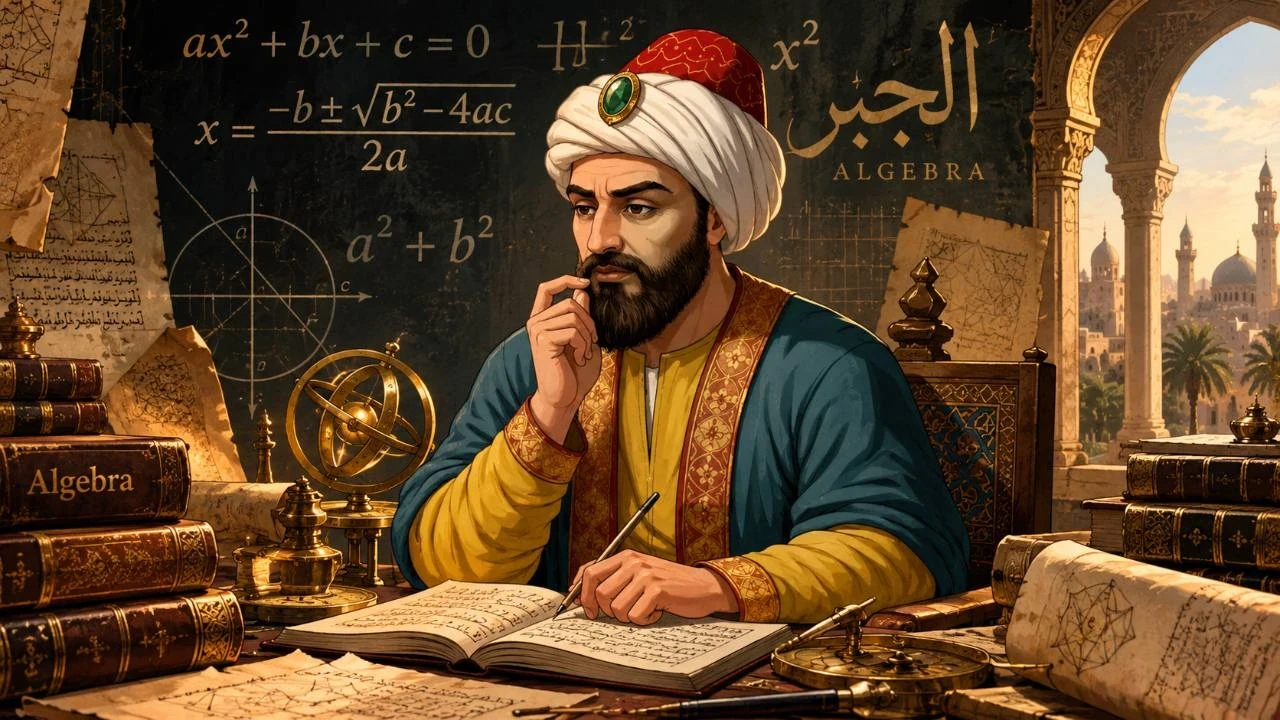
PRESDA AI-generated editorial illustration. The imagined portrait, setting and modern mathematical notation are not a historical reconstruction of al-Khwarizmi or his manuscripts.
An unknown quantity, a practical problem and a repeatable method: this is the enduring combination behind al-Khwarizmi's reputation. Working in ninth-century Baghdad, Muhammad ibn Musa al-Khwarizmi helped turn the solution of equations into a systematic subject. His algebra was written in words, not the familiar strings of letters and signs used in classrooms today. Its influence is visible in both mathematical practice and the name of the discipline itself. MacTutor: al-Khwarizmi
A scholar in Abbasid Baghdad
Al-Khwarizmi is usually dated to around 780 to around 850, but his birthplace and parts of his biography remain uncertain. The secure setting for his scholarly career is Baghdad and the Abbasid court, especially the reign of the caliph al-Ma'mun, from 813 to 833. Later testimony associates him with the Bayt al-Hikma, often translated as the House of Wisdom. Historians debate what that affiliation meant; it should not be imagined automatically as a modern research university. Biographical Encyclopedia of Astronomers: life and institutional context
That uncertainty is worth preserving. A precise birthplace or a picturesque scene inside a vast academy may make a biography smoother, but neither is necessary to explain his achievement. What survives most clearly is a body of mathematical and astronomical work, created in an intellectual world that used and transformed knowledge from several traditions.
What did al-Khwarizmi contribute to algebra?
His treatise, commonly dated to about 825, organized methods for solving linear and quadratic problems. Its Arabic title includes al-jabr and al-muqabala, usually rendered as restoration and balancing or reduction. The Mathematical Association of America describes six standard equation types, classified by combinations of squares, roots and numbers. In this language, a root represents an unknown quantity; a square represents that quantity multiplied by itself. MAA: a Latin manuscript of the Algebra
The important move was organizational. Instead of treating each problem as an isolated puzzle, a reader could recognize its form and apply an appropriate procedure. This is one reason the work belongs in the history of algebra as a discipline, even though solving problems involving unknown quantities was much older.
Equations before modern symbols
Al-Khwarizmi explained calculations rhetorically, using prose and geometrical demonstrations. He did not write the modern quadratic formula on a blackboard. The MAA's teaching project on his work shows how completing the square can be understood through an actual geometric square. The illustration accompanying this article uses modern symbols as a visual shorthand, not as a reconstruction of his manuscript. MAA: completing the square through primary sources
A calculation that still makes sense
Consider x² + 10x = 39, expressed here in modern notation. Half of ten is five; its square is twenty-five. Adding twenty-five to both sides gives x² + 10x + 25 = 64. The left side is now (x + 5)². Taking the positive square root gives x + 5 = 8, and therefore x = 3. Substitution checks the answer: nine plus thirty equals thirty-nine. This example illustrates the method discussed in the historical accounts. MacTutor: the quadratic example
Why modern algebra also gives a second answer
A modern student can also take x + 5 = -8, producing x = -13. That answer works in today's signed-number system. It does not mean the historical treatment was carelessly missing a step: its permitted quantities and classification of problems differed from ours. The comparison shows why reading old mathematics requires attention to what its authors meant by a number or a solution.
Geometrically, the operation adds the missing corner needed to complete a larger square. The proof connects a sequence of numerical instructions with a reason those instructions work. That connection remains valuable for learners who can memorize a formula without yet understanding it.
Mathematics for an inhabited world
The treatise's practical aims included inheritance, commerce and measuring land. Algebra was not presented merely as intellectual decoration. It could organize a situation involving known and unknown quantities into a problem that a trained reader could solve. The method made abstraction useful: different real-world questions could share the same mathematical structure. MacTutor: the treatise's practical purpose
His interests also extended to astronomical tables and geography. The Biographical Encyclopedia of Astronomers situates these works within the exchange and adaptation of Indian and Greek materials. Al-Khwarizmi's career therefore belongs to a broader history of calculation, observation and transmission, rather than to a single invention made in isolation. Biographical Encyclopedia of Astronomers: scientific works
From Arabic manuscripts to European readers
The transmission can be followed through surviving objects. The Bodleian Libraries preserve an Arabic manuscript of the algebra as MS. Huntington 214. The MAA documents a Latin copy made in Trier in 1456, derived from Gerard of Cremona's translation. These are witnesses to a long life of copying, teaching and reinterpretation, not autograph pages written by al-Khwarizmi himself. Bodleian: MS. Huntington 214 MAA: Latin manuscript history
Another record, at the British Library, describes a commentary completed in 1211 and preserved in a copy dated 1627. Its existence is a reminder that the story was not simply a one-way handover to Europe. Readers continued to explain and develop the work in Arabic over centuries. British Library: commentary on al-Khwarizmi
Did he invent algorithms and zero?
Neither claim is accurate as a literal first invention. The word algorithm derives from Latin forms of his name, while his arithmetic helped transmit Indian place-value methods. A word's ancestry is not proof that its namesake invented every procedure it now describes. His achievement is substantial without making him the sole origin of computation or the inventor of zero.
His legacy is best understood as a way of making methods teachable and reusable. For the surrounding intellectual world, read PRESDA's account of Abbasid Baghdad. For another transformation in mathematical explanation, explore Copernicus and Earth's motion and Newton's laws.
FAQ
Frequently Asked Questions
What is this PRESDA article about?
How al-Khwarizmi systematized equations in Abbasid Baghdad, why algebra bears his book's name and what his work really contributed to mathematics.
Which category does this story belong to?
This story is part of PRESDA's Science coverage.
Who published this article?
Al-Khwarizmi: The Mathematician Who Helped Shape Modern Algebra was published by PRESDA Editorial on PRESDA.
PRESDA Dispatch
Stay Informed. Stay Aware.
A sharp briefing across AI, gaming, sport, business, world affairs, paparazzi, and lifestyle.