OUR UNIVERSE: FROM THE BIG BANG TO THE END OF TIME
Explore 13.8 billion years of cosmic history, Webb discoveries, black holes and possible futures, with clear distinctions between evidence and hypotheses.
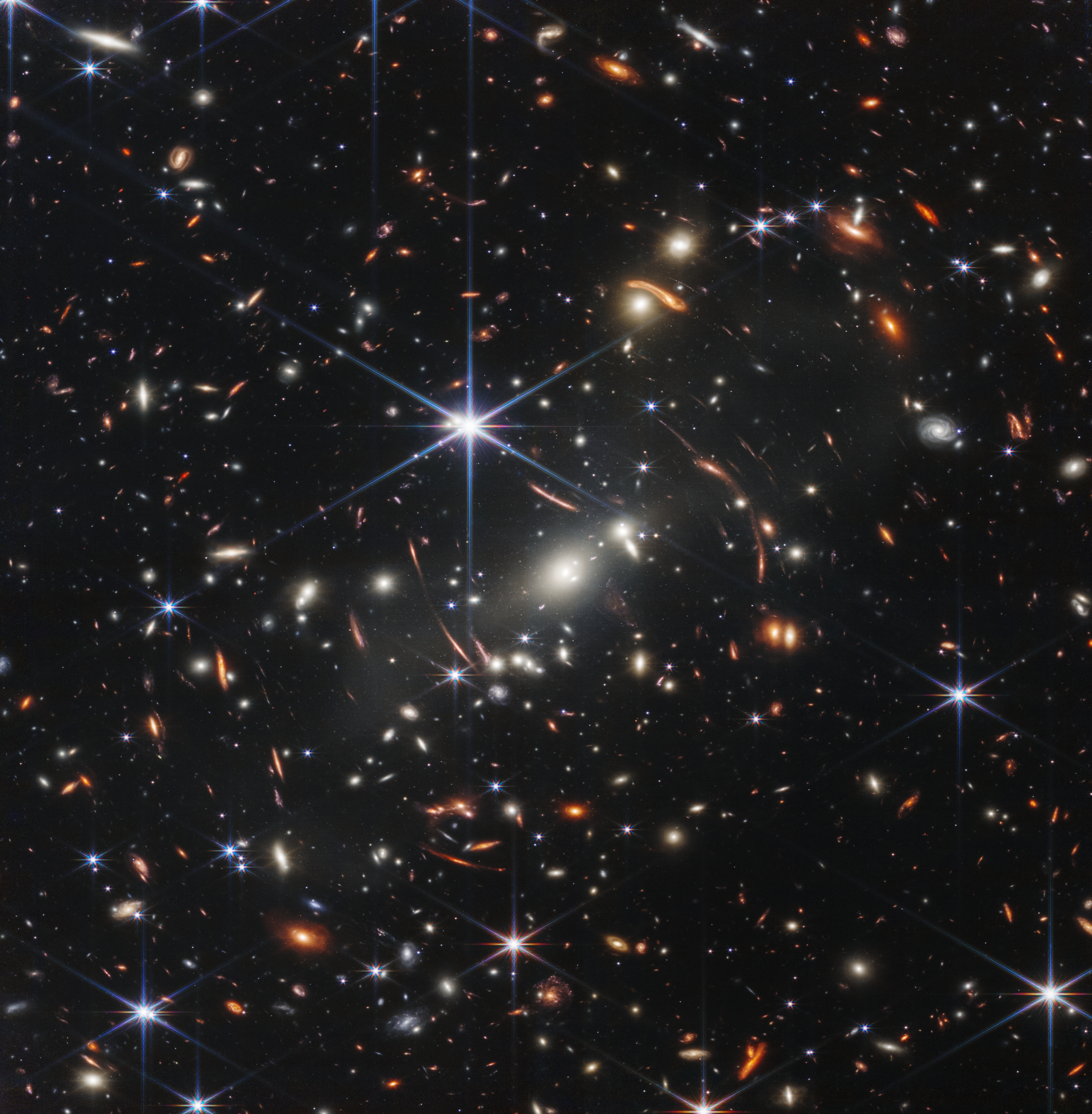
Webb’s First Deep Field: SMACS 0723, released in 2022. Authentic NIRCam observations with infrared wavelengths mapped to representative visible colours. Original composition preserved. Credit: NASA, ESA, CSA, and STScI. CC BY 4.0. Official image record · CC BY 4.0 · Original high-resolution image
The universe is everything physical we can investigate: space, time, matter, radiation and the structures they form. Its observable history stretches back about 13.8 billion years, from a hot, dense early state to a cosmos filled with galaxies. That account rests on converging evidence. It does not mean scientists have explained why anything exists, identified every ingredient or discovered how time will end.
Look closely at a deep-field image and the sky changes character. What first resembles a scattering of stars becomes a crowd of galaxies, each seen at a different stage of its past. A telescope collects light, but also history. The challenge is to reconstruct that history without allowing a beautiful picture, an elegant equation or an irresistible headline to say more than the evidence permits.
The Big Bang was not an explosion into empty space
The Big Bang model describes an expanding universe that was once much hotter and denser. It does not place an explosion at one location in a pre-existing void. On sufficiently large scales, distances between freely moving galaxies grow as space expands. Running that history backward leads toward earlier, denser conditions. Expansion measurements, the abundance of light elements and the cosmic microwave background support this picture independently. NASA: the universe
The often-quoted age of 13.8 billion years is an inference from measurements interpreted through a cosmological model, not a date read from a single cosmic clock. The Planck collaboration's analysis of the microwave sky gives a particularly precise estimate within the standard model, which includes ordinary matter, cold dark matter and a cosmological constant. Precision within that framework should not be confused with complete knowledge: scientists still test the model's assumptions and investigate tensions between different measurements. Planck Collaboration: cosmological parameters
Inflation and the limits of the earliest story
Inflation proposes that an exceptionally brief episode of accelerated expansion preceded the familiar hot phase. It offers explanations for why the observable universe looks so uniform on large scales and why its geometry is close to spatially flat. In many versions, microscopic quantum fluctuations were stretched into the seeds of later structure. This is an influential theoretical framework with observational successes, but the field or mechanism responsible has not been identified. ESA: the microwave background and inflation
A responsible timeline therefore changes its language near the beginning. We can describe a cooling plasma and the formation of light nuclei with much greater confidence than we can reconstruct the ultimate origin of space and time. Extrapolating classical general relativity to a singularity signals that the theory has reached a limit; it is not a photograph of creation. Proposals involving a bounce, a prior phase or other universes remain hypotheses. None is needed to turn the well-supported hot Big Bang into an established explanation of absolute beginnings.
The oldest light we can map
For its first hundreds of thousands of years, the universe was an electrically charged plasma in which light repeatedly scattered from free electrons. About 380,000 years after the hot beginning, cooling allowed neutral atoms to form and photons to travel much more freely. We receive that ancient radiation as the cosmic microwave background, or CMB. Expansion has stretched its wavelengths; today its temperature is approximately 2.7 kelvin, only a little above absolute zero. ESA: why the microwave
The CMB is not a picture of the Big Bang itself. It records a much later transition, although still extraordinarily early in cosmic history. Its tiny temperature variations preserve information about density differences and physical processes in the young universe. Observatories including COBE, WMAP and Planck made this afterglow measurable in increasing detail. The mottled maps used in astronomy exaggerate small variations so that we can study them; their dramatic colours do not mean the early sky looked like a brightly painted globe. ESA: Planck and the CMB
How can the observable universe be 92 billion light-years wide?
A light-year is a distance: the span light travels in one year. The observable universe is approximately 92 billion light-years across, often rounded to about 93 billion with different numerical conventions and cosmological parameters. That is much larger than twice its age multiplied by light speed because space expanded while the oldest light was travelling. The present distance to the matter that emitted a photon is not simply the distance inferred from its travel time. NASA: how big is space?
The word observable does essential work. It describes the region from which signals have had time to reach us, not a measured boundary around everything that exists. Beyond it may lie vastly more universe. Nor does cosmological expansion mean objects locally overtake light in violation of relativity: the growth of large-scale distances is different from an object racing through nearby space. Our horizon is a limit to our information, not a wall against which a spacecraft would collide.
How darkness gave way to stars and galaxies
After neutral atoms formed, the universe had no stars. Gravity gradually amplified small differences in density. Gas collected within growing structures, cooled and compressed until some regions became hot enough for nuclear fusion. The first generations of stars changed their surroundings with radiation, winds and, in some cases, explosions. Their precise properties and formation dates remain active research questions. Astronomers reconstruct this era from observations and simulations rather than possessing a complete inventory of the first stars. NASA: early-universe research
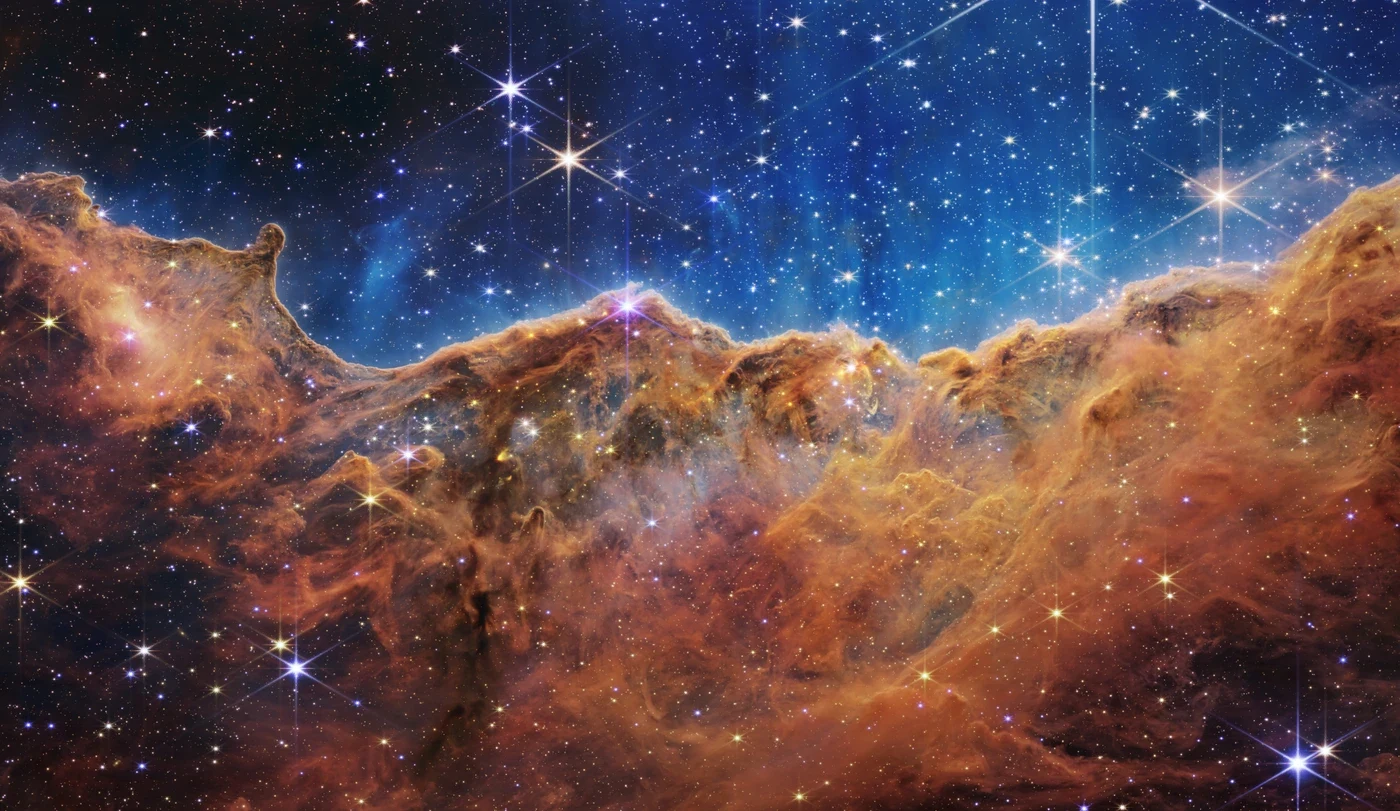
Webb’s 2022 NIRCam view of the Cosmic Cliffs in NGC 3324, a star-forming region in the Carina Nebula. Measured infrared wavelengths are represented with visible colours.
CC BY 4.0. Resized and converted to WebP by PRESDA. Full composition preserved. Reuse follows the individual license stated here.
Galaxies grew through gas accumulation, star formation and mergers, not by following a single tidy sequence. Young stars emitted radiation that helped ionize intergalactic hydrogen again during reionization. Webb observations have linked early galaxies to clearer regions in the surrounding gas, strengthening the case that galaxies drove this transformation. It was a gradual, uneven process across space. The familiar spiral galaxies nearby are survivors of long, complicated histories, not templates into which every early object immediately fitted. NASA: galaxies and reionization
The making of elements, planets and ourselves
The early universe produced mainly hydrogen and helium nuclei, with traces of other light elements. Stars later manufactured much of the heavier material through nuclear reactions. Their evolution returned enriched gas to space, allowing new stars and planets to form from a chemically more varied supply. A star is therefore both an object with a lifetime and a participant in a wider cycle. Its mass strongly shapes its evolution, including whether its final remnant becomes a white dwarf, neutron star or black hole. NASA: stars
Not every element comes from the same stellar process. Neutron-star mergers are an important site for making very heavy elements through rapid neutron capture. Observations of the 2017 event GW170817 connected gravitational waves with a kilonova, providing evidence for this pathway. Meanwhile, planets assemble from material in discs around young stars. Our solar system formed about 4.6 billion years ago. Saying we are made of stellar material captures a real chemical inheritance, although much of our hydrogen has a more ancient, primordial origin. ESO: GW170817 NASA: solar-system formation
Our address in the Milky Way
Our Sun belongs to the Milky Way, a barred spiral galaxy containing more than 100 billion stars. We live within its disc, far from its central region, and see the galaxy's crowded plane as a luminous band across a dark sky. Because we are inside it, a whole-galaxy portrait showing our exact location from above is necessarily a reconstruction, not a photograph taken by a distant camera. The difference between observation and illustration matters even in familiar classroom diagrams. NASA: stars and our galaxy
The Sun is about 26,000 light-years from the galactic centre and formed roughly 4.6 billion years ago. Its gravity holds our planetary system together, while the system participates in the galaxy's wider motion. Cosmic expansion does not steadily inflate your body, Earth's orbit or every gravitationally bound structure. Local forces dominate at those scales. Moving outward through our cosmic address makes humanity physically small, but scale alone cannot answer questions about value, responsibility or meaning. Those are human interpretations, not measurements supplied by a telescope. NASA: Sun facts
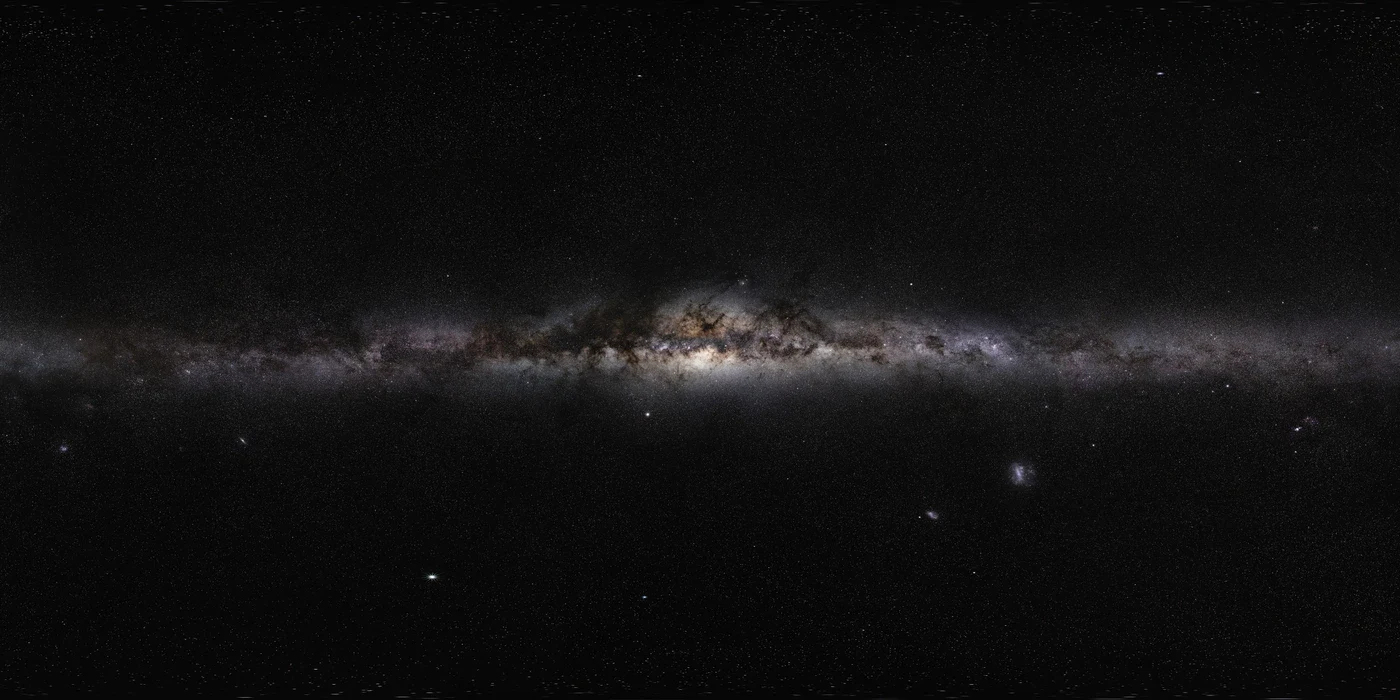
Serge Brunier’s photographic panorama of the sky, released by ESO in 2009. This mosaic looks outward from Earth along the Milky Way; it is not a photograph of our galaxy from outside.
CC BY 4.0. Resized and converted to WebP by PRESDA. Full composition preserved. Reuse follows the individual license stated here.
Black holes: where spacetime becomes extreme
General relativity describes gravity through the geometry of spacetime. A black hole has an event horizon, a boundary beyond which light cannot escape to distant observers. Black holes are not holes punched into an ordinary surface, and they do not indiscriminately suck up everything in a galaxy. Far away, their gravitational influence depends on mass much as it does for other objects. The most extreme effects occur close to them, where tidal forces and the paths available to light become crucial. NASA: black holes
The Event Horizon Telescope's image of Sagittarius A*, released in 2022, shows emission from hot material around the Milky Way's central black hole and a dark central shadow. It is not a visible-light photograph of a solid surface. Reconstructed from radio observations, it connects a striking image to precise physical tests. Stellar orbits, radiation from accreting material and gravitational-wave detections provide complementary evidence for black holes. Their interiors, and a complete reconciliation of gravity with quantum physics, remain beyond our settled account. ESO: Sagittarius A*
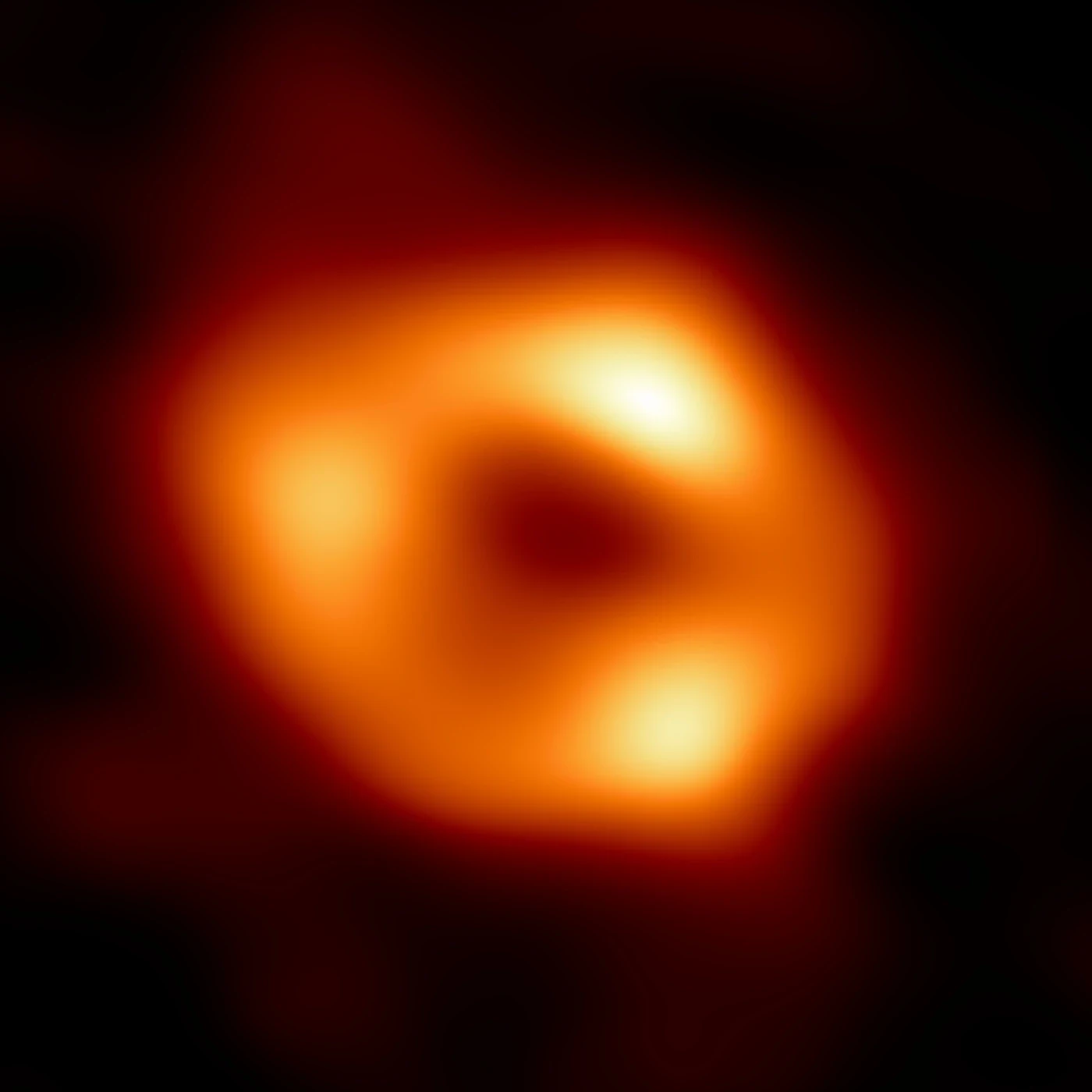
Sagittarius A*, released in 2022 from Event Horizon Telescope observations made in 2017. This averaged reconstruction shows radio emission around the black hole’s shadow, not a visible-light photograph of a surface.
CC BY 4.0. Resized and converted to WebP by PRESDA. Full composition preserved. Reuse follows the individual license stated here.
Dark matter: invisible does not mean imaginary
Galaxies and galaxy clusters behave as though they contain more gravitating matter than their visible stars and gas can supply. Rotation measurements, gravitational lensing and large-scale structure contribute to the case for dark matter. In colliding clusters, the inferred mass distribution can be separated from much of the hot ordinary gas. These are observations that any successful theory must explain. Dark matter is not merely a label attached to an unusually dark patch in a photograph. NASA: Hubble and dark matter
In the standard cosmological picture, ordinary matter accounts for roughly 5% of today's total cosmic energy budget, dark matter about 27% and dark energy about 68%. These are model-based estimates, not three piles collected in a laboratory. Dark matter appears to cluster and help build structure; its microscopic nature is unknown. Proposals to modify gravity are also investigated, but must address the full range of evidence. Detecting a particular dark-matter particle would answer a different question from inferring additional mass through its gravitational effects. ESA: Planck science highlights
Dark energy and the unfinished expansion story
Dark energy names the unknown component or explanation associated with the universe's accelerated expansion. It is not another name for dark matter. The simplest standard description is a cosmological constant: an energy density associated with space that does not dilute as the universe expands. That model has explained a great deal, but it leaves a profound question about the underlying physics. Observing acceleration does not mean astronomers have bottled the substance responsible for it. NASA: dark energy
Measurements continue to test whether that description is sufficient. DESI results released in 2025 strengthened hints, in combinations with other datasets, that dark energy might evolve. The collaboration did not announce a definitive discovery of changing dark energy. Such distinctions matter because the inference depends on datasets, modelling and systematic uncertainties. A preference in one analysis is an invitation to further tests, not a reliable countdown to cosmic collapse. An evergreen account must preserve that uncertainty rather than freezing a developing debate into a dramatic certainty. Berkeley Lab: DESI results and their limits
What James Webb has actually changed
Webb observes infrared light with imaging and spectroscopy. This makes it powerful for studying distant galaxies whose light has been stretched by expansion, dusty stellar nurseries and the atmospheres of planets around other stars. Its deep fields are real observations assembled from measured wavelengths, often translated into representative visible colours. They are neither ordinary human-eye views nor invented scenes. The hero for this feature is the official SMACS 0723 deep field, credited to NASA, ESA, CSA and STScI, with its original composition preserved. ESA/Webb: image record
Among its major achievements, spectroscopy confirmed extraordinarily early luminous galaxies, including JADES-GS-z14-0 in research published in 2024. NASA subsequently reported MoM-z14 as a galaxy seen about 280 million years after the Big Bang. These observations test how rapidly stars and galaxies assembled. They do not, by themselves, demonstrate that the universe is older than the Big Bang model allows. Brightness, stellar mass, dust, active black holes and distance estimates must be disentangled before a challenge to a galaxy-formation model becomes a challenge to cosmology itself. Nature: early galaxies NASA: MoM-z14
Webb also detected carbon dioxide in the atmosphere of WASP-39 b through transmission spectroscopy. Researchers measured how starlight changed as it passed through the planet's atmosphere, identifying a molecular signature rather than photographing individual molecules. That achievement opened new opportunities for comparative planetary science. It was not a discovery of life: WASP-39 b is a hot gas giant, and carbon dioxide can arise without biology. The most important scientific advances often improve what we can distinguish, not simply how far away we can see. Nature: carbon dioxide in WASP-39 b
Life elsewhere and the Fermi question
Planets are abundant, and the ingredients of complex chemistry occur beyond Earth. Neither fact establishes that life is common. Habitability describes conditions that could support life, not evidence that organisms actually inhabit a world. A promising atmospheric molecule requires scrutiny because geology, chemistry, stellar activity and measurement errors can imitate or complicate a biological interpretation. NASA's astrobiology programme still distinguishes the search for life from a confirmed detection: no extraterrestrial life has been established. NASA: astrobiology
The Fermi paradox expresses a tension between the apparent opportunities for technological civilizations and our lack of confirmed evidence for them. It is a question built on uncertain assumptions about life's origins, intelligence, longevity, communication and interstellar travel. Civilizations might be rare, short-lived, distant or difficult for our instruments to recognize. These are possible explanations, not discoveries. Our search covers a limited portion of possible signals and environments. Silence so far neither proves that humanity is alone nor justifies claims that visitors are secretly here. NASA: life in the universe
Does the universe have a centre or an edge?
In the standard large-scale description, the universe has no privileged spatial centre. Every observer is at the centre of their own observable region because their information arrives from surrounding space. That does not make their position the site of the Big Bang. Expansion can be described without assigning a special central galaxy, just as distances can increase across a surface without selecting one point on that surface as the origin of all motion. The analogy illustrates a principle, not the universe's literal shape. NASA: cosmological overview
Whether the whole universe is infinite remains unknown. A finite space need not have an edge, and observations compatible with near-flat geometry do not prove infinite extent. We should therefore separate three questions: how far we can observe, what large-scale geometry the measurements support, and what may exist beyond our horizon. Philosophers imagined innumerable worlds long before modern cosmology could test anything comparable. Our Giordano Bruno biography explores that history, while preserving the difference between a philosophical vision and astronomical evidence.
Big Freeze, Big Crunch or Big Rip?
If expansion continues and dark energy behaves like a positive cosmological constant, the broad expectation is a progressively colder, more dilute universe. Star formation eventually declines as usable gas becomes less available. Existing stars exhaust their fuel on vastly different timescales. This family of futures is often called the Big Freeze or heat death. It describes the dwindling availability of energy differences that can sustain activity, not a sudden moment when every object reaches the same temperature. NASA: possible cosmic fates
A Big Crunch would require expansion eventually to reverse, followed by contraction. A Big Rip arises in certain hypothetical models where dark energy behaves strongly enough to tear apart structures, potentially down to much smaller scales. Neither is an observed destiny. Dark energy's future behaviour cannot be read directly from its present effects, and accelerated expansion alone does not imply a rip. These scenarios are conditional extrapolations of physical models, not three equally established endings waiting for astronomers to choose among them. NASA: dark energy and cosmic fate
Even the phrase end of time deserves caution. A universe becoming cold and sparse need not mean time itself stops. Predictions about extremely remote eras also rely on physics that has not been tested under all relevant conditions. Useful science identifies which assumptions lead to which outcome and asks how observations might discriminate between them. Attaching a confident date to the end of everything would replace that discipline with storytelling. The uncertainty is part of the subject, not an inconvenience to remove.
Carl Sagan and the scale of responsibility
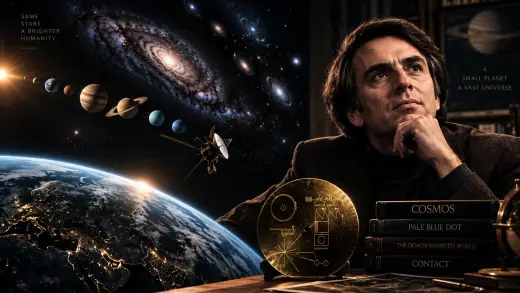
On February 14, 1990, Voyager 1 photographed Earth from the outer solar system. In the image known as the Pale Blue Dot, our planet is a tiny point within scattered sunlight. Carl Sagan championed the backward look and later made the image central to his reflections on humanity. Its power comes from an authentic change of perspective: every human landscape disappears into a speck, while nothing about the lives within it becomes less real. NASA: Voyager's Pale Blue Dot
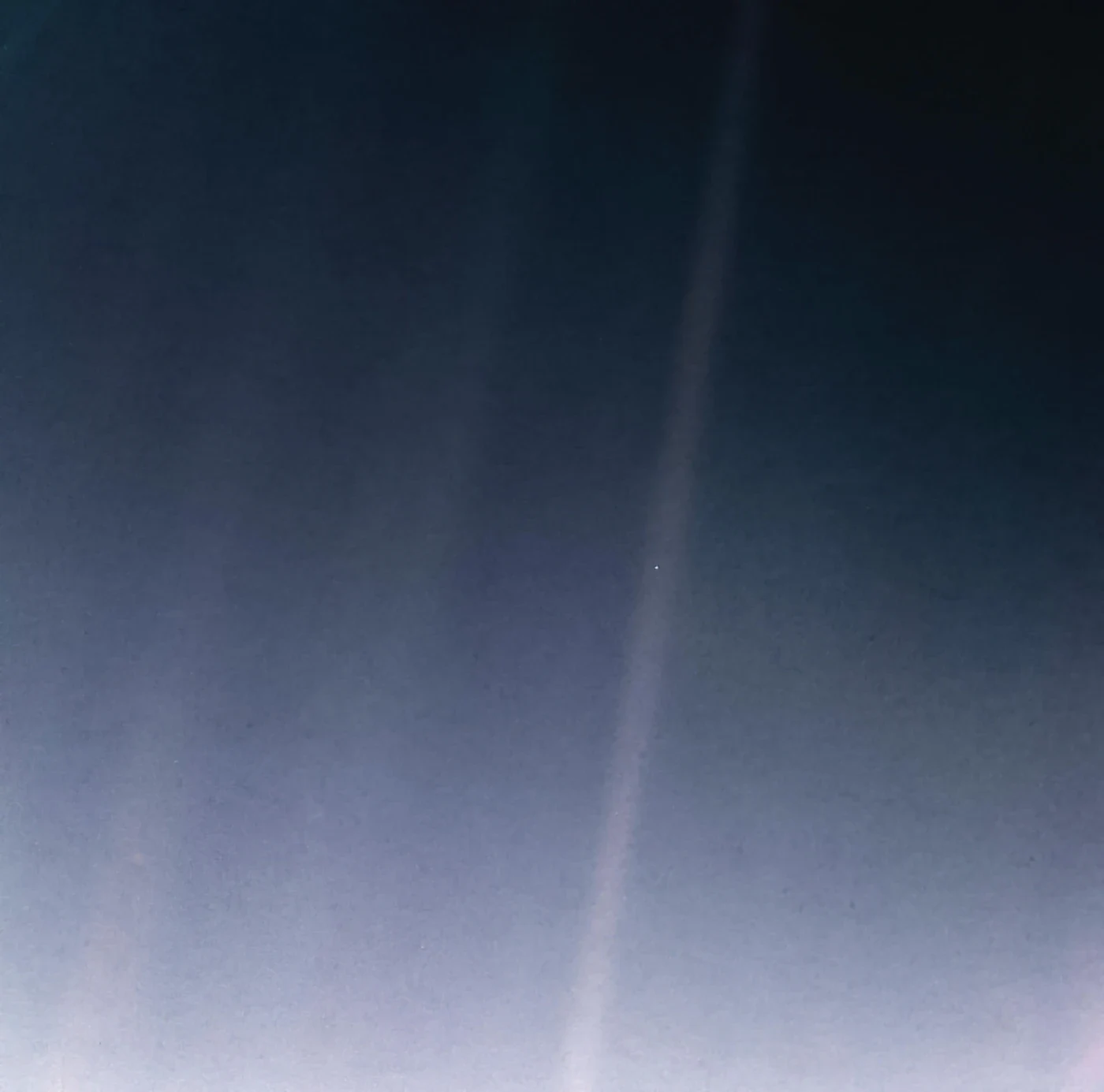
Earth in Voyager 1’s Pale Blue Dot photograph, taken on February 14, 1990. This is NASA’s 2020 reprocessing of the original data. The streaks are scattered sunlight inside the camera.
NASA media usage guidelines. Resized and converted to WebP by PRESDA. Full composition preserved. Reuse follows the individual license stated here.
Cosmology can explain why that point contains ancient hydrogen, recycled stellar elements and a planet capable of asking questions. It cannot make kindness or stewardship inevitable. Those are choices. Sagan's cosmic perspective remains valuable because it joins curiosity to humility: we inhabit a small world in a vast history, and our knowledge is both remarkable and unfinished. For the nearer story of how humans learned to travel beyond it, see our account of the Apollo Moon landings and their evidence. Understanding the universe begins with looking outward, but it can change how carefully we look after home.
FAQ
Frequently Asked Questions
What is this PRESDA article about?
Explore 13.8 billion years of cosmic history, Webb discoveries, black holes and possible futures, with clear distinctions between evidence and hypotheses.
Which category does this story belong to?
This story is part of PRESDA's Science coverage.
Who published this article?
OUR UNIVERSE: FROM THE BIG BANG TO THE END OF TIME was published by PRESDA Editorial on PRESDA.
PRESDA Dispatch
Stay Informed. Stay Aware.
A sharp briefing across AI, gaming, sport, business, world affairs, paparazzi, and lifestyle.