A SIGNAL FROM 10 BILLION YEARS AGO: A COSMIC RECORD
MeerKAT detected the burst. Webb found its galaxy. A record redshift opens a window on cosmic history, while the source of the flash remains uncertain.
A radio flash lasting milliseconds has carried a trace of the distant Universe to Earth. FRB 20240304B travelled for more than 10 billion years before its detection, according to the discovery team. Its host galaxy has a measured redshift of 2.148, placing the event when the Universe was only about three billion years old. University of Sydney: October 8 discovery announcement
The record is scientifically useful because the burst was localized and its host’s redshift measured. This is not simply a distant-looking pulse or a distance guessed from how radio frequencies arrived. The signal offers evidence about both its birthplace and the material between that galaxy and us. Caleb et al.: original author preprint, August 2025
THE DISCOVERY: ONE BURST, THREE IMPORTANT DATES
The MeerTRAP collaboration detected FRB 20240304B on March 4, 2024, using South Africa’s MeerKAT radio telescope. The international study was led by Manisha Caleb, with Themiya Nanayakkara and colleagues contributing the host-galaxy investigation. The University of Sydney announced the Science publication on October 8, 2026, under the title “A fast radio burst at redshift 2, three billion years after the Big Bang”. Caleb et al., Science, 2026 University of Sydney: October 8 discovery announcement
Detection and publication are different events. An author preprint was posted on August 3, 2025. The newly published study therefore develops an already reported discovery, rather than describing a radio flash that arrived this week. Its designation encodes the 2024 detection date. Caleb et al.: original author preprint, August 2025
HOW MEERKAT AND WEBB FOUND THE SOURCE
MeerTRAP searches MeerKAT data for brief radio transients. The team recovered recorded telescope data to localize the burst precisely enough to seek a host galaxy. Initial ground-based searches, including Keck and MMT observations, did not reveal the faint host. That absence motivated deeper infrared observations, not a conclusion that no galaxy existed. NASA: Webb identifies the distant FRB host Caleb et al.: original author preprint, August 2025
Webb’s NIRCam revealed a galaxy at the right location. Its NIRSpec instrument measured the galaxy’s spectrum and cosmological redshift. These are distinct steps: imaging identifies a candidate host; spectroscopy measures how far its recognizable spectral features have shifted. Webb characterized the galaxy, not the original millisecond radio pulse. ESA/Webb: distance, host galaxy and source interpretation
Detection, localization and galaxy spectroscopy are separate measurements.
- MeerTRAP detects a brief pulse in MeerKAT data
- Recorded radio data narrow its sky position
- Webb NIRCam identifies the faint host galaxy
- Webb NIRSpec measures its redshift: 2.148
Sources: NASA / Webb
PRESDA Data Graphics
WHAT DOES “10 BILLION YEARS” ACTUALLY MEAN?
The author manuscript gives a spectroscopic redshift of z = 2.148 ± 0.001, consistent with the 2.148 value in the current observatory announcement. Redshift is dimensionless. It measures the stretching of wavelengths as the Universe expands; it is not a distance expressed in light-years. Caleb et al.: original author preprint, August 2025 ESA/Webb: distance, host galaxy and source interpretation
The headline refers to light-travel time, also called lookback time. The burst was emitted roughly three billion years after the Big Bang and arrived more than ten billion years later. The Universe is about 13.8 billion years old today. These are rounded ages, not an exact stopwatch measurement. NASA: cosmological redshift and the age of the Universe
Present-day separation is a different quantity. Space expanded during the journey, so multiplying travel time by the speed of light does not give today’s separation from the host. Cosmologists also use luminosity distance to relate brightness to emitted power. Such distances depend on the adopted cosmological model and must not be substituted for lookback time. NASA: cosmological redshift and the age of the Universe
Rounded cosmic ages. Event order is chronological; spacing is illustrative, not a distance scale.
- Big Bang: start of the cosmic timeline
- Burst emitted: Universe about 3 billion years old
- March 4, 2024: arrival detected by MeerKAT
- October 8, 2026: Science publication announced
Universe today: about 13.8 billion years old
Sources: NASA; University of Sydney
PRESDA Data Graphics
WHAT IS A FAST RADIO BURST?
An FRB is a brief, intense pulse of radio emission. The first recognized examples launched a field in 2007; some sources repeat, while others have only been seen once. “Non-repeating” often describes what observers have detected so far, not proof that a source can never flash again. Radio telescopes measure the pulse’s frequency structure, arrival times and polarization. Petroff, Hessels and Lorimer: peer-reviewed FRB review
Their power is remarkable, but comparisons require care. ESO estimated that the earlier record-holder FRB 20220610A released radio energy equivalent to decades of the Sun’s total emission in a fraction of a second. That estimate belongs to that burst. It is not a measured energy budget for FRB 20240304B, nor evidence that every FRB has the same output. ESO: FRB 20220610A, the 2023 distance record
A SMALL GALAXY, AND A CLUE TO THE ENGINE
The new host is a dwarf galaxy actively forming stars. ESA/Webb reports a stellar population that could have formed on a timescale of about 30 million years, inferred from its star-formation rate. This is a model-based timescale, not a directly measured birthday for every star. A young environment makes a rapidly formed source plausible. ESA/Webb: distance, host galaxy and source interpretation
A magnetar is a neutron star with an exceptionally strong magnetic field. Such an object can remain after a massive star dies. A radio burst from the Milky Way magnetar SGR 1935+2154, reported by the CHIME/FRB collaboration in 2020, established an important observational connection between magnetars and FRB-like emission. CHIME/FRB Collaboration: radio burst from a Galactic magnetar
For this particular distant burst, a young magnetar is a favored interpretation, not an identified object. The host properties make a long-delay merger explanation less attractive to the researchers. They do not exclude every alternative or prove that all FRBs arise by one mechanism. The specific process that converts a magnetar’s energy into a radio pulse remains debated. ESA/Webb: distance, host galaxy and source interpretation
A PROBE OF THE MATTER BETWEEN GALAXIES
Ionized gas delays lower-frequency radio waves more than higher-frequency ones. The resulting dispersion measure tracks electrons integrated along the sightline. With an independently measured host redshift, astronomers can compare how much matter the pulse encountered with how far through cosmic history it travelled. Macquart et al.: a census of baryons using localized FRBs
Macquart and colleagues demonstrated this approach with a sample of localized bursts in Nature in 2020. It helps investigate ordinary matter dispersed through the cosmic web, including gas difficult to observe directly. “Missing baryons” means ordinary matter that had escaped a complete observational census, not dark matter. Macquart et al.: a census of baryons using localized FRBs
The new sightline contains the imprint of the nearby Virgo Cluster and another intervening structure at roughly redshift 0.3, according to the observatory account. These foreground contributions matter: a large dispersion measure cannot automatically be attributed entirely to diffuse intergalactic gas or to extreme distance. Keck Observatory: host identification and intervening structures
The author analysis also considers polarization and magnetic fields. Oppositely directed fields can partly cancel their effects along a long sightline. Turning one pulse into a unique three-dimensional map requires assumptions and additional evidence. The detection is a new probe, not a complete reconstruction of the cosmic web. Caleb et al.: original author preprint, August 2025
Conceptual path, not a spatial map. The contributions of host gas, foreground structures and diffuse gas must be separated.
- Host galaxy and source environment
- Intergalactic ionized gas and intervening galaxies
- Foreground structure near redshift 0.3
- Nearby Virgo Cluster
- Milky Way and telescope at Earth
Sources: Keck; Caleb et al.
PRESDA Data Graphics
HOW THE RECORD COMPARES WITH EARLIER BURSTS
FRB 20220610A, detected by ASKAP in June 2022 and reported in 2023, had a host redshift of about 1.016 and a light-travel time of about eight billion years. FRB 20240304B reaches redshift 2.148 and a lookback time of more than ten billion years. The new redshift is more than twice the older value; the travel time is not twice as long. ESO: FRB 20220610A, the 2023 distance record Ryder et al.: FRB at redshift 1, author manuscript
The careful formulation is a record for a localized FRB with a measured host redshift, as supported by the study and October 8 announcements. Bursts without securely identified hosts may have large dispersion measures, but those alone do not establish a higher-distance record. Nor is this the oldest light or most distant astronomical object ever observed. Caleb et al.: original author preprint, August 2025 Ryder et al.: FRB at redshift 1, author manuscript
Bars compare dimensionless host redshift from zero. Light-travel times below are rounded and are not represented by bar length.
Measured host redshift, z
- FRB 20220610A1.016
About 8 billion years of light travel
- FRB 20240304B2.148
More than 10 billion years of light travel
Reported redshift uncertainties: ±0.002 (older), ±0.001 (new). These do not express uncertainty in a rounded travel time.
Sources: Caleb et al.; Ryder et al.
PRESDA Data Graphics
WHAT THE EARLY UNIVERSE CAN TELL US
The burst demonstrates that FRB activity existed during “cosmic noon”, the broad era of vigorous star formation. It extends the reach of host-linked FRB observations into a substantially earlier epoch. That connects compact stellar remnants with galaxy evolution, without implying that the signal came from the Big Bang or the Universe’s first stars. ESA/Webb: distance, host galaxy and source interpretation
One unusual host cannot establish the demographics of every distant FRB. Bright bursts and galaxies that can be characterized are easier to enter the sample. Selection effects, host gas and uncertain source models must be considered before inferring how the entire FRB population evolved. Petroff, Hessels and Lorimer: peer-reviewed FRB review
The next step is a larger high-redshift sample, combining sensitive radio surveys, accurate localization and deep imaging or spectroscopy. The team points to MeerKAT and future SKA capabilities. Repeat monitoring may constrain this source, but neither a future repeat nor a definitive magnetar identification is guaranteed. University of Sydney: October 8 discovery announcement
WHAT THIS DISCOVERY DOES, AND DOES NOT, PROVE
The strong result is a distant, host-linked radio burst whose measured redshift establishes a new observational reach. The source mechanism remains unresolved. Independent reporting by Sky & Telescope places the result in that wider research context. There is no scientific basis here for calling the pulse a message from a civilization. Sky & Telescope: independent reporting, October 8, 2026
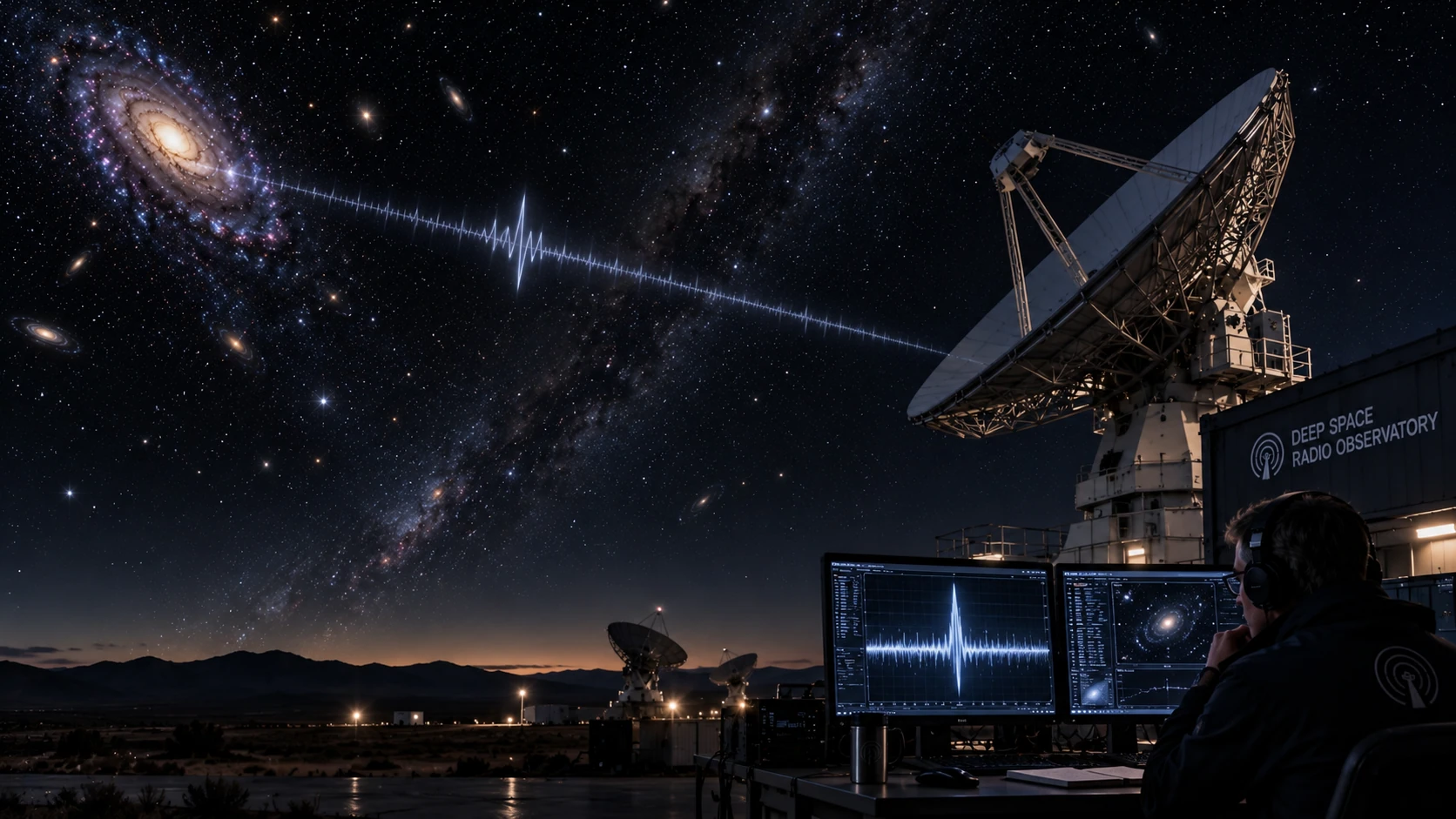
The hero is an AI-generated conceptual illustration, not a photograph of the discovery, a real telescope configuration or a signal visible across the sky. For more cosmic context, read PRESDA’s Carl Sagan feature and its reporting on NASA’s lunar communications plans.
FAQ
Frequently Asked Questions
Is the FRB exactly 10 billion light-years away?
The headline describes more than 10 billion years of light-travel time. Its measured host redshift is 2.148. Present-day separation and luminosity distance are different, model-dependent quantities.
Did Webb detect the radio burst?
MeerKAT detected the radio pulse on March 4, 2024. Webb subsequently imaged and measured the spectrum of its host galaxy.
Has a magnetar been confirmed as its source?
No. A young magnetar is favored by the host’s properties, but the emitting object and radio-emission mechanism remain unconfirmed.
PRESDA Dispatch
Stay Informed. Stay Aware.
A sharp briefing across AI, gaming, sport, business, world affairs, paparazzi, and lifestyle.