WHY DOES ANYTHING EXIST? THE OLDEST QUESTION SCIENCE CANNOT SETTLE
What does the Big Bang explain, and what remains open? Explore evidence, quantum cosmology and philosophical arguments about why anything exists.
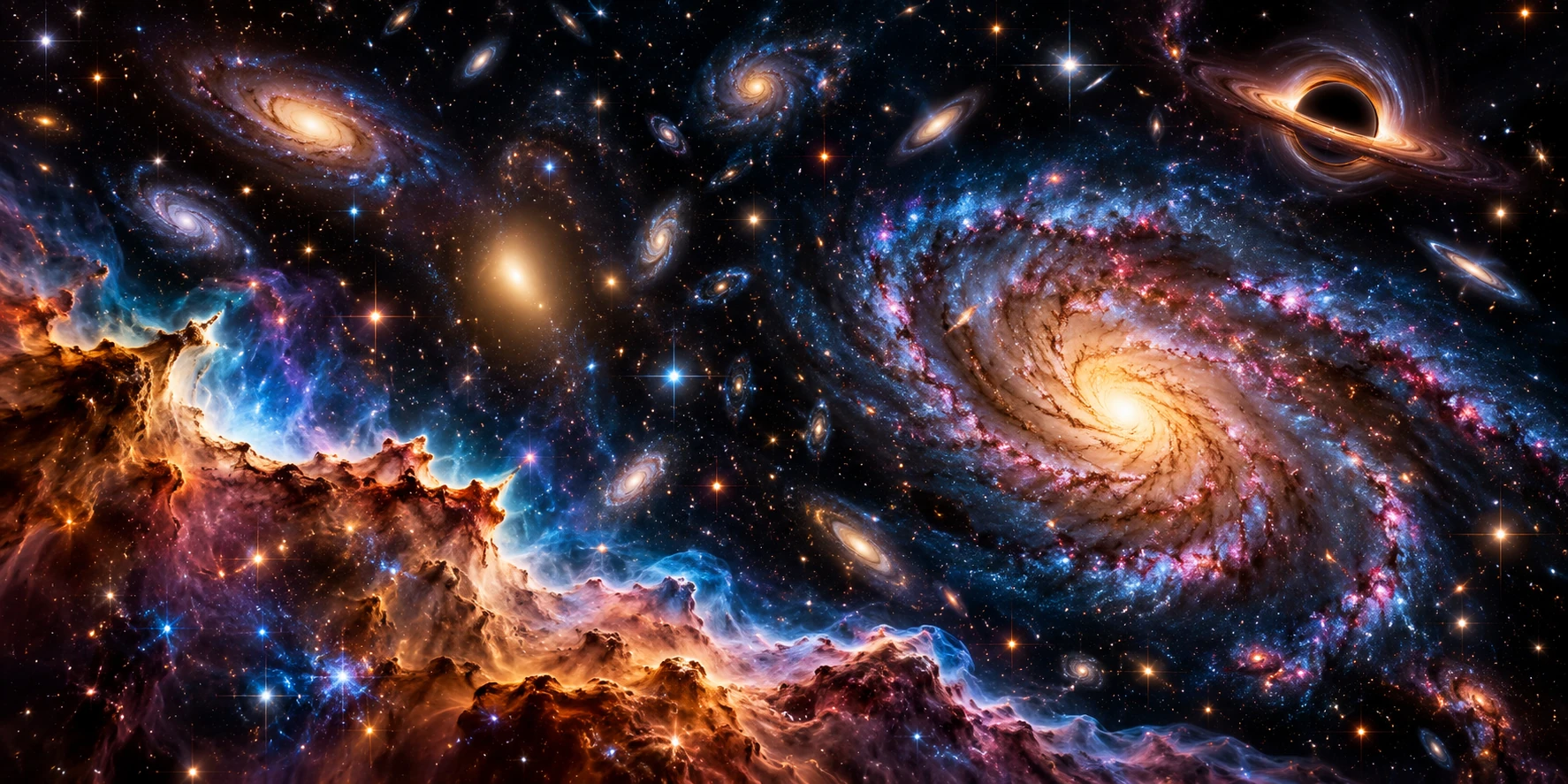
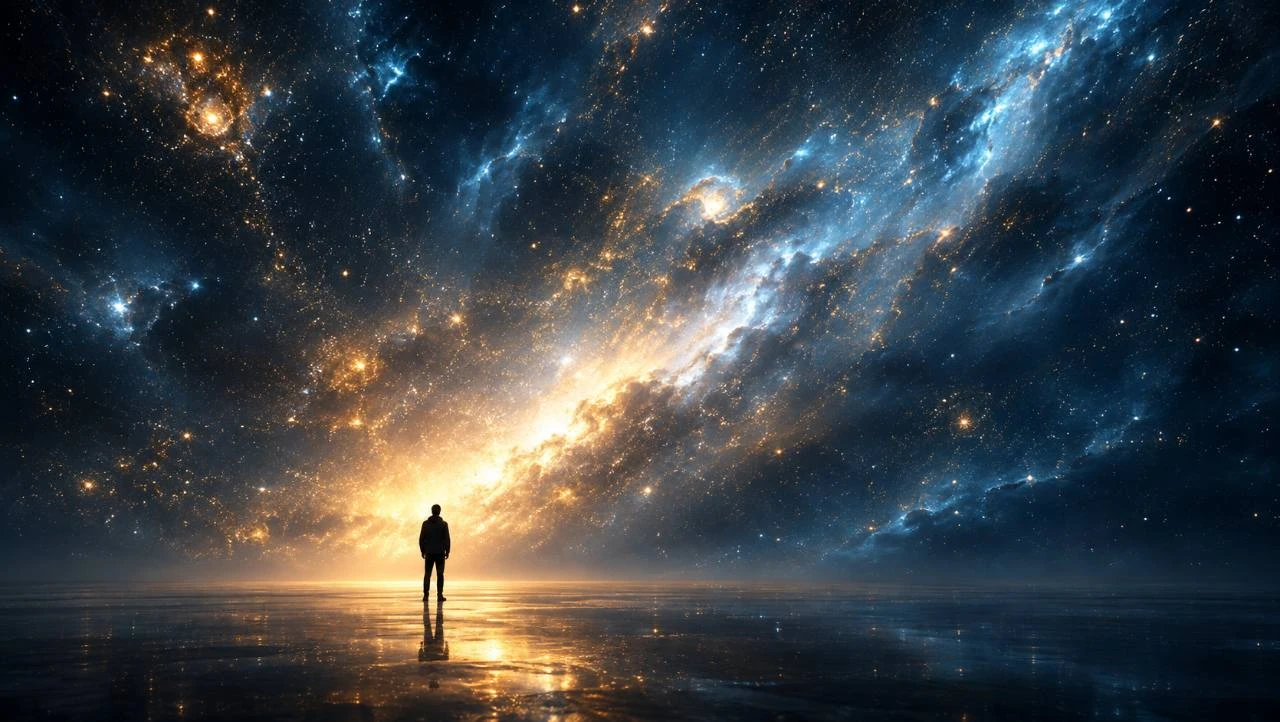
Conceptual cosmic illustration, not a telescope observation, a simulation output or an image of the Big Bang. The human figure, reflective surface and arrangement of cosmic structures are imagined. Editorial image supplied for PRESDA. Original creator and reuse licence not provided.
Imagine removing every star, every planet and every person. Then remove the space that held them and the laws that described their behaviour. The exercise is almost impossible to picture, because even a dark, empty stage would still be something. That difficulty gives an ancient question its continuing force: why does anything exist at all? Science reconstructs an extraordinary history of the universe. The further demand for an explanation of existence itself remains unsettled, and it is important to understand why these are not simply two versions of the same problem.
Why this is different from asking what happened first
A question about the first event asks where a physical history begins or how one state developed from another. A question about existence asks why there is any reality, perhaps including the laws and conditions used in an explanation. Philosophical discussions of nothingness make this distinction explicit. Describing an earlier state may explain a later universe, while leaving the existence of that earlier state open to question. This is not an objection to tracing cosmic history. It identifies the extra demand hidden in the word why. Stanford Encyclopedia of Philosophy: nothingness
What the Big Bang model does explain
Modern cosmology describes a universe that expanded and cooled from an early hot, dense phase. NASA’s overview connects that history with the formation of light elements, the later release of freely travelling radiation and the emergence of stars and galaxies. These are physical processes within an evolving cosmos. Calling this account the Big Bang does not make it a demonstrated creation of all reality from absolute nothingness. Nor is the present uncertainty about the earliest regime a reason to discard the evidence for the later hot universe. NASA: the universe and its early evolution
The cosmic microwave background is a particularly powerful witness. ESA’s Planck mission mapped tiny variations in this ancient radiation, carrying information from when the universe was about 380,000 years old. Within the standard cosmological framework, Planck data support an age of about 13.8 billion years. These numbers are connected to observations and models, not to an eyewitness picture of creation. The approved hero is an imagined cosmic scene. It is not a Planck map, and no person stood outside the universe to watch its origin. ESA: Planck science highlights
Why a quantum vacuum is still something
In quantum field theory, a vacuum is a physical state, not the absence of all structure, properties and rules. The philosophy of cosmology therefore warns against treating a vacuum-based origin story as an automatic answer to the metaphysical question. A model can describe a transition using a quantum state and dynamical principles, while the reader can still ask why those ingredients exist. This does not make the physics empty. It means that the word nothing has shifted meanings between a technical physical description and an absolute philosophical absence. Stanford Encyclopedia of Philosophy: philosophy of cosmology
Models of origins are not observations of creation
Hartle and Hawking’s 1983 wave-function proposal is a classic attempt to formulate a quantum description of the universe. Their paper specifies mathematical ingredients and works through a simplified cosmological model. It is a proposal within theoretical physics, not an experiment witnessing literal nothing becoming something. Such research can change how a beginning or boundary is represented. Evaluating it requires examining mathematical consistency and physical consequences. Even a successful description of cosmic initial conditions would leave a separate question about whether it explains the existence of the framework itself. Hartle and Hawking: wave function of the universe, 1983
NASA notes that what preceded inflation and what powered it remain unknown. That uncertainty should not be filled with an asserted memory of what happened before time. Depending on the model, familiar temporal language may cease to apply in the earliest regime. Saying that there was definitely no before can be as premature as describing that before in detail. Scientific caution is specific: identify which account is being discussed, what evidence supports it and where extrapolation begins. Uncertainty is not a licence to make every imaginable story equally credible. NASA: the universe and its early evolution
Necessary existence and the demand for a reason
One philosophical family of answers argues that contingent things, which might not have existed, require an explanation in something necessary. Leibniz’s version appeals to the principle of sufficient reason and identifies an ultimate necessary ground with God. Other arguments organize the problem differently. Their force depends on contested premises about explanation, necessity and whether a collection of contingent things needs a further ground. A telescope neither directly verifies nor refutes those premises. Presenting the position fairly means acknowledging its argument and its objections, not announcing a scientific discovery of a first cause. Stanford Encyclopedia of Philosophy: cosmological argument
Could existence be a brute fact?
Physicist Sean Carroll defends a different philosophical position: an explanatory account must eventually reach brute facts, rather than an ultimate explanation of why there is any reality. On this view, a self-contained universe need not have an external sustaining cause. This is an argument about the limits of explanation, not a measurement proving that no deeper answer exists. Its critics can ask why we should stop there; its defenders can ask whether the demand for a further reason is itself justified. The dispute concerns the standards of explanation as much as the contents of the cosmos. Sean Carroll: why is there something rather than nothing?
Would a multiverse answer the question?
A multiverse could, in some proposals, place our observable universe within a larger physical structure. Such proposals face questions about evidence, selection effects and how probabilities are defined. They should not be reported as the observed discovery of other universes. More importantly, expanding the inventory of reality is different from explaining why the inventory exists. Even if a particular multiverse account were supported, the question could be asked about its underlying laws and structure. This is a limitation of the proposed answer to the ultimate question, not a blanket rejection of multiverse research. Stanford Encyclopedia of Philosophy: philosophy of cosmology
An open question need not be an empty one
The phrase science cannot settle describes the absence of an established scientific resolution here, not a theorem proving that future inquiry can never contribute. New physics may transform the question. Philosophical analysis may reveal that some demands are mistaken, or clarify what an answer would need to accomplish. None of that warrants replacing uncertainty with a preferred certainty. Our guide to the history of the universe explores the empirical account, while AI consciousness examines a different boundary between observable performance and deeper explanation.
There is something, and we are part of it. That starting point is extraordinary without being evidence for any one metaphysical conclusion. The productive response is to ask better questions: which observation needs explaining, which assumptions are being used and whether a proposed answer explains a process, a beginning or existence itself. Wonder becomes more intellectually powerful when it preserves those distinctions. We can know a great deal about the universe while remaining unsure why there is a universe to know.
Related reading: The scientific history of our universe.
FAQ
Frequently Asked Questions
Does the Big Bang explain why anything exists?
It describes the early hot universe and its subsequent evolution. That is different from establishing why there is any reality, including laws and initial conditions.
Is a quantum vacuum the same as nothing?
No. A vacuum in quantum field theory is a physical state with properties and a theoretical structure. Absolute philosophical nothingness is a different idea.
Has science proved a necessary creator or a brute-fact universe?
No. These are philosophical positions with disputed premises. Cosmological observations do not by themselves settle the ultimate explanatory dispute.
Could future science contribute to the question?
Yes. New theories and observations may change how the problem is understood. No established resolution exists, but that is not a proof of permanent unknowability.
PRESDA Dispatch
Stay Informed. Stay Aware.
A sharp briefing across AI, gaming, sport, business, world affairs, paparazzi, and lifestyle.