Einstein's Equations May Explain the Universe Without Dark Energy
A 2026 mathematical study challenges cosmic expansion models. Understand its assumptions, the dark energy hypothesis and the observational tests still needed.
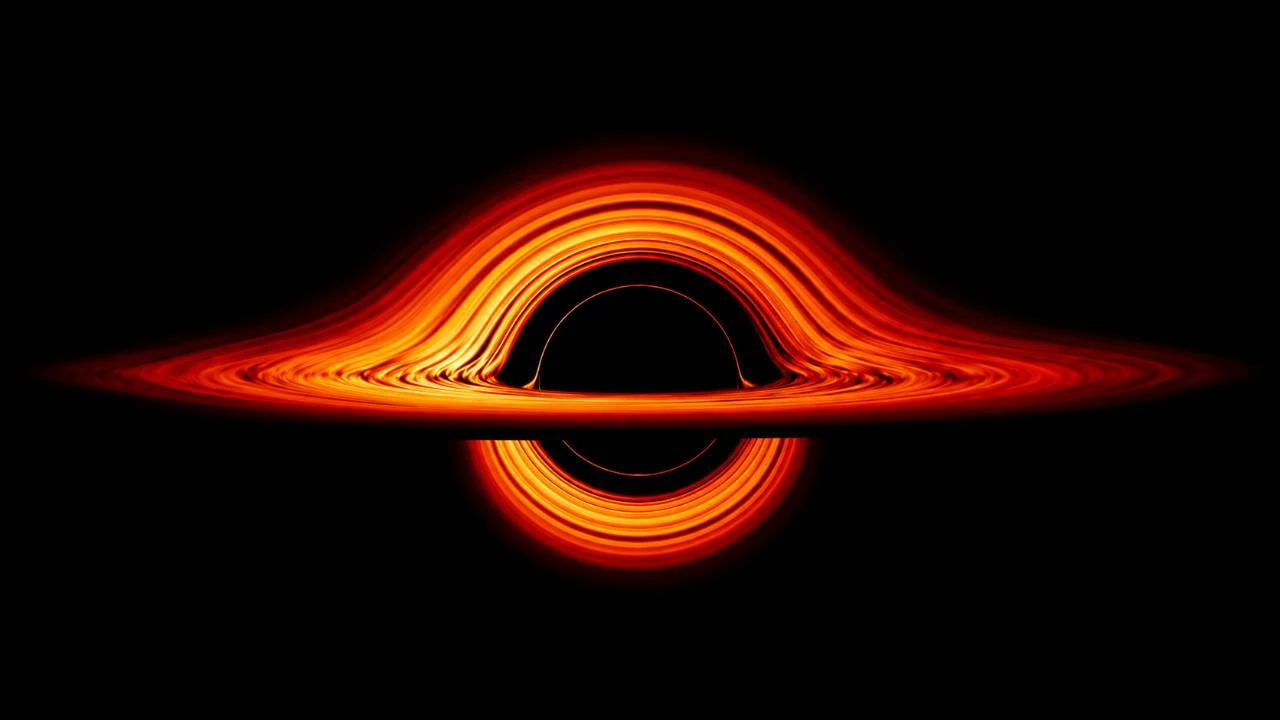
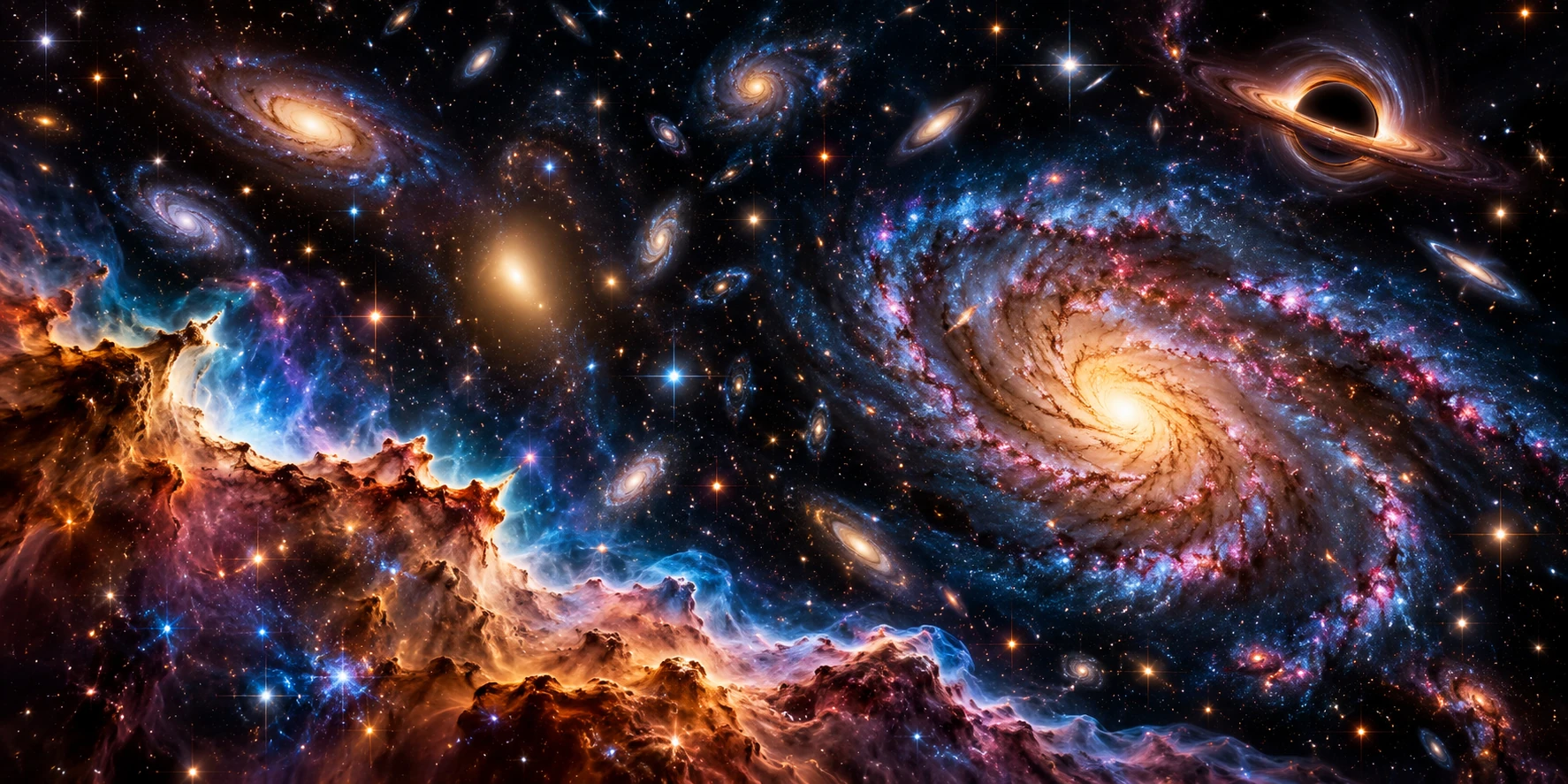
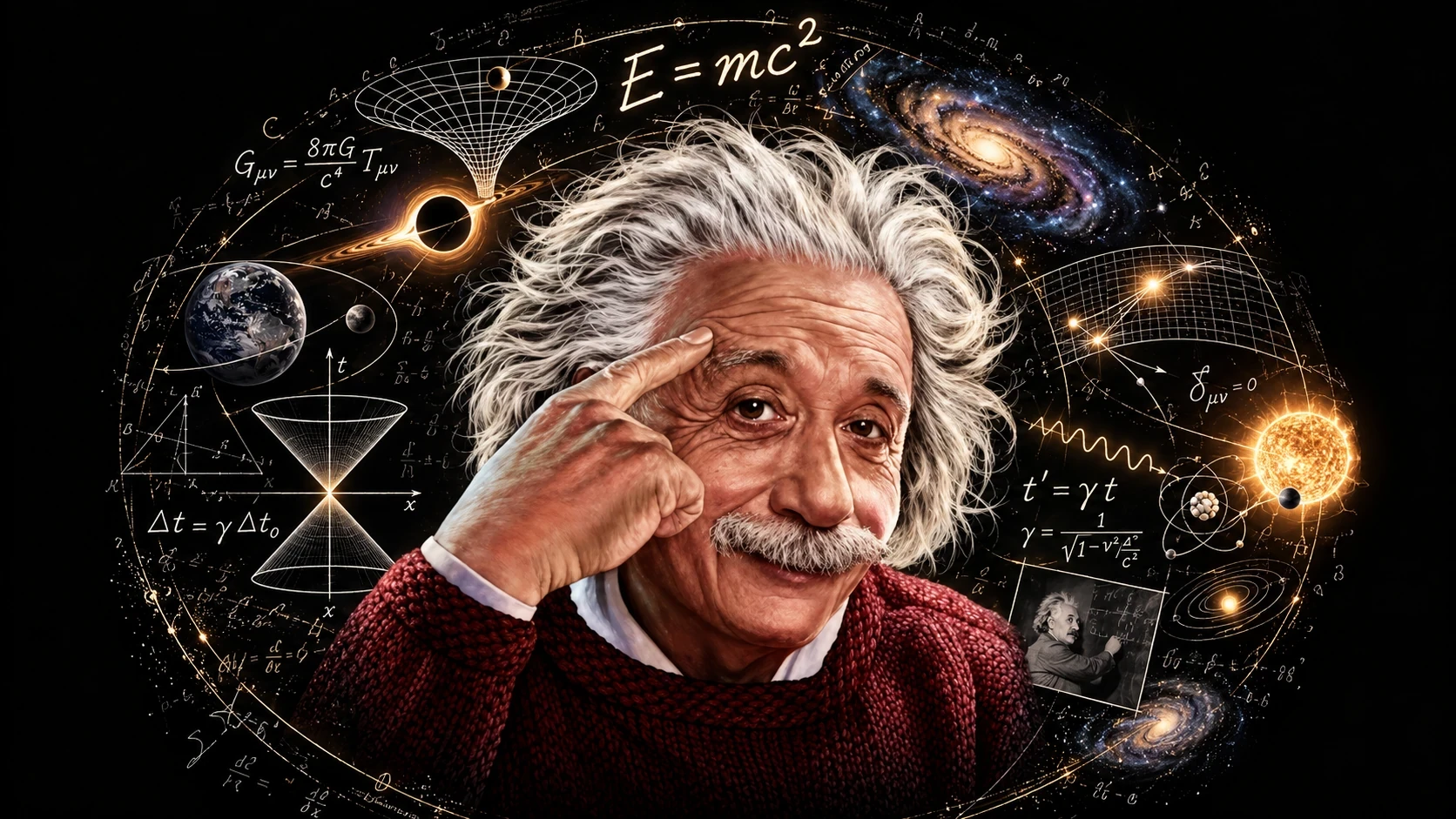
PRESDA AI-generated editorial illustration. The portrait, cosmic scenes and symbols are conceptual, not a scientific diagram or a representation of the study's equations.
What if cosmic acceleration reflects a feature of the universe's geometry rather than an extra ingredient called dark energy? A 2026 study by Christopher Alexander, Blake Temple and Zeke Vogler investigates that possibility within general relativity. It offers a mathematical alternative to explore, not observational proof that dark energy has disappeared from cosmology. The study in Proceedings of the Royal Society A
The distinction matters because the headline contains two different questions. Can Einstein's equations produce a model with the relevant behaviour? And does that model describe the universe astronomers actually observe? A positive answer to the first does not automatically settle the second.
What the 2026 study actually examines
The paper is titled The instability of critical and underdense Friedmann spacetimes at the Big Bang as an alternative to dark energy. It studies pressureless cosmological solutions and radial perturbations: departures from uniformity that vary with distance from a centre. Its mathematical setting combines Einstein's gravity equations with fluid dynamics, the Einstein-Euler system. The authors find instability in the Friedmann solutions they analyse and describe families evolving away from them with an acceleration relative to Friedmann behaviour at intermediate times. Paper and abstract
Why the publication timeline matters
UC Davis discussed the research on May 27, 2026. An October headline should not make it sound like a result first announced that day. Temple, a UC Davis mathematics professor emeritus and the corresponding author, argues that instability could offer an explanation within Einstein's theory without introducing dark energy. That is the researchers' interpretation of their analysis, rather than an agreed replacement for the standard cosmological model. UC Davis research announcement
Why astronomers introduced dark energy
In 1998, two teams studying distant Type Ia supernovae found that their observations pointed to accelerating expansion. Saul Perlmutter, Brian Schmidt and Adam Riess received the 2011 Nobel Prize in Physics for that discovery. The crucial measurement concerned the relationship between distance and cosmic expansion; it was not a laboratory detection of a new substance. The Nobel Prize's account of the discovery
Dark energy is the name given to the unknown explanation for that acceleration. In the standard Lambda-cold dark matter framework, usually written Lambda-CDM, Lambda is the cosmological constant. It behaves as a constant energy density associated with space. NASA describes several possibilities beyond that simplest interpretation, including an evolving field or a limitation of gravity theory on cosmic scales. NASA's dark energy overview
Dark energy and dark matter are different problems
Dark matter helps explain gravitational effects associated with the distribution of matter; dark energy concerns the accelerated expansion of space. Removing a cosmological constant from a proposed model would not, by itself, remove the need to account for dark matter evidence. Nor does the familiar mass-energy relation E = mc², shown in popular Einstein imagery, stand in for the gravitational field equations used in this research. Readers can explore another application of relativity in PRESDA's guide to black-hole interiors. NASA's explanation of the dark universe
How instability could change the interpretation
A solution can satisfy equations exactly yet respond strongly to a small disturbance. Think of a carefully arranged pattern that cannot preserve its form once its surroundings change. A stability analysis asks how departures evolve; it does not merely ask whether the original pattern is mathematically allowed.
Here, the researchers use self-similar variables to study departures from Friedmann expansion. Their results concern a defined mathematical class, including spherical symmetry and pressureless matter. Those assumptions are essential to what has been demonstrated. Translating the result into a claim about every realistic cosmological model would require further argument and testing. The mathematical scope of the paper
A centre of symmetry raises an observational question
UC Davis also highlights the Copernican principle: our observing location should not have a privileged cosmic status. A spherically symmetric alternative introduces a centre, so its interpretation must address where observers can sit while seeing a sky like ours. This is a modelling issue, not evidence that Earth occupies the centre of the universe. Temple challenges how the principle is applied to competing descriptions; his argument does not measure Earth's position in such a model. The authors' discussion of observer location
What would make the alternative convincing?
A replacement must earn its place through predictions that can be compared with independent measurements, including supernova distances, galaxy clustering and the cosmic microwave background. NASA stresses that observations are needed to distinguish a cosmological constant, an evolving dark energy component and alternatives involving gravity. Agreement with one feature of expansion is only part of that task. NASA on the tests of dark energy
Recent observational work already shows why these comparisons must be made carefully. DESI's March 2025 analysis used nearly 15 million galaxies and quasars and combined its measurements with other datasets. The collaboration reported strengthened hints that dark energy could evolve. Such hints concern a different hypothesis from a universe without dark energy; they are not independent confirmation of the Alexander-Temple-Vogler model. Berkeley Lab's DESI results
Mathematical proof and physical evidence have different jobs
A proof establishes a result from specified assumptions. Observations test whether the assumptions and resulting predictions describe nature. Peer review gives the paper a place in the scientific literature, but it does not turn every cosmological interpretation into a measured fact. Further work must connect the proposed geometry to light propagation, observable distances and the broader evidence, while comparing its performance and assumptions with competing models.
Has dark energy been ruled out?
No. The defensible conclusion is that this study develops a possible explanation worth investigating within general relativity. It does not establish that the actual universe contains no dark energy. Its interest lies in pressing a fundamental question: how much of what we infer depends on the cosmic ingredients we assume, and how much on the geometry through which we interpret the evidence?
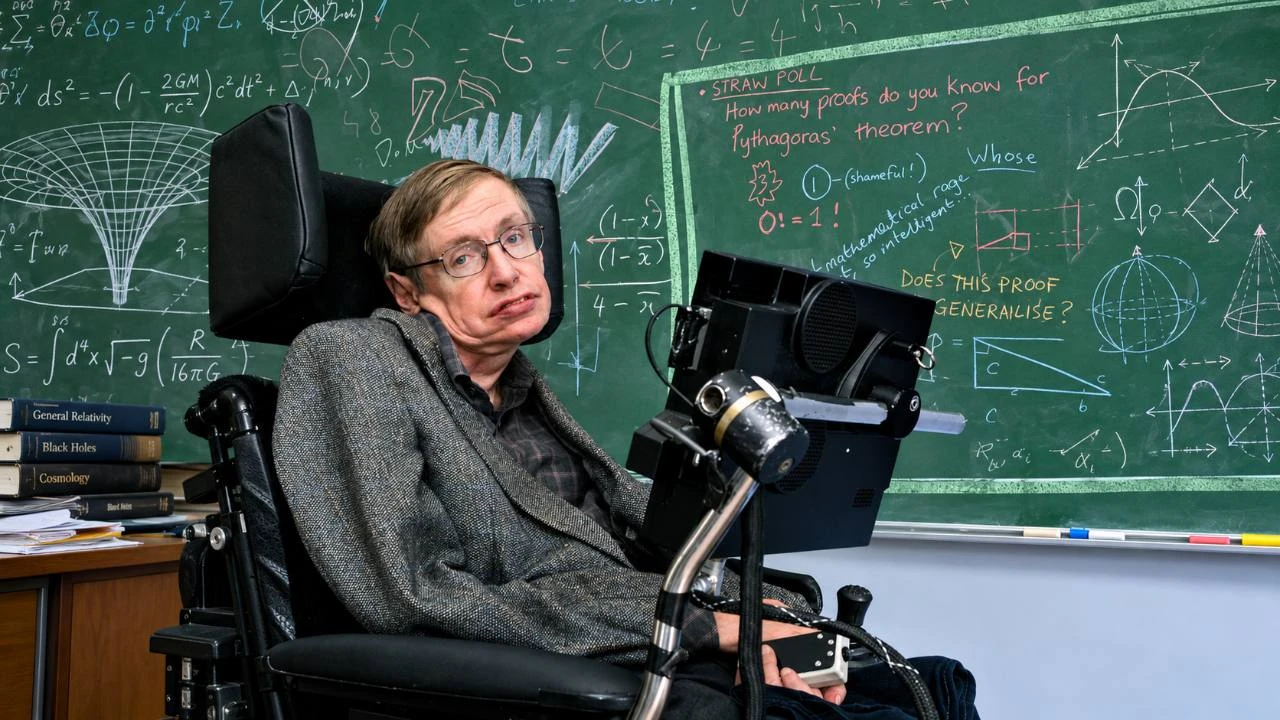
That is a demanding question, rather than a final verdict. Relativity remains both a tool for building models and a framework whose consequences must face observation, a relationship also central to Stephen Hawking's work on black holes and cosmology.
FAQ
Frequently Asked Questions
What is this PRESDA article about?
A 2026 mathematical study challenges cosmic expansion models. Understand its assumptions, the dark energy hypothesis and the observational tests still needed.
Which category does this story belong to?
This story is part of PRESDA's Science coverage.
Who published this article?
Einstein's Equations May Explain the Universe Without Dark Energy was published by PRESDA Editorial on PRESDA.
PRESDA Dispatch
Stay Informed. Stay Aware.
A sharp briefing across AI, gaming, sport, business, world affairs, paparazzi, and lifestyle.