What Happens Inside a Black Hole?
What happens beyond an event horizon? Explore black-hole formation, tidal forces, singularities, Hawking radiation and the limits of current science.
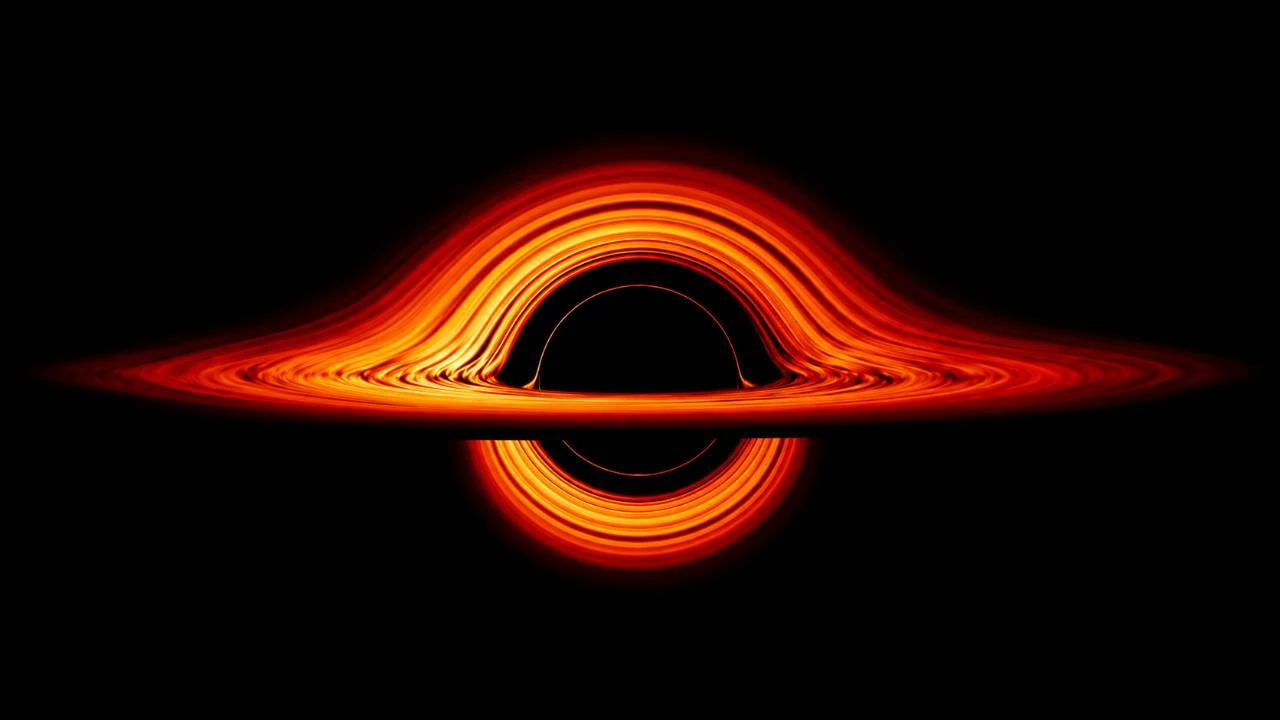
User-supplied black-hole illustration showing a luminous disk distorted by gravitational lensing. Not an observation of the interior or a scale diagram.
A black hole is not a hole punched through a backdrop of stars. It is a region of spacetime from which signals cannot reach the distant outside universe. Its boundary, the event horizon, is one of the clearest ideas in modern physics. What ultimately happens deeper inside is among the least settled. General relativity predicts an unavoidable breakdown in the simplest classical model, but no observation has shown us the final destination of falling matter.
That distinction makes the question more interesting, not less. Scientists have compelling evidence for astrophysical black holes through stellar orbits, radiation from nearby gas, gravitational waves and images of horizon-scale surroundings. They do not have a camera report from beyond an event horizon. To follow a hypothetical journey inward is therefore to move through layers of knowledge: observation first, well-tested theory next, and eventually questions requiring physics we do not yet possess.
How nature makes a black hole
One established route begins when a massive star exhausts the processes that support its core against gravity. Depending on the core and the star’s history, collapse can leave a neutron star or produce a black hole. Not every dying star becomes one, and the Sun is not massive enough to follow this route. Black holes also grow by accreting matter and by merging. Their existence does not require a cosmic vacuum cleaner that pulls in everything at unlimited distance. NASA on black-hole types
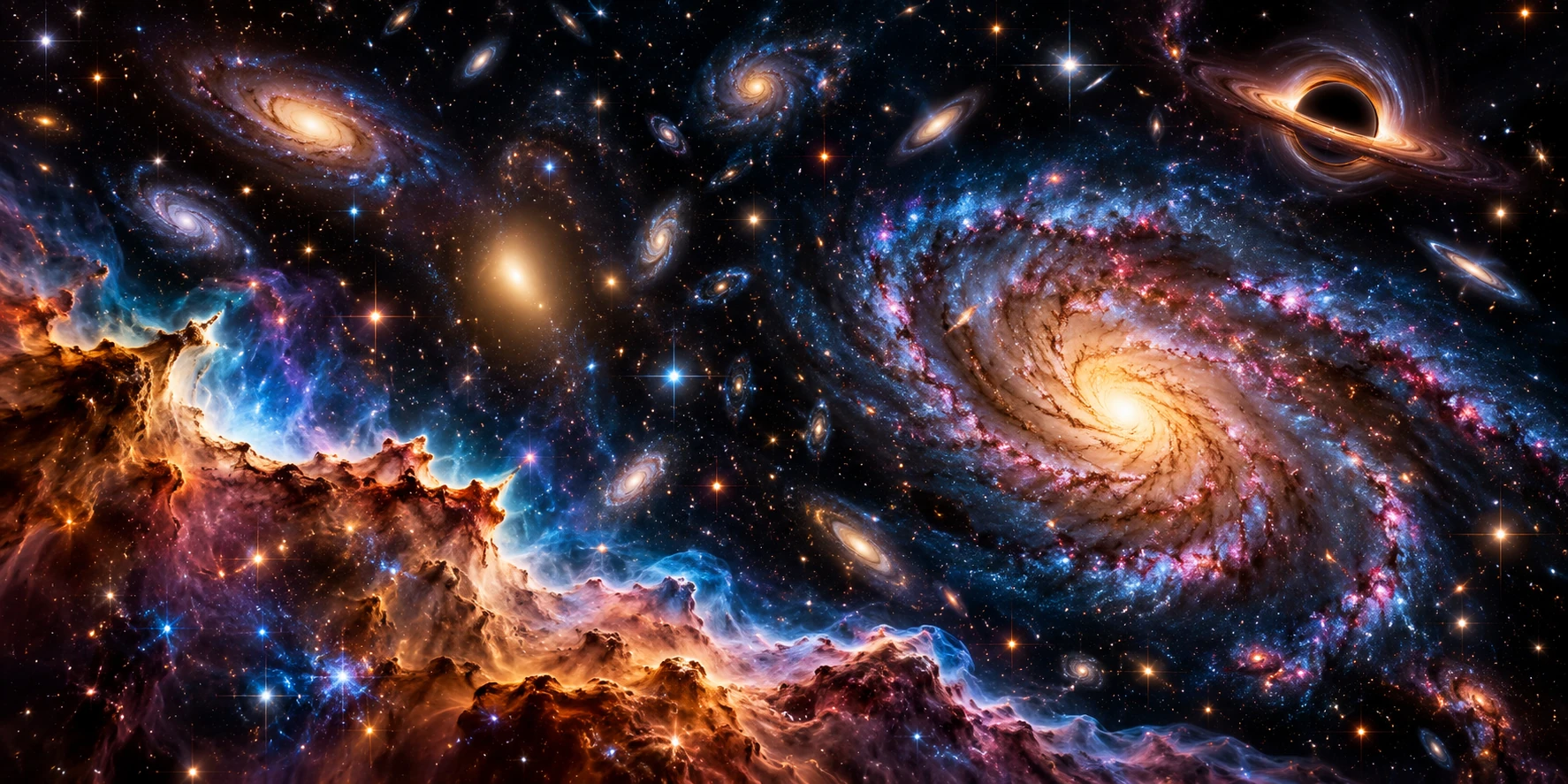
Supermassive black holes occupy the centers of many galaxies, but how their earliest seeds formed and grew remains an active research problem. Collapse of massive gas clouds and growth from stellar remnants are among the possibilities studied. Primordial black holes, proposed to form from conditions in the early universe, belong to another category: a hypothesis, not an established population. The word black hole describes a physical kind of region, not one uniquely known birth process.
The event horizon is a causal boundary
The horizon is not a solid surface. In the classical description, it separates events that can send light outward to distant observers from those that cannot. Inside a simple nonrotating black hole, all future-directed paths available to light and matter lead toward smaller radius. Escape is not prevented merely by an engine being too weak. There is no outward route to the distant universe available within the light-speed limit.
For an ideal nonrotating, uncharged black hole, the horizon radius is 2GM/c², where G is the gravitational constant, M the mass and c the speed of light. A solar mass corresponds to a radius of roughly three kilometers. This is a scale relation, not a claim that a Sun-mass black hole necessarily forms through ordinary stellar collapse. Rotation changes the geometry, so this simple formula is not a universal radius for every black hole. NASA’s black-hole mathematics
Why the surroundings can be brilliant
Gas falling toward a black hole can form a hot accretion disk outside the horizon. Frictional and magnetic processes in the flow release energy, making the environment luminous even though the interior cannot send light back out. Strong gravity bends the light’s paths, producing distorted views of the disk. The bright arcs in illustrations represent that surrounding material and lensing, not flames burning inside an observable cavity. NASA’s anatomy guide
Some systems also launch powerful jets from their surroundings. Those outflows are not material climbing out after crossing the event horizon. Equally, a black hole without a bright supply of nearby gas need not display a spectacular disk. The popular glowing-ring image is a view of an environment under particular conditions, rather than a mandatory appearance for every black hole. Our supplied hero is an illustration of such an environment, not a photograph of the interior.
What a falling traveler would experience
Imagine a freely falling observer approaching a sufficiently large, quiet black hole. In classical relativity, crossing its horizon need not produce a sudden local collision with a wall. A clock carried by the observer continues ticking normally along its own path, and the crossing occurs after a finite amount of that observer’s time. This is a theoretical thought experiment, not a practical voyage: radiation, gas and other hazards can make real environments lethal well before the horizon.
NASA’s relativistic visualizations explore such journeys by calculating light paths and camera motion. They illustrate predictions of a chosen model, not observations of an actual descent. For a large enough hole, tidal forces at the horizon can be relatively modest. That does not provide a return ticket. Local conditions may be unremarkable at the crossing while the global ability to communicate with the outside has changed irreversibly. NASA’s simulated plunge
Time dilation does not freeze the traveler’s clock
Compare that falling observer with someone far away receiving successive light signals. Signals sent from closer to the horizon arrive increasingly delayed and redshifted in the idealized picture. The outside observer does not see a bright, permanently frozen person glued to the boundary. The signal fades and shifts out of detectable bands. The falling observer’s own clock, meanwhile, has not stopped.
Relativity distinguishes the time recorded along a person’s path from coordinate descriptions used to map events. Confusing the two creates the apparent contradiction that a traveler both crosses and never crosses. The exterior Schwarzschild time coordinate becomes ill-behaved at the horizon; this is not evidence of a physical wall there. Nor does falling in automatically grant a view of the entire infinite future of the universe. University of Texas astronomy notes
Spaghettification: the importance of differences
The dangerous stretching effect comes from tidal forces: gravity differs between neighboring parts of an extended object. Feet closer to the black hole follow a different tendency from a head farther away. In an appropriate falling frame, the object stretches in one direction and is squeezed in others. The same broad principle produces familiar tides, but the gradients near a compact object can become destructive. NASA on tidal disruption
Mass matters in a counterintuitive way. At the horizon of a larger black hole, the tidal gradient can be weaker than at the horizon of a smaller one. Thus a stellar-mass hole may tear an extended object apart before crossing, whereas a sufficiently large supermassive hole can allow a gentler crossing followed by destruction deeper in. There is no single universal point of spaghettification independent of the hole, trajectory and object. A human body is not a test particle, so mathematical paths alone are not survival predictions.
The singularity marks the limit of the classical account
In the ideal Schwarzschild solution, continued inward travel ends at a singularity where curvature grows without bound. General singularity theorems establish, under specified assumptions, that classical spacetime cannot always be extended along every freely falling path. They do not establish the microscopic composition of a final object. Treating the singularity as a photographed nugget of infinitely dense matter mistakes a mathematical limit for an observation. Hawking and Penrose’s singularity theorem
Rotating solutions have more elaborate interior structures, and realistic disturbances make their interpretation harder. Extrapolating an ideal mathematical extension into a usable passage to another universe is not justified. Researchers expect quantum gravity to matter where classical curvature becomes extreme, but they do not yet have an experimentally confirmed description of that regime. The responsible answer to what ultimately replaces the singularity is that we do not know.
Can a black hole evaporate?
Stephen Hawking’s calculation predicts thermal radiation from quantum fields in a black-hole spacetime. A hole losing more energy than it absorbs would lose mass. For the simplest case, smaller holes have higher temperatures. Astrophysical holes are predicted to be extremely cold, and their radiation has not been detected directly. The hot light from an accretion disk is a different process and must not be presented as Hawking radiation. Hawking’s detailed radiation calculation
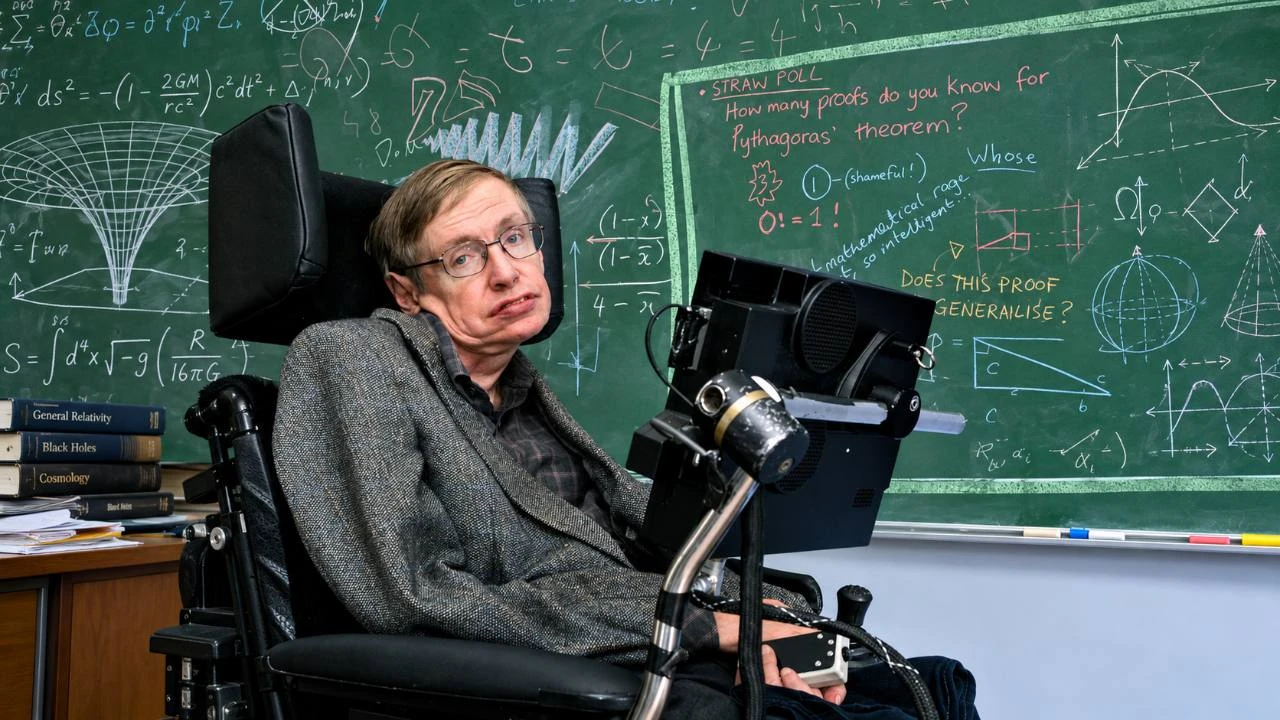
The radiation is not a classical escape route for a person or a message from behind the horizon. It changes the long-term energy balance of the system through a quantum effect. Extrapolating the calculation to the very last stage of evaporation eventually requires physics beyond its semiclassical assumptions. Claims that the final outcome is definitely an explosion, a remnant or a new universe go beyond established evidence. Our Stephen Hawking biography explains how this prediction transformed his field.
Where does the information go?
Ordinary quantum evolution preserves information about a complete physical state. Hawking’s original evaporation picture seemed to allow it to disappear into featureless thermal radiation. Reconciling these descriptions is the information paradox. Information in this context concerns quantum states and correlations, not whether an observer can reconstruct a familiar object with ordinary tools. Losing practical access and destroying information fundamentally are different claims. Hawking’s 1976 analysis
Research involving holography and quantum entanglement has made substantial progress in model systems. Calculations of radiation entropy can recover behavior consistent with information preservation. Such results are important clues rather than a direct observation of the interior of an astrophysical hole. They have not produced a universally verified account of what every falling observer experiences. A solution in a controlled theoretical setting and an experimentally established explanation of nature remain distinct achievements. Maldacena’s research perspective
What observations establish, and what remains hidden
The first gravitational-wave signal observed by LIGO on September 14, 2015, and announced in February 2016 matched the merger of two black holes. The Event Horizon Telescope released an image of M87*’s surroundings in 2019 and Sagittarius A*’s in 2022. These observations test strong gravity through exterior signals. The dark shadow in an EHT image is not a resolved photograph of the physical interior, and its apparent boundary is not simply the horizon’s diameter. LIGO’s detection record ESO on Sagittarius A*
The achievement is substantial without inventing a final answer. We can measure effects of objects whose interiors cannot report back, compare those measurements with relativity and identify where theory becomes incomplete. The journey from Newton’s laws and gravity to black-hole physics is a story of increasingly precise descriptions, each with a domain of validity. Beyond the horizon, science offers powerful conditional predictions. At the deepest limit, intellectual honesty requires an open question rather than a fictional destination.
FAQ
Frequently Asked Questions
What is this PRESDA article about?
What happens beyond an event horizon? Explore black-hole formation, tidal forces, singularities, Hawking radiation and the limits of current science.
Which category does this story belong to?
This story is part of PRESDA's Science coverage.
Who published this article?
What Happens Inside a Black Hole? was published by PRESDA Editorial on PRESDA.
PRESDA Dispatch
Stay Informed. Stay Aware.
A sharp briefing across AI, gaming, sport, business, world affairs, paparazzi, and lifestyle.