OUR SOLAR SYSTEM: THE SUN, EIGHT PLANETS AND BEYOND
Explore the Sun, all eight planets, ocean moons and distant icy worlds, with NASA planet comparisons and clear explanations of our Solar System.
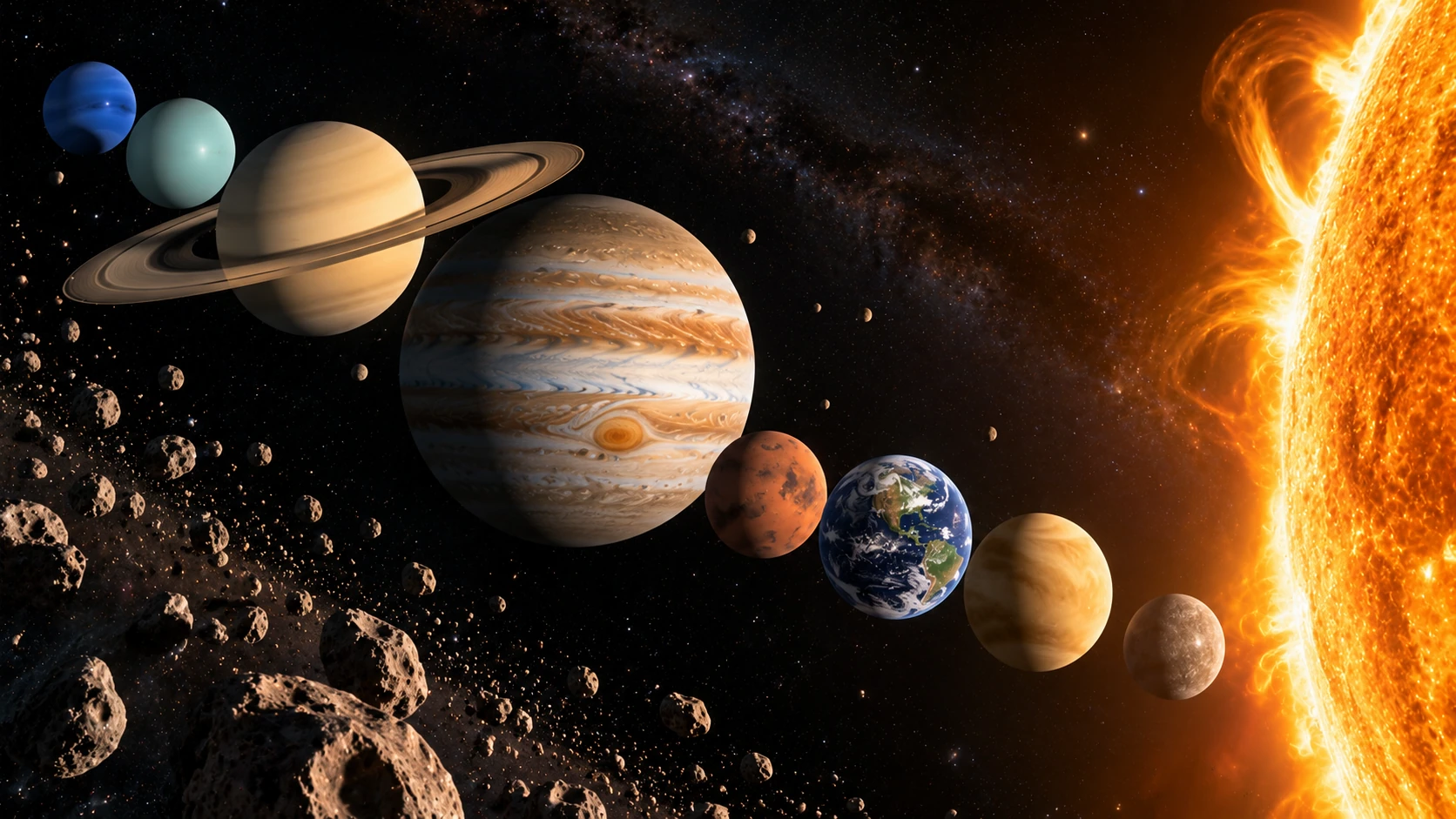
PRESDA artistic illustration generated with AI, not a real photograph. Planetary sizes, distances and alignment are not to scale. This is not an orbital map or an actual configuration. Original composition and colours preserved.
The Solar System is a family held together by gravity: one star, eight planets, their moons and immense populations of smaller bodies. It is also a record of transformation. Dust became worlds; collisions rearranged their surfaces; atmospheres escaped or thickened; sunlight powered a living planet. What looks orderly in a classroom diagram is a dynamic environment whose history we reconstruct from rocks, light, spacecraft measurements and physical models.
The familiar outward sequence is Mercury, Venus, Earth, Mars, Jupiter, Saturn, Uranus and Neptune. But a journey through this neighbourhood should not stop at memorizing names. It should explain why these worlds differ, how their motions work and where the Sun's domain ends. Our hero is an artistic illustration, not a photograph or an orbital map. Planetary sizes, distances and the apparent alignment are not to scale or a depiction of a particular moment.
A beginning written in dust and meteorites
About 4.6 billion years ago, part of a molecular cloud collapsed under gravity. Most of the accumulating material went into the young Sun, while surrounding gas and dust formed a rotating disc. Within that disc, solids collected into larger bodies through a complicated sequence of sticking, collisions and gravitational growth. Meteorites and returned samples preserve chemical and chronological evidence of these early processes. The broad disc-origin picture is well supported, although the precise history of planetary assembly remains under investigation. NASA: Solar System formation
Temperature helped determine what could condense where. The hot inner regions favoured rocky and metallic materials; colder regions allowed more volatile substances to join growing bodies. Giant planets acquired substantial envelopes, while smaller rocky worlds developed very differently. That explanation is a framework, not a claim that every planet formed quietly in its present orbit. Migration, impacts and gravitational encounters are important parts of modern models. The Solar System is therefore an archaeological site with missing evidence, not a construction project whose every step has been recovered. NASA: planetary systems
The Sun: a star, not a burning ball of fire
The Sun produces energy through nuclear fusion in its core, where hydrogen is converted into helium and a small amount of mass becomes energy. This is not chemical combustion requiring oxygen. Energy moves outward through the radiative zone and then the convective zone before escaping from the visible photosphere. Above that lie the chromosphere and corona. The core reaches roughly 15 million degrees Celsius; different layers have very different temperatures. The apparent surface is not solid ground on which anything could stand. NASA: Sun facts
Our star also sends charged particles into space as the solar wind, carrying magnetic fields outward. The corona, solar wind and magnetic eruptions connect the Sun to the planets far beyond its visible outline. When solar disturbances interact with Earth's magnetic environment, they can produce auroras and disrupt technological systems. A flare and a coronal mass ejection are related kinds of solar activity, but not identical events. Understanding this changing environment is practical science as well as astronomy: spacecraft, communications and electrical infrastructure all operate within it. ESA: space weather
Rotation, revolution and the geometry of falling
Rotation is a body's spin about its axis. Revolution is its motion around another body, such as a planet's journey around the Sun. Gravity continually bends a planet's path; its sideways motion prevents it from simply falling straight inward. Kepler's laws describe elliptical orbits with the Sun at one focus, and planets move faster near perihelion, their closest approach, than near aphelion. Most planetary orbits are only modestly elongated. Illustrations often exaggerate their oval shapes so that the geometry is easier to see. NASA: orbits and Kepler's laws
A day also needs a definition. One rotation relative to distant stars is not always the same interval as one sunrise-to-sunrise cycle, because orbital motion matters too. Venus makes this distinction especially striking. Nor are Earth's seasons primarily caused by changing distance from the Sun: axial tilt changes the angle and duration of illumination in each hemisphere. Gravity is not absent in space, and an astronaut's apparent weightlessness in orbit reflects continuous free fall rather than escape from Earth's attraction. NASA: Earth facts NASA: microgravity
Eight planets, compared on the same basis
The table uses NASA's metric planetary fact sheet. Distances are rounded orbital semimajor axes, commonly described as average distances from the Sun; actual distance changes during an orbit. Diameters are equatorial, not mean diameters, and giant-planet measurements refer to a reference atmospheric level rather than solid ground. Orbital periods are rounded Earth days, using the source's convention. These choices keep the comparisons consistent and avoid mixing incompatible numbers. NASA: planetary fact sheet NASA: definitions
| Planet | Distance from Sun (million km) | Equatorial diameter (km) | Orbital period (Earth days) | Key feature |
|---|---|---|---|---|
| Mercury | 57.9 | 4,879 | 88 | Smallest planet |
| Venus | 108.2 | 12,104 | 224.7 | Hottest planetary surface |
| Earth | 149.6 | 12,756 | 365.2 | Only known inhabited world |
| Mars | 228 | 6,792 | 687 | Iron-oxide-rich reddish surface |
| Jupiter | 778.5 | 142,984 | 4,331 | Largest planet |
| Saturn | 1,432 | 120,536 | 10,747 | Prominent icy rings |
| Uranus | 2,867 | 51,118 | 30,589 | Axis tilted about 98° |
| Neptune | 4,515 | 49,528 | 59,800 | Outermost major planet |
Mercury: small, dense and exposed
Mercury is the innermost and smallest planet, a cratered rocky world with a disproportionately large metallic core. It completes an orbit in about 88 Earth days, yet rotates much more slowly than Earth. Its extremely thin exosphere cannot redistribute heat like a substantial atmosphere, producing severe contrasts between illuminated and dark regions. Being closest to the Sun does not make Mercury the hottest planet. Water ice can persist in permanently shadowed polar craters, where sunlight does not directly reach the ground. That combination is a useful warning against judging an entire world from its average solar distance. A planet's atmosphere, rotation and local terrain all shape its environment. NASA: Mercury
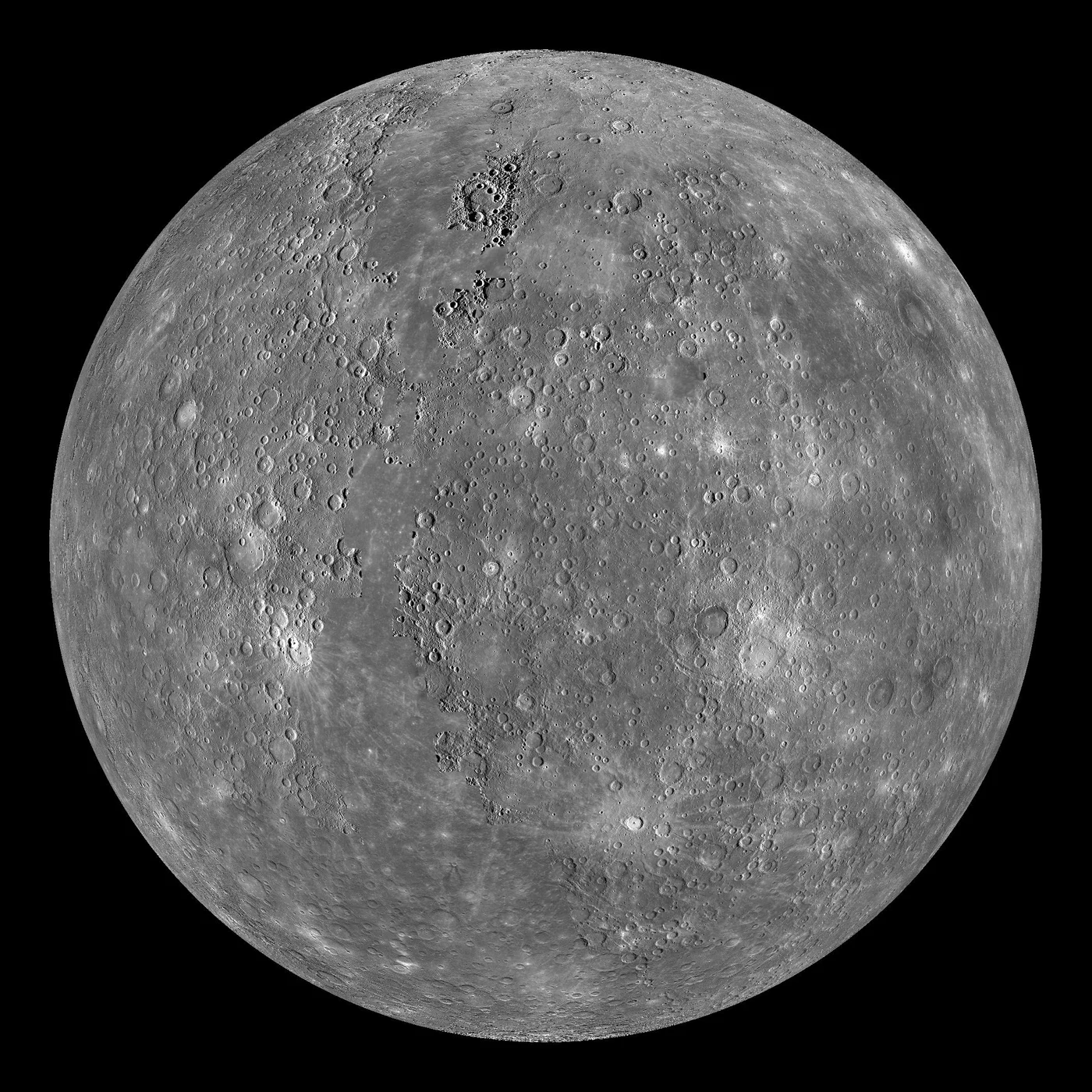
MESSENGER global view of Mercury, released in 2011.
NASA/Johns Hopkins University Applied Physics Laboratory/Carnegie Institution of Washington
NASA media usage guidelines. Resized and converted to WebP by PRESDA. Full composition preserved. Reuse follows the individual license stated here.
Venus: the danger of a superficial resemblance
Venus is similar to Earth in size but radically different at its surface. Its thick carbon-dioxide atmosphere produces an intense greenhouse effect, making it hotter than Mercury despite its greater distance from the Sun. Clouds rich in sulfuric acid conceal the landscape in ordinary visible-light views. Venus rotates slowly in the opposite direction to most planets: one sidereal rotation lasts roughly 243 Earth days, longer than its approximately 225-day year. Its solar day is different, about 117 Earth days. This is why the familiar statement that a Venusian day exceeds its year needs qualification. Similar size does not guarantee a familiar climate, and speculative claims of life in its clouds are not established detections. NASA: Venus
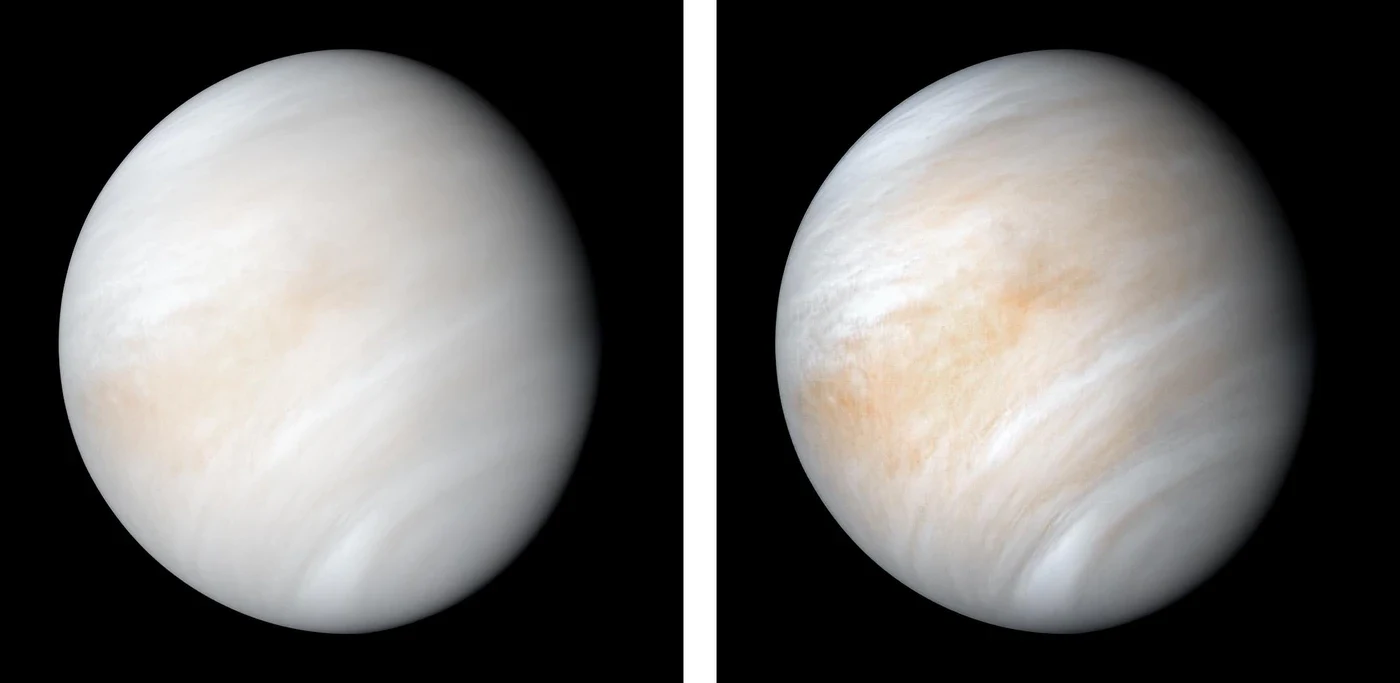
Mariner 10 observations from February 1974, reprocessed in 2020 by Kevin M. Gill. False-colour views combine ultraviolet and orange filters; the right view has enhanced contrast.
NASA/JPL-Caltech; processing: Kevin M. Gill
NASA media usage guidelines. Resized and converted to WebP by PRESDA. Full composition preserved. Reuse follows the individual license stated here.
Earth: the world that makes comparison possible
Earth is the only world known to host life, with extensive liquid-water oceans, an atmosphere and an active geological system. Its surface is continually reshaped by plate tectonics, erosion and biological activity. Our planet is neither a standard destiny for rocky worlds nor a guarantee that similar-sized exoplanets will be habitable. Oceans, atmosphere, interior processes and the Sun interact over time. Earth's magnetic field helps shape its response to the solar wind, while the atmosphere provides essential protection and regulates temperature. Understanding these systems requires measurements, not a single label such as Earth-like. The planet is our reference point because we can investigate it closely, not because every other world must resemble it. NASA: Earth overview
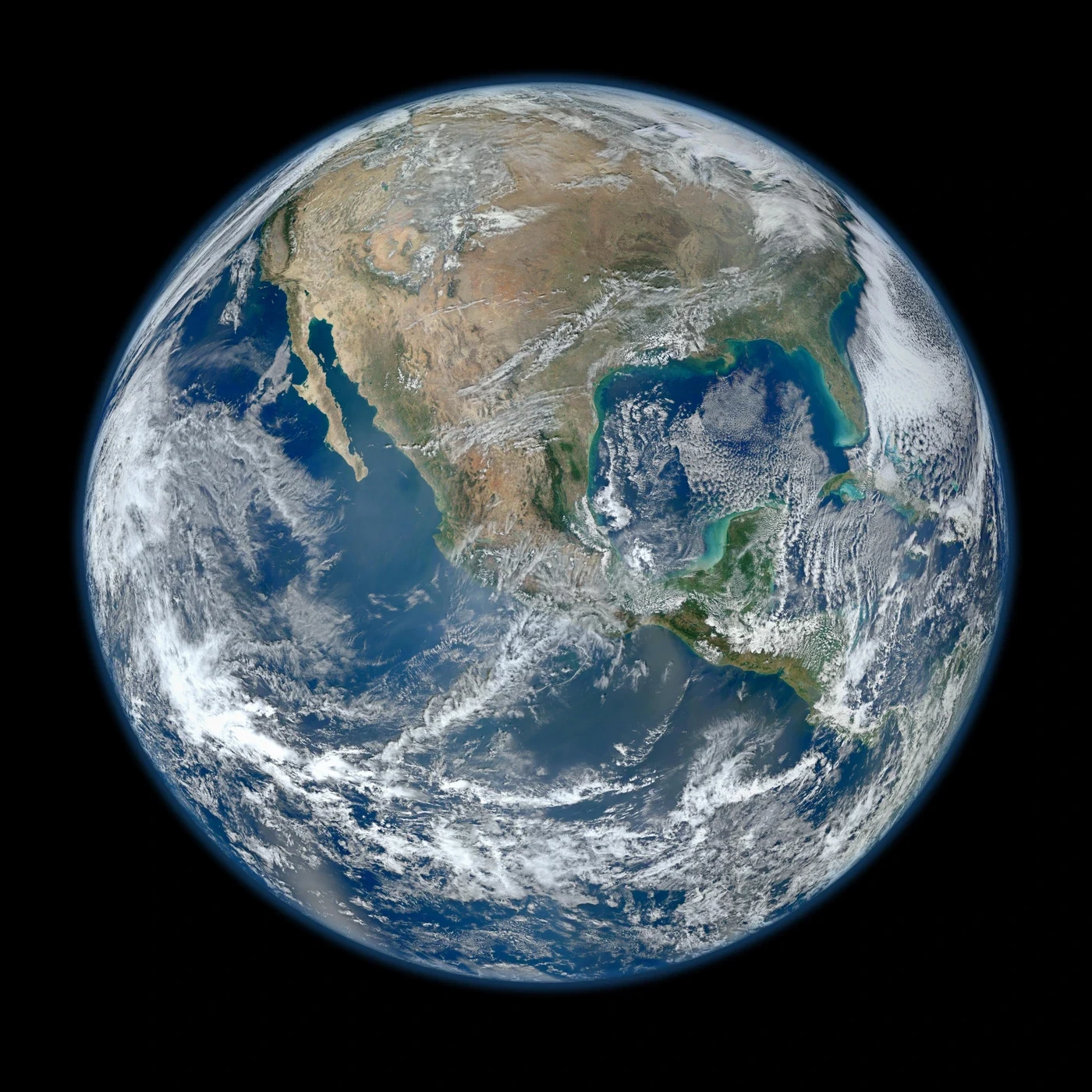
Blue Marble composite from four Suomi NPP satellite orbits in January 2012. This is a projected composite, not a single exposure.
NASA media usage guidelines. Resized and converted to WebP by PRESDA. Full composition preserved. Reuse follows the individual license stated here.
Mars: a changed world with an accessible past
Mars has a thin atmosphere, a cold surface and geological evidence that liquid water once shaped parts of its landscape. Ancient channels, lake sediments and water-altered minerals are clues to past environments, not proof that organisms inhabited them. Its reddish appearance comes largely from iron minerals altered by oxidation. The planet has polar ice, towering volcanoes and enormous canyon systems, alongside the small moons Phobos and Deimos. A Martian year lasts about 687 Earth days; its rotation is much closer to Earth's than Venus's. Rovers make Mars unusually tangible, but a photograph of an interesting rock is not a biological diagnosis. Claims about ancient life require multiple lines of evidence and careful exclusion of non-biological explanations. NASA: Mars
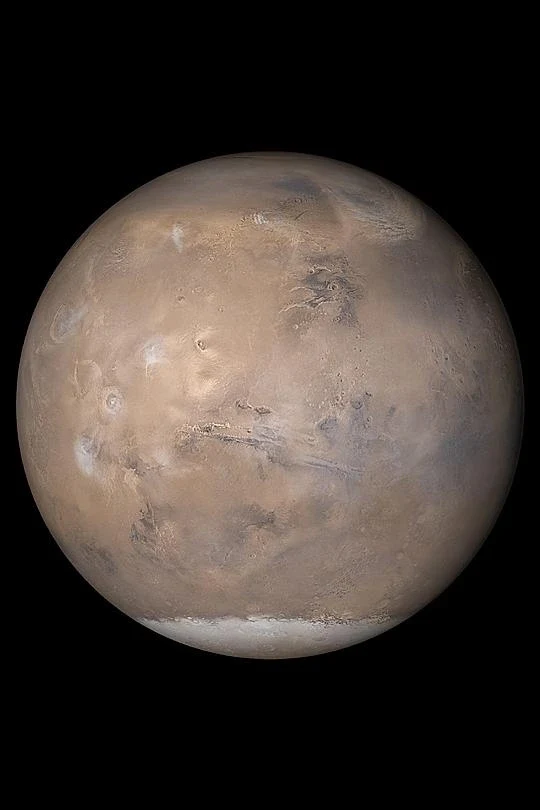
Mars Global Surveyor view of Mars, published by NASA in 2003.
NASA/JPL/Malin Space Science Systems
NASA media usage guidelines. Resized and converted to WebP by PRESDA. Full composition preserved. Reuse follows the individual license stated here.
Jupiter: the giant with a system of its own
Jupiter is the largest planet and consists mainly of hydrogen and helium. Its cloud bands and storms belong to a deep atmosphere, not a thin covering above a familiar rocky surface. Rapid rotation helps shape its flattened figure and atmospheric circulation. The Great Red Spot is a long-lived storm whose appearance changes, rather than a permanent painted marking. Beneath the clouds, pressure transforms the behaviour of matter; detailed interior models are tested through gravity and magnetic measurements. Jupiter's powerful magnetosphere makes its surroundings a challenging radiation environment. Its moons, rings and gravitational influence turn it into much more than a large destination on a planetary checklist. Understanding Jupiter means studying a connected system. NASA: Jupiter
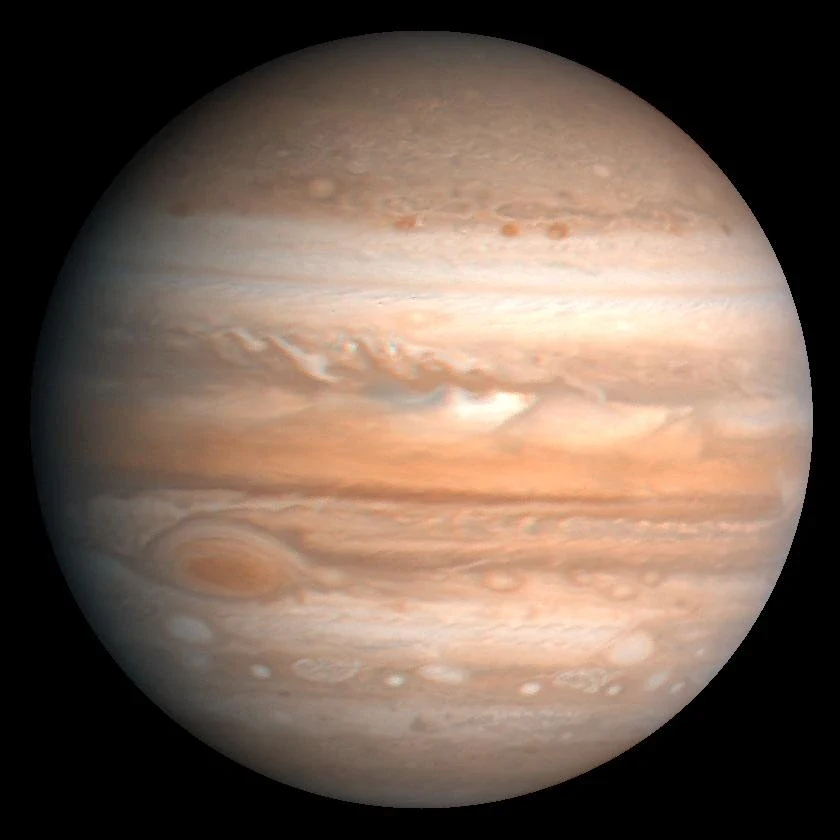
Jupiter from Voyager observations in 1979, processed by the US Geological Survey in 1990.
NASA media usage guidelines. Resized and converted to WebP by PRESDA. Full composition preserved. Reuse follows the individual license stated here.
Saturn: rings made of countless separate objects
Saturn's bright rings are not solid discs. They contain innumerable particles, composed largely of water ice with other material, following their own orbits. Gaps, waves and structure reveal interactions among the particles and moons. Saturn itself is a hydrogen-and-helium giant with no accessible solid surface like Earth's. Its average density is lower than water's, although the popular floating-in-a-bathtub comparison is only a density analogy, not a physically workable experiment. The rings also are not unique: all four giant planets have ring systems. What makes Saturn distinctive is their extraordinary visibility. Their origin and evolution remain research subjects, so an attractive image should not be mistaken for a settled account of their age. NASA: Saturn
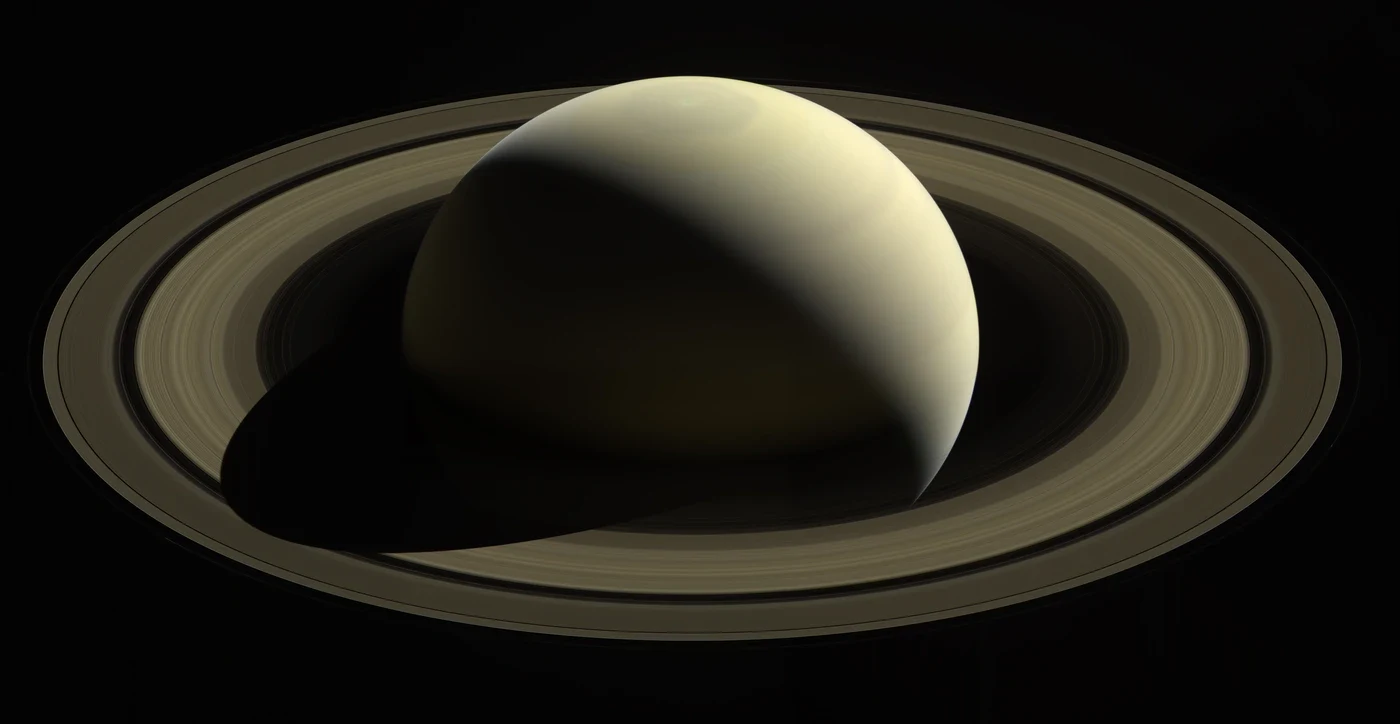
Cassini colour composite of Saturn and its rings from October 28, 2016 observations, released in 2017.
NASA/JPL-Caltech/Space Science Institute
NASA media usage guidelines. Resized and converted to WebP by PRESDA. Full composition preserved. Reuse follows the individual license stated here.
Uranus: a planet tilted almost onto its side
Uranus is an ice giant, a category reflecting a different bulk composition from Jupiter and Saturn, not a claim that it is a frozen solid ball. Its atmosphere contains hydrogen, helium and methane; methane absorbs red light and contributes to its blue-green appearance. Its rotation axis is tilted about 98 degrees, creating extreme seasonal illumination during its long orbit. A major collision is one proposed explanation for that orientation, but the full history remains debated. Rings and moons accompany the planet, while its interior structure and unusual magnetic field pose questions that a single flyby cannot settle. The word ice in planetary science should not conceal the high pressures and temperatures expected deep inside. NASA: Uranus
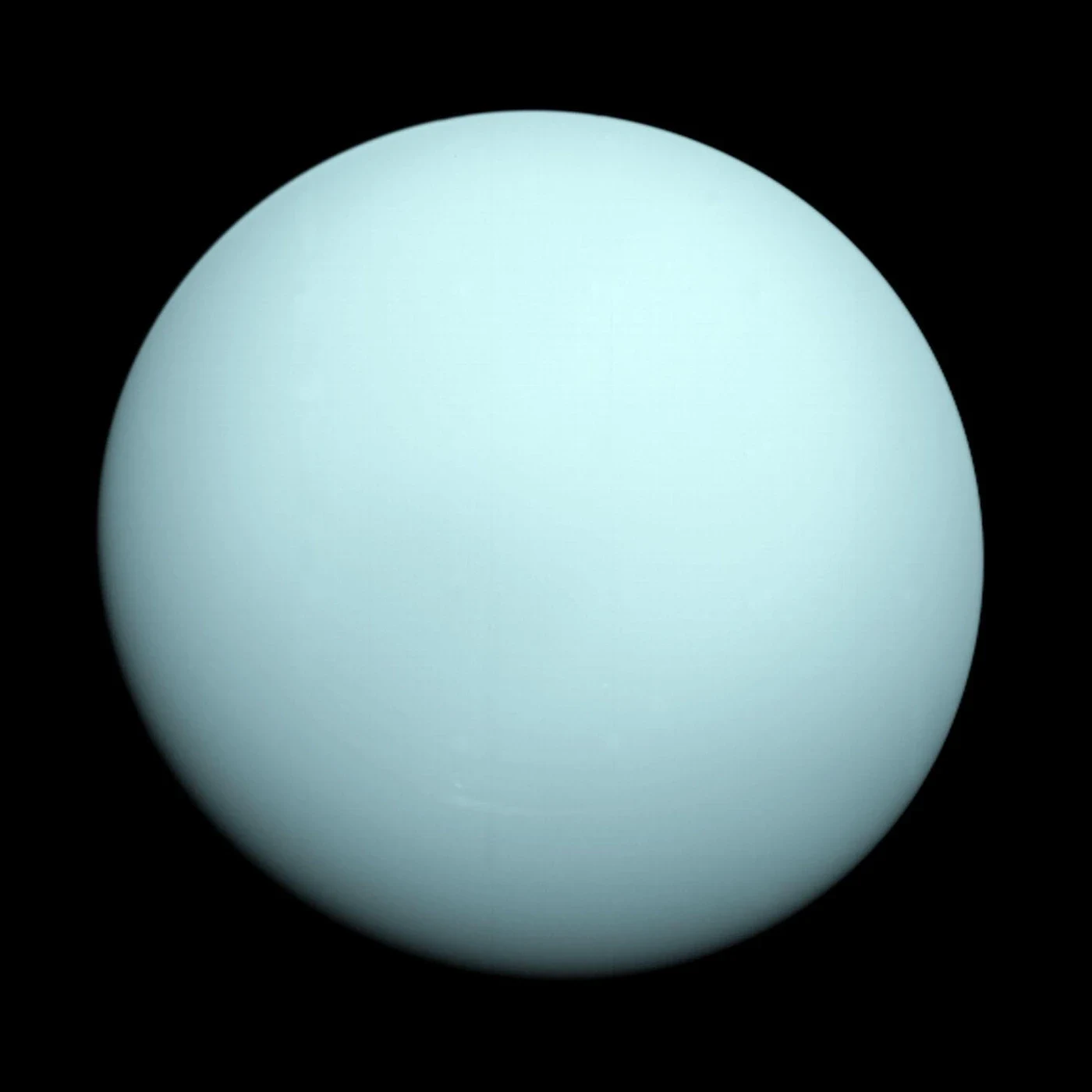
Uranus observed by Voyager 2 in 1986.
NASA media usage guidelines. Resized and converted to WebP by PRESDA. Full composition preserved. Reuse follows the individual license stated here.
Neptune: a distant, active atmosphere
Neptune is the outermost of the eight planets and takes roughly 165 Earth years to circle the Sun. It is another ice giant, with a dynamic atmosphere containing storms and strong winds despite receiving much less sunlight than Earth. Methane contributes to its colour, but familiar spacecraft pictures can use processing that increases contrast and colour differences. They should not automatically be read as naked-eye portraits. Its large moon Triton moves in a retrograde orbit, opposite the planet's rotation, supporting the interpretation that it was captured rather than formed in its present configuration. Neptune marks the end of the major-planet sequence, not the edge of the Solar System or the end of interesting worlds. NASA: Neptune
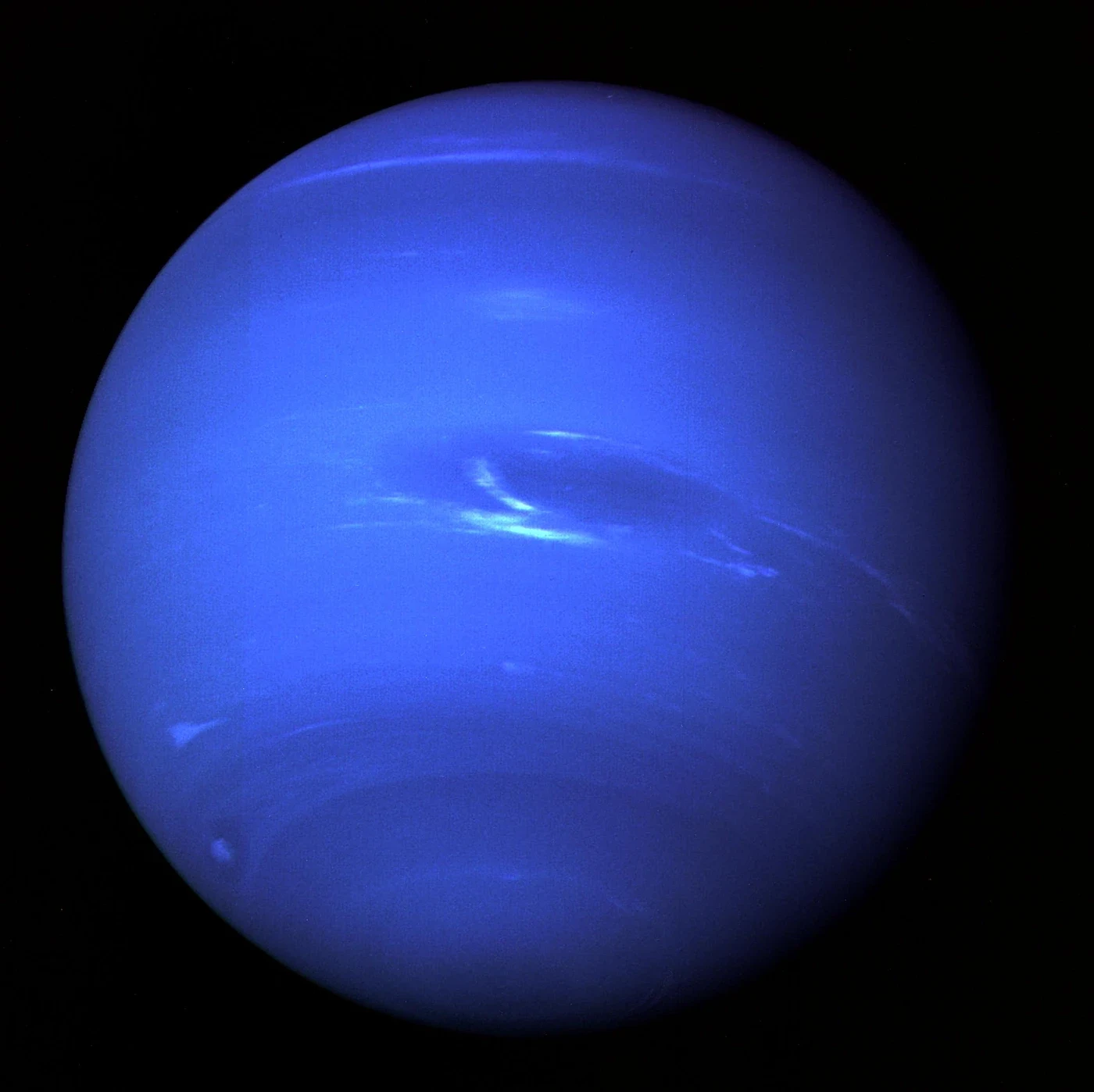
Voyager 2 view of Neptune in 1989, assembled from green and orange filter observations. Processed colour should not be read as a naked-eye view.
NASA media usage guidelines. Resized and converted to WebP by PRESDA. Full composition preserved. Reuse follows the individual license stated here.
Our Moon: a companion that still rotates
Earth's Moon keeps approximately the same face toward us because its rotation and orbital periods are synchronized. It does rotate; otherwise different sides would face Earth during its orbit. Its far side is not permanently dark. Both sides receive sunlight through the lunar cycle. The leading formation explanation involves a giant impact early in Earth's history, although the details remain under study. Craters and ancient rocks preserve evidence that Earth's more active surface often erases. Lunar research connects planetary formation to human exploration, discussed further in our feature on the Apollo Moon landings and their evidence. NASA: Moon facts
Giant planets, remarkable moons
Jupiter's four large Galilean moons are Io, Europa, Ganymede and Callisto. Io is intensely volcanic, with tidal interactions supplying heat. Ganymede is the largest moon in the Solar System, larger in diameter than Mercury, and has its own magnetic field. Europa's icy exterior overlies strong evidence for an ocean, while evidence also supports possible subsurface oceans in Ganymede and Callisto, with different degrees of certainty. These bodies demonstrate why a moon can be a major scientific world in its own right. ESA's Juice mission targets the icy moons to investigate their structures and environments; habitability research is not the same as a life-detection announcement. ESA: Juice targets
Saturn's Titan has a substantial nitrogen-rich atmosphere and surface rivers, lakes and seas involving liquid methane and ethane. It offers a working comparison with Earth's water cycle, but at much colder temperatures and with different liquids. Enceladus, a smaller icy moon, sends material from its interior into space through plumes near its south pole. Other major Saturnian moons, including Rhea, Iapetus, Dione and Tethys, add further geological variety. A moon's importance cannot be read from diameter alone. Composition, tidal heating and interactions with its planet can make a small body scientifically exceptional. NASA: Titan NASA: Saturn's moons
Ocean worlds: promising environments, not discovered life
Enceladus is compelling because spacecraft could sample expelled material without drilling through kilometres of ice. A peer-reviewed analysis published in Nature in 2023 identified phosphates in ice grains originating from its ocean. Phosphorus is important to terrestrial biology, but its detection is chemical evidence, not evidence of organisms. Water, useful elements and possible energy sources make a place worth investigating; they do not establish that life began there. Europa and other candidate ocean worlds demand the same discipline. The search becomes stronger when scientists specify which observations would distinguish biology from plausible non-biological chemistry. Nature: phosphates from Enceladus
There is also a difference between an ocean inferred from several physical measurements and an ocean directly visited by a probe. Ice thickness, salinity, exchange with the surface and contact with rock affect the possibilities for habitability. Instruments designed to study these properties answer environmental questions first. As our Our Universe feature explains, abundant worlds and interesting chemistry do not yet resolve whether life exists elsewhere. No confirmed extraterrestrial organism has been found. That uncertainty makes exploration meaningful, rather than diminishing its value. NASA: astrobiology
Asteroids and comets: more than leftover rubble
Asteroids are small bodies, many rocky or metallic, with a large population in the main belt between Mars and Jupiter. The belt is not the dense obstacle course familiar from films: most of its volume is empty space. Small bodies retain clues to early materials and later collisions, and some have been altered by heat or water. The terms also depend on context: a meteoroid travels through space, a meteor is the luminous atmospheric phenomenon, and a surviving fragment reaching the ground is a meteorite. Studying these objects helps reconstruct origins and assess impact hazards without turning every close approach into a prediction of disaster. NASA: asteroids
Comets contain volatile ices as well as dust and rocky material. When a comet approaches the Sun, heating can release gas and dust to form a coma and tails. A tail is therefore not a permanent trail attached to every comet throughout its orbit. Solar radiation and the solar wind shape the tails, which generally extend away from the Sun rather than simply behind the direction of travel. Comets and asteroids are useful categories, but real objects can complicate neat boundaries. Their diverse histories matter more than a rigid contrast between perfectly icy and perfectly rocky bodies. NASA: comets
Pluto, dwarf planets and the Kuiper Belt
Pluto did not disappear when it was classified as a dwarf planet in 2006. Under the International Astronomical Union's Solar System definition, a planet orbits the Sun, is approximately round through its own gravity and has cleared its orbital neighbourhood. Pluto meets the first two conditions but not the third. Clearing means gravitational dominance, not an absolutely empty orbit. The classification is about how objects relate to their surroundings, not whether they are fascinating. Ceres, in the asteroid belt, and distant Eris, Haumea and Makemake also belong to the recognized dwarf-planet group. NASA: planets and dwarf planets
The Kuiper Belt is a broad population of icy bodies beyond Neptune, with its main region extending roughly from 30 to 50 astronomical units. One astronomical unit is approximately the Earth-Sun distance, about 150 million kilometres. Pluto is one member of this larger landscape, not an isolated oddity at the end of a row. The distribution and orbits of these objects constrain models of giant-planet migration and early gravitational disturbance. Farther populations include scattered objects with very extended orbits. Beyond Neptune, the Solar System becomes less familiar, but it does not abruptly become empty. NASA: Kuiper Belt
Where does the Solar System end?
There is no single boundary that answers every scientific question. The Oort Cloud is a hypothesized distant reservoir of icy bodies inferred especially from long-period comet orbits, not a shell photographed around the Sun. Models place it much farther out than the Kuiper Belt, potentially reaching tens of thousands of astronomical units. Its detailed population and structure remain uncertain. Passing Neptune or Pluto is therefore not equivalent to leaving all bodies associated with the Sun. Gravity also weakens gradually with distance rather than switching off at a marked line. NASA: Oort Cloud
The heliosphere is a different kind of domain: the bubble shaped by the solar wind and its magnetic field within the interstellar environment. Its outer boundary, the heliopause, marks a transition between plasma regimes, not the end of solar gravity. Voyager 1 crossed it in 2012 and Voyager 2 in 2018. Both entered interstellar space in this physical sense while remaining far inside the estimated extent of the Oort Cloud. These statements are compatible because they describe different boundaries. Scientific precision sometimes begins with asking what a familiar phrase such as leaving the Solar System actually means. NASA: Voyager's interstellar mission
Exploration changes the map
The Voyager missions transformed the outer planets from remote points into detailed worlds, revealing atmospheric structure, moons and rings. Gravity assists exchanged momentum with planets and reshaped spacecraft trajectories, enabling journeys that would otherwise require much more propellant. Such manoeuvres are applications of orbital mechanics, not engines that manufacture energy from nothing. Later missions have exchanged the breadth of flybys for repeated observations from orbit or close surface investigation. Every strategy has limits: one passing view can miss seasonal change, while even a long orbital mission samples only part of a world's history. NASA: Voyager fact sheet
New Horizons flew past Pluto on July 14, 2015, revealing an unexpectedly varied world with mountains, ice plains and atmospheric haze. On January 1, 2019, it encountered Arrokoth in the Kuiper Belt, providing a close look at a much smaller body and clues to early assembly. These were flybys, not landings or long-term orbits. Their images demonstrate how exploration can overturn expectations without overturning established physics: distant, cold objects can have complex histories. Mission conclusions depend on combining pictures with spectra, particle measurements and careful modelling. NASA: New Horizons
Parker Solar Probe explores the opposite extreme, close to our star. On December 24, 2024, it passed about 3.8 million miles, or 6.1 million kilometres, above the Sun's surface, within the tenuous corona. It did not land on the Sun. The mission investigates how the corona is heated and how the solar wind accelerates, using close measurements that distant observations cannot replace. Heat protection, spacecraft orientation and the distinction between particle temperature and total heat transfer matter enormously in that environment. Exploring our neighbourhood means understanding its central star as well as collecting planetary portraits. NASA: Parker's close approach
A future measured in stellar lifetimes
The Sun will not remain as it is indefinitely. As its internal composition evolves, its luminosity changes, affecting Earth's long-term environment well before the final stages of stellar evolution. In roughly five billion years, it is expected to enter its red-giant phase. Its expanding outer layers will transform the inner planetary system. Detailed planetary outcomes depend on mass loss, tides and orbital evolution, so a precise timetable for Earth's fate should not be presented as an observed fact. The broad stellar pathway is much more secure than every detail of a particular planet's survival. NASA: stars and planetary environments
Ultimately the Sun is expected to shed its outer layers and leave a white dwarf, a compact stellar remnant that gradually cools. It lacks the mass needed to end as a supernova and black hole. The surviving Solar System would be profoundly different, with altered illumination and orbits. This is a prediction from stellar physics, not a reason to confuse remote natural evolution with the environmental choices humanity faces now. Billions of years of future change do not make present-day stewardship irrelevant. NASA: why the Sun will not become a black hole
A neighbourhood still being discovered
The Solar System teaches a useful combination of confidence and restraint. We know the planetary order, can predict spacecraft paths and read ancient history in rocks. We do not yet know whether hidden oceans contain life, exactly how every planet migrated or every detail of our star's eventual transformation. The most compelling picture is neither a catalogue of settled trivia nor a collection of sensational mysteries. It is a connected story of matter and motion, with one inhabited world able to study the others. Looking outward helps explain why home is distinctive, and how much remains to learn.
FAQ
Frequently Asked Questions
What is this PRESDA article about?
Explore the Sun, all eight planets, ocean moons and distant icy worlds, with NASA planet comparisons and clear explanations of our Solar System.
Which category does this story belong to?
This story is part of PRESDA's Science coverage.
Who published this article?
OUR SOLAR SYSTEM: THE SUN, EIGHT PLANETS AND BEYOND was published by PRESDA Editorial on PRESDA.
PRESDA Dispatch
Stay Informed. Stay Aware.
A sharp briefing across AI, gaming, sport, business, world affairs, paparazzi, and lifestyle.