HYPATIA: THE BRILLIANT WOMAN OF ANCIENT ALEXANDRIA
Meet Hypatia, Alexandria’s philosopher and mathematics teacher. Explore surviving testimony, her murder in 415 and the legends that obscure her achievements.
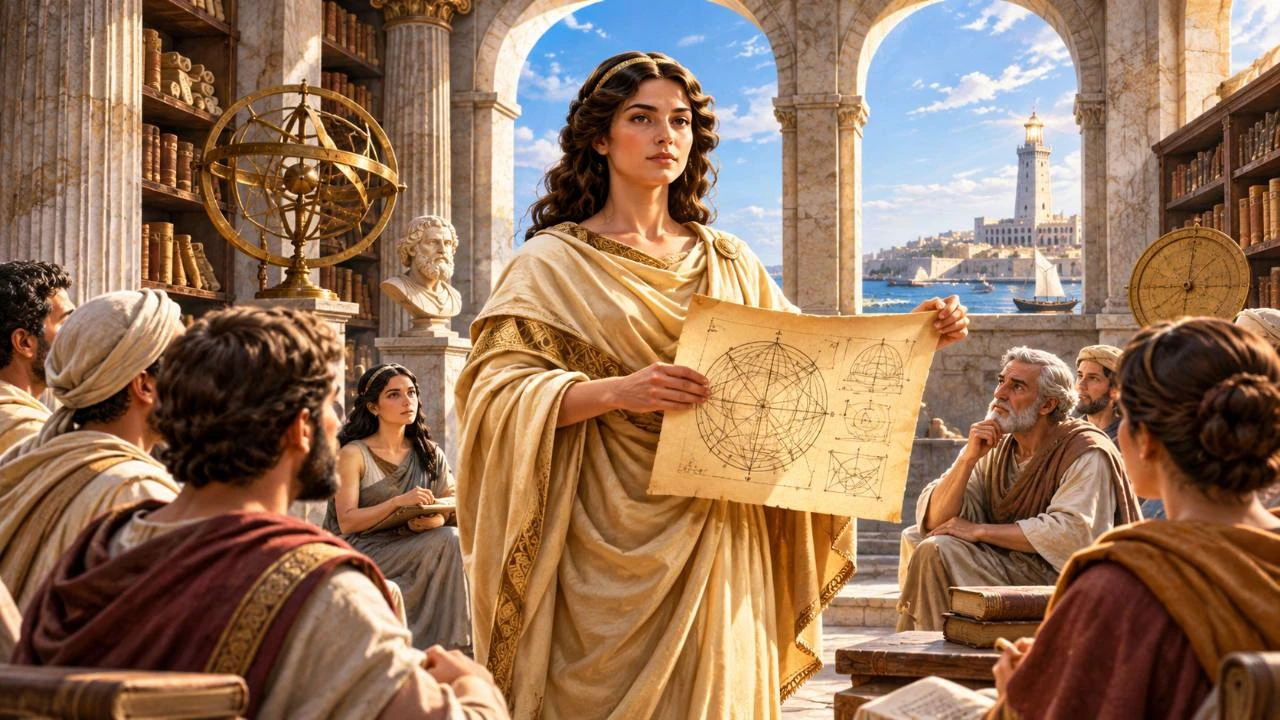
Historical reconstruction, not an authenticated portrait or documented teaching scene. The architecture, objects and clothing are illustrative. Editorial image supplied for PRESDA. Original creator and reuse licence not provided.
Before Hypatia became a symbol, she was a teacher. That is the most useful starting point for understanding a woman whose death is often better known than her work. In late antique Alexandria, her authority grew through learning, conversation and the regard of students. Recovering that life means resisting two temptations: reducing her to the violence that killed her, or filling every gap in the record with a modern wish.
A life in mathematics and philosophy
Hypatia was the daughter of Theon of Alexandria, a mathematician associated with the transmission of Greek mathematical learning. She taught mathematics and Neoplatonic philosophy, becoming a prominent intellectual figure around the beginning of the fifth century. Her birth year remains uncertain. Describing her as a professor at a modern-style university would impose the wrong institution on her world: her teaching belonged to the philosophical and scholarly culture of late antiquity. University of St Andrews: Hypatia
What a student’s letters preserve
Synesius of Cyrene, her former student and later a Christian bishop, wrote to her about intellectual and practical matters. In Letter 15, he requests an instrument generally interpreted as a hydrometer, used to compare the density of liquids. The correspondence gives us something more valuable than a legend of solitary genius: a glimpse of trust and technical exchange. It does not establish that Hypatia invented that instrument, and expertise should not be confused with an invention claim. Synesius: Letter 15 to Hypatia
The work behind the reputation
Later testimony associates her with commentaries on mathematical works, including those of Diophantus and Apollonius. The surviving evidence is fragmentary, and the extent of her editorial contribution to texts linked with her father is debated. Teaching, explaining and preserving difficult material are substantial intellectual activities even when no complete independent treatise survives. Neither an unqualified first woman mathematician label nor a list of unsupported discoveries is needed to recognise her importance. University of St Andrews: Hypatia
Alexandria, March 415
The historian Socrates Scholasticus describes her murder by a Christian mob led by a reader named Peter. He links the attack to rumours about her relationship with the prefect Orestes and his conflict with the bishop Cyril. His account condemns the killing. That testimony supports a story of political hostility and religious violence; it does not prove that Cyril personally ordered the murder. Hypatia’s Christian students also complicate a simple tale of two uniformly opposed intellectual camps. Socrates Scholasticus, translated at Fordham University
The reconstructed scene above imagines a classroom; it cannot restore her face or the words of a lost lesson. What survives is enough for a richer legacy: a woman recognised for intellectual authority, a teacher whose relationships crossed religious boundaries, and a reminder that careful historical memory honours achievement better than decorative certainty.
Related reading: Giordano Bruno and the history of ideas.
FAQ
Frequently Asked Questions
When did Hypatia live?
She taught in late fourth- and early fifth-century Alexandria and was murdered in March 415. Her birth year is uncertain.
Did she invent the astrolabe or hydrometer?
The evidence discussed here does not establish either invention. Instrument-related correspondence demonstrates expertise and exchange.
Is the hero a real portrait?
No. It is a historical reconstruction with imagined appearance, clothing and setting.
PRESDA Dispatch
Stay Informed. Stay Aware.
A sharp briefing across AI, gaming, sport, business, world affairs, paparazzi, and lifestyle.