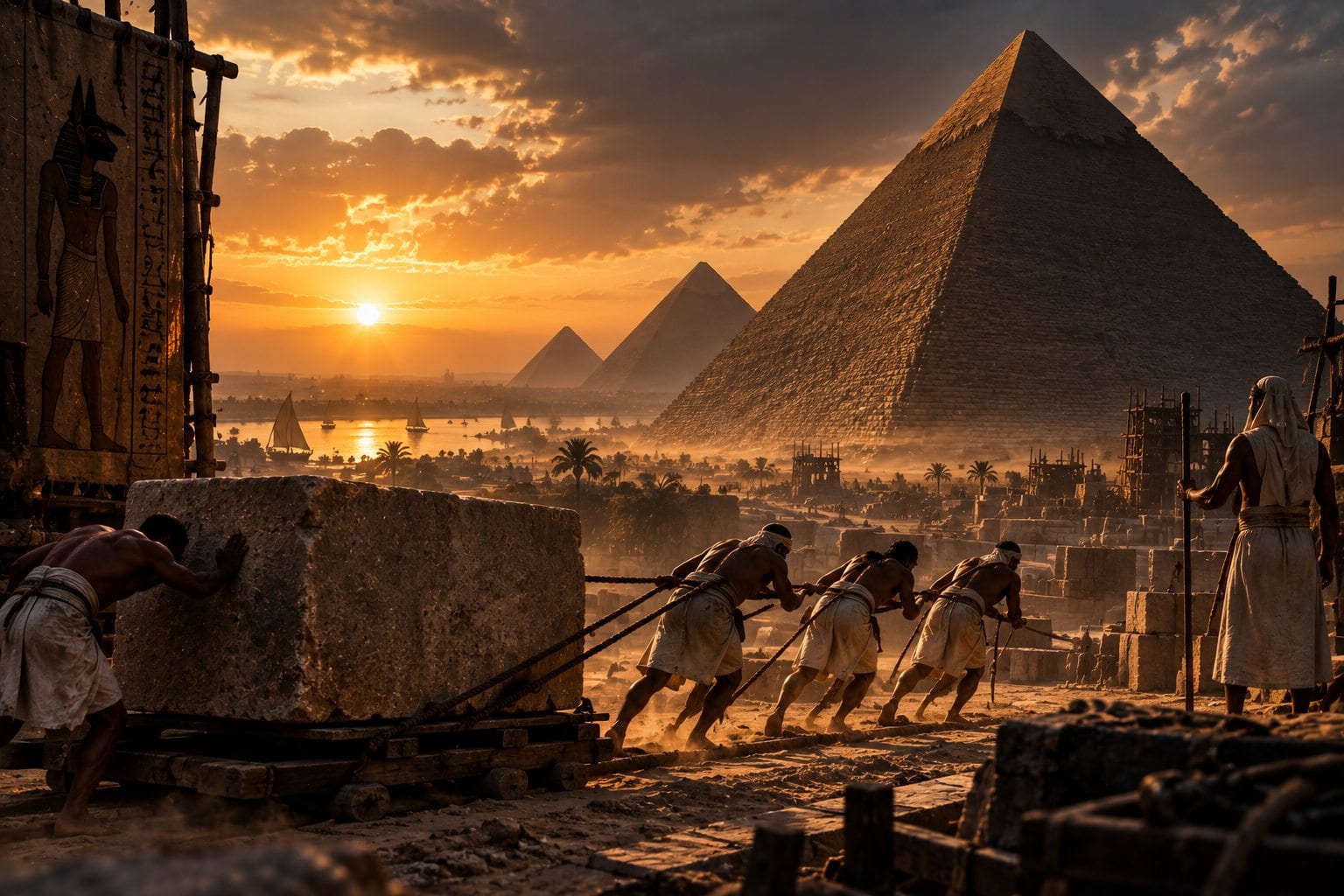
THE PYRAMIDS: HOW ANCIENT EGYPT BUILT THE IMPOSSIBLE
More than 4,500 years ago, ancient Egyptians built monuments so enormous and precise that they still inspire mystery today. But the real story of the pyramids may be more fascinating than the myths.
More than 4,500 years ago, ancient Egyptians began constructing some of the most recognizable structures humanity has ever created.
The pyramids.
Even today, standing beside the Great Pyramid of Giza creates a strange sense of scale.
Millions of blocks.
Enormous weight.
Remarkable geometry.
No cranes.
No trucks.
No modern engines.
And yet the structure survived while entire civilizations disappeared around it.
That extraordinary achievement has generated centuries of questions.
How were the pyramids built?
Who built them?
Why were they constructed?
And how could an ancient society organize a project of such enormous scale?
The answer does not begin at Giza.
The pyramids were not invented overnight.
Egyptian engineers learned how to build them gradually, one monument at a time. For more PRESDA history features, read the history of horses in human civilization and Galileo and the Church.
WHEN WERE THE EGYPTIAN PYRAMIDS BUILT?
The Egyptian pyramids were built over many centuries, but the classic pyramid age began in the Old Kingdom. Djoser's Step Pyramid at Saqqara belongs to the Third Dynasty, around the 27th century BCE, and marks the major leap from earlier mastaba tombs to monumental stone pyramid architecture.
Sneferu, founder of the Fourth Dynasty, pushed that experiment further in the 26th century BCE with the Meidum, Bent and Red pyramids. Soon after, pyramid building reached its most famous form at Giza, where Khufu's Great Pyramid was built during the Fourth Dynasty, around the 26th century BCE.
BEFORE THE PYRAMIDS
Before the famous pyramids, elite Egyptians were commonly buried beneath rectangular structures known today as mastabas.
These tombs had flat roofs and sloping sides.
They already contained important elements of Egyptian funerary architecture.
But during Egypt's Third Dynasty, something revolutionary happened.
Instead of building one mastaba, builders began stacking increasingly smaller levels above one another.
The result changed architecture forever.
DJOSER: THE FIRST GREAT PYRAMID
At Saqqara stands one of the most important buildings in architectural history: the Step Pyramid of Djoser.
Built during the Third Dynasty, around the 27th century BCE, it represented an extraordinary leap in monumental stone construction.
The complex is traditionally associated with Djoser's official Imhotep.
Rather than a smooth pyramid, Djoser's monument rises through a sequence of large steps.
It was not yet the pyramid form that would later dominate Giza.
But the fundamental idea had arrived: build upward, in stone, on an enormous scale.
The Egyptians had begun experimenting with the architecture that would eventually produce the Great Pyramid.
SNEFERU: LEARNING TO BUILD A TRUE PYRAMID
The next major chapter belongs to Pharaoh Sneferu, founder of Egypt's Fourth Dynasty.
His reign is associated with several enormous pyramid projects.
And together, they reveal something important: Egyptian engineering evolved through experimentation.
At Meidum stands a pyramid whose complex construction history continues to be studied.
Then came the extraordinary Bent Pyramid at Dahshur.
Its lower section rises at a steep angle before the slope visibly changes partway upward.
The result is one of the strangest and most recognizable pyramids in Egypt.
Why did the angle change?
Engineering concerns during construction are widely considered part of the explanation, although specialists continue studying the monument's building history.
Then came the Red Pyramid.
Its sides rise at a consistent angle, producing what is generally regarded as the first successful large-scale smooth-sided pyramid.
The progression matters.
Djoser.
Meidum.
Bent Pyramid.
Red Pyramid.
Then Giza.
The Great Pyramid did not suddenly appear from nowhere.
Egyptian builders had generations of experience behind them.
KHUFU AND THE GREAT PYRAMID
Around the 26th century BCE, during the reign of Pharaoh Khufu, Egyptian pyramid building reached its most famous achievement.
The Great Pyramid of Giza.
Originally standing approximately 146.6 meters tall, it dominated the landscape.
For thousands of years, it remained the tallest human-made structure on Earth.
Its outer surface was originally covered with finely finished limestone casing stones, giving the pyramid a much smoother appearance than the structure we see today.
Inside were passages, chambers and architectural spaces constructed with extraordinary planning.
The Great Pyramid was part of a larger funerary complex.
And it was not alone.
KHAFRE AND MENKAURE
Giza eventually became home to three monumental royal pyramids.
Khufu's Great Pyramid is the largest.
The pyramid of Khafre stands nearby and can sometimes appear taller because it occupies slightly higher ground.
Khafre's pyramid also preserves some casing stones near its summit.
The third principal pyramid belonged to Menkaure.
It is considerably smaller.
Together, the three pyramids created one of history's most famous landscapes.
But constructing them required far more than architectural ambition.
It required logistics on a scale that remains astonishing.
HOW WERE THE PYRAMIDS BUILT?
There is no single surviving Egyptian instruction manual explaining every step of Great Pyramid construction.
That leaves room for debate about specific techniques.
But archaeology gives us a much clearer picture than popular mythology sometimes suggests.
Egyptian builders possessed stone-working tools, ropes, wooden sledges, levers, boats, organized labor, surveying knowledge, quarrying expertise, administrative systems and generations of construction experience.
Most of the Great Pyramid's core stone came from limestone quarried relatively close to the site.
Higher-quality limestone used for casing was transported from areas such as Tura.
Granite used in important internal spaces came from much farther south, including Aswan.
Moving all of this required an enormous transportation network.
And one extraordinary discovery gave us a glimpse of that network from the people who actually lived during Khufu's reign.
THE DIARY OF MERER
At Wadi al-Jarf on Egypt's Red Sea coast, archaeologists discovered ancient papyri dating to the reign of Khufu.
Among them was the diary of an official named Merer.
The documents describe the activities of a work crew involved in transporting limestone by boat toward Khufu's pyramid project.
This is extraordinary.
Instead of a theory created thousands of years later, we have administrative records from the period itself.
Merer's diary does not explain every construction technique used on the Great Pyramid.
But it provides powerful evidence of the sophisticated logistics behind the project.
Stone.
Boats.
Canals and waterways.
Work crews.
Administration.
The pyramid was not magic.
It was organization.
MOVING STONE WITHOUT MACHINES
One of the biggest questions remains obvious: how do you move enormous blocks without trucks or cranes?
Ancient Egyptian artwork and experimental archaeology provide clues.
Heavy objects could be placed on wooden sledges and pulled by teams of workers.
One famous Egyptian depiction shows liquid being poured in front of a sledge carrying a large statue.
Modern experiments have demonstrated that appropriately dampening sand can reduce resistance under certain conditions, making heavy loads easier to drag.
Ramps almost certainly played an important role in raising materials.
But exactly what ramp systems were used at different stages of the Great Pyramid remains debated.
Straight ramps?
Zigzagging ramps?
Ramps wrapping around portions of the structure?
Different systems at different stages?
Archaeology supports the use of ramps in ancient Egyptian construction generally.
But there is no universally accepted complete reconstruction of the exact system used for every level of Khufu's pyramid.
And that distinction matters.
Science does not need to pretend every detail is solved.
WHO ACTUALLY BUILT THE PYRAMIDS?
Popular culture has often portrayed the pyramids as monuments constructed entirely by enormous armies of chained slaves.
The archaeological evidence presents a more complicated picture.
Excavations around Giza uncovered settlements associated with the people who supported pyramid construction.
Archaeologists found evidence of food production, housing, administration and organized workforces.
Specialized craftsmen and permanent workers likely operated alongside rotating labor forces.
Some workers may have been recruited through forms of state labor obligation.
Ancient Egyptian society was hierarchical and labor conditions should not be romanticized.
But the simple Hollywood image of anonymous masses of foreign slaves building the pyramids under whips is not supported as a complete description of the workforce revealed by archaeology.
These monuments required skilled people.
Stone workers.
Surveyors.
Boat crews.
Administrators.
Craftsmen.
Food producers.
Laborers.
The pyramid was not merely a pile of stone.
It was a national-scale organization project.
WHY DID THE EGYPTIANS BUILD PYRAMIDS?
The pyramids were fundamentally connected with kingship, death and the Egyptian understanding of the afterlife.
Egyptian royal funerary beliefs placed enormous importance on the continued existence of the king after death.
The pyramid complex was therefore not simply a monument designed to impress future tourists.
It belonged to a religious and political system.
The pyramid's form has also been connected by scholars with solar symbolism and ideas surrounding royal ascent and rebirth.
Temples, causeways, subsidiary structures and ritual spaces formed part of the larger funerary landscape.
The pyramid was architecture.
But it was also theology.
And political power carved into stone.
INSIDE THE GREAT PYRAMID
The interior of the Great Pyramid contains some of ancient Egypt's most extraordinary architecture.
The descending passage.
The ascending passage.
The so-called Queen's Chamber.
The Grand Gallery.
The King's Chamber.
Above the King's Chamber are structural spaces designed in relation to the enormous weight of stone above.
The Grand Gallery is particularly remarkable.
Its high corbelled walls create a dramatic internal space hidden inside millions of tons of masonry.
Yet even after centuries of exploration, the Great Pyramid still contains surprises.
Modern physics has allowed researchers to look inside without breaking the monument apart.
SCANNING A PYRAMID WITH COSMIC PARTICLES
Scientists can study large structures using particles called muons.
Muons are produced naturally when cosmic rays interact with Earth's atmosphere.
They can pass through large amounts of material.
By measuring how many muons arrive through different directions, researchers can identify variations in density inside a structure.
Essentially, scientists can use naturally occurring particles to help see through stone.
The ScanPyramids project applied this technology to the Great Pyramid.
And in 2017, researchers announced something extraordinary.
THE BIG VOID
Nature reported that muon measurements revealed a previously unknown large void above the Grand Gallery.
The space became known as the ScanPyramids Big Void.
Its existence was detected using multiple independent muon techniques.
But an important question remains unanswered: what is it?
A chamber?
A structural feature?
A construction space?
Something else?
Its function remains uncertain.
That is exactly where responsible archaeology separates itself from sensationalism.
We know the void exists.
We do not yet know precisely why it exists.
ANOTHER HIDDEN CORRIDOR
The Great Pyramid produced another major discovery in the 2020s.
Researchers characterized a previously unknown corridor near the pyramid's northern face using non-invasive scanning techniques.
The corridor is several meters long and sits behind the monument's exterior.
Again, the discovery demonstrated something remarkable.
More than 4,500 years after construction, one of the most studied buildings on Earth can still reveal previously unknown internal spaces.
The pyramids are ancient.
The investigation is modern.
WHAT ABOUT ALIENS?
No discussion of the pyramids on the modern internet seems complete without aliens.
The argument usually sounds like this: the pyramids are too enormous, too precise, too difficult. Ancient people could not possibly have built them. Therefore, some lost civilization or extraterrestrial intelligence must have helped.
There is a fundamental problem with that argument.
We have no credible archaeological evidence that extraterrestrials built the Egyptian pyramids.
More importantly, Egyptian pyramid construction did not appear suddenly.
We can observe its development.
Mastabas.
Djoser's Step Pyramid.
Sneferu's experiments.
The Bent Pyramid.
The Red Pyramid.
Then Giza.
We have quarries.
Tools.
Worker settlements.
Administrative evidence.
Transport records.
Earlier pyramids.
Later pyramids.
The engineering tradition is visible.
The pyramids do not appear in history without ancestors.
They evolve.
The real story is not that ancient Egyptians were incapable of building them.
The real story is that they were capable of far more than modern people sometimes assume.
WHY DID EGYPT STOP BUILDING GIANT PYRAMIDS?
Egypt did not immediately abandon pyramid building after Giza.
Pyramids continued to be constructed by later rulers, although generally on smaller scales and using different construction approaches.
Over centuries, Egypt changed.
Political conditions changed.
Resources changed.
Religious traditions evolved.
Royal burial practices evolved.
By the New Kingdom, many pharaohs were buried in hidden rock-cut tombs associated with the Valley of the Kings rather than beneath enormous pyramid monuments.
The age of giant royal pyramids had passed.
But their influence never did.
THE PYRAMIDS SURVIVE
Ancient Egypt experienced invasions.
Dynasties disappeared.
Languages changed.
Religions changed.
Empires rose and fell.
Rome came and went.
Medieval kingdoms came and went.
The industrial world emerged.
Humans invented electricity, aircraft, computers and spacecraft.
And the Great Pyramid remained.
Its casing was largely stripped away.
Parts were damaged.
Its surroundings transformed.
But the core survived.
For approximately four and a half millennia.
THE REAL MIRACLE OF THE PYRAMIDS
Perhaps the greatest mystery of the pyramids is not whether ancient Egyptians possessed some supernatural technology.
The more interesting question is how human beings organized themselves well enough to build them.
Quarrymen cut the stone.
Sailors transported material.
Workers pulled blocks.
Surveyors measured.
Craftsmen shaped.
Administrators tracked supplies.
Farmers produced food.
Engineers solved problems.
Thousands of individual human actions became one enormous structure.
The pyramids are not evidence that humans could not have built them.
They are evidence of what humans were already capable of.
More than 4,500 years later, the Great Pyramid still stands on the Giza plateau.
Not because ancient Egypt defeated time.
But because, for one extraordinary period in human history, an entire civilization learned how to build for eternity.
FAQ
Frequently Asked Questions
How were the Egyptian pyramids built?
The pyramids were built through quarrying, transport by boat and land, organized work crews, surveying, stone-working tools, sledges, levers and ramps. The exact ramp systems used at every stage of the Great Pyramid remain debated.
Who built the pyramids?
Archaeology points to organized Egyptian workforces including skilled craftsmen, permanent workers, rotating labor groups, administrators, boat crews and food producers, rather than the simple myth of anonymous foreign slaves building the monuments under whips.
When was the Great Pyramid of Giza built?
The Great Pyramid was built during the reign of Pharaoh Khufu in Egypt's Fourth Dynasty, around the 26th century BCE.
What was the first Egyptian pyramid?
The Step Pyramid of Djoser at Saqqara, built during the Third Dynasty, is widely treated as the first great Egyptian pyramid and a breakthrough in monumental stone architecture.
What is the Diary of Merer?
The Diary of Merer is a group of ancient papyri from Wadi al-Jarf that records a work crew transporting limestone toward Khufu's pyramid project, offering rare administrative evidence from the period.
What is the ScanPyramids Big Void?
The ScanPyramids Big Void is a large previously unknown space detected above the Grand Gallery of the Great Pyramid using cosmic-ray muon measurements. Its function remains uncertain.
Did aliens build the pyramids?
There is no credible archaeological evidence that aliens built the Egyptian pyramids. The monuments fit within a visible Egyptian engineering tradition that developed from mastabas to Djoser, Sneferu's pyramids and Giza.
PRESDA Dispatch
Stay Informed. Stay Aware.
A sharp briefing across AI, gaming, sport, business, world affairs, paparazzi, and lifestyle.