THE KINGDOM OF BOHEMIA: PRAGUE, CHARLES IV AND THE HEART OF MEDIEVAL EUROPE
Bohemia was a powerful medieval kingdom within the Holy Roman Empire. Its history runs from the Přemyslid dynasty and Charles IV's Prague to the Hussite Wars, Habsburg rule and the modern Czech legacy.
The Kingdom of Bohemia was a medieval and early modern kingdom centered on the Czech lands, with Prague as its principal political and cultural city. For much of its history Bohemia was also a constituent kingdom of the Holy Roman Empire. Those identities were compatible: the Bohemian king governed his own realm while holding an important position within the empire's elective and constitutional order. Modern Czech borders should not be projected backward onto a political landscape that changed through dynastic unions, war and imperial institutions.
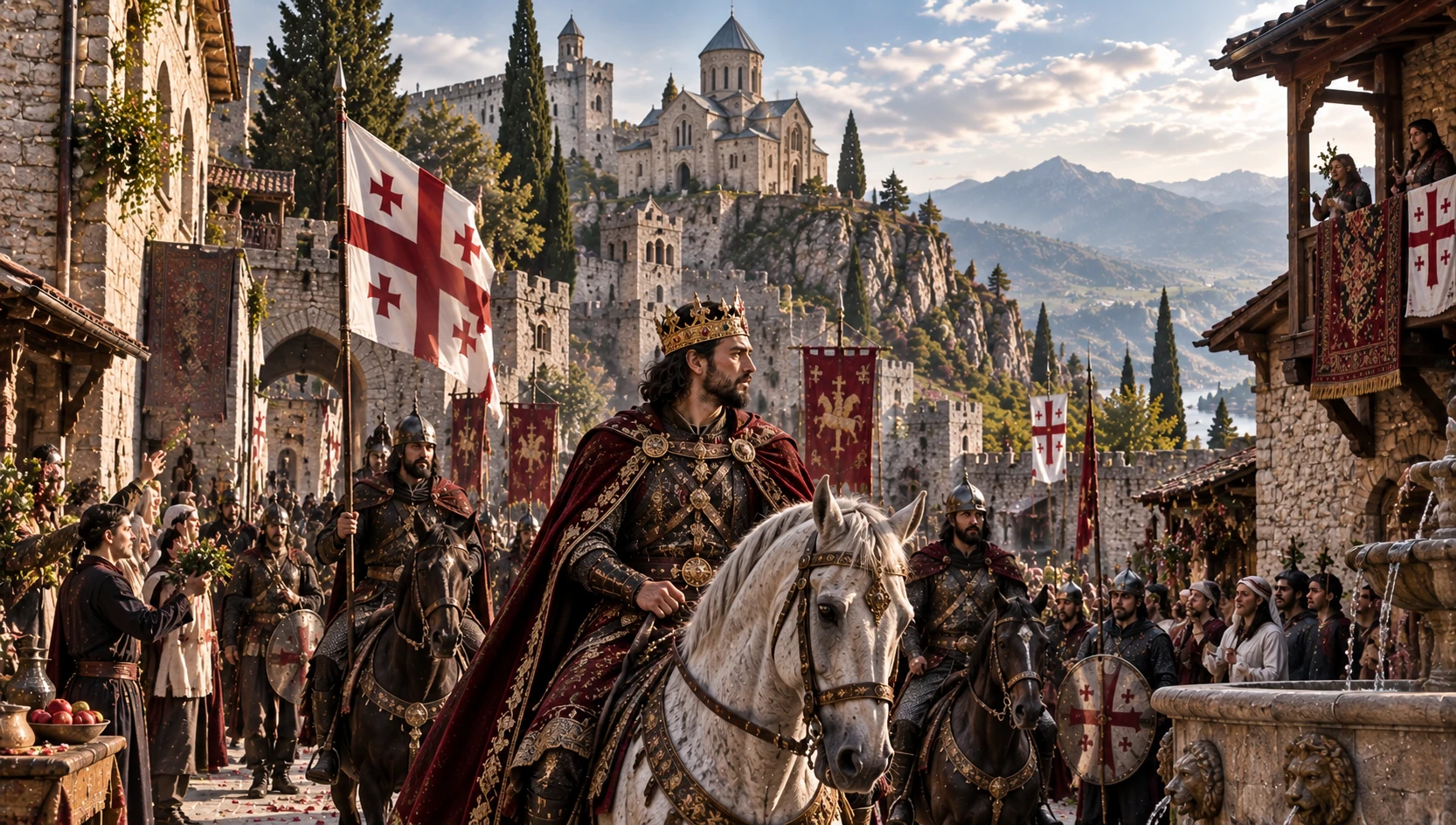
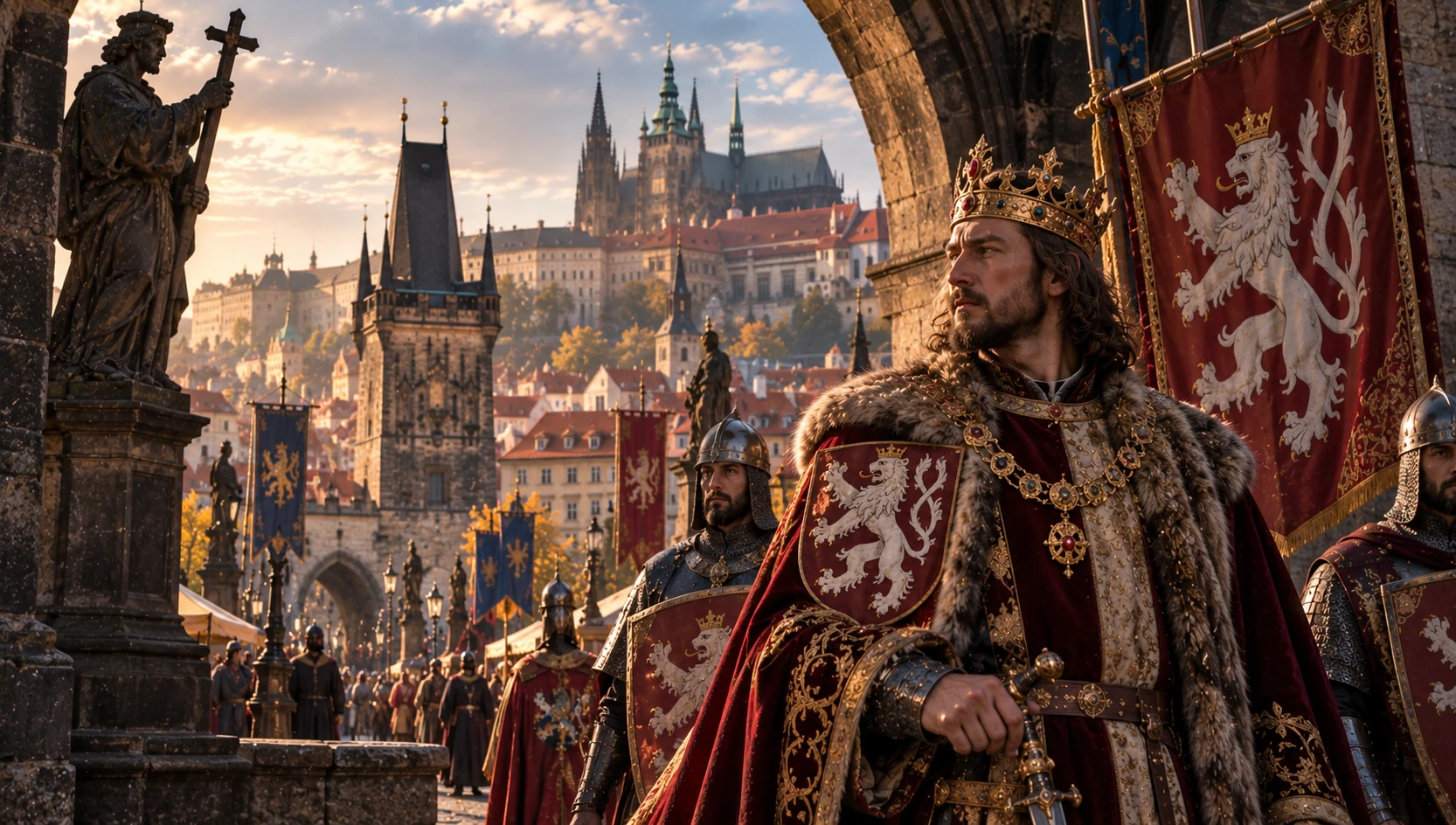
The supplied hero image is an editorial reconstruction of medieval Prague and Bohemian royal power. It is not a literal portrait of a particular king or a documentary view of one medieval ceremony.
ORIGINS AND THE PŘEMYSLID DYNASTY
Slavic communities settled in the central European lands of Bohemia and Moravia during the early medieval period. Local political centers developed around fortified settlements, river routes and agricultural districts. Frankish and later East Frankish rulers competed for influence, while neighboring Great Moravia helped spread Christian institutions and elite culture. The region contained multiple communities and lordships rather than a ready-made nation with modern boundaries.
The Přemyslid dynasty gradually established primacy in Bohemia. Duke Bořivoj is traditionally remembered as an early Christian ruler, and the dynasty's Prague base expanded through marriage, warfare, tribute and church patronage. Christianity became linked to political legitimacy, but conversion was a long process involving local elites, monasteries and competing Latin and Slavic traditions. Bohemia's rulers maintained their own institutions while navigating the authority of the German kings and the Holy Roman Empire.
In 1085, Vratislav II received a royal crown from Emperor Henry IV, but the dignity was not yet automatically hereditary. The title marked Bohemia's growing importance within the empire. A permanent hereditary kingdom emerged under Ottokar I, who secured the Golden Bull of Sicily from Emperor Frederick II in 1212. The document confirmed Bohemian privileges and hereditary royal status, while the king remained an imperial prince with responsibilities in the empire.
OTTOKAR II AND BOHEMIAN EXPANSION
Přemysl Ottokar II, king from 1253 to 1278, built one of the strongest central European monarchies of his age. He controlled or influenced Austria, Styria, Carinthia and Carniola through inheritance, conquest and dynastic politics. His power reached toward the Adriatic, but this was a composite network rather than a single administratively uniform state. German princes and neighboring rulers resisted his expansion, and his conflict with the rising Habsburg Rudolf I ended at the Battle of Marchfeld in 1278, where Ottokar was killed.
The defeat reduced Bohemian influence in the Alpine lands and allowed the Habsburg dynasty to expand. Yet the Přemyslid monarchy had strengthened Prague's institutions, encouraged urban growth and connected Bohemia to the broader political economy of the empire. After the dynasty ended in the male line in 1306, a succession crisis opened the way for the Luxembourg dynasty.
LUXEMBOURGS AND CHARLES IV
John of Luxembourg became king of Bohemia in 1310 through marriage to Elizabeth of the Přemyslid line. He was an energetic European ruler who fought in Italy, supported imperial politics and relied on experienced administrators in Prague. His son Charles was raised across several European courts and brought a broad political outlook to Bohemia. Charles became king of Bohemia in 1346 and was elected King of the Romans in 1346, later receiving the imperial crown in Rome in 1355.
Charles IV treated Bohemia as the dynastic and symbolic center of his power. The Golden Bull of 1356 formalized the electoral constitution of the empire and confirmed the special position of the Bohemian king as one of the seven prince-electors. The empire was not a centralized German nation-state. It was a layered political order in which the Bohemian Crown included lands with different laws, languages and local privileges.
Prague experienced an extraordinary building and intellectual program. Charles expanded Prague Castle and began the Gothic rebuilding of St. Vitus Cathedral. The Charles Bridge connected the castle and royal city across the Vltava. In 1348 he founded Charles University, the first university north of the Alps and east of Paris in the central European region. New Town, churches, monasteries and administrative buildings enlarged Prague into a major imperial residence. Prague Castle: history of the castle
Charles's government relied on law, diplomacy, tax revenues, mining and cooperation with estates. Silver from Kutná Hora helped finance the monarchy and supported Bohemia's role in European commerce. German-speaking settlers, Czech-speaking communities, Jews, clergy, merchants and migrants all shaped urban life. Economic growth did not mean social equality: towns had hierarchies, rural labor obligations and religious distinctions, while royal projects depended on extraction from the countryside.
WENCESLAUS IV AND THE REFORMING CHURCH
Charles's son Wenceslaus IV became king of Bohemia in 1363 and King of the Romans in 1376. His reign was troubled by noble opposition, urban tensions and conflict with church and imperial factions. Prague University became a center of debate about clerical wealth, church authority and the relationship between scripture and ecclesiastical power.
Jan Hus, a preacher and university master, criticized clerical abuses and argued that the church should follow Christian teaching rather than wealth and political privilege. Hus drew on the English theologian John Wycliffe but developed arguments suited to Bohemian controversies. The Council of Constance condemned him for heresy and executed him in 1415 despite a promise of safe conduct. His death transformed reform into a political and religious crisis. Radio Prague: Jan Hus and the Hussite movement
THE HUSSITE WARS AND JAN ŽIŽKA
Hus's execution provoked outrage among many Bohemian nobles, townspeople and clergy. The First Defenestration of Prague in 1419, when councilors were thrown from a town hall window, helped trigger the Hussite Wars. Hussite groups differed over communion, church property, political reform and the place of royal authority. They were not a single nationalist party, and conflicts among moderate Utraquists, radical Taborites and other factions shaped the war.
Jan Žižka became the most famous Hussite commander. His forces used fortified wagon formations, firearms and disciplined infantry to defeat larger crusading armies sent by the papacy and imperial allies. The victories demonstrated tactical innovation and the strength of mobilized urban and rural communities. They did not create a permanent centralized Hussite state. Žižka died in 1424, and later commanders continued the struggle.
The wars ended through negotiation and the defeat of radical forces at Lipany in 1434. The Compactata allowed limited recognition of Utraquist practice, while moderate Hussites and Catholics negotiated a political settlement. George of Podebrady became king in 1458 and sought to stabilize the kingdom through compromise. Bohemia retained a distinctive religious settlement, although tensions with the papacy and neighboring rulers continued.
JAGIELLONIANS AND THE HABSBURG SUCCESSION
After George's death, the Jagiellonian dynasty ruled Bohemia and Hungary. Vladislaus II and Louis II faced powerful estates, Ottoman pressure and the political fragmentation of central Europe. Louis died at the Battle of Mohács in 1526, where the Ottoman army defeated the Hungarian forces. Bohemian and Hungarian succession then passed to Ferdinand of Habsburg, who was connected to the Jagiellonian dynasty by marriage.
Habsburg rule did not erase Bohemia as a kingdom. The Bohemian Crown retained estates, laws and privileges, while the Habsburg ruler also held Austria, Hungary and other territories. Prague remained important, but the dynasty's broader center of gravity often lay in Vienna. The relationship between royal authority and the Bohemian estates became increasingly contested over taxation, religious rights and political autonomy.
WHITE MOUNTAIN AND THE LOSS OF AUTONOMY
The Reformation deepened religious diversity in Bohemia. Utraquists, Lutherans, Catholics and other Protestant communities competed for influence, while the Habsburg monarchy promoted Catholic renewal. In 1618, Protestant members of the Bohemian estates threw royal governors from a Prague window in the Second Defenestration. The revolt expanded into the opening phase of the Thirty Years' War.
At the Battle of White Mountain on November 8, 1620, imperial and Catholic League forces defeated the Bohemian rebel army. The Habsburg victory brought executions, confiscations and the forced or pressured conversion of many Protestant nobles and towns. The 1627 Renewed Land Ordinance strengthened hereditary Habsburg rule, made Catholicism dominant and reduced the political power of the estates. White Mountain became a powerful symbol in later Czech national narratives, but its meaning has been interpreted differently by Catholic, Protestant, German and Czech historians.
Bohemia remained a kingdom within the Habsburg monarchy, yet its autonomy narrowed. German and Czech were both used in administration and society, with language policy changing over time. Prague's political importance declined relative to Vienna, although its universities, churches, crafts and civic institutions continued. The Kingdom of Bohemia was not abolished in 1620; rather, its constitutional balance shifted toward dynastic centralization.
BOHEMIA IN THE HABSBURG MONARCHY
The eighteenth century brought administrative reform under Maria Theresa and Joseph II, military taxation and efforts to standardize law. Bohemia's textile, glass, mining and manufacturing sectors connected it to the Habsburg economy. Industrialization accelerated during the nineteenth century, especially in northern and eastern Bohemian districts. Towns expanded, railways linked Prague to Vienna and German-speaking and Czech-speaking populations debated education, political representation and cultural authority.
The Czech national revival developed through scholarship, publishing, theater and language activism. Historians and writers recovered medieval chronicles, legends and literary works, sometimes turning a complex imperial past into a straightforward national story. The medieval kingdom became a resource for modern identity, but it should not be treated as proof that the political community of the Middle Ages was identical to the modern Czech nation.
Prague's medieval monuments became central to this legacy. St. Vitus Cathedral, Charles Bridge, the Old Town and Prague Castle preserve layers from Přemyslid, Luxembourg, Hussite, Habsburg and modern periods. The buildings are not frozen evidence of a single golden age. They reflect rebuilding, religious change, imperial administration, tourism and modern conservation.
LEGACY OF THE KINGDOM OF BOHEMIA
Bohemia's legacy rests on several overlapping histories. The Přemyslids established a durable monarchy and linked it to Christian Europe. Ottokar II made the kingdom a major central European power. Charles IV turned Prague into an imperial residence, university city and center of architecture and scholarship. The Hussite movement challenged church authority and left a distinctive religious memory. Habsburg rule integrated Bohemia into a larger monarchy while provoking debates over autonomy, language and identity.
The kingdom's history matters because it complicates simple divisions between national and imperial history. Bohemia was not merely a province of Germany, nor was it an isolated Czech nation-state. It was a kingdom with its own crown, estates and political traditions inside the Holy Roman Empire and later the Habsburg monarchy. Modern Czech identity draws on this past, but historical evidence shows changing populations, institutions and loyalties rather than one unbroken political form.
FREQUENTLY ASKED QUESTIONS
**Was Bohemia part of the Holy Roman Empire?**
Yes. The Bohemian king was an imperial prince and, from the fourteenth century, one of the empire's seven electors. Bohemia retained its own crown and institutions while participating in the empire's political order.
**Why was Charles IV important?**
Charles IV made Prague the principal center of his dynastic and imperial government. He expanded Prague Castle, began the Gothic St. Vitus Cathedral, built Charles Bridge and founded Charles University.
**What caused the Hussite Wars?**
Jan Hus's reform ideas, his execution at Constance in 1415, disputes over church wealth and authority and conflicts among Bohemian political factions combined to produce the Hussite Wars. The movement included several competing groups.
**Did White Mountain end the Kingdom of Bohemia?**
No. Bohemia remained a kingdom under the Habsburg crown, but the defeat of 1620 and later legislation sharply reduced the political power of its estates and strengthened hereditary central rule.
**Was medieval Bohemia the same as modern Czechia?**
No. Medieval Bohemia was a changing kingdom within larger imperial structures. Its crown lands, languages and institutions did not match the borders or national assumptions of the modern Czech Republic.
SOURCES AND FURTHER READING
For connected European history, read PRESDA's Kingdom of Hungary, Kingdom of Croatia and Swedish Empire articles.
> Bohemia was both a kingdom with its own institutions and a central part of the Holy Roman Empire, a dual identity that shaped Prague's medieval importance.
FAQ
Frequently Asked Questions
Was Bohemia part of the Holy Roman Empire?
Yes. The Bohemian king was an imperial prince and later one of the seven electors, while Bohemia retained its own crown and institutions.
Why was Charles IV important?
He made Prague an imperial center, expanded Prague Castle, began St. Vitus Cathedral, built Charles Bridge and founded Charles University.
What caused the Hussite Wars?
Hus's reform ideas, his execution, church controversies and conflicts among Bohemian political factions combined to produce the wars.
Did White Mountain end the Kingdom of Bohemia?
No. Bohemia remained a kingdom under the Habsburg crown, but its estates lost much of their political power after 1620.
Was medieval Bohemia the same as modern Czechia?
No. Medieval Bohemia was a changing kingdom whose crown lands and institutions did not match modern Czech borders.
PRESDA Dispatch
Stay Informed. Stay Aware.
A sharp briefing across AI, gaming, sport, business, world affairs, paparazzi, and lifestyle.