MOROCCAN ZELLIGE: THE ANCIENT ART OF GEOMETRY AND COLOR
How Moroccan zellige turns glazed clay into geometric mosaics. Its history, hand-cut craft, architectural setting and transmission to new artisans.
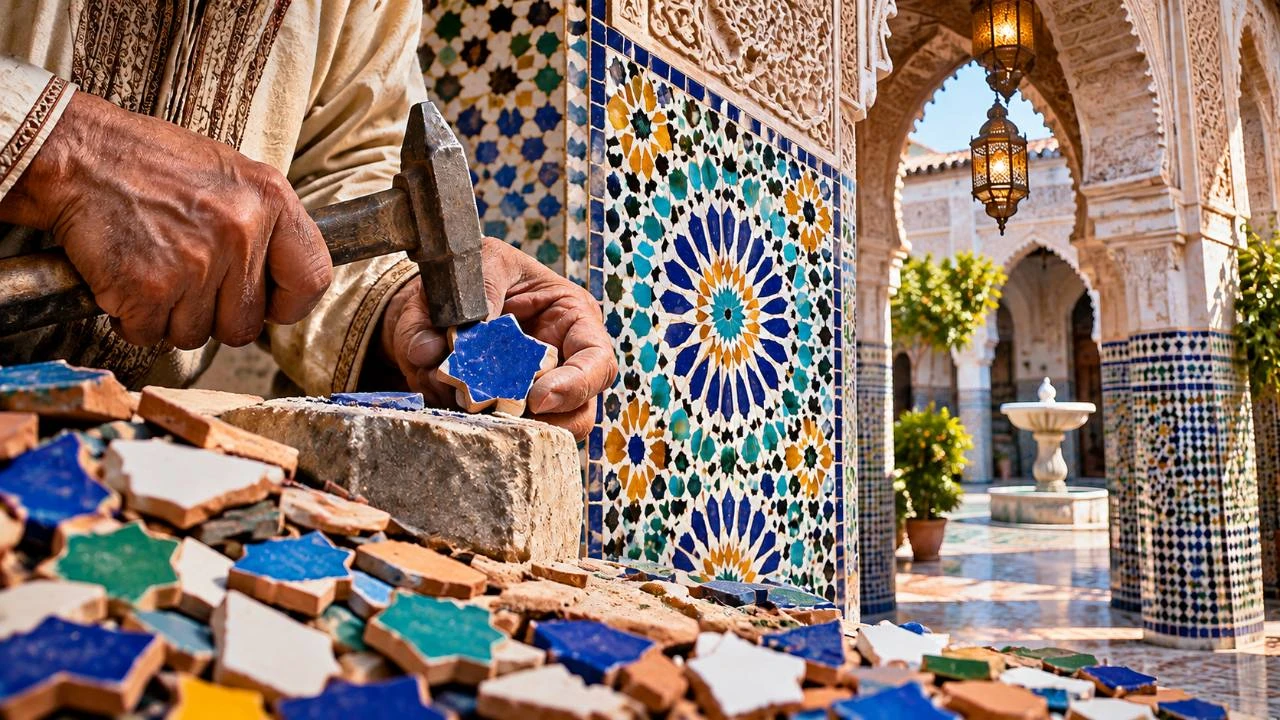
Supplied editorial illustration of zellige craftsmanship. It does not document an identified artisan or verified historic site.
At a distance, Moroccan zellige can look almost impossibly seamless: stars open into interlacing bands, small diamonds join larger polygons, and colour seems to travel across a wall. Up close, the design resolves into separate pieces of glazed clay. The precision belongs not to a printed surface but to a craft that brings material, geometry and the trained hand together. Museum of Ethnography: Moroccan zellige history and living heritage The Met: Moroccan Court, geometric design and 2011 craftsmanship
Zellige, also written zellij or zilij, is a form of architectural mosaic assembled from cut glazed terracotta. It is deeply associated with Morocco, especially cities such as Fez and Tétouan, while belonging to a wider history of exchange across North Africa and al-Andalus. Understanding it means looking beyond a fashionable tile finish to the knowledge required to make a composition work.
| Aspect | What to look for |
|---|---|
| Material | Glazed terracotta pieces assembled as mosaic. |
| Technique | Preparation, firing, hand-cutting and fitted assembly. |
| Geometry | Repeated and interlacing shapes within an architectural surface. |
| Transmission | Skills taught through makers, workshops and new generations. |
What makes zellige distinctive?
The essential relationship is between small shaped pieces and a larger patterned surface. A single piece may be visually simple, but its edges and angles matter because it has to meet other pieces. The finished effect comes from assembly: colour, contour and repetition become a continuous design rather than a collection of isolated tiles. Museum of Ethnography: Moroccan zellige history and living heritage
That distinguishes a cut mosaic from a surface on which a complete pattern is merely printed or painted. Both can be decorative, but they involve different processes. Calling every geometric ceramic tile “zellige” can hide the labour and material decisions that define the traditional craft.
From clay to a fitted composition
The craft includes preparing and firing clay, glazing, precise hand-cutting and assembly. The artisan must think about a piece as part of a system. A small deviation can alter how shapes meet, especially where a pattern changes direction or approaches a border. Museum of Ethnography: Moroccan zellige history and living heritage
The work therefore joins planning and adjustment. Geometry provides relationships, while experience guides the handling of the material. The point is not that every handmade surface is mechanically identical. It is that a skilled maker can organise individual pieces into a coherent whole while working with the realities of fired clay and glaze.
A history longer than a design trend
The Museum of Ethnography’s 2026 exhibition on Moroccan zellige traces early development to tenth-century Fez and follows the craft through the Marinid and Saadian periods. Such an institutional account provides historical context, rather than proof of a single inventor or a moment when every related mosaic tradition began. Museum of Ethnography: Moroccan zellige history and living heritage
Surviving architecture offers a more concrete way to encounter that history. The Met’s teaching material identifies the courtyard and fountain of the Attarin Madrasa in Fez with the dates 1323–25. It also explains the connections between Moroccan courtyard decoration and the arts of southern Spain in the fourteenth and fifteenth centuries. The Met: Moroccan Court, geometric design and 2011 craftsmanship
These connections do not make Moroccan craftsmanship anonymous. They show how a recognisable local tradition can develop through exchange, patronage and generations of practice. Its history is richer than a claim that every motif appeared in isolation or that later makers simply repeated an unchanging ancient formula.
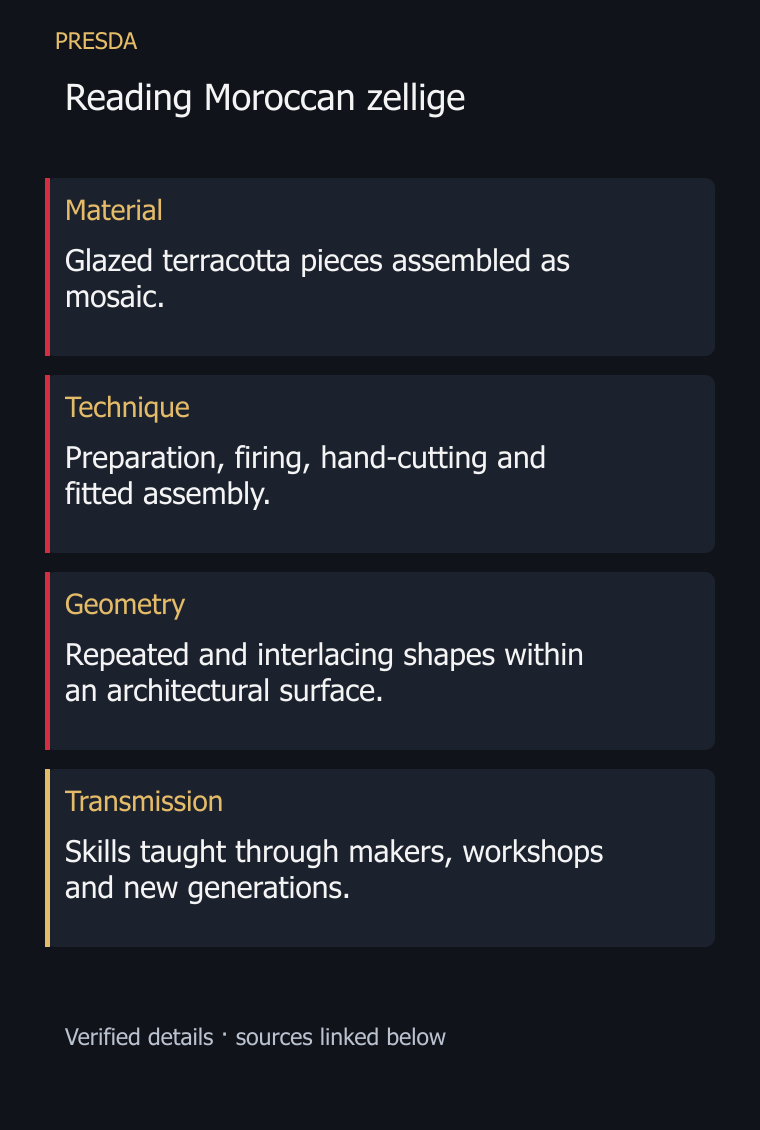
Four aspects of traditional zellige. Sources: Museum of Ethnography, The Met and UNESCO. These describe a craft, not a universal specification for every tile product.
Geometry that extends beyond the panel
In its analysis of the Moroccan Court, The Met describes designs radiating from a star’s centre into interlacing stars, pentagons and other shapes. Repetition makes the composition seem capable of continuing beyond the physical border. The wall ends, but the visual logic suggests a larger field. The Met: Moroccan Court, geometric design and 2011 craftsmanship
That effect can be understood through operations such as repetition, rotation and reflection. A limited group of shapes can generate a complex surface when the relationships between them remain consistent. The viewer does not need to calculate every angle to feel the rhythm, but the maker has to control how the pieces fit.
Mathematics does not cancel the human hand
It is tempting to describe a geometric surface as if it were produced entirely by an equation. That misses the transformation from drawing to clay. Thickness, cut edges, glaze and the conditions of assembly all belong to the object. The pattern is mathematical, but the finished work is also material and architectural.
Equally, apparent complexity should not invite invented codes. A particular star count or colour does not automatically have one universal spiritual meaning in every building. Interpretation needs the context of the place, its patrons, its makers and the evidence available, rather than a list of symbolic meanings applied indiscriminately.
Colour is part of the structure
Colour helps the eye distinguish paths through a design. A star can stand out against its surrounding shapes; a contrasting band can make an interlacing route legible. Change the colour relationships and the same geometry can be read differently, with a different balance between centre, background and border.
The Museum of Ethnography treats colour, geometric form and artisanal skill as inseparable aspects of zellige’s visual language. That is a useful approach because it avoids reducing the craft to either mathematics alone or a palette detached from the work of making and placing the pieces. Museum of Ethnography: Moroccan zellige history and living heritage
For the observer, a practical exercise is to follow one colour across a panel, then look again for the repeated shapes. The surface often becomes easier to read in stages. What first appears to be an overwhelming puzzle can reveal a disciplined sequence of centres, connections and returns.
Architecture gives the mosaic its setting
Zellige is not only an object to inspect in isolation. The Met describes a traditional courtyard arrangement with coloured tilework low on the walls, carved plaster above and wood at a higher level. A fountain, natural light and the surrounding rooms complete an experience of space. The Met: Moroccan Court, geometric design and 2011 craftsmanship
The changing viewpoint matters. A panel seen across water, from a doorway or at close range offers different relationships between detail and whole. The craft’s effect comes partly from how it is encountered within a building, not only from the beauty of a small sample held under uniform lighting.
PRESDA’s feature on Morocco’s dynasties and historical transformations provides wider context for the changing worlds in which architectural arts developed. Patronage and construction belong to political and social history, while the skill of cutting and assembling is transmitted through people and workshops.
A living craft, not a museum fossil
In 2011, craftsmen from Fez helped create The Met’s Patti Cadby Birch Moroccan Court in New York. The Naji family and their company, Arabesque, made an architectural setting using traditional materials and techniques. The museum’s film follows that work, demonstrating contemporary expertise rather than presenting craft as something that ended centuries ago. The Met: Moroccan Court, geometric design and 2011 craftsmanship The Met: Building the Moroccan Court
The project also helps distinguish a modern work from the historical objects around it. A newly built courtyard can interpret an architectural tradition without becoming an original medieval monument. Its value includes showing that the knowledge remains usable and that named makers, not an abstract past, bring the space into being.
Transmission requires more than admiration
UNESCO’s account of a 2024 visit to master craftsman Mohamed El Messal’s workshop in Tétouan describes a joint project with Morocco’s ministry to preserve knowledge through transmission to younger generations. It documents a practical training effort, not merely an expression of appreciation for a beautiful surface. UNESCO: transmission of zellige skills in Tétouan
UNESCO’s Creative Cities profile also places zellige within Tétouan’s broader craft neighbourhoods and Arab-Andalusian heritage. Those sources establish a context of living skills. They should not be confused with a separate claim that every craft mentioned on a UNESCO webpage has its own World Heritage or intangible-heritage inscription. UNESCO: Tétouan’s craft context
How to look at zellige with greater attention
Start with the whole setting, then move toward the join between two pieces. Notice how a border handles the meeting of a pattern and an architectural edge. Look at the difference between the glaze’s surface and the geometry of the cut, and at how several small elements produce a larger form.
The same care can be taken with photographs. A beautiful image does not by itself identify the workshop, age or location of the work. The supplied hero for this article is an editorial illustration, not documentation of a named master at a verified historic site. Keeping that distinction visible respects the real people and places behind the craft.
Readers exploring Morocco’s visual environments can also turn to Chefchaouen’s distinctive urban story. Its colour traditions are a different subject, but both stories encourage looking beyond an attractive image to the history, context and continuing life of a place.
Why the tradition still matters
Zellige joins the repeatable and the individual. A geometric system can be extended, but every physical panel has to be made and fitted somewhere. That relationship explains why the craft continues to interest architects and viewers: it can organise a space while rewarding attention to the smallest piece.
Its continuity depends on more than copying a star pattern. It requires the transmission of material knowledge, patient practice and recognition of the artisans who carry it. The ancient art of geometry and colour remains a living activity because people continue to learn how to turn fired clay into a convincing whole.
FAQ
Frequently Asked Questions
What is Moroccan zellige?
Architectural mosaic made from shaped pieces of glazed terracotta, strongly associated with Moroccan craftsmanship and a wider North African and Andalusian history.
Is it the same as any patterned ceramic tile?
No. A cut-piece mosaic and a tile carrying a printed or painted pattern involve different techniques, even when their visual motifs resemble one another.
Why are geometric patterns so important?
They organise how pieces fit and repeat. Rotation, reflection and interlacing can make a bounded panel appear to extend beyond its edges.
Is zellige still made by living artisans?
Yes. The Met’s 2011 Moroccan Court and UNESCO’s documented Tétouan training project provide examples of continuing practice and transmission.
Does every colour or star have one fixed meaning?
No universal interpretation should be assumed. Meanings need to be connected to a specific work, place and historical evidence.
PRESDA Dispatch
Stay Informed. Stay Aware.
A sharp briefing across AI, gaming, sport, business, world affairs, paparazzi, and lifestyle.