MOROCCO'S INDEPENDENCE DAY: 71 YEARS OF FREEDOM AND SOVEREIGNTY
Why Morocco celebrates November 18, how Mohammed V’s return shaped independence, and how the 1955 milestone connects with recognition in 1956.
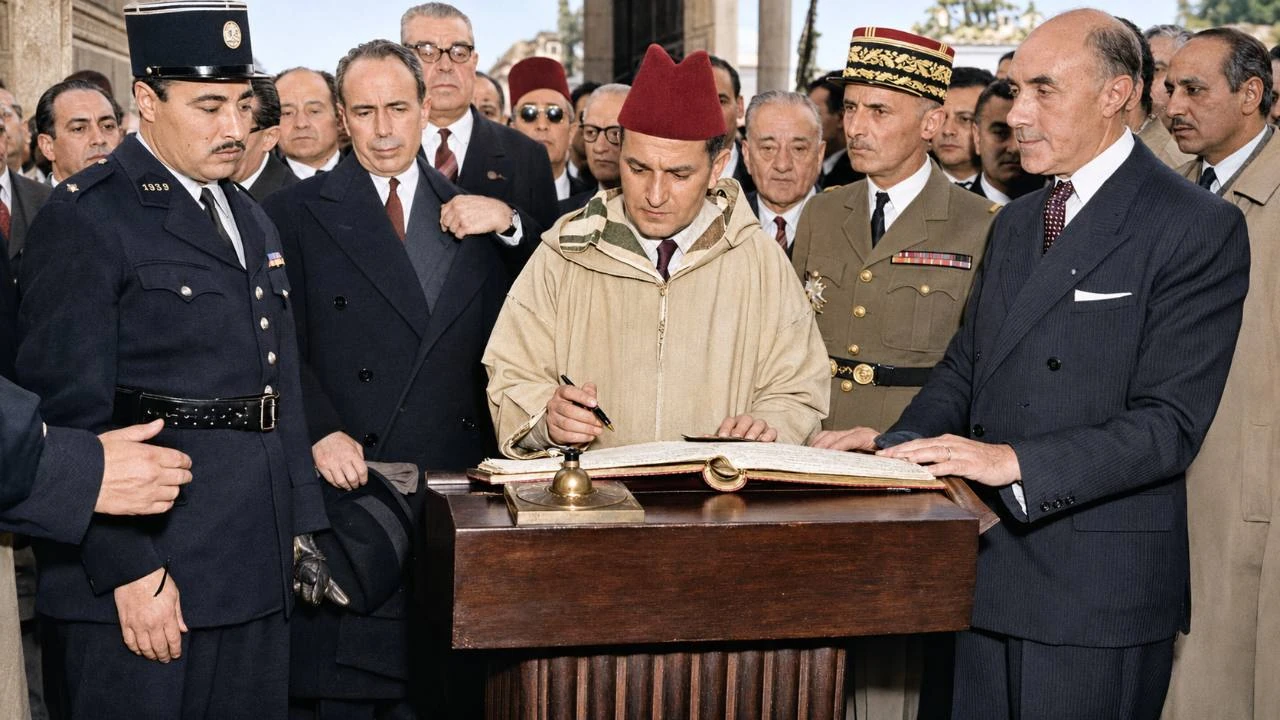
Colorized signing image supplied to PRESDA. Exact ceremony, date and original photographic provenance unverified.
Morocco marks its 71st Independence Day commemoration on November 18, 2026. The anniversary looks back to Mohammed V’s speech on November 18, 1955, following his return from exile. Formal recognition by France came on March 2, 1956, followed by a Spanish declaration on April 7. Understanding those dates reveals a process in which popular resistance, nationalist organisation, royal authority and negotiations converged. The holiday remembers a decisive turn in that process. Moroccan government: 71st Independence Day anniversary French diplomatic archives: Treaty of Fez and independence Spanish official gazette: recognition and transfer of powers
Why does Morocco celebrate November 18?
| Date | Milestone |
|---|---|
| January 11, 1944 | Presentation of the Independence Manifesto |
| August 20, 1953 | Removal and exile of Mohammed V |
| November 18, 1955 | Speech commemorated on Independence Day |
| March 2 and April 7, 1956 | French and Spanish recognition respectively |
The date gives national memory a focal point: a sovereign returning to address a country demanding freedom. Mohammed V came back on November 16, 1955, after more than two years in exile. His speech two days later expressed the transition toward independence and the work of building the state. Morocco’s government identifies the 2026 celebration as the 71st anniversary of that milestone. The calculation is 2026 minus 1955, rather than a count from the following year’s diplomatic recognition. Moroccan government: 71st Independence Day anniversary
A holiday and a legal transition
A commemorative date can capture a political breakthrough before all legal arrangements have been completed. November 1955 and March 1956 answer different historical questions. One concerns the moment commemorated; the other concerns the formal end of the French protectorate. Keeping both visible allows readers to understand why histories, official documents and calendars sometimes lead with different years. Independence emerged through successive decisions, with practical transfers continuing after the most celebrated speeches. French diplomatic archives: Treaty of Fez and independence French diplomatic archives: transition in 1956
What was the protectorate?
The Treaty of Fez of March 30, 1912 established the French protectorate. The sultanate continued to exist, while French institutions exercised extensive authority over administration and policy. A Spanish protectorate operated in other zones, adding another layer to the territorial and diplomatic landscape. Calling Morocco a protectorate describes its formal colonial arrangement; it does not mean that Moroccans retained effective control over the decisions that mattered to their country’s political future. French diplomatic archives: Treaty of Fez and independence Spanish official gazette: recognition and transfer of powers
Colonial government worked through offices, regulations, security structures and local intermediaries. Its history therefore survives in administrative records as well as accounts of resistance. French diplomatic archives describe documents created by the protectorate and the withdrawal of its administration after independence. These records illuminate how power was organised, though their institutional viewpoint must be read alongside Moroccan sources. They record a colonial system’s operations and the difficulties of dismantling it. French diplomatic archives: transition in 1956
How did the independence movement develop?
Resistance took armed, political and civic forms across different regions and generations. The independence movement connected demands for political rights with the claim that Morocco should determine its own affairs. The January 11, 1944 Independence Manifesto became a major public statement of that ambition. It helped shift the political horizon from proposed changes within colonial rule toward national sovereignty. Morocco commemorates the manifesto separately, recognising that independence had an organised political history before the events of 1955. Moroccan government: Independence Manifesto of 1944
The manifesto’s importance also lies in the way a demand can outlast the circumstances of its presentation. A document can give dispersed grievances a shared language and become a reference for later mobilisation. It cannot, by itself, compel a colonial administration to withdraw. That required sustained pressure and changes in the balance of political authority. The campaign drew strength from the relationship between the nationalist movement and Mohammed V, while involving people whose contributions extended beyond formal leadership. Moroccan government: Independence Manifesto of 1944 Moroccan government: Revolution of the King and the People
Why Mohammed V’s exile mattered
French authorities removed Mohammed V on August 20, 1953, sending him and his family into exile. Their destinations included Corsica and Madagascar. The removal was intended to resolve a confrontation over authority, but intensified opposition and made the absent sultan a powerful focus of mobilisation. Morocco remembers August 20 as the Revolution of the King and the People. The name expresses the central place of that alliance in the country’s account of liberation. Moroccan government: Revolution of the King and the People
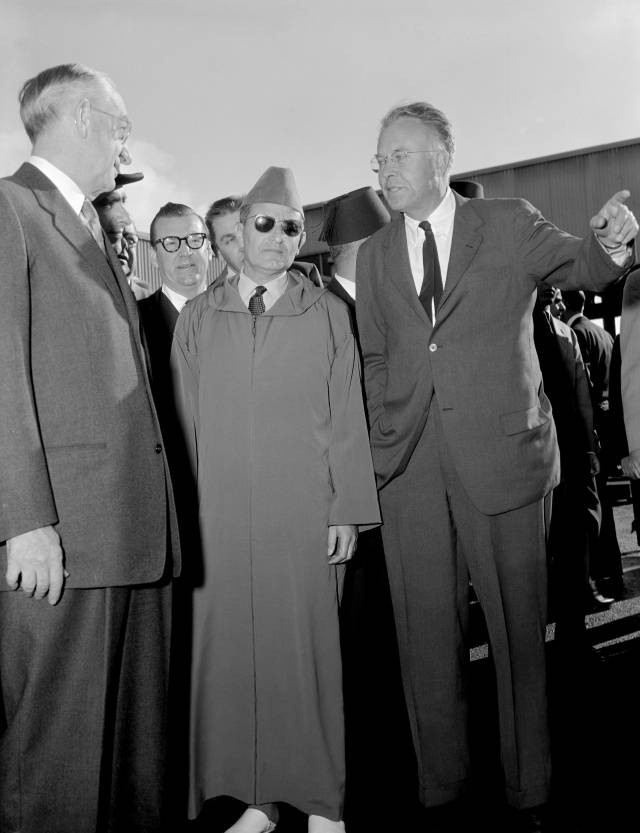
Mohammed V during his visit to Lawrence Berkeley Laboratory on December 5, 1957. This documented visit followed independence; it is separate from the supplied signing image.
Lawrence Berkeley National Laboratory / Wikimedia Commons · Public domain
Exile changed the political meaning of return. The journey back in November 1955 represented the restoration of a figure whose removal had become inseparable from the sovereignty dispute. It also showed the limits of an arrangement sustained against growing resistance. Celebratory images of the return capture public emotion, while negotiations and administrative records explain how that emotion translated into changes in government. Both forms of evidence belong in a history of independence. Moroccan government: 71st Independence Day anniversary French diplomatic archives: transition in 1956
What changed in 1956?
On March 2, 1956, France formally recognised Morocco’s independence. The French diplomatic archive describes the document as recognising independence and unity. Recognition changed the basis of the relationship between the two states and required the winding down of protectorate administration. It did not mean that every office, responsibility and practical arrangement could be transformed in one day. Sovereignty needed institutions capable of carrying out decisions after the declaration had been signed. French diplomatic archives: Treaty of Fez and independence French diplomatic archives: transition in 1956
Spain recognised independence through the joint declaration of April 7, 1956. A later Spanish official gazette records agreements intended to complete transfers of powers and regulate financial, monetary and economic relations. This documentary trail shows that independence involved successive negotiations with different colonial authorities. A single anniversary cannot contain every part of that chronology, but a clear timeline can connect them without treating the dates as competing versions of the same event. Spanish official gazette: recognition and transfer of powers
What did sovereignty require after independence?
The immediate task extended from obtaining recognition to exercising authority through government. Administrative services, public finance, representation abroad and relations with former colonial powers needed workable arrangements. The Spanish agreements provide concrete examples of those continuing responsibilities. Independence established a new political basis for making such decisions. The practical quality of sovereignty depended on the institutions, personnel and resources available to implement them. This is the state-building dimension behind the language of freedom. Spanish official gazette: recognition and transfer of powers
National commemoration also brings together experiences that were uneven across the country. A royal speech, a manifesto and a local act of resistance belong to different scales of history. Reading them together gives the anniversary greater depth than a list of famous names alone. For the longer sequence of dynasties and political change, see PRESDA’s history of Morocco. It provides context for why the survival and transformation of the sultanate mattered in the twentieth century.
Reading the supplied signing image
The latest colorized signing image supplied to PRESDA is used as the hero. Its original photographic provenance, exact ceremony and date have not been independently authenticated. It therefore accompanies the historical account without serving as proof of a particular agreement. Colorization adds another interpretive layer to any underlying photograph. The chronology here rests on documentary sources, which distinguish November 1955 from the formal recognitions and transfers that followed in 1956.
What does the 71st anniversary remember?
It remembers the recovery of national agency through a prolonged struggle, together with the obligation to give that agency institutional form. November 18 connects the return from exile, the public affirmation of independence and the work that followed. Explaining the dates strengthens that memory by making it precise. Seventy-one years refers to the commemorated 1955 milestone; the formal recognitions of 1956 remain essential to the same history. Moroccan government: 71st Independence Day anniversary French diplomatic archives: Treaty of Fez and independence
FAQ
Frequently Asked Questions
Why is the anniversary 71 years in 2026?
Morocco counts the commemoration from November 18, 1955, when Mohammed V addressed the country after returning from exile. Subtracting 1955 from 2026 gives 71. Formal French recognition followed in March 1956, so histories referring to that legal milestone use a different starting year.
When did France recognise Moroccan independence?
France formally recognised independence on March 2, 1956. French diplomatic archives document the agreement and the subsequent withdrawal of protectorate administration. November 18 remains the national commemorative date associated with the political breakthrough of 1955.
When did Spain recognise independence?
The joint Spanish-Moroccan declaration was issued on April 7, 1956. Later agreements regulated practical transfers and relations in areas such as finance and the economy, illustrating why recognition and administrative transition were related but distinct steps.
Why was Mohammed V’s return important?
His removal in August 1953 had intensified resistance and made him a focus of the sovereignty struggle. Returning on November 16, 1955 restored that central figure before the speech commemorated two days later. It marked a major change in the political balance.
Does the hero prove where independence was signed?
No. It is the latest supplied colorized signing image, but its exact ceremony, date and underlying photographic provenance remain unverified. The article’s dates and account of recognition are supported by the cited government and archival documents.
PRESDA Dispatch
Stay Informed. Stay Aware.
A sharp briefing across AI, gaming, sport, business, world affairs, paparazzi, and lifestyle.