THE SWEDISH EMPIRE: HOW SWEDEN BECAME A GREAT EUROPEAN POWER
Sweden’s seventeenth-century empire grew from state centralization, Baltic warfare, disciplined armies and resource wealth, then declined after Poltava and the Great Northern War.
Sweden became a great European power during the seventeenth century by combining a more centralized state with Baltic trade, mining revenue and an army able to move and fight far from Scandinavia. The Swedish Empire was never a state that controlled the entire Baltic. It was a changing collection of Swedish provinces, conquered territories, garrison towns and diplomatic influence around the sea, and its power declined sharply after Russia’s victory at Poltava in 1709 and the peace settlement of 1721.
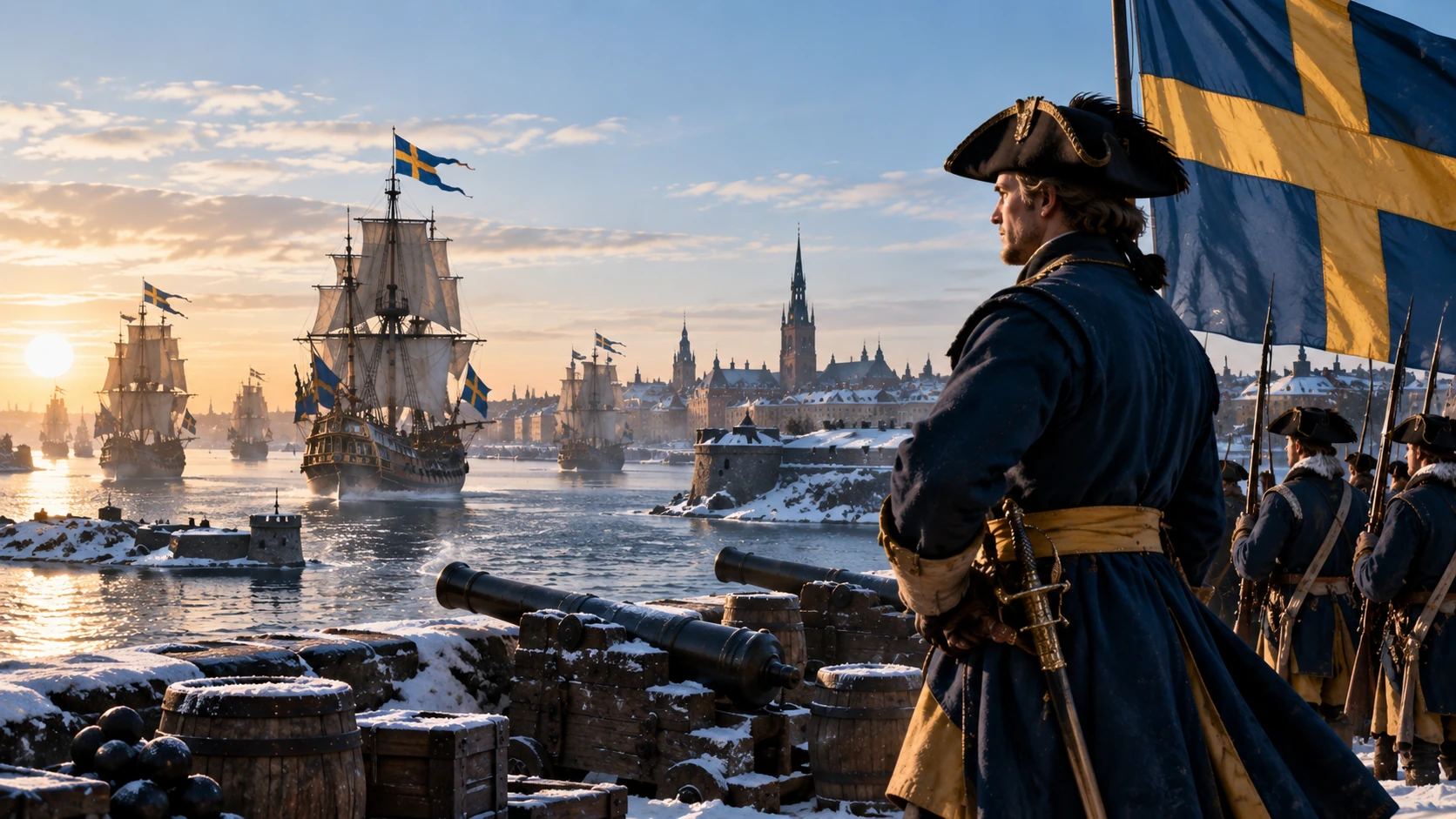
The supplied hero image is an editorial reconstruction of Sweden’s imperial age. It combines ships, fortifications and soldiers as visual shorthand, rather than depicting one documented battle or a particular seventeenth-century harbor.
SWEDEN BEFORE THE EMPIRE
Medieval Sweden was a Christian kingdom spread across the Scandinavian peninsula and the eastern lands that later became Finland. Its kings depended on regional law, noble families, bishops and local assemblies. Sweden’s position gave it access to the Gulf of Bothnia and the eastern Baltic, but its population and tax base were smaller than those of the major states farther south. The monarchy’s ability to raise money and troops was therefore a continuing political problem.
In 1397, Sweden entered the Kalmar Union with Denmark and Norway under one monarch. The union was not a fully integrated kingdom. Swedish nobles, towns and bishops defended their privileges, while Danish kings often tried to strengthen their control from outside Sweden. Rebellions, elections and periods of separate Swedish rule followed. The Stockholm Bloodbath of 1520, when King Christian II’s opponents were executed after his victory, helped turn resistance into a broader challenge to Danish authority. Swedish History Museum: The Kalmar Union and Gustav Vasa
GUSTAV VASA AND A STRONGER CROWN
Gustav Eriksson, later known as Gustav Vasa, led the revolt that ended Danish rule in Sweden. He was elected king in 1523, a date often used to mark the end of the union in practice. Gustav did more than win a war. He built a hereditary monarchy, appointed royal officials, expanded written administration and demanded more regular taxation from local communities. The Swedish crown became less dependent on temporary bargains with magnates, even though noble power remained important.
The Reformation gave the crown new resources and a new relationship with the church. At the diet of Västerås in 1527, church property was transferred to the crown and the king gained greater control over ecclesiastical administration. Lutheran teaching spread through preaching and printed texts, but the transformation was gradual. Under Gustav’s sons and successors, the Church of Sweden became a firmly Lutheran state church. The process strengthened central government while also changing parish life, education and the distribution of wealth. Swedish History Museum: Gustav Vasa and the Reformation
BALTIC WARS AND THE MAKING OF A POWER
The Vasa monarchy pursued security and influence around the Baltic. Sweden fought Denmark-Norway over the Scandinavian peninsula and maritime routes, Poland-Lithuania over Livonia and the Vasa dynastic claim to the Polish crown, and Russia over access to the Gulf of Finland and Ingria. These conflicts were not one continuous plan for total domination. They were linked to trade, dynastic politics, frontier security and the opportunity to capture customs revenues from ports.
By the early seventeenth century, Sweden had acquired or secured footholds in Estonia, parts of Livonia and Ingria, as well as important positions on the Finnish side of the Gulf. The crown also built fortresses and a navy. Historians sometimes describe the ambition as *dominium maris Baltici*, dominion of the Baltic Sea. The phrase is useful for describing a strategic aspiration, but it should not be read as proof that Sweden controlled every shore or all shipping. Local elites, rival states and independent cities continued to shape the region.
GUSTAVUS ADOLPHUS AND THE THIRTY YEARS’ WAR
Gustavus Adolphus, or Gustav II Adolf, became king in 1611 during war with Denmark. Working with Chancellor Axel Oxenstierna, he reorganized taxation, provincial administration and military recruitment. County governors connected the central government to local officials, while a system of allotments and household obligations helped provide soldiers. Sweden still relied on allies, foreign troops and captured resources, but its institutions could sustain campaigns more effectively than before.
The Swedish army combined disciplined infantry, mobile artillery and cavalry used for shock action. Gustavus reduced some infantry units to more flexible formations and coordinated different arms on the battlefield. These changes made the army effective, but he did not invent modern warfare. Military practice across Europe was changing through experiments by many states, and historians continue to debate whether the period deserves the label ‘military revolution.’ Swedish success also depended on logistics, officers, fiscal extraction and the willingness of soldiers to endure severe conditions.
In 1630 Sweden intervened in the Thirty Years’ War, a conflict that had begun in the Holy Roman Empire and involved religion, dynastic claims and the balance of European power. Gustavus won a major victory over the imperial army at Breitenfeld on 17 September 1631. The battle opened central Germany to Swedish operations and made the king a leading Protestant commander. At Lützen on 6 November 1632, Swedish forces fought another major battle, but Gustavus was killed in the fighting. The result was militarily costly for both sides and did not end the war.
Sweden remained powerful after the king’s death because Oxenstierna, the regency for the young Queen Christina and the state’s fiscal and administrative machinery continued the war. Swedish troops held and expanded positions in northern Germany, while subsidies and alliances connected the Swedish government to wider anti-imperial coalitions. The Peace of Westphalia in 1648 confirmed Swedish gains including Western Pomerania, Wismar and the bishoprics of Bremen and Verden. These were German territories under the Swedish crown, not extensions of present-day Sweden, and their value came partly from ports, river routes and a voice in imperial politics.
THE AGE OF GREATNESS
Queen Christina ruled in her own right from 1644 and abdicated in 1654. Oxenstierna and other administrators had already made the state more capable of collecting taxes, managing provinces and negotiating with foreign powers. Sweden’s economy rested on agriculture, crown revenues, customs and exports of iron, copper, timber and tar. The Falun copper mine and expanding iron industry helped pay for armies and fleets, although war also imposed heavy burdens on peasants and towns.
Swedish possessions around the Baltic included Finland, Estonia, parts of Livonia, Ingria and Karelia at different moments. Sweden also held German territories after Westphalia. Some areas were directly administered provinces, while others were occupied, contested or tied to the crown through treaties. Finnish soldiers and communities were integral to the Swedish realm, but Finland was not a colony in the modern overseas sense. Imperial government was multilingual and involved Baltic German, Finnish, Estonian, Latvian, German and Swedish institutions.
Sweden’s overseas ambitions were modest compared with those of Spain, the Dutch Republic, England or France. New Sweden was founded on the Delaware River in 1638 and remained under Swedish control until the Dutch conquest in 1655. The colony was small, depended on European trade and interacted with Indigenous communities in a contested landscape. Sweden also participated in limited African and Caribbean ventures, including trading companies connected to the Atlantic slave trade. These projects mattered to the history of Swedish colonialism, but they did not create a large overseas empire comparable to the major Atlantic powers. National Park Service: New Sweden
CHARLES X AND CHARLES XI
Charles X Gustav inherited a kingdom still fighting Poland-Lithuania. When Denmark-Norway declared war in 1657, he moved rapidly from the Polish theater into Jutland and across the frozen Danish Belts in the winter of 1658. The march was a remarkable military operation, but it was also a gamble made possible by unusual ice conditions and a vulnerable Danish position. The Treaty of Roskilde in February 1658 transferred Scania, Blekinge, Halland, Bohuslän and Norwegian districts to Sweden. Sweden reached its greatest territorial extent, but the gains remained exposed and the king soon resumed war. Danmarkshistorien Lex: Treaty of Roskilde
Charles XI, who came to the throne as a child in 1660, eventually restored royal control over nobles and state finances. The Reduction reclaimed crown lands that had been granted away, and a more centralized administration supervised taxation, justice and defense. The allotment system, often called *indelningsverket*, linked farms to the support of soldiers and officers. The resulting Carolean army was disciplined and relatively inexpensive to maintain, but its strength depended on a society that carried substantial military obligations.
CHARLES XII AND THE GREAT NORTHERN WAR
Charles XII became king in 1697 at the age of fifteen. Denmark-Norway, Saxony-Poland-Lithuania and Russia formed a coalition in 1700 to challenge Swedish power. Sweden defeated Denmark’s forces at the opening of the war and then won a celebrated victory over Peter the Great’s army at Narva on 30 November 1700. Charles moved into Poland-Lithuania, deposed Augustus II as Polish king and installed a Swedish-backed candidate before forcing Augustus to recognize the settlement at Altranstädt in 1706.
Charles then chose to invade Russia. The campaign moved across a vast landscape in 1708, where Russian forces avoided a decisive battle, destroyed supplies and used distance to weaken the Swedish army. Swedish soldiers also faced poor roads, shortages of horses and ammunition, and the severe winter of 1708–1709. Charles turned toward Ukraine and relied on uncertain alliances, including support from Hetman Ivan Mazepa. At Poltava on 8 July 1709, Peter’s reorganized army defeated the Swedish force. The battle destroyed Sweden’s offensive position in the east and gave Russia the initiative, although the Great Northern War continued for another twelve years.
Charles escaped to Ottoman territory and spent years at Bender seeking diplomatic and military support. He returned to Sweden in 1714 and launched a campaign against Norway. During the siege of Fredriksten in 1718, he was killed by a shot. Historians have debated whether the bullet came from Norwegian defenders or a Swedish assassin, but the evidence does not establish a single theory as fact. His death removed a determined commander without solving the war’s financial and strategic problems.
NYSTAD AND THE END OF SWEDISH HEGEMONY
Sweden continued fighting after Charles XII died. Russia attacked Swedish territory and dominated the eastern Baltic, while Denmark-Norway and Hanover pressed Sweden in the west and Germany. Peace treaties at Stockholm, Frederiksborg and finally Nystad in 1721 ended the Great Northern War. Sweden lost Estonia, Livonia, Ingria, part of Karelia and other possessions to Russia. It kept Finland and the Scandinavian heartland, but its position as the leading northeastern European power had ended.
Peter the Great’s Russia emerged as the dominant state on the Baltic’s eastern shore. Sweden entered the Age of Liberty, a constitutional period in which the Riksdag and competing political groupings exercised more power than the monarchy. The change did not erase Sweden’s imperial legacy, but it redirected state capacity toward administration, commerce and domestic politics. The later loss of Finland to Russia in 1809 belonged to a different era and should not be projected backward into the seventeenth-century empire.
WHAT THE SWEDISH EMPIRE LEFT BEHIND
Sweden’s rise shows how a relatively small population could become a major military power through institutions, natural resources, negotiated taxation and strategic geography. The state drew soldiers and revenue from Sweden and Finland, acquired ports and provinces around the Baltic, and used German possessions to enter continental politics. Its victories were real, but they were expensive. Famine, disease, conscription and war levies affected ordinary people across the realm and in the territories Swedish armies occupied.
Gustavus Adolphus remains famous for combining infantry, artillery and cavalry, yet his reputation should be understood within a broader European transformation. Oxenstierna’s administration and later reforms under Charles XI were as important as battlefield tactics. The Thirty Years’ War connected Swedish power to the politics of the Holy Roman Empire, while Poltava shifted the northern balance toward Russia. Swedish cultural and political institutions also left durable traces around the Baltic, even where sovereignty later changed.
The empire was therefore a historical phase, not an inevitable expression of modern Sweden. After 1721, Sweden remained a kingdom with important European interests, but it increasingly pursued security and reform rather than territorial expansion. The memory of the great-power era still shapes museums, monuments and national narratives, while scholarship continues to examine both the state’s military achievements and the human cost of the system that made them possible.
FREQUENTLY ASKED QUESTIONS
**Did Sweden control the whole Baltic Sea?**
No. Sweden held important ports and provinces around the Baltic at different times, but Denmark-Norway, Poland-Lithuania, Russia, the Dutch and local authorities remained powerful actors. *Dominium maris Baltici* describes an ambition for strategic predominance, not total control.
**Why was Breitenfeld important?**
The Swedish-led victory on 17 September 1631 broke an imperial field army and opened central Germany to Protestant and allied operations. It made Gustavus Adolphus a leading commander, but it did not by itself decide the Thirty Years’ War.
**Why did Poltava change northern Europe?**
Poltava in 1709 destroyed Sweden’s ability to conduct a major offensive in the east and transferred the initiative to Russia. The war continued, but Russia’s later gains and the Treaty of Nystad confirmed a new balance of power.
**Was Charles XII assassinated?**
The origin of the shot that killed him at Fredriksten in 1718 remains disputed. Norwegian fire is the conventional explanation, while later investigations proposed an internal Swedish assassination. The evidence does not settle the question conclusively.
**Was New Sweden a large Swedish colony?**
No. New Sweden occupied a small area along the Delaware River from 1638 to 1655. Sweden’s overseas colonial and slave-trading ventures were limited compared with major Atlantic empires, but they are part of the country’s wider imperial history.
SOURCES AND FURTHER READING
For connected histories, see PRESDA’s Russian Empire, Kingdom of Hungary and Kingdom of Croatia articles.
> Sweden’s empire was a changing Baltic system of provinces, ports, alliances and occupations, sustained by state reform and paid for by war.
FAQ
Frequently Asked Questions
Did Sweden control the whole Baltic Sea?
No. Sweden held important ports and provinces around the Baltic at different times, but rival states and local authorities remained powerful actors. Dominium maris Baltici describes an ambition for strategic predominance, not total control.
Why was Breitenfeld important?
The Swedish-led victory on 17 September 1631 broke an imperial field army and opened central Germany to allied operations, making Gustavus Adolphus a leading commander.
Why did Poltava change northern Europe?
Poltava in 1709 destroyed Sweden’s ability to conduct a major offensive in the east and transferred the initiative to Russia, whose gains were confirmed by the Treaty of Nystad.
Was Charles XII assassinated?
The origin of the shot that killed him at Fredriksten in 1718 remains disputed. The evidence does not establish a single theory conclusively.
Was New Sweden a large Swedish colony?
No. New Sweden occupied a small area along the Delaware River from 1638 to 1655. Sweden’s overseas colonial and slave-trading ventures were limited compared with major Atlantic empires, but they are part of its imperial history.
PRESDA Dispatch
Stay Informed. Stay Aware.
A sharp briefing across AI, gaming, sport, business, world affairs, paparazzi, and lifestyle.