THE VIKINGS: RAIDERS, EXPLORERS AND THE WORLD BEYOND THE LEGEND
They raided monasteries, built trade networks across continents and reached North America centuries before Columbus. But the real Vikings were far more complex than the warriors of legend.
The Vikings became famous because frightened writers remembered their ships arriving without warning.
A sail on the horizon could mean trade.
It could mean news.
It could mean a raid.
Between roughly the late eighth and eleventh centuries, Scandinavian seafarers moved through the rivers, coasts and seas of Europe and beyond. They attacked monasteries, settled in Britain and Ireland, served in Constantinople, traded silver from Islamic markets, crossed the North Atlantic and built a short-lived base in North America.
But the real history of the Vikings is larger than the image of warriors with axes.
They were farmers, sailors, merchants, craftspeople, enslavers, settlers, explorers, political actors and religious communities living through a period of extraordinary movement.
The history of the Vikings is therefore not only a story of violence.
It is a story of ships, ambition, trade, mythology, migration and cultural transformation. For more PRESDA history features, read the Ottoman Empire and the history of chess.
WHO WERE THE VIKINGS?
The word Viking should be used carefully.
It is often used today as a convenient label for medieval Scandinavians from areas that are now Denmark, Norway and Sweden. Historically, however, it did not simply mean every Scandinavian person.
Many scholars connect the term with raiding or seaborne activity, while modern usage has expanded it into a broad cultural label.
That distinction matters because most people in Viking Age Scandinavia were not spending every day raiding foreign coasts.
They farmed land, raised animals, made tools, built ships, traded goods, formed households, worshipped gods, negotiated marriages, settled disputes and lived within local power structures.
The Viking Age itself is usually dated from around 793 to 1066 in western historical narratives, beginning with the raid on Lindisfarne and ending conveniently with the Battle of Stamford Bridge.
Those dates are useful markers, not hard walls.
Scandinavian travel, trade and violence existed before 793, and Norse influence continued after 1066.
LINDISFARNE - 793
The raid on the monastery of Lindisfarne in 793 became one of the most dramatic moments in early medieval memory.
Lindisfarne sat on a tidal island off the coast of Northumbria. It was a major religious center and a place associated with manuscripts, relics and Christian learning.
When raiders struck, the event shocked writers across the Christian world.
The attack became a symbolic beginning for the Viking Age in western Europe, but it should not be described as the first contact between Scandinavia and the outside world.
Long before 793, northern peoples had traded, travelled and interacted across the North Sea and Baltic world.
What made Lindisfarne so powerful as a historical marker was its combination of violence, religious meaning and written memory.
Monasteries could be attractive targets because they held portable wealth, often stood near navigable coasts or rivers and were not built as fortresses.
To monastic writers, the raid looked like a spiritual catastrophe.
To raiders, it may have looked like opportunity.
WHY DID THE VIKINGS LEAVE SCANDINAVIA?
There is no single explanation for Viking expansion.
The evidence points toward overlapping pressures and opportunities rather than one simple cause.
Population and settlement pressures may have mattered in some regions.
Political competition at home also mattered. Ambitious leaders needed followers, wealth and prestige, and foreign raiding could help provide all three.
Trade opportunities pulled Scandinavians outward as well. Silver, luxury goods, furs, weapons, slaves and other commodities moved through expanding networks.
Ships made the movement possible.
Weak or fragmented political targets abroad created openings for raiding, tribute-taking and settlement.
In other words, Viking expansion was not simply caused by poverty, climate or bloodlust.
It was produced by maritime skill, political competition, economic opportunity and the vulnerability of regions connected by sea and river routes.
THE LONGSHIP: THE MACHINE BEHIND THE VIKING AGE
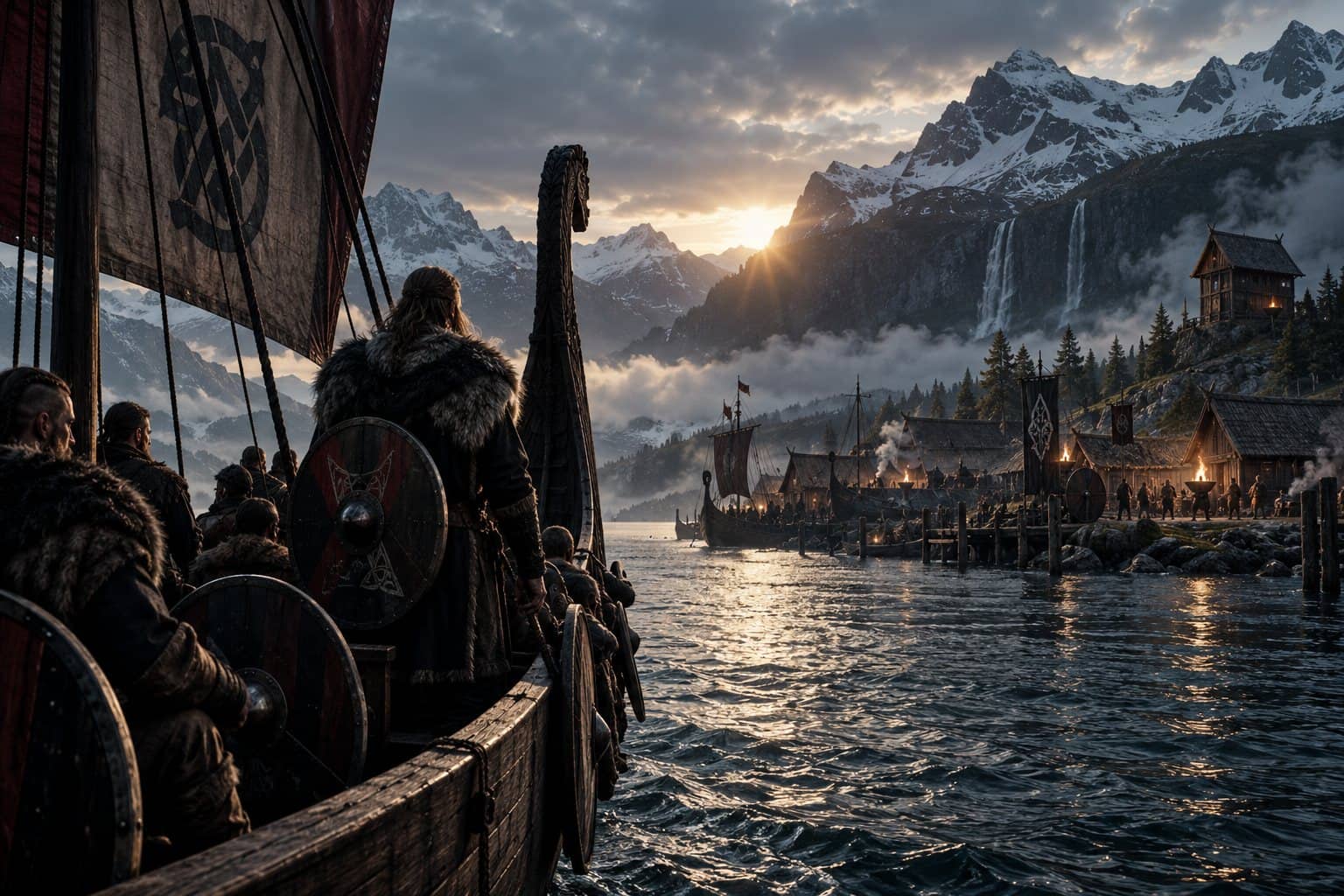
The longship was the defining technology of the Viking Age.
Viking ships used clinker-built construction, with overlapping planks fastened together to create strong, flexible hulls.
They could use sails for open-water travel and oars for maneuvering when wind failed or precision mattered.
Their shallow drafts allowed them to approach beaches, move along coasts and penetrate rivers that deeper vessels could not easily use.
That combination changed the geography of power.
A monastery, town or settlement did not need to sit beside the open sea to be vulnerable. If a river connected it to navigable water, a Scandinavian crew might reach it.
The same ships that enabled raids also supported trade, migration and settlement.
They carried people, weapons, cargo, livestock, news and ambition.
The Viking Age was not made by ships alone, but without ships it would be almost impossible to imagine.
FROM RAIDS TO CONQUEST
Early Viking activity in Britain and Ireland often involved seasonal raiding.
Over time, however, raids could become something larger.
Armies overwintered.
Leaders demanded tribute.
Settlers established communities.
Scandinavian power became political.
In the 860s, the force known in English sources as the Great Heathen Army arrived in England. It campaigned across several Anglo-Saxon kingdoms and helped transform Viking activity from coastal assault into conquest and territorial control.
York, known in its Scandinavian context as Jorvik, became one of the great Norse-influenced centers in England.
Alfred the Great of Wessex resisted Scandinavian expansion and later agreements helped define the Danelaw, where Scandinavian legal and settlement influence became deeply embedded.
This evolution is crucial.
The Vikings did not remain only hit-and-run raiders.
In some regions they became rulers, neighbors, traders and ancestors.
RAGNAR LOTHBROK: HISTORY OR LEGEND?
Ragnar Lothbrok is one of the most famous names associated with the Viking world.
He is also one of the most difficult to handle responsibly.
Much of Ragnar's story comes from later sagas and medieval literary traditions, not from secure contemporary biography.
The legendary Ragnar fights, schemes, fathers famous sons and dies in dramatic fashion in stories written long after the events they describe.
Historians therefore debate whether Ragnar reflects one historical individual, several figures merged together, or a largely literary hero shaped by later storytelling.
That does not make Ragnar irrelevant.
It makes him important in a different way.
He shows how Viking memory was built, retold and amplified through saga tradition.
PRESDA treats Ragnar as a legendary figure with possible historical echoes, not as a fully verified biography.
IVAR THE BONELESS AND THE GREAT HEATHEN ARMY
Ivar the Boneless is another name where history and legend meet.
He is associated with the Great Heathen Army and appears in traditions connected with Ragnar's sons.
The nickname Boneless remains debated.
Some interpretations have suggested a physical condition, others a metaphorical or literary meaning, and none should be presented as certain without stronger evidence.
What can be said carefully is that Ivar belongs to the remembered world of Viking military expansion in Britain and Ireland.
Like Ragnar, he became larger in later storytelling than the surviving contemporary evidence can fully support.
The responsible approach is not to erase him, but to separate evidence from legend.
VIKINGS IN FRANCE - AND THE BIRTH OF NORMANDY
Viking forces also targeted Frankish territory.
Raids reached deep into river systems and threatened major centers, including Paris.
Frankish rulers sometimes fought, negotiated, paid tribute or granted land in an attempt to manage the threat.
The settlement associated with Rollo became the foundation for Normandy.
This is one of the great examples of Viking transformation.
Scandinavian settlers did not remain culturally frozen as raiders.
They entered Christian politics, adopted local language and customs, and became part of the medieval European order.
Their descendants, the Normans, later reshaped history in England, southern Italy and the Mediterranean.
But by then they were not simply Vikings in another place.
They were a new political culture with Scandinavian roots and Frankish-Christian forms.
EASTWARD: THE VIKINGS AND THE RUS'
The Viking world did not only face west.
Scandinavian groups moved eastward along river systems through eastern Europe, connecting the Baltic with the Black Sea, the Caspian world and Byzantium.
The history of the Rus' is complex and should not be reduced to a simple ethnic slogan.
Scandinavian, Slavic, Finnic and other components all belonged to the political and commercial worlds that developed along these routes.
Norse travelers could serve as traders, warriors, settlers and elite groups within wider societies.
The rivers made movement possible, but movement required organization: boats, portages, trading contacts, military force and knowledge of local routes.
This eastern dimension reminds us that the Viking Age was not only a North Atlantic story.
It was a Eurasian network story.
CONSTANTINOPLE AND THE VARANGIAN GUARD
Some Norse and Scandinavian-connected warriors travelled as far as Constantinople.
The Byzantine capital, one of the richest cities in the medieval world, attracted merchants, soldiers and diplomats from enormous distances.
The Varangian Guard became the most famous symbol of this connection.
It included warriors from northern Europe who served the Byzantine emperor.
Their presence shows the extraordinary reach of Viking Age mobility.
A person could leave Scandinavia, travel through eastern routes and end up serving inside the imperial world of Constantinople.
That journey collapses the false idea that Vikings existed only on the edge of Europe.
They were connected to some of the greatest centers of medieval power.
VIKINGS AND THE ISLAMIC WORLD
One of the most revealing forms of Viking Age evidence is silver.
Archaeologists have found large quantities of Islamic silver dirhams in Scandinavia and northern Europe.
Those coins did not arrive by accident.
They point to trade networks linking the Viking world with Islamic markets through eastern Europe and beyond.
Silver mattered because it could be weighed, exchanged, hoarded and transformed into jewelry or bullion.
The goods moving through these networks included furs, amber, weapons, luxury goods and enslaved people.
This does not mean large Viking armies conquered the Middle East.
It means Scandinavian traders and intermediaries participated in far-reaching economic systems shaped by demand from powerful Islamic and Byzantine markets.
The Viking Age was violent, but it was also commercial.
A coin found in a Scandinavian hoard can tell a story that stretches from northern Europe toward Baghdad, Central Asia and the Volga routes.
THE DARK SIDE: SLAVERY
The romantic version of Viking history often forgets slavery.
It should not.
Thralldom was a real part of Viking Age society and economy.
Captives could be taken in raids, traded through markets, forced into labor and treated as property within social systems that were sharply hierarchical.
This history complicates any attempt to turn Vikings into simple freedom-loving adventurers.
They were part of a world in which unfree labor was widespread, and they profited from it.
The slave trade also connected raiding to commerce.
A raid could produce portable wealth, but it could also produce human captives who were moved through trade networks.
Any serious history of the Vikings must therefore include both maritime skill and human exploitation.
WOMEN IN VIKING SOCIETY
Women in Viking Age society should not be flattened into modern slogans.
They were not living in a society of modern equality.
They were also not invisible.
Evidence from law, graves and material culture suggests that women could hold important household, property, textile, religious and elite roles depending on status and region.
Some elite burials show women associated with wealth and authority.
The question of female warriors is more debated.
Sagas include shield-maidens and warrior women, but sagas were written down later and cannot be treated as direct documentary evidence for everyday military practice.
Archaeology has also produced important debate, including grave interpretations that complicate older assumptions.
The safest conclusion is that Viking Age gender roles were varied, status mattered enormously, and the evidence does not support either a simple myth of universal equality or a simple myth of total female powerlessness.
ODIN, THOR AND THE NORSE GODS
Before Christianization, Scandinavian religion included gods such as Odin, Thor, Freyja and Freyr, along with ritual practices, sacred places, sacrifice, myth and ideas about death.
Thor's hammer pendants are among the most recognizable archaeological symbols associated with Norse belief.
Valhalla, Odin's hall for selected slain warriors, became one of the most famous ideas in Norse mythology.
But our knowledge has limits.
Many famous Norse myths survive in texts written down after Scandinavia had been Christianized.
That does not make them worthless.
It means they must be read carefully.
Archaeology, place names, inscriptions and later literature all contribute different kinds of evidence.
The pre-Christian Norse world was not a single frozen system. It changed across regions and generations.
DID VIKINGS REALLY WEAR HORNED HELMETS?
The horned Viking helmet is one of history's most persistent costume mistakes.
There is no good evidence that ordinary Viking Age warriors fought in Hollywood-style horned helmets.
The best-known complete Viking Age helmet, the Gjermundbu helmet from Norway, does not have horns.
Horned headgear appears in other archaeological or artistic contexts, including earlier periods and possibly ritual or display imagery.
That is not the same as evidence that Viking raiders wore horns into battle.
The stereotype grew through later art, theatre, opera, nationalism and popular culture.
It survived because it looked dramatic.
History is less theatrical and more interesting: Viking warriors used practical equipment, not fantasy branding.
ERIK THE RED AND GREENLAND
The Norse expansion across the North Atlantic led to Iceland, Greenland and beyond.
Erik the Red is associated in saga tradition with the settlement of Greenland after exile from Iceland.
The sagas provide narrative detail, while archaeology and environmental evidence help confirm and complicate the wider settlement story.
Norse communities existed in Greenland for centuries.
They farmed, hunted, traded and maintained connections with the North Atlantic world.
But Greenland presented serious challenges: climate, distance, limited resources, changing trade patterns and the demands of survival in a marginal environment.
The Greenland settlements are therefore not only a story of bold exploration.
They are a story of adaptation under pressure.
LEIF ERIKSON AND THE ROAD WEST
Leif Erikson is the most famous name connected with Norse voyages west of Greenland.
The sagas describe lands known as Helluland, Markland and Vinland.
Scholars continue to debate how saga geography should map onto real locations.
What matters is that Norse voyagers did cross farther west than Greenland.
Their journeys reached the edge of North America.
The written saga tradition alone would require caution.
But archaeology gave the story a physical foundation.
NORTH AMERICA - CENTURIES BEFORE COLUMBUS
L'Anse aux Meadows in Newfoundland is the first authenticated Norse archaeological site in North America.
Parks Canada and UNESCO identify it as evidence of Norse presence around AD 1000.
The site includes remains of Norse-style buildings and evidence connected with iron working and repair activity.
That matters enormously.
It demonstrates European presence in North America roughly five centuries before Christopher Columbus's 1492 voyage.
But language must be precise.
Vikings did not discover America in the sense that nobody lived there.
Indigenous peoples had inhabited the Americas for thousands of years before Norse ships arrived.
The Norse presence at L'Anse aux Meadows is better understood as the first confirmed European foothold in North America.
Saga accounts suggest encounters and conflict with Indigenous peoples, but those stories must be handled cautiously and not inflated beyond the evidence.
The archaeological fact is already remarkable enough.
FROM ODIN TO CHRIST
The Viking Age also saw the gradual Christianization of Scandinavia.
Conversion was not instant.
It involved kings, missionaries, trade, politics, marriage, diplomacy and local practice.
Harald Bluetooth is famously associated with the Jelling Stone, which presents him as a ruler who won Denmark and Norway and made the Danes Christian.
That inscription is both religious and political.
Christianity helped connect Scandinavian rulers with the wider European order, but older beliefs did not disappear overnight.
For a time, old and new practices could coexist, compete and overlap.
The conversion of Scandinavia helped transform Viking societies into Christian medieval kingdoms.
1066 - THE END OF THE VIKING AGE?
The year 1066 is often used as the traditional endpoint of the Viking Age.
That year, Harald Hardrada of Norway invaded England and was defeated by Harold Godwinson at the Battle of Stamford Bridge.
Soon afterward, William of Normandy crossed the Channel and won at Hastings.
The symbolism is powerful: one Scandinavian king falls, and a Norman ruler with distant Scandinavian ancestry changes England.
But historical periods do not end neatly on one day.
Scandinavian kingdoms, merchants, sailors and political influence continued.
What changed was the world around them.
By the later eleventh century, Scandinavia was increasingly Christian, centralized and integrated into European diplomatic and royal systems.
The age of classic Viking raiding had faded, but Scandinavians had not disappeared.
WHAT HAPPENED TO THE VIKINGS?
The Vikings did not vanish.
Their societies changed.
Local chieftains and warrior networks increasingly gave way to kingdoms, churches, law codes and medieval institutions.
Christian rulers had different incentives from pagan raiding leaders.
Trade routes changed.
Political borders hardened.
European kingdoms became better organized against raiding.
Scandinavians became Danes, Norwegians, Swedes, Icelanders, Greenlanders, Normans and members of other communities shaped by migration and settlement.
The people remained.
The Viking Age ended because the social, religious and political conditions that produced it had changed.
VIKING MYTH VS REALITY
MYTH: All Vikings were raiders.
REALITY: Many were farmers, traders, craftspeople, settlers and sailors. Raiding was important, but it was never the whole society.
MYTH: Vikings always wore horned helmets.
REALITY: Standard Viking Age combat helmets with horns are not supported by archaeological evidence.
MYTH: Ragnar Lothbrok's entire story is proven history.
REALITY: Much of Ragnar's fame comes from later literary tradition and remains debated.
MYTH: Columbus was the first European to reach North America.
REALITY: Norse presence at L'Anse aux Meadows around AD 1000 is archaeologically established, while Indigenous peoples had lived in the Americas for thousands of years.
MYTH: Viking society was simply heroic warrior culture.
REALITY: It also included commerce, farming, politics, religion, family life and slavery.
THE VIKING LEGACY
The Viking legacy remains visible across language, place names, archaeology, shipbuilding, literature and political history.
In parts of Britain and Ireland, Scandinavian settlement left traces in names and local identities.
Normandy preserved a transformed Scandinavian legacy inside French and Christian political culture.
The North Atlantic world kept memories of Iceland, Greenland and Vinland alive through sagas and archaeology.
Modern fascination with Norse mythology, runes, warriors and longships is powerful, but it can become dangerous when detached from evidence and turned into nationalist fantasy.
The real Viking legacy is not one pure identity.
It is contact.
Scandinavians met Anglo-Saxons, Franks, Irish kingdoms, Slavic communities, Byzantines, Islamic markets and Indigenous peoples across the Atlantic world.
Their story is a history of movement through other people's worlds.
THE BIGGER STORY
The Vikings became famous because Europe remembered the violence of their raids.
Raids mattered.
They destroyed communities, reshaped politics and filled chronicles with fear.
But raids tell only part of the story.
Their ships connected worlds.
Their merchants moved goods across enormous distances.
Their settlers created new communities.
Their explorers crossed the North Atlantic.
Their societies changed through trade, conquest and religion.
The real Vikings are more interesting than the myth precisely because they cannot be reduced to horned helmets and warriors.
They lived in a world of farms and ships, gods and silver, slavery and settlement, memory and legend.
The longship on the horizon was never only one thing.
Sometimes it brought terror.
Sometimes it brought trade.
Sometimes it carried people into a future they could not yet imagine.
FAQ
Frequently Asked Questions
Who were the Vikings?
The Vikings were Scandinavian seafarers and communities associated with the Viking Age. They were not only raiders; many were farmers, traders, settlers, craftspeople, sailors and political actors.
When was the Viking Age?
Western histories often use 793 to 1066 as convenient markers, from the Lindisfarne raid to the Battle of Stamford Bridge. These dates are useful but not absolute boundaries.
Did Vikings really wear horned helmets?
There is no good evidence that ordinary Viking Age warriors fought in horned helmets. The complete Gjermundbu helmet does not have horns, and the stereotype mostly comes from later art and popular culture.
Did Vikings reach North America before Columbus?
Yes. L'Anse aux Meadows in Newfoundland is the first authenticated Norse archaeological site in North America and dates to around AD 1000, roughly five centuries before Columbus's 1492 voyage.
Was Ragnar Lothbrok a real person?
Ragnar is famous from later sagas and medieval traditions. Historians debate whether he reflects one historical individual, several figures combined or a largely literary legendary figure.
What was the Great Heathen Army?
The Great Heathen Army was a large Scandinavian force active in England from the 860s. It helped shift Viking activity from seasonal raiding toward conquest, settlement and political control.
What happened to the Vikings?
They did not simply disappear. Scandinavian societies became increasingly Christianized, centralized and integrated into medieval European kingdoms, changing the conditions that had produced the Viking Age.
PRESDA Dispatch
Stay Informed. Stay Aware.
A sharp briefing across AI, gaming, sport, business, world affairs, paparazzi, and lifestyle.