THE SOVIET UNION: HOW A SUPERPOWER ROSE, RULED AND COLLAPSED
From revolution and industrial transformation to spaceflight and dissolution: the ambitions, achievements and human costs of the Soviet experiment.
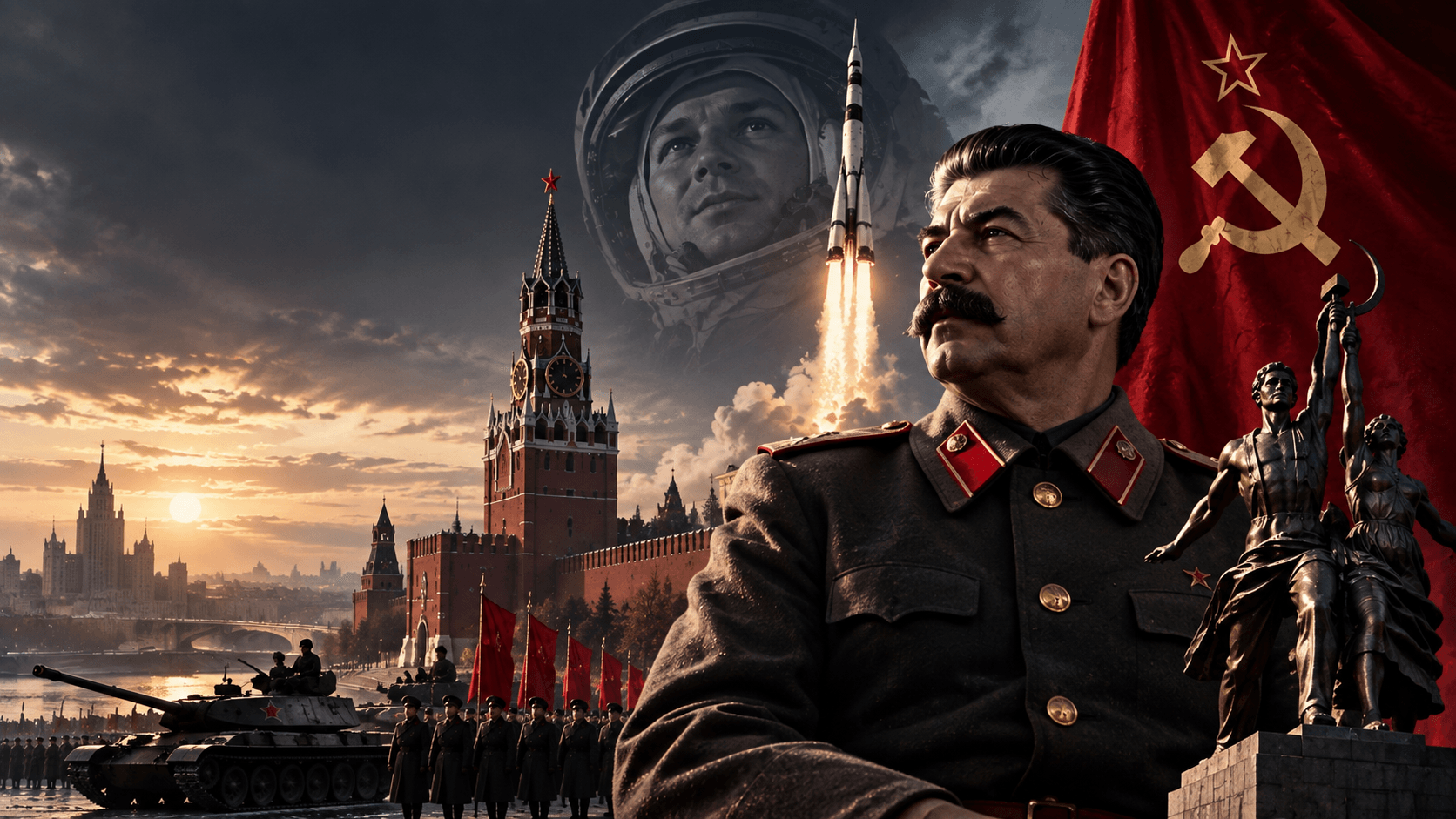
In April 1961, the Soviet Union sent a human being around the Earth. Thirty years later, the state that accomplished that feat ceased to exist. Between those moments lies a question that still matters: how could a country capable of extraordinary scientific achievement struggle so profoundly with the way it governed itself?
The Soviet Union, formally the Union of Soviet Socialist Republics or USSR, existed from 1922 to 1991. Its history began in the revolutions and civil war that destroyed the Russian Empire. It became an industrial and military superpower, helped defeat Nazi Germany and competed with the United States across the planet. It also built a system of political repression whose victims included people the revolution had promised to liberate.
Understanding Soviet history requires holding those realities together. Neither a parade of rockets nor a catalogue of prisons can explain the whole society. The central story is how revolutionary promises became institutions, how those institutions mobilized immense resources, and why they eventually lost the capacity to hold a multinational state together.
FROM THE RUSSIAN REVOLUTION TO BOLSHEVIK RULE
1917 brought two revolutions
The First World War intensified shortages, military failure and distrust of the monarchy. In 1917, the February Revolution ended tsarist rule. A provisional government struggled for authority alongside soviets, councils representing workers and soldiers. The Bolsheviks, led by Vladimir Lenin, seized power in the October Revolution. These familiar names use Russia’s old calendar: the revolutions occurred in March and November under the Gregorian calendar used today. The National Archives: The Russian Revolution
Lenin did not personally overthrow the tsar in a single uninterrupted revolution. The monarchy had already fallen when his party overthrew the provisional government. Political alternatives existed, and the outcome was contested rather than inevitable. Like the upheavals explored in PRESDA’s history of the French Revolution and its aftermath, the Russian Revolution became a struggle over who could speak for the people. The National Archives: The Russian Revolution
Civil war hardened the new state
Bolshevik victory did not bring peace. Civil war, foreign intervention and struggles over territory devastated the former empire. Political policing became embedded in the new regime. The Library of Congress’s archival exhibition documents repression under Lenin as well as its later expansion under Stalin. Revolutionary claims to represent workers did not produce an open contest between parties. Library of Congress: Revelations from the Russian Archives
By 1921, economic breakdown and resistance forced a retreat from wartime controls. Lenin’s New Economic Policy allowed a partial return to markets while retaining state control over strategic sectors. In a contemporary speech, Lenin openly defended the retreat. It is evidence of tactical flexibility, but also a political justification written by the leader responsible for the policy. Markets and political freedom did not advance together. Lenin, October 1921: Explaining the New Economic Policy
THE SOVIET UNION WAS CREATED IN 1922, NOT 1917
On 30 December 1922, representatives of four Soviet republics approved the founding documents of the USSR: the Russian, Ukrainian, Byelorussian and Transcaucasian republics. The last encompassed Armenia, Azerbaijan and Georgia. The revolutionary government therefore preceded the union state. The Presidential Library’s document exhibition is useful for this institutional chronology, rather than as a neutral account of everything Soviet rule meant. Presidential Library: Documents on the creation of the USSR
Russia was the largest component, not another name for the entire country. The union’s composition changed over time; at its dissolution it contained 15 union republics. Ukrainians, Kazakhs, Georgians, Uzbeks, Baltic peoples and many others had distinct experiences within it. The Eastern Bloc was different again: Poland and Hungary were Soviet-dominated states, not republics inside the USSR. Office of the Historian: Dissolution and independent republics ETH Zurich archival project: Warsaw Pact chronology
STALIN: INDUSTRIAL TRANSFORMATION AND STATE VIOLENCE
After Lenin’s death in 1924, Joseph Stalin consolidated power through the Communist Party apparatus and the defeat of rivals. His dominance developed over years. By the end of the decade, the leadership had committed to a drastic transformation of industry and agriculture. Library of Congress: Revelations from the Russian Archives
Factories, steel and the command economy
The first five-year plan began in 1928. State priorities directed investment toward heavy industry and military capacity. New industrial centres expanded, drawing people into factories and technical work. Archival economic research confirms substantial transformation while warning that official output measures can misrepresent wider progress. Steel production and household comfort are not the same measure. Davies, Harrison, Khlevniuk and Wheatcroft: The Soviet economy in historical perspective
Historians distinguish the fact that industrialization occurred from the claim that Stalin’s methods were the only possible route. The latter cannot be proved simply by pointing to the factories that existed afterward. Investment choices and coercion shaped who paid for growth. Davies, Harrison, Khlevniuk and Wheatcroft: The Soviet economy in historical perspective
Collectivization, famine and the Holodomor
Forced collectivization subjected farming communities to collective structures and intense state pressure. Grain procurement, dispossession and agricultural disruption helped produce catastrophic famine. Ukraine, Kazakhstan and other Soviet regions suffered, although timing and local mechanisms differed. In Kazakhstan, the assault on pastoral life was especially destructive. Harvard Ukrainian Research Institute: Hunger by Design
The Ukrainian famine of 1932–1933 is known as the Holodomor. Harvard’s research examines its geography and demographic consequences, showing why national totals alone cannot explain how policy and mortality varied locally. Millions died across the wider Soviet famine. A single combined figure without a defined territory, period and method would create false precision. Harvard MAPA: Mapping the Great Famine
Many historians interpret the Holodomor as genocide; scholarly debate concerns intent, chronology and its relationship to the broader Soviet famine. This disagreement does not erase coercive state policies or mass suffering. It is a debate about historical interpretation, not a reason to treat well-documented starvation as an open question. Harvard Ukrainian Research Institute: Hunger by Design
Purges, censorship and the Gulag
The Great Terror reached its most intense phase in 1937–1938. Political leaders were only part of its victim population. Security operations targeted ordinary citizens as well as alleged opponents, using administrative categories that could turn suspicion into arrest, forced labour or execution. Paul Gregory’s archival study examines this machinery. Paul R. Gregory: Terror by Quota, an archival study
The Gulag was a system of forced-labour camps, not merely a metaphor for an unpleasant workplace. Terror also extended beyond camps through surveillance and deportation. A single death total cannot neatly capture execution, camp mortality, famine and deportation: these are different categories that must not be added together carelessly. Paul R. Gregory: Terror by Quota, an archival study
Censorship restricted publication and public debate. The state’s treatment of writers and dissidents demonstrates how control reached beyond formal politics. What could be said about society was itself a matter of power. Library of Congress: Revelations from the Russian Archives
WORLD WAR II: THE EASTERN FRONT AND ITS HUMAN COST
From the Nazi-Soviet pact to invasion
On 23 August 1939, Nazi Germany and the Soviet Union signed a nonaggression pact with secret arrangements dividing areas of Eastern Europe into spheres of influence. Soviet forces subsequently occupied eastern Poland. The later Soviet struggle against Hitler does not remove this earlier cooperation. USHMM: The Soviet Union and the Eastern Front
Germany invaded the USSR on 22 June 1941. The Eastern Front became a war of annihilation, involving mass murder of Jews, brutal occupation and the destruction of civilian communities. Soviet resistance was a struggle for survival against a genocidal invader. USHMM: The Soviet Union and the Eastern Front
How the Red Army reached Berlin
The USSR survived the initial disaster, mobilized industry and manpower, and reversed the German advance. Stalingrad in 1942–1943 and Kursk in 1943 were major stages in that reversal. Soviet troops reached Berlin in 1945. USHMM: The Soviet Union and the Eastern Front Imperial War Museums: Second World War galleries
The victory belonged to a coalition. Soviet armies carried an immense burden in the land war against Germany; Allied production, supplies and operations elsewhere also mattered. Describing victory as Stalin’s personal achievement diminishes soldiers, civilians and the wider alliance. Minimizing the Soviet contribution distorts the military history just as seriously. Imperial War Museums: Second World War galleries
A SUPERPOWER AND AN EASTERN BLOC
Victory left the USSR with enormous military influence in Eastern Europe. Communist governments consolidated power across the Soviet sphere, while the Western powers developed their own alliances. Europe’s division was institutional as well as geographical. The Warsaw Pact, formed in 1955, organized the Soviet-led military alliance. ETH Zurich archival project: Warsaw Pact chronology
The Soviet atomic test in 1949 ended the American nuclear monopoly. Nuclear weapons changed the meaning of military power: direct war between the superpowers could threaten both with destruction. Deterrence did not make their relationship safe. It made the possible consequences of miscalculation vastly greater. Office of the Historian: Atomic diplomacy
The Cold War was therefore neither continuous direct warfare nor genuine peace. Diplomatic confrontation and weapons development could coexist with negotiations. The ability to threaten destruction made the search for limits urgent, even when neither side trusted the other. Office of the Historian: Atomic diplomacy Office of the Historian: SALT I agreements, 1972
KHRUSHCHEV, THE CUBAN MISSILE CRISIS AND THE SPACE RACE
Reform had limits
Following Stalin’s death in 1953, Nikita Khrushchev emerged as the leading figure in a new leadership. His denunciation of Stalin in 1956 challenged the personality cult and encouraged partial liberalization. Yet Soviet forces crushed the Hungarian uprising that same year. De-Stalinization did not mean permission to leave Moscow’s strategic orbit. ETH Zurich archival project: Warsaw Pact chronology
October 1962: escaping nuclear danger
The Cuban Missile Crisis began after the United States discovered Soviet nuclear missile installations in Cuba. Kennedy and Khrushchev confronted the possibility that pressure or miscalculation could produce war. The settlement removed Soviet missiles from Cuba and included an American non-invasion assurance. A private understanding also concerned removal of U.S. Jupiter missiles from Turkey. Office of the Historian: Cuban Missile Crisis
The crisis was not simply won by refusing to compromise. Public firmness and private concessions operated together. Cold War reconnaissance, another part of this rivalry, is explored in PRESDA’s history of Area 51 and secret aircraft. Office of the Historian: Cuban Missile Crisis
Sputnik and Yuri Gagarin changed what seemed possible
On 4 October 1957, Sputnik became the first artificial satellite to orbit Earth. Its signal carried political meaning: Soviet technology could demonstrate its reach above every national border. The launch helped accelerate American investment in space. Scientific exploration and military missile development were closely connected. NASA: Sputnik and the beginning of the Space Age
On 12 April 1961, Yuri Gagarin became the first human in space, completing an orbit aboard Vostok 1. The achievement depended on engineers, technicians and collective work, not just one celebrated pilot. It was a Soviet accomplishment involving resources across the union, including the launch site in Kazakhstan. NASA: Remembering Yuri Gagarin
Valentina Tereshkova became the first woman in space on 16 June 1963. The United States achieved the first crewed Moon landing with Apollo 11 in July 1969. A claim that one country “won everything” conceals these different achievements. NASA: Valentina Tereshkova and women in space NASA: Apollo 11 mission overview
The communist world was not one obedient bloc
The split between China and the Soviet Union complicated the idea of a single communist camp. Ideological disputes and security fears divided governments that outsiders might otherwise group together. Sino-Soviet tension helped encourage China’s rapprochement with the United States. The Cold War was global, but its participants were not merely pieces moved by Washington and Moscow. Office of the Historian: Rapprochement with China
WHAT WAS LIFE IN THE SOVIET UNION LIKE?
There was no single Soviet experience. A rural family during collectivization, an urban student and a privileged official occupied different social worlds. Industrial transformation expanded technical opportunities, but aggregate production figures cannot describe the welfare of every household. Growth and hardship could exist together. Davies, Harrison, Khlevniuk and Wheatcroft: The Soviet economy in historical perspective
Revolutionary plans promised to transform domestic life as well as employment. Research on Soviet housing and gender examines the ambition to create new ways of living, but also the heavy workloads that could prevent women from participating on equal terms. Collective ideals did not automatically remove practical inequality at home. Cambridge University Press: Gender and housing in Soviet Russia
Science could bring prestige and conflict with the state in the same lifetime. Andrei Sakharov, a major Soviet nuclear physicist, became a prominent advocate of human rights and disarmament and received the Nobel Peace Prize in 1975. PRESDA’s history of the Nobel Prize provides context for that international recognition. European Parliament: Andrei Sakharov
Education was a central state commitment. Soviet constitutional provisions promised access to schooling and vocational training, and the system developed extensive specialist education. That ambition mattered for a society seeking engineers, teachers and scientists. A constitutional promise is not a complete measure of outcomes, however: access, political restrictions and the experience of individual communities require separate assessment. Library of Congress: Constitutional right to education in Russia
BREZHNEV: STABILITY, STAGNATION AND AFGHANISTAN
The Brezhnev era is associated with stagnation, meaning mounting economic difficulty rather than the disappearance of all achievement. Slower growth and problems adapting to technological change became increasingly consequential. A system designed to mobilize resources for large projects struggled to renew itself. David L. Hoffmann, Ohio State Origins: The Soviet Collapse
Competition continued alongside negotiation. The 1972 SALT I agreements limited parts of the strategic arms competition. They did not eliminate nuclear danger, but demonstrated that adversaries could negotiate rules while remaining rivals. Office of the Historian: SALT I agreements, 1972
The limits of reform were particularly visible in 1968, when a Soviet-led invasion ended the Prague Spring in Czechoslovakia. Moscow would not accept reforms that it believed endangered the wider bloc. The promise of socialist solidarity could become a justification for military intervention. Office of the Historian: Invasion of Czechoslovakia
In December 1979, the USSR intervened militarily in Afghanistan. An operation intended to sustain a friendly regime became a prolonged war, with devastating consequences for Afghans and substantial costs for Soviet forces. Moscow’s assumptions about its ability to control events proved deeply flawed. Office of the Historian: Soviet invasion of Afghanistan
Archival discussion highlights leadership fears, intelligence assessments and Afghan instability rather than one mechanical explanation. Soviet troops completed their withdrawal on 15 February 1989. The war damaged confidence and legitimacy, but did not alone cause the USSR’s dissolution. Wilson Center: International history of the Afghan war NATO chronology: Soviet withdrawal completed, 15 February 1989
Brezhnev led the party from 1964 until his death in 1982. The brief leaderships of Yuri Andropov and Konstantin Chernenko followed before Gorbachev took over. This succession exposed the difficulty of renewing an ageing leadership as pressures accumulated. The Library of Congress’s 1991 country study records these developments from the vantage point of the union’s final year. Library of Congress: Soviet Union, a country study, 1991
GORBACHEV, CHERNOBYL AND REFORM
Mikhail Gorbachev became Communist Party leader in 1985. Perestroika meant restructuring; glasnost meant openness. He initially sought to renew the Soviet system, not oversee its disappearance. Reforms changed institutions and loosened censorship, allowing criticism to move beyond boundaries the leadership could reliably control. Office of the Historian: Collapse of the Soviet Union
On 26 April 1986, the Chernobyl nuclear accident struck in Soviet Ukraine. The IAEA’s later reassessment examined reactor design deficiencies and wider safety failures, correcting an account that placed excessive emphasis on operators alone. Institutional failure could not be explained through one convenient culprit. IAEA: INSAG-7 reassessment of the Chernobyl accident
Political debate and contested elections changed the relationship between the party and society. Criticism of the system could now become an organized challenge to its authority. Attempts to restore confidence instead revealed how much confidence had already been lost. Office of the Historian: Collapse of the Soviet Union
1989 TO 1991: THE STATE COMES APART
The Berlin Wall opened on 9 November 1989 as communist rule across Eastern Europe unravelled. This was not the date the USSR ended. The wall belonged to divided Germany; the Soviet Union continued for another two years. US National Archives: The Berlin Wall and its fall
Within the USSR, movements demanded sovereignty or independence. The failed hardline coup of August 1991 weakened the union leadership and strengthened republican authorities, especially Boris Yeltsin, the president of the Russian republic. Dissolution accelerated through decisions made inside the Soviet state, not simply through the actions of a foreign adversary. Office of the Historian: Dissolution and independent republics
Gorbachev resigned as Soviet president on 25 December 1991. The union formally ended on 26 December. These adjacent dates describe different acts, which is why both appear in accounts of the dissolution. New states inherited economic connections and unresolved conflicts as well as sovereignty. Office of the Historian: Collapse of the Soviet Union US National Archives: The Berlin Wall and its fall
WHY DID THE SOVIET UNION COLLAPSE?
Economic weakness created pressure, not a timetable
A system effective at concentrating resources struggled with efficiency and technological renewal. Oil revenues could ease pressure without resolving those weaknesses. But structural problems do not explain why a state ends in one particular year. Economic strain created a setting in which political choices became decisive. David L. Hoffmann, Ohio State Origins: The Soviet Collapse
Reform weakened old controls
Gorbachev sought renewal, but the institutions under challenge also held the system together. Political openness and economic restructuring created competing expectations and centres of power before a stable new settlement existed. The problem cannot be reduced to an abstract claim that freedom itself destroyed the state. Gorbachev’s willingness to let Eastern European governments change without Soviet military intervention also transformed the political environment. Office of the Historian: Collapse of the Soviet Union
National movements and republican leaders changed the balance
The USSR was a multinational union. Independence movements and republican leadership ambitions interacted. Popular aspirations and elite interests could reinforce each other without being identical. The national question was therefore also a struggle over who would exercise political authority. Office of the Historian: Dissolution and independent republics
Foreign commitments added costs
Arms competition and overseas commitments exposed limits and absorbed resources. Negotiations and withdrawal offered ways to reduce those pressures. Yet an external rival is not a complete explanation for internal fragmentation. The Afghan war and nuclear competition help explain the burden, not every decision made in 1991. Office of the Historian: SALT I agreements, 1972 Wilson Center: International history of the Afghan war
Contingency matters
Historians differ over the weight of economics, reform and national movements. David Hoffmann emphasizes that the collapse surprised contemporary specialists. Its eventual occurrence should not be confused with inevitability. The failed coup and political choices affected how the crisis ended. David L. Hoffmann, Ohio State Origins: The Soviet Collapse
MYTH VS REALITY: THE SOVIET UNION
“The USSR was simply Russia”
Russia was its largest republic, but the union included distinct peoples and territories. Treating every Soviet achievement or loss as exclusively Russian erases that diversity. Office of the Historian: Dissolution and independent republics
“Stalin founded the Soviet Union by himself”
The union was established in 1922 under Lenin’s leadership. Stalin later transformed its system of rule. Founding a state and reshaping its institutions are different historical processes. Presidential Library: Documents on the creation of the USSR
“Industrial success proves terror was necessary”
Industrialization under a coercive regime does not establish that every act of coercion caused growth. Nor does it prove that less destructive alternatives were impossible. Factories cannot settle that counterfactual question. Davies, Harrison, Khlevniuk and Wheatcroft: The Soviet economy in historical perspective
“The Soviet Union won World War II alone”
Its contribution to defeating Nazi Germany was indispensable. The wider Allied effort also mattered. Recognizing the Eastern Front’s importance does not require deleting the other fronts. Imperial War Museums: Second World War galleries
“Everyone was equal and experienced the same life”
Official ideals did not make domestic work or access to opportunity equal in practice. Gender and housing research reveals the distance between promises and everyday constraints. Different personal memories can describe different circumstances. Cambridge University Press: Gender and housing in Soviet Russia
“The Space Race had only one meaningful winner”
Sputnik, Gagarin, Tereshkova and Apollo 11 represent different firsts. A victory slogan is less informative than the actual sequence of achievements. NASA: Sputnik and the beginning of the Space Age NASA: Remembering Yuri Gagarin NASA: Valentina Tereshkova and women in space NASA: Apollo 11 mission overview
“One president or one mistake caused the collapse”
External pressure mattered, but dissolution involved domestic reform and republican politics. A single-cause account cannot explain why the union fragmented rather than merely replacing its leader. David L. Hoffmann, Ohio State Origins: The Soviet Collapse
THE SOVIET LEGACY: ACHIEVEMENT WITHOUT ABSOLUTION
The USSR left scientific institutions, industrial landscapes and memories of extraordinary wartime endurance. It also left families marked by persecution and communities transformed by forced policies. Those inheritances cannot be reduced to one verdict about whether every aspect of Soviet life was good or bad.
The stronger question is more precise: what did particular institutions enable, whom did they exclude, and what happened when people tried to change them? Soviet history reveals both the capacity of organized human effort and the danger of making it answerable to power without effective public accountability.
FAQ
Frequently Asked Questions
What does USSR stand for?
USSR stands for Union of Soviet Socialist Republics, the formal name of the Soviet Union, which existed from 1922 to 1991.
Was the Soviet Union the same as Russia?
No. Russia was the largest union republic, but the USSR was a multinational state containing 15 union republics at its dissolution. Eastern Bloc countries such as Poland were not part of the USSR.
When was the Soviet Union founded?
The Soviet Union was founded on 30 December 1922. The Bolsheviks had taken power in Russia in 1917, so the revolution and the creation of the union were separate events.
Why did the Soviet Union collapse?
Economic weaknesses, destabilizing reforms, independence movements, struggles between union and republican leaders, and the failed August 1991 coup interacted. Foreign commitments added pressure, but no single cause explains the dissolution.
When did the Soviet Union end?
Gorbachev resigned as Soviet president on 25 December 1991, and the USSR formally ended on 26 December. The opening of the Berlin Wall in 1989 was an earlier, separate event.
Did Stalin found the Soviet Union?
The union was established under Lenin’s leadership in 1922. Stalin later consolidated personal power and radically reshaped its economy and political institutions.
What did the Soviet Union achieve in space?
Its milestones included the first artificial satellite, Sputnik in 1957; the first human in space, Yuri Gagarin in 1961; and the first woman in space, Valentina Tereshkova in 1963. The United States achieved the first crewed Moon landing in 1969.
PRESDA Dispatch
Stay Informed. Stay Aware.
A sharp briefing across AI, gaming, sport, business, world affairs, paparazzi, and lifestyle.