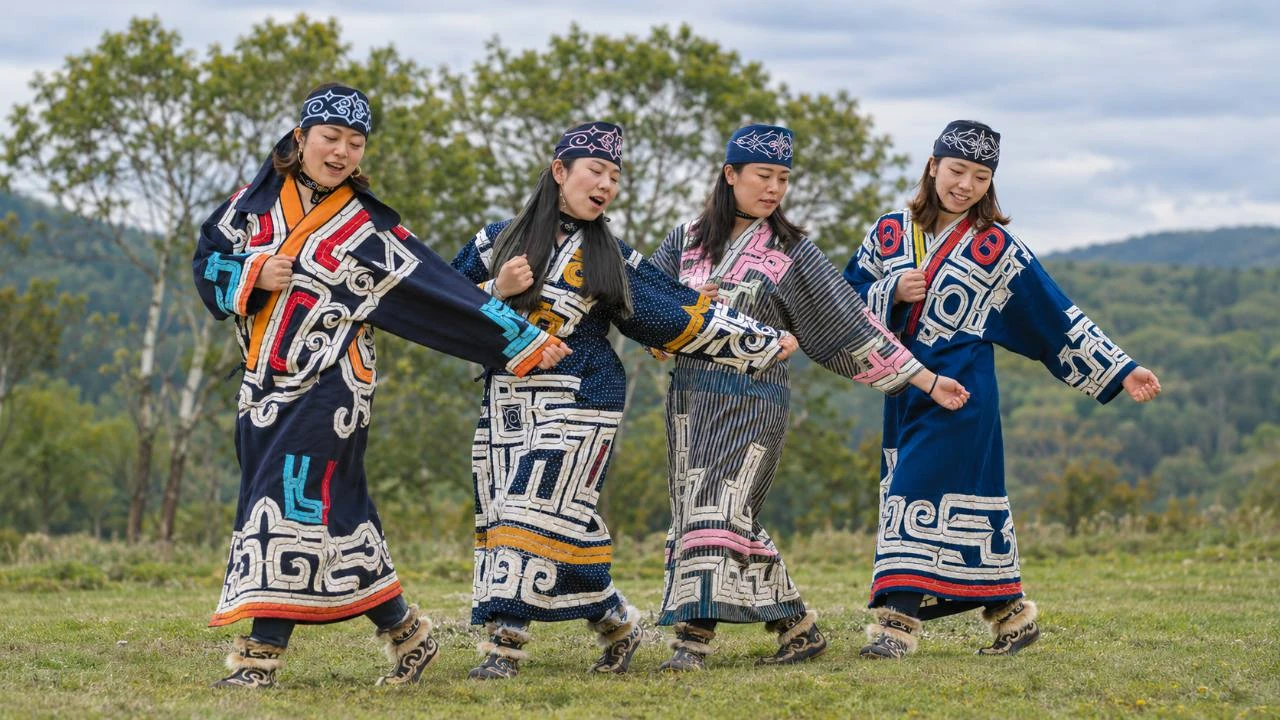
THE AINU: JAPAN'S INDIGENOUS PEOPLE AND THEIR FORGOTTEN HISTORY
Trace Ainu history from northern trade and Meiji-era assimilation to legal recognition, language teaching and the National Ainu Museum.
Editorial illustration supplied for PRESDA.
The Ainu are an Indigenous people whose ancestral homelands include Hokkaido and northern Honshu, southern Sakhalin and the Kuril Islands. Their history stretches beyond the border of contemporary Japan. What is sometimes described as a forgotten history was preserved by Ainu families, language teachers, authors and organisers who kept telling it even when it received little attention in institutions. The Ainu Association of Hokkaido describes long-running efforts to win recognition and contest the way outsiders presented that history. Ainu Association of Hokkaido Japan Tourism Agency on Ainu trade
Before the map looked the way it does now
| Year | Measure |
|---|---|
| 1899 | Hokkaido assimilation-era law |
| 1997 | Ainu Cultural Promotion Act |
| 2008 | Parliament calls for Indigenous recognition |
| 2019 | Ainu Policy Promotion Act recognises the Ainu as Indigenous |
Hokkaido was part of a maritime world connected to northern Honshu, the Amur region and the Sea of Okhotsk. The Japan Tourism Agency describes exchanges across these routes. Goods circulated through relationships that could make very distant places relevant to daily life. An object found in an archaeological context might reveal contact or exchange, while leaving open who transported it or how it was used. At the National Ainu Museum, an exhibition on history before the nineteenth century brought together archaeology, written records and historical images. These sources give different perspectives on the same landscape. Japan Tourism Agency on Ainu trade National Ainu Museum exhibition archive
Who wrote the records?
A record produced by a trading office can tell us what its clerks counted. It may tell us less about the people who brought goods to market or their own names for the places involved. A painting can preserve information about clothing while reflecting the painter’s interests and assumptions. Oral traditions passed down within communities can retain meanings that a commercial account never tried to capture. Putting these sources together requires asking what each one was for. It also allows readers to recognise Ainu people as historical actors, rather than as the subjects of someone else’s description. Ainu Association of Hokkaido National Ainu Museum exhibition archive
What changed in the Meiji period?
Japanese settlement and state control expanded after Hokkaido was incorporated under the Meiji government. Ainu communities faced policies that pushed assimilation and restricted access to places where people hunted and fished. The 1899 law often translated as the Hokkaido Former Aborigines Protection Act is central to accounts of that period. Its historical name contains a term now regarded as offensive. The word “protection” in the title can obscure what the law meant for a population pressured to change how it used land and passed on its language. Japan Tourism Agency on Ainu trade UNESCO on the Ainu language
Assimilation can work through practical rules as well as official labels. If a community loses access to a river, the loss includes a food source, alongside opportunities to teach the knowledge and vocabulary associated with fishing. If children are discouraged from using a language at school, a decision made in a classroom can change the language spoken at home years later. These examples help explain why adding a museum exhibition or a language course today addresses only part of what communities experienced.
The people who carried the language forward
The Ainu language is distinct from Japanese. One account of its survival begins with what speakers chose to record. Chiri Yukie wrote down and translated oral epics known as kamuyyukar. Japan’s tourism agency credits her compilation of thirteen epics with bringing Ainu-language writing into print through the work of an Ainu author. A printed text allows a reader to return to particular words and compare them with a translation. Performance and teaching give those words another life, because readers cannot learn every aspect of spoken language from a book alone. Japan Tourism Agency on Chiri Yukie
From oral epics to community radio
UNESCO describes efforts to teach Ainu through regional classes and highlights the radio initiative backed by Shigeru Kayano, who served in Japan’s parliament. A recording and a conversation solve different problems. A learner can listen to a recording repeatedly, but a teacher can respond when the learner hesitates or mispronounces a word. Community education needs both, as well as occasions to use the language. The presence of courses and archives shows the work being done. It does not by itself tell us how many people use Ainu daily. UNESCO on the Ainu language
From cultural promotion to legal recognition
Japan passed the Ainu Cultural Promotion Act in 1997, followed by a 2008 parliamentary resolution calling for recognition of the Ainu as Indigenous and legislation in 2019 explicitly recognising them as such. These moments are distinct. A law that promotes culture, a resolution of parliament and a statute that formally recognises a people each have different practical effects. The Ainu Association’s work predates those milestones. When a government changes its legal language, it records an institutional decision. Ainu identity and collective organisation did not begin on that date. Ainu Association of Hokkaido Japan Ministry of Land, Infrastructure, Transport and Tourism
Why population figures need a footnote
Japan’s government refers to an estimate of about 11,450 Ainu people living in Hokkaido from the prefecture’s 2023 survey. This describes a geographically bounded survey. It should not be used as a total for all people of Ainu descent in Japan or elsewhere, or as a count of speakers of the Ainu language. Discrimination and the way surveys identify respondents affect what population statistics can tell us. It is also possible for someone to participate in Ainu community life outside the places a particular survey covers. UNESCO on the Ainu language Japan Ministry of Land, Infrastructure, Transport and Tourism
What it means to encounter Ainu culture today
Upopoy, the National Ainu Museum and Park in Shiraoi, gives visitors a place to learn about Ainu history and see some of the work of preservation and teaching. Like any national institution, it offers one point of entry into a wider story. A performance can introduce visitors to a tradition without representing every family or region. Some cultural knowledge is kept and taught in settings that a visitor never sees. The association, local museums and language projects are worth reading alongside the national exhibition because the history is told in more than one place. Ainu Association of Hokkaido Japan Ministry of Land, Infrastructure, Transport and Tourism National Ainu Museum exhibition archive
For another feature about the difference between an outsider’s first impression and the way people live and describe their own history, see PRESDA’s article on the Himba.
What the legal record still leaves open
A state can publish a policy and fund cultural programmes without settling all questions about access to land, water or fisheries. The practical effect of recognition depends in part on how specific rules are written and who participates in those decisions. That is why a timeline of laws should be read alongside accounts from Ainu organisations and communities. A statute gives one record of what a government promised. It cannot tell us by itself whether an individual can exercise a right, whether a school offers a language course or whether a community considers an arrangement fair. Ainu Association of Hokkaido Japan Ministry of Land, Infrastructure, Transport and Tourism
There is a similar point about museums. Collecting an object and documenting who made it are separate things. Where records are sparse, a label may reproduce the assumptions of an early collector unless someone checks it with community knowledge and other evidence. The National Ainu Museum’s exhibitions show why reading archaeological finds alongside historical sources matters. What looks like a finished story on a wall depends on choices about which voices, names and materials to include. National Ainu Museum exhibition archive
FAQ
Frequently Asked Questions
Where are the Ainu from?
Their ancestral homelands include Hokkaido, northern Honshu, southern Sakhalin and the Kuril Islands.
When did Japan recognise the Ainu as Indigenous?
Japan’s parliament passed recognition resolutions in 2008. A 2019 act explicitly recognises the Ainu as Indigenous.
Is Ainu the same as Japanese?
No. It is a distinct Indigenous language with its own oral and written traditions.
PRESDA Dispatch
Stay Informed. Stay Aware.
A sharp briefing across AI, gaming, sport, business, world affairs, paparazzi, and lifestyle.