BAGHDAD 1258: THE MONGOLS AND THE FALL OF THE ABBASIDS
Hulagu’s siege ended Abbasid rule in Baghdad. The evidence for the sack, the loss of books and the city’s later scholarly life tells a more complex story.
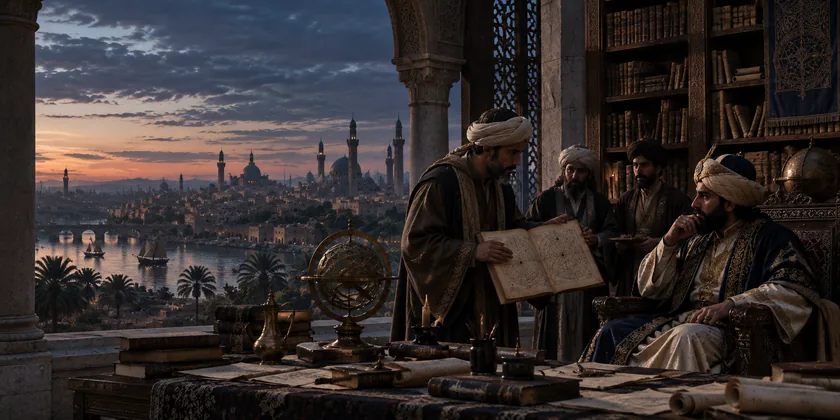
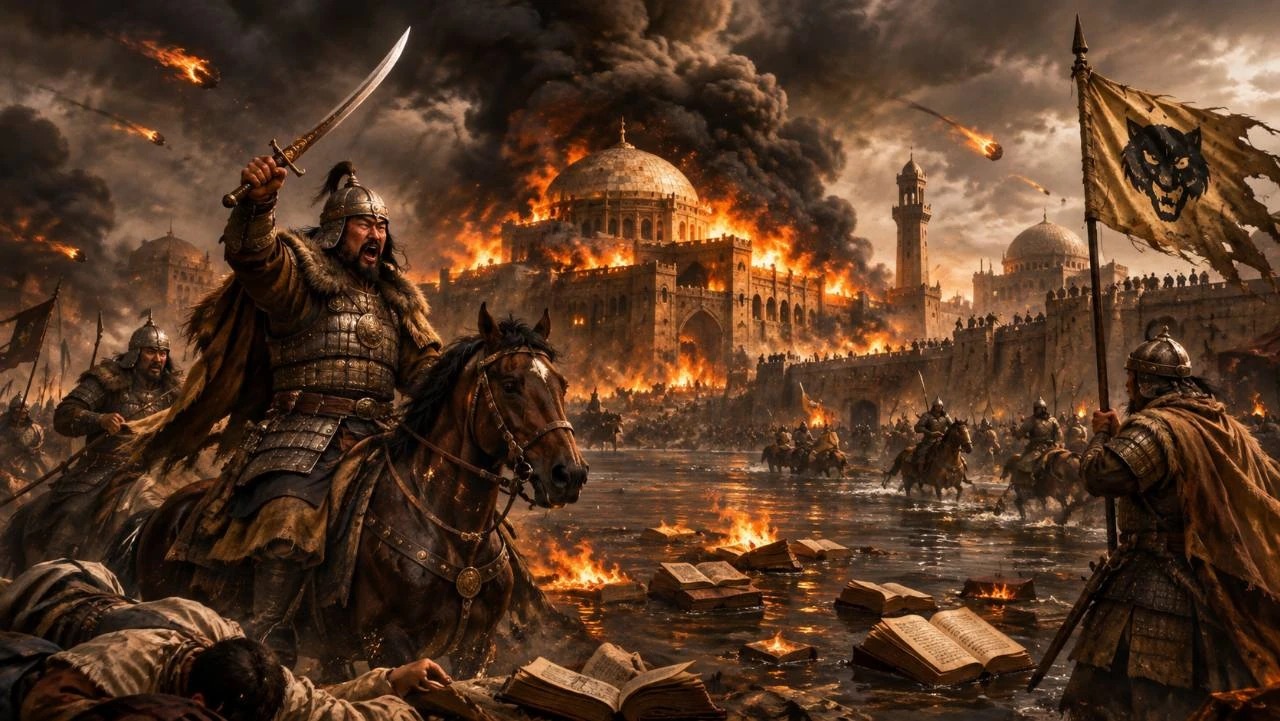
Editorial reconstruction supplied to PRESDA. Books in the river evoke a later legend.
In February 1258, forces commanded by Hulagu took Baghdad. The sack killed inhabitants, damaged the city and ended the rule of the Abbasid caliphs from their capital. Al-Musta’sim, the last Abbasid caliph to rule there, was executed. Later accounts turned the disaster into a story about the end of learning itself. The surviving evidence tells us more about what was lost and what endured. Encyclopaedia Iranica: Hulagu Khan
A Mongol campaign that began far from Baghdad
Hulagu was a grandson of Genghis Khan and brother of the Great Khan Möngke. His campaign expanded Mongol authority westward through Iran. In 1256 his forces captured Alamut, a major stronghold of the Nizari Ismailis. Negotiations with the Abbasid court failed to produce a settlement. By the end of 1257, Mongol forces were converging on Baghdad. Encyclopaedia Iranica: Hulagu Khan
The siege, surrender and sack
Baghdad’s defenders resisted before surrender. The capture and the caliph’s execution broke the political institutions centered on the Abbasid court. Chroniclers describe extensive killing and looting, but their death tolls differ too widely for a precise figure. Later stories also differ about the manner of al-Musta’sim’s death. His execution is better established than the details attached to it. Encyclopaedia Iranica: Baghdad under the Mongols
Why a court, a school and a library tell different parts of the story
The strongest accounts of 1258 distinguish political collapse from what happened to particular institutions. The caliph and much of his family were killed, ending Abbasid rule in Baghdad. The army’s sack and the deaths and dislocations that accompanied it were catastrophic. To learn whether a particular school or library closed, reopened or moved books, however, historians need evidence at the level of that institution. A chronicle of conquest and a later record of someone hearing a text therefore answer different questions. Source · Reuven Amitai, Encyclopaedia Iranica Source · Michal Biran, Libraries and knowledge in Ilkhanid Baghdad
How to read the manuscript painting
The illustration reproduced here is from a copy of Rashid al-Din’s Compendium of Chronicles made around 1430–1434, roughly 175 years after the siege. The painter gives viewers an organized view of walls, buildings and opposing groups. The image shows how a later manuscript represented 1258. It cannot establish the precise city plan, the appearance of individual people or which moment the artist meant to collapse into a single scene. Its date and provenance are part of the evidence. Source · Bibliothèque nationale de France, manuscript reproduction
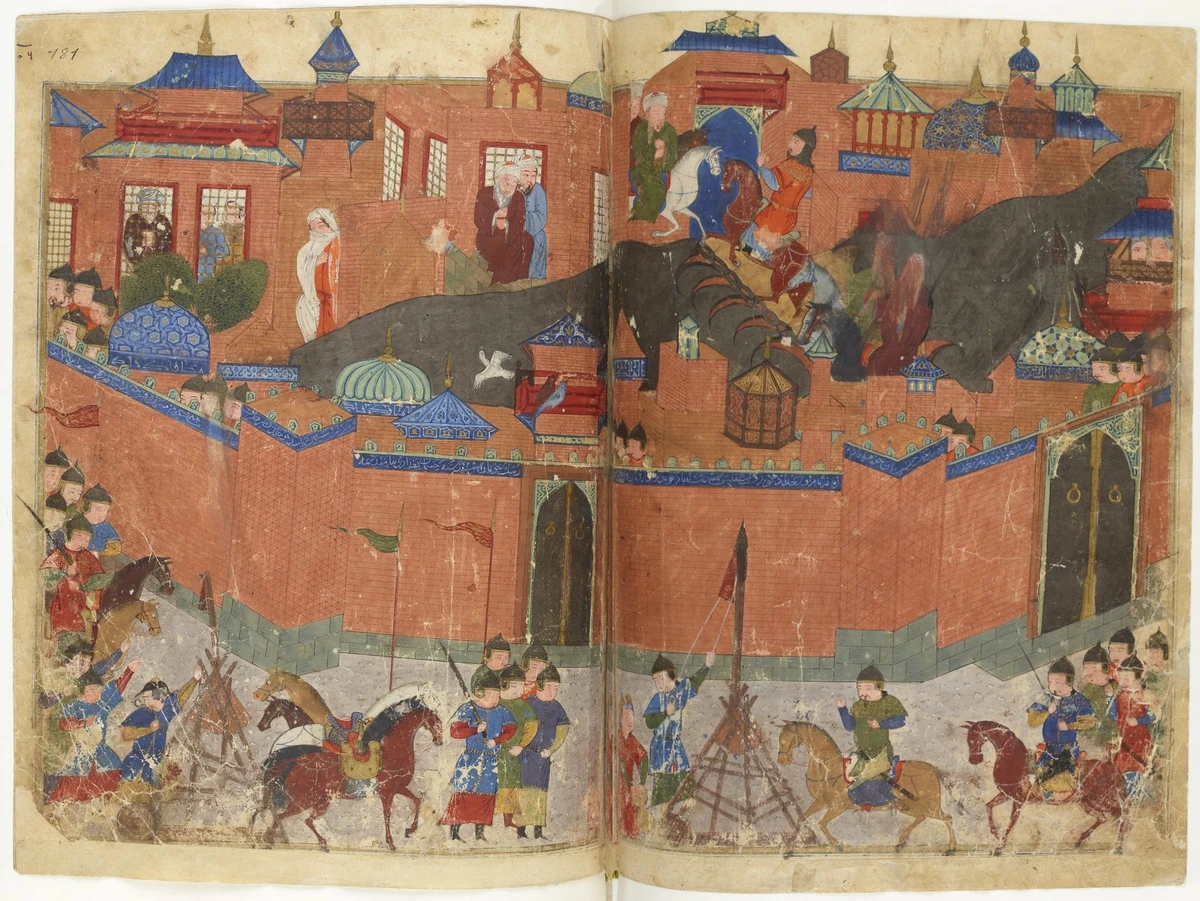
The siege of Baghdad as depicted in a copy of Rashid al-Din’s Compendium of Chronicles, ca. 1430–1434. Bibliothèque nationale de France, public domain.
Image recordWhat evidence survived the sack?
Historian Michal Biran studied Arabic biographical dictionaries, lists of books and records called samāʿ, which can register that a text was heard or transmitted. Such records let historians ask where people taught, read and circulated books after the conquest. They reveal continued activity in Ilkhanid Baghdad and the functioning of libraries. Biran also describes colleges reopening after the sack. Continuity does not cancel the damage. It establishes that the city’s working institutions and intellectual networks did not all meet the same fate on one date. Source · Michal Biran, Libraries and knowledge in Ilkhanid Baghdad Source · Michal Biran, the Mongol conquest of Baghdad
What changed when the Abbasid caliphate returned in Cairo
The Abbasid title reappeared in Cairo under Mamluk rule in 1261. The Baghdad court had exercised power within Iraq and had a long history as the seat of the dynasty. The Cairo arrangement rested on a different political foundation. The Mamluk sultans ruled, and restoring a caliphal title could serve their claims to legitimacy. Baghdad, meanwhile, remained within a Mongol-ruled polity. Reading this alongside PRESDA’s history of Mesopotamia situates 1258 in the much longer history of political centers and written culture between the rivers. Source · Reuven Amitai, Encyclopaedia Iranica Source · Michal Biran, the Mongol conquest of Baghdad
The libraries and the legend of the Tigris
Historian Michal Biran documents real harm to Baghdad’s book collections through looting, fire, disruption and loss. Stories of ink turning the Tigris black or books forming a bridge belong to a later literary tradition and cannot establish the scale of destruction. Nor do those stories prove that the early Abbasid House of Wisdom still existed in its familiar form as a single library in 1258. Michal Biran: libraries in Ilkhanid Baghdad
Collections survived or were rebuilt, and scholars copied, taught from and circulated books under Ilkhanid rule. Biran traces evidence of that activity through library histories and the biographies of scholars. Baghdad lost its Abbasid court and much of its population and material wealth. The city’s intellectual networks changed and continued to function. Michal Biran: libraries in Ilkhanid Baghdad
What ended in 1258 and what moved elsewhere
Baghdad became part of the territories ruled by Hulagu’s dynasty, the Ilkhanids. In 1261 the Mamluks installed an Abbasid caliph in Cairo. That office conferred legitimacy on its patrons while the Mamluk sultans held political power. The Abbasid name endured in a different setting, while Baghdad’s role as the seat of the old caliphate had ended. Encyclopaedia Iranica: Ilkhanid dynastic history
The fall of Baghdad in the wider Mongol campaign
Baghdad’s fall opened the way for further Mongol expansion toward Syria. Aleppo fell in 1260 and Mongol forces took Damascus. Later that year, the Mamluks defeated the army of Hulagu’s general Kitbuqa at Ayn Jalut. Baghdad remained under Mongol rule, but the Mamluks became the Ilkhanate’s main rivals to the west. Hulagu also faced conflict with the Golden Horde. These fronts explain why a conquest that ended Abbasid rule in Iraq did not produce uninterrupted Mongol expansion across the region. Source · iranicaonline.org Source · iranicaonline.org
How to read the sources for 1258
Mongol-era and Mamluk writers told the campaign from different political positions. Reuven Amitai notes that historians disagree about how much of Hulagu’s eventual rule in Iran was already intended by his brother Möngke. Some evidence comes from authors writing within the institutions whose legitimacy was at stake. That context helps explain why the conquest and the execution of the caliph are well established, while accounts of motives and particular episodes require greater caution. Source · iranicaonline.org
The Abbasid Caliphate and Baghdad’s golden age.
FAQ
Frequently Asked Questions
Did the Tigris really turn black with ink?
The image comes from later accounts. Books and collections suffered real losses, but the story is unverified.
Did the Abbasid title disappear in 1258?
Rule from Baghdad ended. A Mamluk-backed Abbasid caliphate began in Cairo in 1261.
PRESDA Dispatch
Stay Informed. Stay Aware.
A sharp briefing across AI, gaming, sport, business, world affairs, paparazzi, and lifestyle.