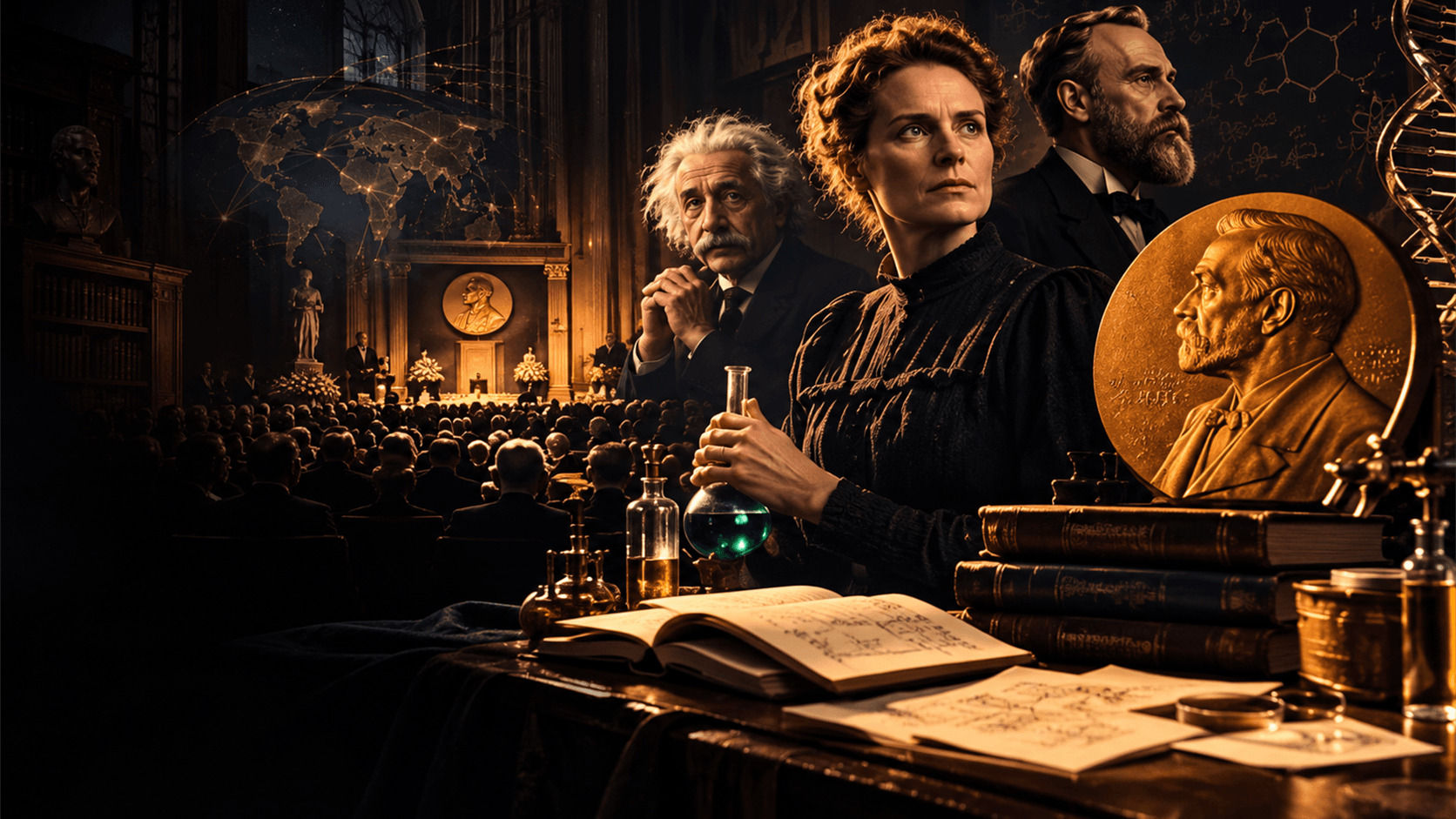
THE NOBEL PRIZE: THE PEOPLE AND DISCOVERIES THAT CHANGED THE WORLD
From Marie Curie and Albert Einstein to breakthroughs in medicine, literature and peace, the Nobel Prize has spent more than a century honoring discoveries, ideas and people that changed humanity.
A Nobel ceremony is built to feel larger than one career.
There is the medal, the diploma, the formal dress, the music, the audience and the strange silence that falls around a name when it becomes part of history.
Since 1901, the Nobel Prize has honored work in physics, chemistry, physiology or medicine, literature and peace. In 1969, an economics prize established by Sweden's central bank began being awarded alongside the original prizes.
The central paradox has never disappeared: the world's most famous awards for benefiting humanity were created from the fortune of Alfred Nobel, an inventor and industrialist whose name was closely tied to explosives.
That contradiction is not a flaw in the story. It is the story.
The Prize That Can Change A Life
A Nobel Prize does more than reward a discovery. It turns a discovery into public memory.
Many scientific advances happen slowly, through notebooks, failed experiments, technical arguments and invisible teamwork. Literature can take decades to find its deepest readers. Peace work can unfold under danger, prison, exile or political pressure.
The Nobel Prize compresses those complicated histories into one global moment.
That compression is powerful, but imperfect. A medal can illuminate a life. It can also leave other contributors in shadow. To understand the Nobel Prize, both truths have to stay visible.
Who Was Alfred Nobel?
Alfred Bernhard Nobel was born in Stockholm on October 21, 1833.
He became a chemist, engineer, inventor, writer and businessman. NobelPrize.org describes him as a man with wide interests in science, literature and social questions, not only as a manufacturer of explosives.
Nobel's family moved through several countries, and his career became international. He worked with nitroglycerin, a powerful but dangerously unstable explosive. His breakthrough was finding ways to handle explosive force more reliably, including the development of dynamite, patented in 1867.
Dynamite had legitimate industrial uses. It helped mining, tunneling, road building, railways, canals and large engineering projects. It also had destructive potential. Nobel understood both sides of technological power better than many of the people who later reduced him to a simple symbol.
By the end of his life, Nobel had built companies and laboratories across countries and held 355 patents. He died in San Remo, Italy, on December 10, 1896.
The Nobel Prize begins with that complicated life: innovation, industry, wealth, danger, literature, science and a desire to attach his fortune to a larger idea.
The Obituary That May Have Changed Everything
One of the most repeated Nobel stories begins with a mistaken obituary.
In 1888, Alfred Nobel's brother Ludvig died. A French newspaper reportedly confused the brothers and published an obituary for Alfred instead. The headline is often translated as 'The merchant of death is dead.'
The story is famous because it feels almost literary. A man reads his own moral judgment in print, sees how posterity may remember him and changes the direction of his legacy.
But careful history needs a softer claim.
The obituary episode is widely repeated and may have affected Nobel's thinking, but it should not be stated as the proven single cause of the Nobel Prizes. Nobel's will came years later, after a life already marked by scientific ambition, literary interests, international friendships and peace-related conversations.
The safer conclusion is more interesting: Nobel knew his inventions could be remembered in more than one way, and his final will tried to direct his name toward work that served humanity.
The Will That Surprised The World
On November 27, 1895, Alfred Nobel signed his last will at the Swedish-Norwegian Club in Paris.
The will directed most of his estate into a fund. The income from that fund would be distributed annually to those who, during the preceding year, had conferred the 'greatest benefit to humankind.'
The original fields were physics, chemistry, physiology or medicine, literature and peace.
The will surprised people close to Nobel. It named institutions that would select the laureates and created an unusual international system of prizes. Family members and other parties questioned the arrangement before the Nobel Foundation was established to administer it.
The first Nobel Prizes were awarded in 1901.
From the beginning, the Nobel Prize was not simply a Swedish award. It was designed as an international judgment about work that mattered beyond borders.
How Are Nobel Prize Winners Chosen?
You cannot nominate yourself for a Nobel Prize.
The process begins with qualified nominators. Depending on the prize, these can include previous laureates, selected academics, professors in relevant fields, members of academies, parliamentary figures for the Peace Prize and other invited nominators.
Different institutions handle different prizes.
The Royal Swedish Academy of Sciences selects laureates in physics and chemistry, and also the economics prize. The Nobel Assembly at Karolinska Institutet selects physiology or medicine. The Swedish Academy selects literature. The Norwegian Nobel Committee selects the Peace Prize.
Nobel deliberations are famously secret. Nominations and expert reports are generally sealed for 50 years before they can be opened to historical research.
That secrecy protects the process, but it also adds mystery. The world sees the announcement. Historians later reconstruct the arguments.
Who Was The First Woman To Win A Nobel Prize?
Marie Sklodowska Curie was the first woman to receive a Nobel Prize.
In 1903, she shared the Nobel Prize in Physics with Pierre Curie and Henri Becquerel for work connected to radiation phenomena. Her research helped transform radioactivity from an observed effect into a scientific field.
In 1911, Curie received the Nobel Prize in Chemistry for her work on radium and polonium, including the isolation of radium and study of its compounds.
That made her not only the first woman Nobel laureate, but the first person to receive Nobel Prizes in two different scientific fields.
The distinction still matters. Marie Curie remains the only person to have received Nobel Prizes in two different natural-science categories: physics and chemistry.
Her achievement was scientific and institutional. She worked in a European scientific world that often treated women as outsiders. Recognition did not erase those barriers; it made her success against them even more extraordinary.
Why Did Marie Curie Win Two Nobel Prizes?
Curie's first Nobel recognized work that helped reveal the phenomenon of radioactivity.
Her second recognized chemical work on radioactive elements themselves, especially radium and polonium. The two prizes were connected, but not identical.
That is why her double Nobel is so rare. She did not receive the same honor twice for the same discovery. She helped open a new physical phenomenon and then advanced the chemistry of substances that embodied it.
The work changed medicine, physics, chemistry and the public imagination. It also came at personal cost. Curie worked with radioactive materials before their dangers were fully understood.
The Nobel story around Marie Curie is therefore not only about brilliance. It is about endurance, evidence, exclusion, risk and the making of a modern science.
The Curie Family: A Nobel Dynasty
The Curie family is one of the most remarkable families in Nobel history.
Marie Curie shared the 1903 Physics Prize with her husband Pierre Curie and Henri Becquerel. Pierre's own work on magnetism, piezoelectricity and radiation was central to the period's physics.
Their daughter Irene Joliot-Curie and son-in-law Frederic Joliot-Curie received the 1935 Nobel Prize in Chemistry for the synthesis of new radioactive elements.
That family arc stretches from the discovery and measurement of radioactivity to the creation of artificial radioactivity.
It also shows how scientific inheritance can be intellectual rather than merely biological. The laboratory, the questions, the tools and the hazards passed from one generation to another.
What Did Einstein Win The Nobel Prize For?
Albert Einstein did not receive the Nobel Prize specifically for relativity.
He was awarded the 1921 Nobel Prize in Physics. The Nobel citation highlighted his services to theoretical physics and especially his discovery of the law of the photoelectric effect.
The photoelectric effect describes how light can eject electrons from a material. Einstein's explanation treated light energy as arriving in discrete packets, a key idea in the development of quantum physics.
Relativity changed modern ideas of space, time, gravity and the universe. But the Nobel committee's citation centered on the photoelectric effect because it had a clear experimental foundation and opened a path into quantum theory.
The myth says Einstein won for relativity. The record says the photoelectric effect.
That correction does not shrink Einstein. It makes the Nobel story sharper.
Penicillin: The Discovery That Saved Millions Of Lives
The 1945 Nobel Prize in Physiology or Medicine went to Alexander Fleming, Ernst Boris Chain and Howard Walter Florey for penicillin and its curative effect in infectious diseases.
Fleming's famous observation came in 1928, when he noticed that a mold contaminating a bacterial culture had killed nearby bacteria.
But the Nobel story is not Fleming alone.
Chain and Florey helped turn penicillin from a striking laboratory observation into a practical medicine. Their work on purification, testing, production and clinical use helped make antibiotics part of modern medicine.
Penicillin changed the treatment of bacterial infections, surgery, childbirth, wound care and wartime medicine. It did not end infectious disease. It did transform the human relationship with bacterial risk.
Discoveries That Changed Humanity
The Nobel Prize is often at its strongest when it recognizes work that quietly becomes part of everyday life.
Radioactivity reshaped physics, chemistry, medicine and energy. The Curie-era discoveries eventually influenced cancer treatment, imaging, nuclear science and modern ideas of the atom.
Quantum physics changed technology as much as theory. Einstein's photoelectric effect, Niels Bohr's atomic work, Max Planck's quantum theory and later quantum discoveries helped build the conceptual world behind electronics, lasers, semiconductors and sensors.
Penicillin and antibiotics changed medicine by making many bacterial infections treatable. The 1945 prize captures one of the great examples of basic observation becoming a public-health revolution.
DNA and molecular biology changed how humans understand inheritance. The 1962 prize to James Watson, Francis Crick and Maurice Wilkins recognized discoveries concerning the molecular structure of nucleic acids and information transfer in living material.
The transistor, recognized by the 1956 Physics Prize to William Shockley, John Bardeen and Walter Brattain, helped create modern electronics. Computers, phones, satellites, medical devices and digital life all rest on semiconductor physics.
Laser-related work recognized by the 1964 Physics Prize helped create technologies used in communication, surgery, manufacturing, barcode scanning, measurement and research.
CRISPR gene editing, recognized by the 2020 Chemistry Prize to Emmanuelle Charpentier and Jennifer Doudna, gave scientists a powerful way to alter DNA with extraordinary precision.
Climate science entered Nobel history through the 2021 Physics Prize, which recognized work by Syukuro Manabe, Klaus Hasselmann and Giorgio Parisi. Manabe and Hasselmann were honored for physical modeling of Earth's climate and reliable prediction of global warming.
The pattern is clear: a Nobel-recognized discovery may begin as a technical problem, then become part of how civilization works.
The DNA Story And Rosalind Franklin
The 1962 Nobel Prize in Physiology or Medicine went to James Watson, Francis Crick and Maurice Wilkins for discoveries concerning the molecular structure of nucleic acids and their significance for information transfer in living material.
Rosalind Franklin's work remains central to the historical debate around that prize.
Franklin used X-ray crystallography to study DNA. Her famous Photo 51 provided crucial structural information. She died in 1958, four years before the Nobel Prize was awarded.
Current Nobel rules do not allow posthumous awards except in the special case where a laureate dies after the prize has been announced. But reducing Franklin's exclusion only to the posthumous rule oversimplifies the history.
The deeper issue is credit: who had access to data, whose work was valued, how women scientists were treated and how collaborative discovery becomes attached to a few names.
Franklin's story is not an argument against the importance of the DNA prize. It is a reminder that discovery is often wider than the medal.
Nobel Peace Prize: When The Award Leaves The Laboratory
The Nobel Peace Prize follows Alfred Nobel's will but operates differently from the science prizes.
It is awarded in Norway by the Norwegian Nobel Committee. It often recognizes political courage, diplomacy, human rights, disarmament, humanitarian work or movements for peace.
Martin Luther King Jr. received the 1964 Nobel Peace Prize for his nonviolent struggle for civil rights.
Nelson Mandela and F.W. de Klerk shared the 1993 Nobel Peace Prize for their work toward ending apartheid peacefully and laying foundations for a democratic South Africa.
Malala Yousafzai and Kailash Satyarthi shared the 2014 Nobel Peace Prize for their struggle against the suppression of children and young people and for the right of all children to education.
The Peace Prize is often the most publicly debated Nobel Prize because it enters living politics. That does not make it less Nobel. It makes it more exposed.
Who Is The Youngest Nobel Prize Winner?
Malala Yousafzai is the youngest Nobel laureate in history.
She received the 2014 Nobel Peace Prize at age 17, sharing it with Kailash Satyarthi.
The Norwegian Nobel Committee recognized their work against the suppression of children and young people and for the right of all children to education.
Malala's Nobel story is powerful because it joins personal survival to a global cause. She became known after being attacked for advocating girls' education in Pakistan, but the prize recognized a wider struggle for children's rights and schooling.
Her age matters because it challenged the usual image of world-changing authority. A teenager became a Nobel laureate because the issue was larger than age.
People Who Won More Than Once
Multiple Nobel Prizes are extremely rare.
Marie Curie won Physics in 1903 and Chemistry in 1911.
John Bardeen won Physics twice: in 1956 for work on the transistor with William Shockley and Walter Brattain, and in 1972 with Leon Cooper and Robert Schrieffer for the theory of superconductivity.
Frederick Sanger won Chemistry twice: in 1958 for work on protein structure, especially insulin, and in 1980 for contributions to determining base sequences in nucleic acids.
Linus Pauling received the 1954 Nobel Prize in Chemistry and the 1962 Nobel Peace Prize. Nobel sources note that he is the only person to have received two unshared Nobel Prizes.
K. Barry Sharpless received the Chemistry Prize in 2001 and again in 2022, the latter shared for click chemistry and bioorthogonal chemistry.
These repeated prizes show something unusual: not one great result, but a career that changed more than one field or changed the same field more than once.
Can Three People Share One Nobel Prize?
Yes. A Nobel Prize can be shared by up to three laureates.
This limit has become controversial in modern science. Many discoveries now involve large teams, international collaborations, shared instruments, databases, technicians, graduate students and decades of cumulative work.
A prize with a maximum of three individual laureates can spotlight leadership and insight. It can also underrepresent the collective reality of modern research.
That tension appears in physics, medicine and chemistry especially. The Nobel system was created in a world of smaller laboratories. Science now often operates at planetary scale.
The rule makes the award legible to the public. It also guarantees omissions.
Why Is There No Nobel Prize In Mathematics?
Alfred Nobel did not include mathematics in his will.
That is the reliable fact.
The famous story that Nobel excluded mathematics because his wife had an affair with a mathematician is not reliable. Alfred Nobel never married.
Historians do not have a definitive documented explanation for why mathematics was omitted. Nobel may have been more focused on fields he saw as practical, experimental, literary or directly connected to peace, but that remains interpretation rather than proof.
Mathematics has major honors, including the Fields Medal and the Abel Prize. They should not be treated as literal Nobel Prizes. They are separate awards with their own histories and rules.
Is The Economics Prize A Real Nobel Prize?
Economics was not one of Alfred Nobel's original prizes.
The Sveriges Riksbank Prize in Economic Sciences in Memory of Alfred Nobel was established by Sweden's central bank in 1968. It was first awarded in 1969.
It is administered alongside the Nobel Prizes and announced through the Nobel system, but historically it has a different origin.
That distinction is why careful wording matters. It is commonly grouped with the Nobel Prizes, but it was not created by Alfred Nobel's 1895 will.
The difference is not a scandal. It is a timeline.
How Much Money Does A Nobel Prize Winner Get?
A Nobel laureate receives three things: a Nobel medal, a personal diploma and a monetary award.
According to the Nobel Foundation's latest official annual reporting available before the 2026 announcements, the prize amount is SEK 11 million for each full prize.
Because the 2026 Nobel Prize announcements had not yet occurred as of September 11, 2026, PRESDA is using the current official Nobel Foundation amount available at publication: SEK 11 million per prize category.
If one person receives the prize, that laureate receives the full monetary award. If two or three laureates share a prize, the Nobel statutes allow the amount to be divided equally or divided so that one half goes to one contribution and the other half is split between two others, depending on the prize decision.
Approximate conversions change with exchange rates, so the Swedish kronor figure is the authoritative amount.
Does The Nobel Prize Make You Rich?
The Nobel Prize money is substantial, but the larger effect is often reputational.
A Nobel Prize can change a scientist's ability to attract attention to a field. It can increase invitations, institutional influence, book sales for some Literature laureates, speaking opportunities and public authority.
But there is no standard post-Nobel income.
A laureate may donate prize money, share it, use it for research, support causes or keep it. The Nobel Prize can open doors, but it does not create a fixed salary.
The medal often matters more than the money because it changes how the world listens.
Can Someone Refuse A Nobel Prize?
Yes.
Jean-Paul Sartre declined the 1964 Nobel Prize in Literature. He had a long-standing practice of refusing official honors and did not want to be institutionalized as a writer.
Le Duc Tho declined the 1973 Nobel Peace Prize, which he had been awarded jointly with Henry Kissinger for negotiations connected to the Vietnam War. He argued that peace had not truly been established.
There are also cases where laureates were pressured or prevented by governments from accepting prizes. Those are different from voluntary refusal.
Refusal does not erase the award from Nobel history. It becomes part of the history.
Mahatma Gandhi: The Nobel Prize That Never Came
Mahatma Gandhi was nominated for the Nobel Peace Prize multiple times but never received it.
After Gandhi was assassinated in 1948, no Nobel Peace Prize was awarded that year.
The Nobel Committee has later reflected publicly on Gandhi as one of the most discussed omissions in Nobel history. But careful writing should not turn that omission into a single speculative explanation.
Gandhi's case shows that the Nobel Prize is not a complete map of moral influence.
Sometimes the most famous absence becomes part of the institution's legacy.
Can A Nobel Prize Be Awarded Posthumously?
Under current Nobel rules, a prize cannot normally be awarded posthumously.
There is an important exception: if a person is announced as a laureate and then dies before receiving the prize, the award can stand.
That distinction matters because Nobel decisions are announcements, not only ceremonies. Once a laureate has been named, the prize is treated differently from a case where someone died before selection.
Posthumous rules affect how history is remembered, especially in fields where a contributor dies before a discovery is fully recognized.
The Most Controversial Nobel Prizes
Nobel decisions have always produced debate.
The Peace Prize can be controversial because it deals with living political conflict. The Literature Prize can be debated because literary value is partly interpretive and shaped by language, translation and cultural power.
Science prizes can also become controversial when they omit crucial contributors, recognize only a few people from a large collaboration or reward work whose consequences later become more complicated.
The Nobel Prize is not a machine for perfect justice. It is a human institution trying to identify world-changing work under rules, categories and limits.
That is why controversy is not outside Nobel history. It is built into it.
The People Nobel Missed
Every prize creates a boundary between those named and those not named.
Rosalind Franklin is the most famous example in molecular biology. Gandhi is one of the most famous examples in peace. Large scientific collaborations create many more cases where essential contributors are not visible in the final prize citation.
Women and minority researchers were historically excluded from many institutions that produced Nobel-level work. That means Nobel underrecognition sometimes reflects not only committee decisions, but older barriers to education, appointments, laboratories, authorship and credit.
A mature view of the Nobel Prize can admire the laureates and still ask who else made the work possible.
The medal records achievement. It does not record every hand.
Women And The Nobel Prize
The story of women and the Nobel Prize begins publicly with Marie Curie in 1903, but it does not end there.
Nobel statistics through the latest completed award cycle show a long historical gender imbalance. Women have won far fewer Nobel Prizes than men, especially in the sciences.
The reasons are structural as well as individual: restricted education, exclusion from laboratories and academies, fewer appointments, less funding, weaker networks, biased credit and the tendency of institutions to remember senior male figures first.
Recent decades have seen more women recognized, including laureates in medicine, chemistry, physics, literature, peace and economics. But the historical imbalance remains one of the central facts of Nobel history.
Curie's achievement is inspiring partly because it was exceptional. The goal of a healthier scientific culture is that brilliance should not need to be exceptional in order to be seen.
Myth Vs Reality
MYTH: Marie Curie was simply the first woman scientist to become famous.
REALITY: She was the first woman Nobel laureate and later became the first person to win Nobel Prizes in two different scientific fields.
MYTH: Einstein won his Nobel Prize for relativity.
REALITY: His Nobel citation centered on the photoelectric effect.
MYTH: There is no mathematics Nobel because Nobel's wife cheated with a mathematician.
REALITY: Nobel never married, and there is no reliable evidence for the story.
MYTH: Economics was one of Alfred Nobel's original prizes.
REALITY: It was established decades later by Sweden's central bank.
MYTH: Every great discovery can receive a Nobel Prize.
REALITY: Rules, category boundaries, timing and limits on the number of laureates mean many important contributors are never individually recognized.
Does The Nobel Prize Still Matter?
The strongest criticism of the Nobel Prize is that modern achievement is often collective.
Science is collaborative. Peace work is collective. Literature is shaped by translators, editors, publishers and readers. The maximum number of scientific laureates can make a shared discovery look smaller and more individual than it really was.
There are also omissions, subjective categories and prizes that age awkwardly.
And yet the Nobel Prize still matters.
It sends global attention toward science, literature and peace. It gives discoveries a public story. It preserves intellectual history. It inspires students who may first encounter a field through a laureate's name.
The Nobel Prize is not perfect. It is still one of the few annual moments when the world pauses to ask which ideas changed humanity.
The Bigger Legacy
Alfred Nobel's fortune was built partly through explosives. His will redirected that fortune toward rewarding contributions intended to benefit humanity.
That redirection did not erase the contradictions of his life. It made them historically productive.
More than a century later, the names change but the question remains: what discoveries, ideas and acts are important enough to change the world?
The Nobel Prize cannot decide who the greatest human beings are, nor can a medal capture every person behind a discovery. But for more than a century, it has recorded something extraordinary: moments when an idea, an experiment, a book or an act of courage changed what humanity believed was possible.
FAQ
Frequently Asked Questions
Who created the Nobel Prize?
The Nobel Prize was created through the will of Alfred Nobel, the Swedish inventor, engineer and businessman who directed most of his estate toward prizes for work that conferred the greatest benefit to humankind.
Who was the first woman to win a Nobel Prize?
Marie Curie was the first woman Nobel laureate. She shared the 1903 Nobel Prize in Physics and later received the 1911 Nobel Prize in Chemistry.
Did Einstein win the Nobel Prize for relativity?
No. Einstein received the 1921 Nobel Prize in Physics, with the citation especially highlighting his discovery of the law of the photoelectric effect.
How much money does a Nobel Prize winner get?
The current official Nobel Foundation amount available before the 2026 announcements is SEK 11 million for each full prize. The money is divided if a prize is shared.
Is there a Nobel Prize in mathematics?
No. Alfred Nobel did not include mathematics in his will. The popular story that this was because of Nobel's wife is false; Nobel never married.
PRESDA Dispatch
Stay Informed. Stay Aware.
A sharp briefing across AI, gaming, sport, business, world affairs, paparazzi, and lifestyle.