QUOKKAS: AUSTRALIA’S FAMOUS SMILING ANIMALS
Meet the quokka, a small Australian wallaby with a famous smile. Explore its real biology, vulnerable status and why a friendly-looking face still needs space.
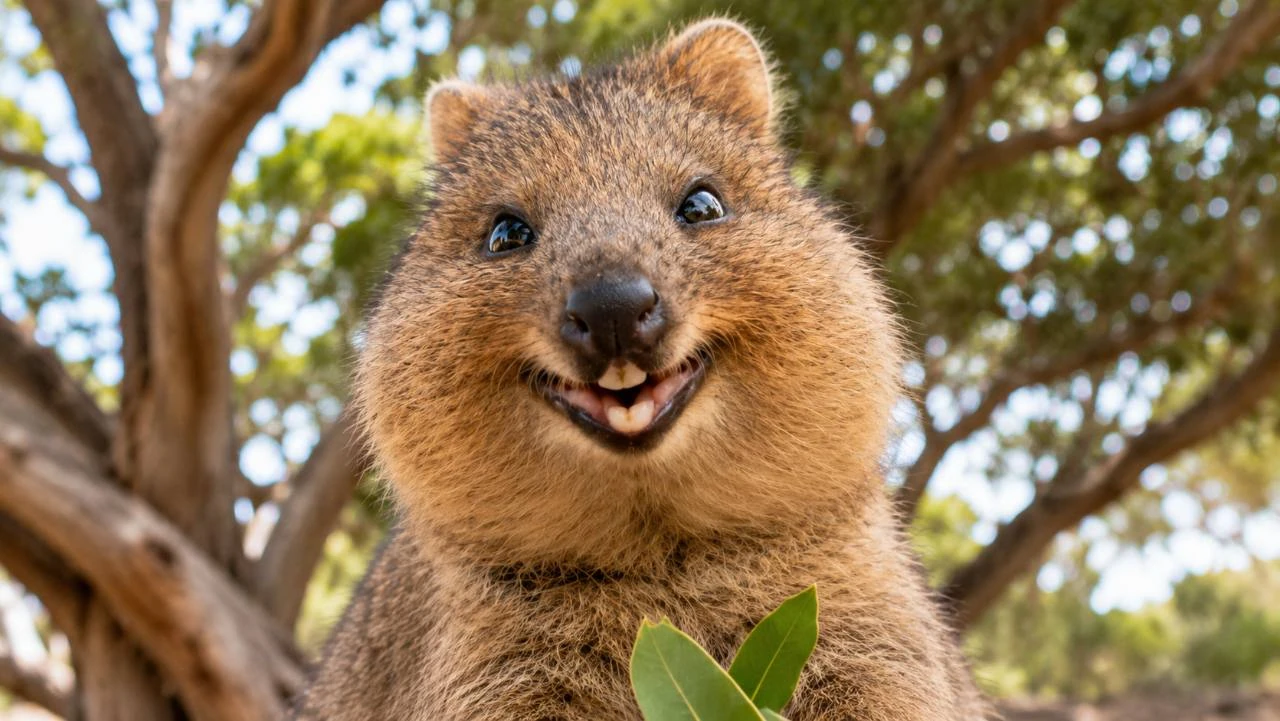
Conceptual wildlife illustration, not a documented encounter or a measurement of emotional state. The expression and setting are illustrative. Editorial image supplied for PRESDA. Original creator and reuse licence not provided.
The quokka has one of wildlife photography’s most irresistible faces. Rounded ears, dark eyes and a mouth that can look upturned have made it seem like a willing participant in the human world of smiles. But the animal has a life beyond our interpretation of its expression. Look past the portrait and the story becomes one of marsupial biology, particular habitats and the difference between being famous and being secure.
A small wallaby, not a rodent
The scientific name is Setonix brachyurus. The Australian Museum places it in the family Macropodidae, alongside kangaroos and other wallabies, and describes it as a small herbivorous marsupial. Its range is in south-western Western Australia, including mainland populations, Rottnest Island and Bald Island. Rottnest’s fame should not become the false claim that every wild quokka lives there. Nor does a round face make it a miniature bear or an unusually large rat. Australian Museum: quokka biology and conservation
What the smile does not tell us
Perth Zoo connects the quokka’s happy reputation with its facial appearance. That is different from measuring happiness or proving that an animal welcomes contact. A photograph captures a visible configuration, not a complete emotional diagnosis. The nickname world’s happiest animal is a human description, not a scientific ranking of species. Keeping that distinction does not reduce the charm of the face; it gives the animal room to have needs that a picture cannot explain. Perth Zoo: quokka species profile
Leaves, shelter and a pouch
Quokkas browse plant material and are most active at night, often sheltering in dense vegetation by day. They can climb to reach food, a useful correction to the idea of a purely ground-bound animal. Females usually give birth to one tiny young, which continues developing in the pouch. The familiar adult portrait conceals this larger life cycle: feeding opportunities, cover and successful reproduction matter more to survival than the angle of a selfie. Australian Museum: quokka biology and conservation
Famous does not mean safe
The Australian Government’s published recovery plan treats the quokka as a conservation problem requiring coordinated action. The Australian Museum and Perth Zoo list it as Vulnerable, and mainland populations have suffered from habitat loss and introduced predators. A visible population near tourists does not provide a census of the species. Conservation has to consider less photographed animals too, together with the vegetation and landscape conditions that support them. Australian Government: Quokka Recovery Plan
Let a wild animal remain wild
Rottnest Island Authority asks visitors not to feed or touch wildlife and to allow animals to find their own food and water. The practical lesson is simple: a curious approach is not an invitation to handle an animal or offer a snack. The most respectful quokka portrait is one made without changing the encounter to suit the camera. Its appeal can be a reason to notice the animal more carefully, not a reason to treat it as a prop. Rottnest Island Authority: protect our wildlife
Related reading: The extraordinary fruit bats of the Philippines.
FAQ
Frequently Asked Questions
Are quokkas really smiling?
Their faces can resemble a human smile. That appearance alone does not establish happiness or willingness to be touched.
Where do quokkas live?
They occur in south-western Western Australia, including mainland populations and Rottnest and Bald islands.
Can you feed or touch them on Rottnest?
Rottnest Island Authority asks visitors not to feed or touch wildlife. Give the animals space and let them forage naturally.
PRESDA Dispatch
Stay Informed. Stay Aware.
A sharp briefing across AI, gaming, sport, business, world affairs, paparazzi, and lifestyle.