Venomous Primate Rediscovered After Nearly a Century
Bangka's slow loris survives: a new study documents more than 90 rescues. Explore its venom, habitat threats and why lost to science never meant extinct.
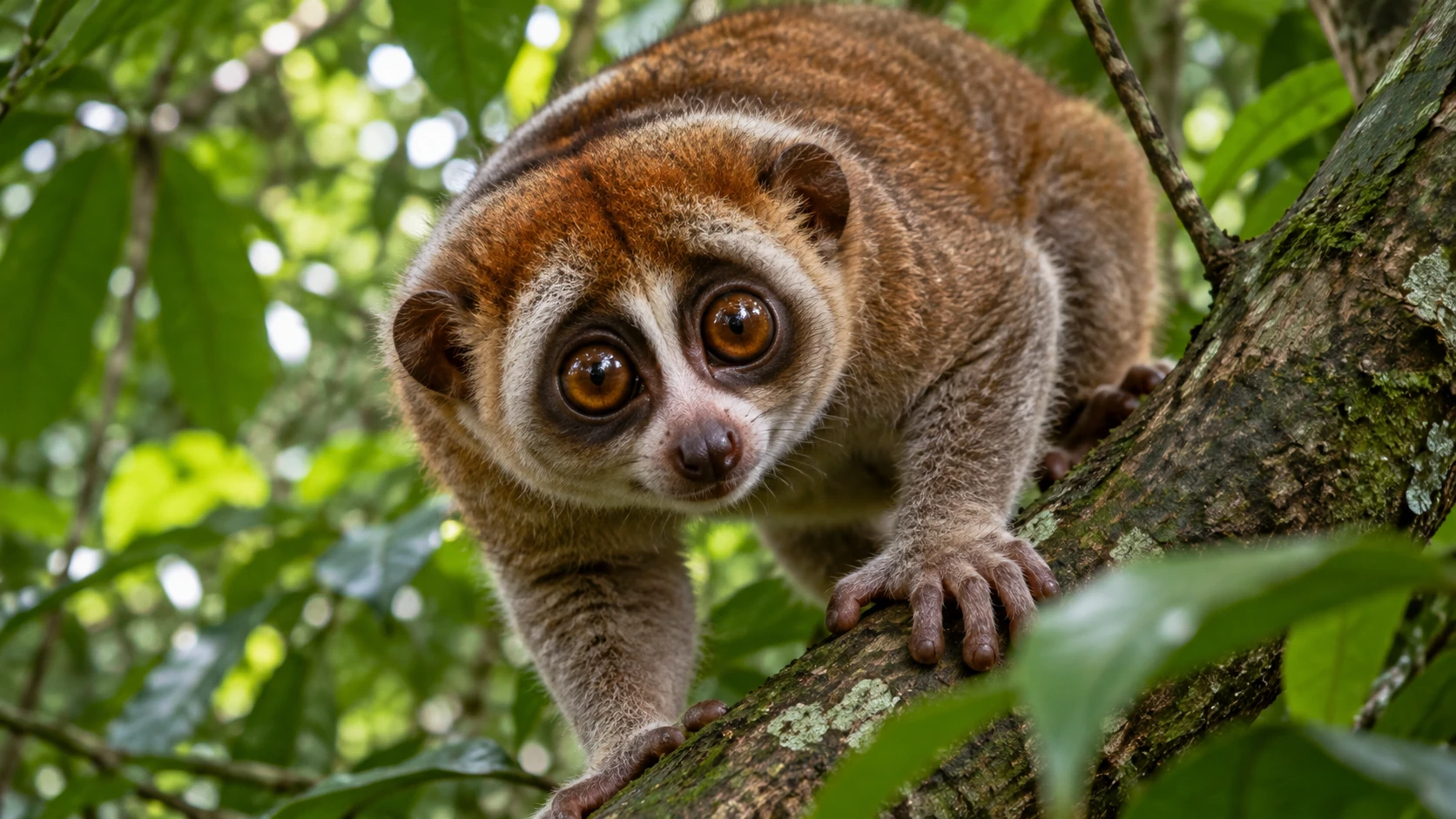
PRESDA AI-generated editorial illustration. This imagined loris is not a photograph of a rescued Bangka animal or evidence for species identification.
A small nocturnal primate has returned to scientific attention on Indonesia's Bangka Island, although the people rescuing it never needed convincing that it existed. The Bangka slow loris, Nycticebus bancanus, is the subject of a new study documenting animals encountered over a decade. Its story is less a resurrection than a correction: a species described as possibly extinct was living alongside communities whose knowledge had not been adequately reflected in the scientific record.
The October 2026 announcement draws on more than 90 rescues by the local ALOBI Wildlife Rescue Center between 2015 and 2025. It offers welcome evidence of survival, but also a disturbing picture of animals repeatedly coming into contact with dangerous infrastructure and damaged habitat. Rediscovery is the beginning of a conservation obligation, not proof that the species is secure. Re:wild's October 20 announcement
Lost to science does not mean extinct
The historical gap needs careful wording. The new Spixiana paper says the IUCN assessment listed the animal as Critically Endangered (Possibly Extinct), citing 1937 as its last sighting year. The authors question that precision: 1937 appears to refer to a publication whose specimens lacked collection dates. The exact last historical record remains uncertain. Nor had all modern evidence disappeared: photographs, local observations and earlier research references existed before this publication. Sani and colleagues' original study
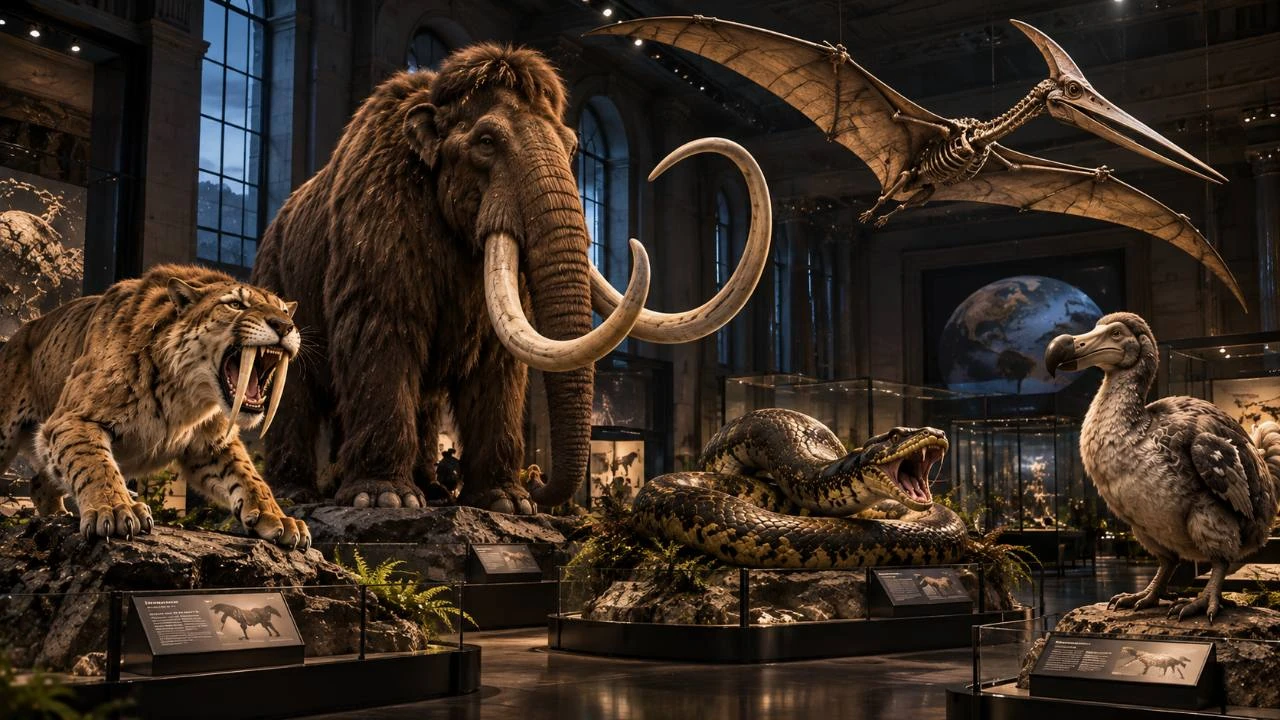
That is why nearly a century describes a long gap in the widely recognized record, not a measured period in which nobody saw a loris. Possibly extinct is also different from formally declared Extinct. The animal has not been brought back from extinction. For comparison, PRESDA's examination of genuinely vanished species explains why evidence of a surviving population changes the entire question. Extinct animals and the evidence they left
What the rescue records establish
The study analyzes ALOBI's records through August 2025. Detailed circumstances were available for 43 animals rescued since 2021, with locations for 39. Encounters included settlements, roads, captivity and electrical burns. Across the longer rescue record, 86 animals were released. These are documented interventions, not an island-wide population count. The authors explicitly report that post-release survival data have not yet been collected. Study methods, results and limitations
A rescue map answers where people found animals and could summon help. It cannot, by itself, show where most lorises live. More reports near a rescue center may reflect better reporting rather than better habitat. Equally, an animal found in a garden does not establish that plantations can replace forest. Presence, abundance and long-term viability are separate questions, and a useful conservation story keeps them separate.
A venomous primate with a very different way of life
Slow lorises belong to the strepsirrhine branch of primates, alongside lemurs and galagos, rather than the monkey and ape branch. They move deliberately through vegetation and have large eyes associated with a nocturnal life. In Reuters interviews, researchers described the Bangka animal's reddish back and pale facial markings, while stressing how little is known about its diet. Insects, plant gums and nectar are plausible foods by comparison with relatives, not a complete, directly measured Bangka menu. Reuters reporting and researcher interviews
The venom system makes slow lorises unusual among mammals. Secretions from a gland near the upper arm combine with saliva and can be delivered through a bite. Their lower front teeth form a toothcomb that also serves grooming. The apparently gentle face should never be read as permission to touch: a bite can cause serious injury and, in people, a dangerous allergic reaction. A wild loris is neither a safe pet nor a prop for a close-up photograph. Reuters on loris anatomy and bite risks
What science knows about the venom
An eight-year field study of Javan slow lorises, published in Current Biology in 2020, linked venom use to competition within the species, including territorial conflict. That research challenges the assumption that venom always evolved primarily to catch prey. It also provides a useful comparison, not a finished explanation of Bangka behavior: observations of Nycticebus javanicus cannot simply be relabeled as observations of Nycticebus bancanus. Peer-reviewed research on slow-loris venom
This distinction matters because rediscovery stories often move faster than biological knowledge. Establishing that a species survives is one finding; describing its feeding ecology, reproduction, social behavior and population trend requires further work. The most compelling feature of this animal is not that every mystery has been solved, but that researchers can now ask better questions about a living population.
The forest problem behind the rediscovery
ALOBI director Langka Sani identifies forest clearance linked to tin mining and oil-palm plantations as major pressures. Re:wild reports rescue records from Bangka's four regencies and Pangkal Pinang city, suggesting a broader distribution than the scientific record had captured. That breadth should not be confused with safety: roads, power lines and fragmented vegetation bring animals into repeated danger. Local conservation teams and habitat pressures
The practical priorities follow from those encounters: retain habitat, reduce dangerous crossings and make local reporting useful to conservation planning. Rescues can save individuals; they cannot compensate indefinitely for the loss of the places those individuals need. Community knowledge belongs at the center of this work, because it was community contact with rescuers that helped make survival visible to the wider research world.
What a successful next chapter would look like
The authors recommend habitat protection, monitored releases and a conservation breeding initiative. These are proposals, not evidence that a complete new program is already operating. Surveys would help establish numbers and distribution; genetic work could clarify relationships; follow-up after release would test whether rehabilitation produces durable gains. The study's conservation recommendations
The next headline worth celebrating will therefore require more than another sighting. It will need evidence that lorises can remain in connected habitat, that rescued animals survive, and that local conservation teams have the resources to keep working. Bangka's slow loris was never waiting for the outside world to declare it alive. Its future now depends on what that world does with the evidence.
FAQ
Frequently Asked Questions
What is this PRESDA article about?
Bangka's slow loris survives: a new study documents more than 90 rescues. Explore its venom, habitat threats and why lost to science never meant extinct.
Which category does this story belong to?
This story is part of PRESDA's Science coverage.
Who published this article?
Venomous Primate Rediscovered After Nearly a Century was published by PRESDA Editorial on PRESDA.
PRESDA Dispatch
Stay Informed. Stay Aware.
A sharp briefing across AI, gaming, sport, business, world affairs, paparazzi, and lifestyle.