Alex the Parrot: The Bird That Challenged Human Intelligence
Explore Irene Pepperberg's work with Alex: meaningful labels, colors, shapes, same and different, numbers, scientific limits and animal cognition.
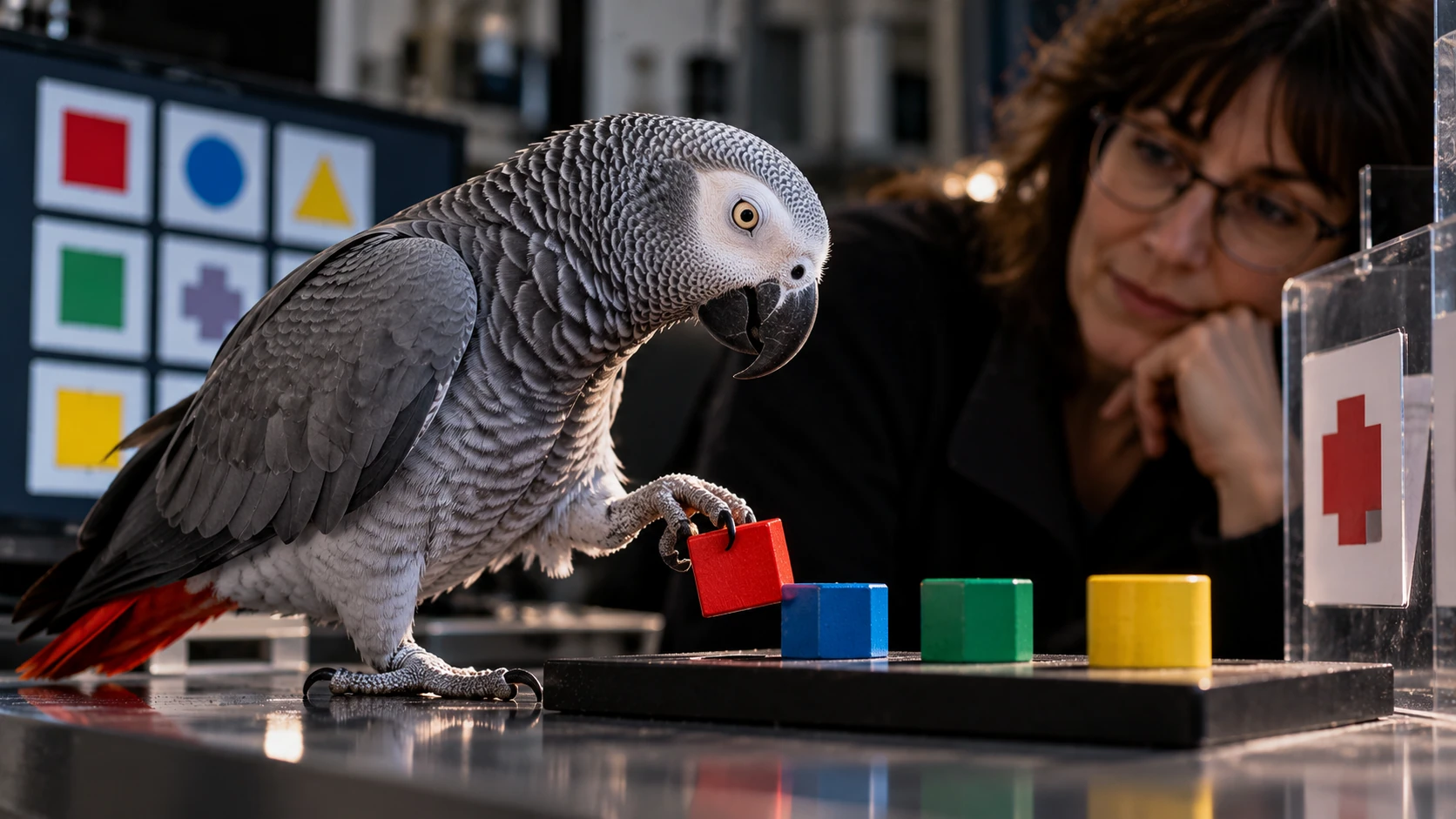
PRESDA AI-generated editorial illustration, supplied and approved. An imagined cognition experiment, not an archival photograph of Alex or Irene Pepperberg and not a reconstruction of a specific published trial.
Ask a talking bird to repeat a word and you may hear a remarkable imitation. Ask it which property two unfamiliar objects share and the question becomes much more demanding. Alex, the African grey parrot studied by Irene Pepperberg, helped make that distinction scientifically visible. His achievement was not to surpass humanity in an intelligence contest. It was to challenge assumptions about what a bird could learn, represent and communicate.
Across a research programme that began in 1977, Alex learned labels for objects and their properties, answered questions about relationships and demonstrated numerical abilities under experimental conditions. The Alex Foundation describes a repertoire exceeding one hundred English labels. Those results deserve neither dismissal as mere mimicry nor inflation into proof of a fully human mind. The interesting science lies between those extremes. The Alex Foundation
An ordinary beginning for an extraordinary study
Alex was a grey parrot, Psittacus erithacus, born in 1976. Pepperberg acquired him from a pet shop in 1977. In her retrospective interview with the Psychonomic Society, she recalled asking the shop employee to choose the bird, rather than selecting one she believed unusually promising. The research partnership would last three decades. The project's importance emerged through work, not through an initial test that identified a feathered prodigy. Alex's life dates Pepperberg's research recollections
That beginning does not prove Alex was statistically average. One bird selected without a formal ability screen is still one bird, not a representative sample of an entire species. It does, however, guard against a tempting origin myth: the researcher did not discover a parrot already equipped with an extensive English vocabulary. The capacities later reported emerged through prolonged, socially rich interaction and carefully designed tasks.
Irene Pepperberg's central question
Pepperberg asked whether vocal learning could become a tool for investigating thought. A bird able to produce human speech sounds might give answers more informative than simply pecking one of two targets. If it could use a label appropriately across situations, researchers could test what that label represented. Her work therefore examined communication and cognition together, while distinguishing successful experimental responses from the full range of human language. Pepperberg's comparative cognition review
This approach changed the practical question. Instead of asking whether Alex sounded human, the experiment could ask whether a response depended on the object, the question and the relevant property. A familiar sound alone would not suffice. Nor would an anecdote about a perfectly timed phrase. What mattered was whether a repeatable pattern of answers supported a defined claim about learning or conceptual understanding.
Learning from a model and a rival
The model/rival method used two human participants in an interactive demonstration. One asked about an object while the other modelled an answer and competed for the questioner's attention. Correct responses could lead to receiving the object; errors elicited corrective feedback. Humans exchanged roles, and the bird had opportunities to participate. Pepperberg's methodological review explains how social interaction, reference and functional consequences were combined. Review of the model/rival technique
The point was not simply to play a recording until Alex copied its sounds. A label was connected to something he could see, request or obtain. Role changes also prevented communication from being tied exclusively to one human questioner. This is an account of a research method, not a promise that any companion parrot will acquire Alex's repertoire, or a reason to pressure an animal into performing for a camera.
Colors, shapes and the importance of the question
Alex learned to identify properties including color, shape and material. His responses could change according to what he was asked about the same object: a color question required a color label, while a shape question required a shape-related answer. The American Psychological Association's account also describes his understanding of relative size and some written numerals. This flexibility made his performance more informative than a single memorized object-name association. American Psychological Association
Imagine, as an explanatory example rather than a quotation from a particular trial, a red wooden square. Naming its color does not answer what it is made from. Naming its material does not answer its shape. Distinguishing those questions requires attending to different dimensions of the same thing. Alex's research used such separations to investigate categorization, rather than treating every correct vocalization as equivalent evidence of understanding.
Same and different are relationships
A landmark 1987 study examined whether Alex could identify the category in which two objects were the same or different. He was not merely choosing between identical pictures. He had to respond with a relevant property category, such as color, shape or material, depending on the question and the pair presented. Tests included unfamiliar objects and combinations, making transfer beyond the training examples important. Pepperberg's original same/different study
The conceptual step is easy to underestimate. Two items can share a color yet differ in shape, so similarity is not a single all-purpose feature. A correct response must track the relation being asked about. Success with new examples weighs against the simplest explanation of memorizing every individual pair, although it does not eliminate the need to examine learning history, experimental controls and alternative explanations.
Numbers were more than a recited sequence
Saying number words in order is different from identifying how many items are present. Alex's numerical research addressed quantities, number labels and their relationships. Earlier work often discussed sets up to six; Pepperberg's 2012 review describes quantification of sets containing up to eight items, including subsets within mixed collections. Calling six his absolute lifetime limit therefore misses later work. Review of numerical abilities
A separate paper published in 2012 examined addition involving written numerals or three successively presented collections. Alex was asked for a total when the earlier addends were no longer visible. The reported performance was above chance, but the author explicitly noted that his death prevented testing all possible arrays. It is evidence about particular small-number tasks, not a claim that he possessed unrestricted arithmetic or a school mathematics curriculum. Addition study and limitations
What does a zero-like concept mean?
The description of Alex's abilities includes a zero-like concept. That cautious phrase matters. A 2005 report from Brandeis described his use of a response for absence in a numerical task, extending an existing label beyond its original context. Identifying that a requested quantity is absent is an important finding. It does not establish understanding of every mathematical property of zero. Brandeis research announcement
Zero can serve as a quantity, a written symbol, a place-value device and an element in formal arithmetic. These are related but distinct achievements. A bird's response in one experimental setting cannot automatically establish the entire package. The same discipline applies to words such as language and reasoning: define the tested ability first, then describe the result without borrowing extra meaning from the familiar human term.
How strong is the evidence?
The studies derive their strength from structured questions, repeated trials, transfer tests and published methods, rather than from a viral clip. Their interpretation still requires scrutiny. In human-animal experiments, unintentional cues, the scoring of vocal responses, reinforcement history and the choice of comparison conditions can affect conclusions. The original same/different paper reports procedures designed to address testing and response assessment; readers can examine those methods rather than relying on an isolated success. Original methods and test design
The largest generalization problem remains straightforward: Alex was one intensively studied individual. Repeated observations strengthen a claim about his performance, but do not become hundreds of independent parrots. Research with other birds helps establish which abilities recur and under what conditions. Training may reveal a capacity, help construct a skill, or do both; separating those possibilities is part of comparative psychology, not an insult to the animal's achievement.
A bird brain is not an inferior human brain
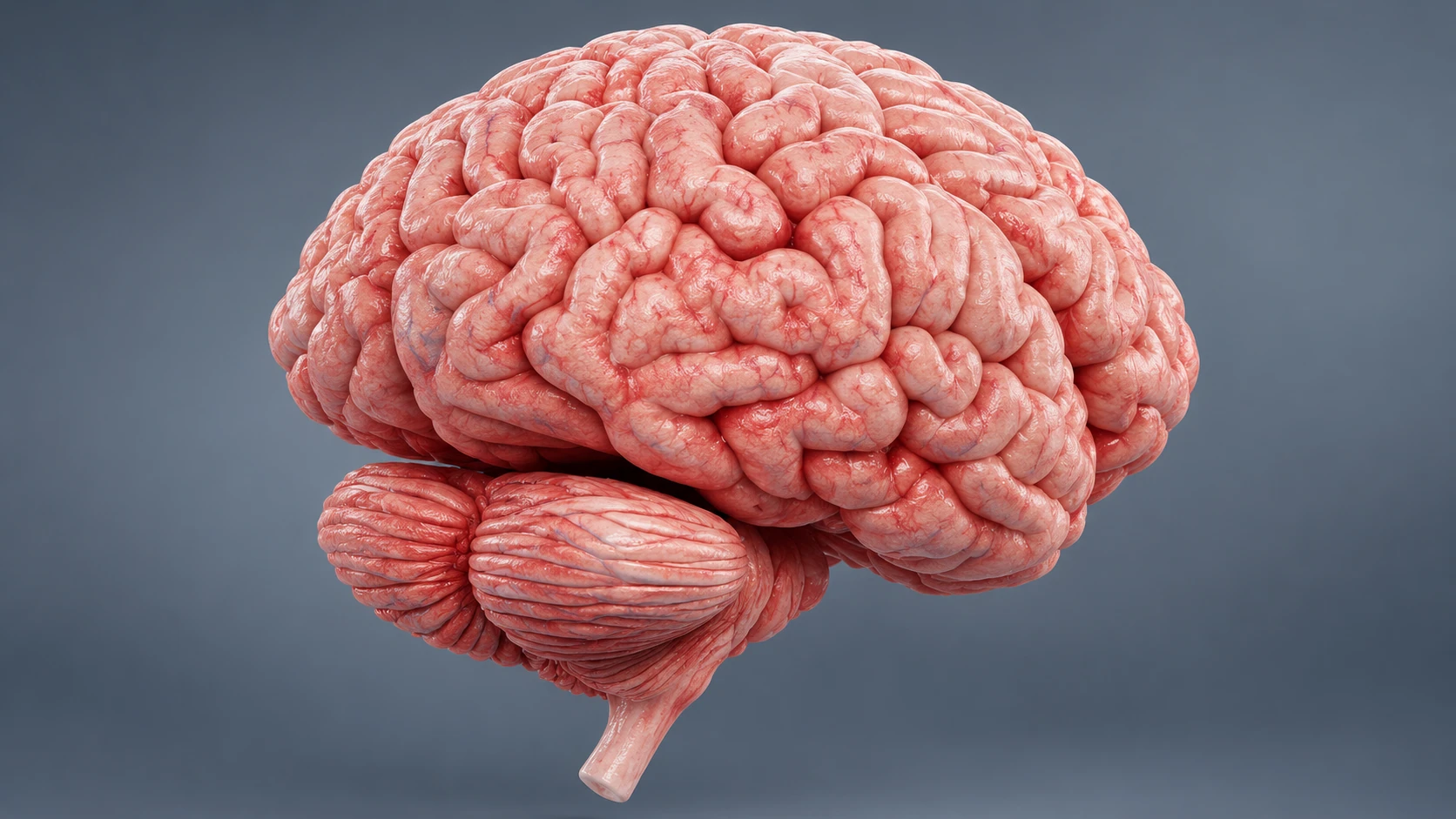
Alex's results encourage a broader question about how cognition evolves. Birds and mammals do not need identical brain organization to solve some comparable problems. A 2016 anatomical study found high neuron densities in the forebrains of sampled parrots and songbirds. That offers useful context for avian cognition, but it is not a measurement of Alex's own brain or a neural explanation of every answer he gave. Comparative neuron study
Comparisons with children can illuminate a specific task, but they should not become a single mental-age label. Human development combines language, social understanding, motor skills, memory and many other capacities that do not advance as one number. Alex's pattern of strengths was a bird's pattern, shaped by his history. Our features on the human brain and bilingualism explore why cognition also resists simple rankings within our own species. The human brain Bilingual brains
Death, affection and a continuing legacy
Alex died on 6 September 2007, aged 31. The loss ended a long research partnership and a close relationship. Pepperberg's later recollections make the emotional connection clear, but affection and scientific evidence answer different questions. A remembered exchange can reveal the importance of a relationship without demonstrating an untested theory about a bird's inner experience. APA interview and obituary context Alex Foundation biography
The Alex Foundation continues research and connects its work to responsible care, conservation and veterinary welfare. The ethical implication is not that an impressive bird should become a fashionable purchase. It is that cognitively and socially capable animals deserve environments suited to their needs. Public fascination with an animal, whether Alex or the ceremonial penguin Sir Nils Olav, creates a responsibility to distinguish what people celebrate from what the animal actually understands. The Foundation's mission Sir Nils Olav's story
The questions Alex left open
How much did symbolic training change the way Alex solved problems? Which abilities would appear in other parrots with different developmental experiences? What could experiments using birds' own communication and ecological priorities reveal that human-language tests miss? Pepperberg's comparative review discusses the possible role of symbolic representation, rather than treating the mechanism behind Alex's achievements as settled. Interpretation and open questions
Alex did not erase the differences between a parrot and a person. He made some confident assumptions about those differences harder to defend. His enduring contribution is a methodological invitation: ask an animal a question it has a meaningful way to answer, test that answer carefully, and remain willing to discover capacities that an easier experiment would never reveal.
FAQ
Frequently Asked Questions
What is this PRESDA article about?
Explore Irene Pepperberg's work with Alex: meaningful labels, colors, shapes, same and different, numbers, scientific limits and animal cognition.
Which category does this story belong to?
This story is part of PRESDA's Science coverage.
Who published this article?
Alex the Parrot: The Bird That Challenged Human Intelligence was published by PRESDA Editorial on PRESDA.
PRESDA Dispatch
Stay Informed. Stay Aware.
A sharp briefing across AI, gaming, sport, business, world affairs, paparazzi, and lifestyle.