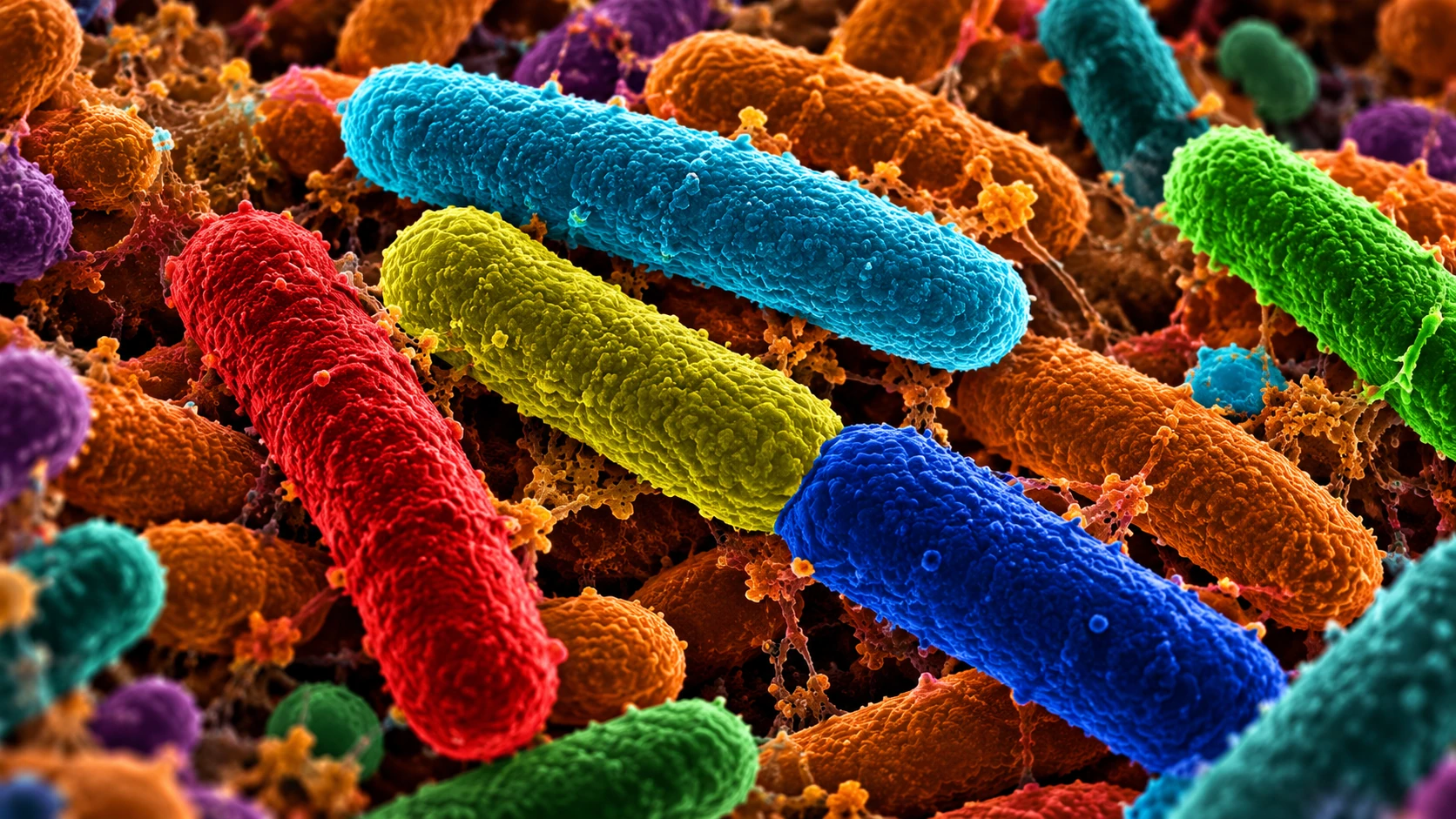
The Human Brain: The Most Complex Organ We Know
Explore brain anatomy, 86 billion neurons, memory, consciousness, sleep and neuroplasticity, separating discoveries from unanswered questions.
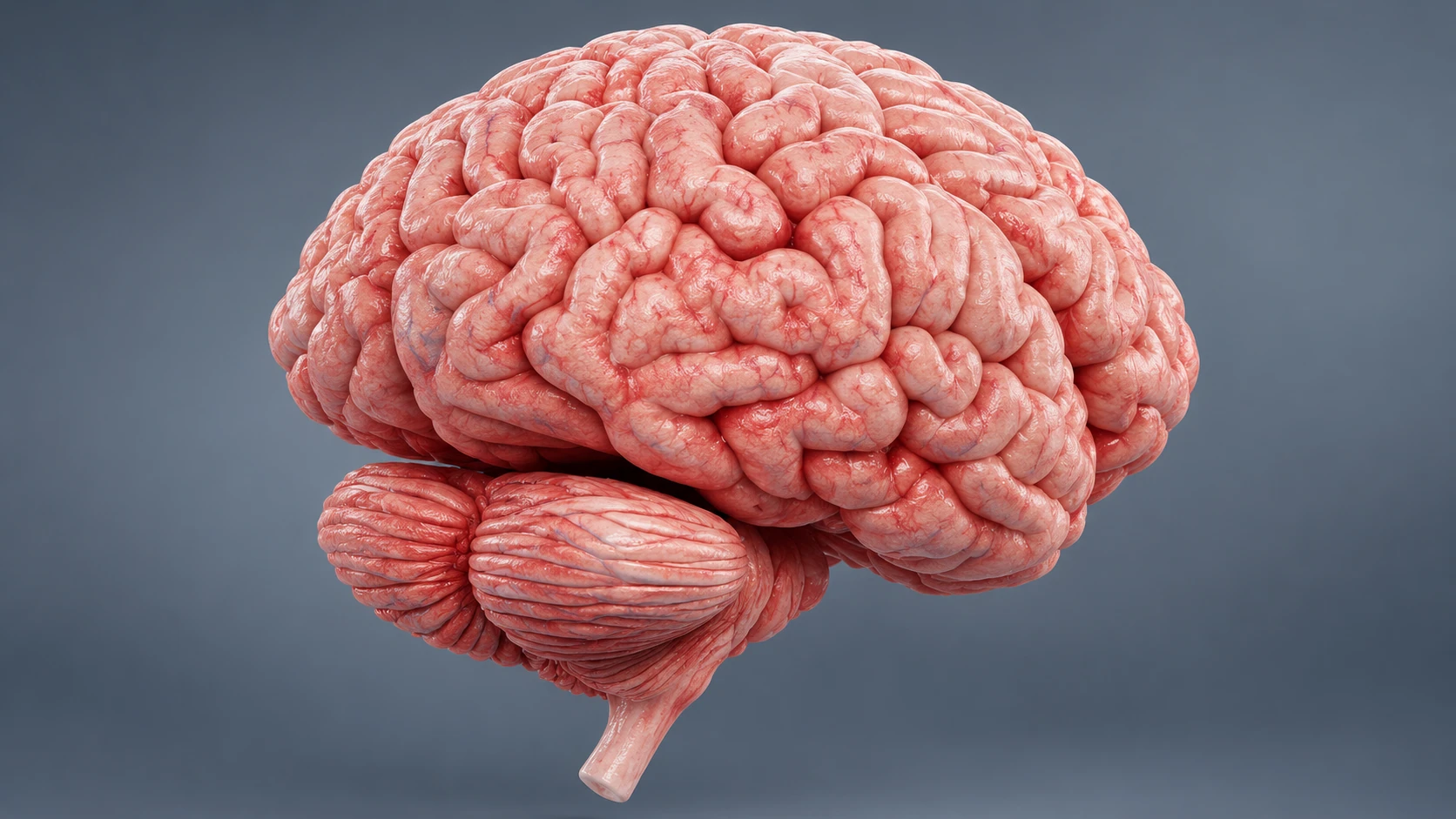
Hero: AI-generated anatomical illustration supplied by PRESDA. This is not a photograph, medical scan or diagnostic image.
Before you finish this sentence, your brain has already performed an extraordinary act. Light has become electrical activity, marks have become language, and language has acquired meaning. You may hear an inner voice, remember something you read years ago or notice a sound elsewhere in the room. None of this requires you to supervise the individual cells involved. The organ doing the work is also creating your experience of watching it happen.
The human brain is the central organ of the nervous system, coordinating sensation, movement, bodily regulation and cognition. Calling it the most complex organ we know expresses the scale of its interacting networks, not a scientific competition with a universally agreed score. Neuroscience can explain much about its cells and circuits. It cannot yet give a complete account of how those processes produce a remembered childhood, a difficult decision or the feeling of being someone.
A living landscape inside the skull
The brain is protected by the skull, membranes called meninges and cerebrospinal fluid. Its folded outer surface is part of the cerebrum, whose two hemispheres communicate through pathways including the corpus callosum. The folds increase the cortical surface that fits inside the head. Grey matter contains many neuronal cell bodies and local connections; white matter contains bundles of axons, many wrapped in insulating myelin. These are interacting tissues, not separate thinking and wiring departments. NINDS: brain anatomy
Frontal regions contribute to planning, movement and behavioural control; parietal regions integrate bodily and spatial information; temporal regions participate in hearing, language and memory; occipital regions are central to vision. Yet these labels describe emphases, not exclusive territories. Reading a face or following a conversation recruits multiple areas. A coloured map showing a single region lighting up is a simplification of coordinated activity that is already occurring across the brain.
Below the cerebral hemispheres, the cerebellum supports coordination, timing and learning, with roles extending beyond movement. The brainstem helps regulate essential functions such as breathing and links the brain with the spinal cord. Deeper structures include the thalamus, involved in information exchange; the hypothalamus, which helps regulate bodily states; and the hippocampus, important for forming certain memories. There is no miniature observer sitting at the centre. Control emerges through relationships between systems. NINDS: brain anatomy
The brain also depends on continuous exchanges with the body. Blood delivers oxygen and nutrients, while specialized barriers regulate which substances move from the circulation into neural tissue. This protection is selective, not absolute. Hormonal signals, immune processes and sensory information continually influence brain function. Even an apparently private act such as concentrating on a problem takes place within this wider physiology. The image of a brain floating alone in a jar is a useful fictional device, but a poor starting point for understanding an organ whose normal work is inseparable from a living body.
What does 86 billion neurons really mean?
The widely cited estimate of about 86 billion neurons comes from research published in 2009 by Frederico Azevedo, Suzana Herculano-Houzel and colleagues. Their method counted cell nuclei in processed tissue and distinguished neuronal from non-neuronal nuclei. The result was an average from sampled adult male brains, not a census of every human being. Individual variation, sampling and measurement matter. The number is a useful estimate, not a biological constant or a measure of someone's intelligence. Azevedo and colleagues, 2009
Neurons also differ dramatically. Some send long projections, while others influence nearby circuits. Most of the brain's neurons are in the cerebellum, a reminder that cell counts cannot simply be equated with conscious thought. Non-neuronal cells are indispensable too: astrocytes help regulate the cellular environment, oligodendrocytes form myelin in the central nervous system, and microglia participate in immune surveillance and tissue maintenance. The old image of neurons as stars surrounded by passive supporting material misses much of the biology. Herculano-Houzel: brain scaling
How cells become a conversation
A neuron maintains electrical differences across its membrane. When conditions reach a threshold, an action potential can travel along its axon. At many synapses, this triggers the release of neurotransmitter molecules, which bind to receptors on another cell. The receiving cell integrates many influences, some favouring activity and others restraining it. Electrical synapses also exist. A thought is not a single spark travelling down one wire: it involves changing patterns within networks operating across different timescales. NCBI: neuronal signalling
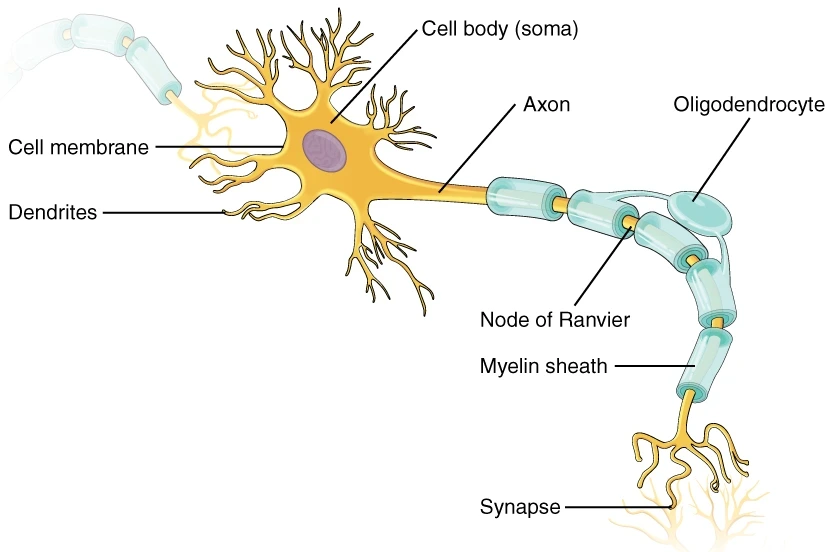
A neuron and its myelin sheath, from OpenStax Anatomy and Physiology. This educational diagram identifies the cell body, dendrites, axon and synapse; it is not a microscope photograph. Original English labels retained.
OpenStax, Anatomy and Physiology (2016) · Original image and credit
Converted to WebP and resized for responsive delivery by PRESDA. Full composition preserved. The image and its derivatives retain the license linked below.
Image license: CC BY 4.0Chemical names can mislead when turned into personality labels. Dopamine is not simply pleasure, serotonin is not simply happiness, and an emotion cannot be read from the amount of one transmitter. Effects depend on receptors, pathways, timing and context. In the same way, the brain is not a computer with an unused compartment waiting to be switched on. Different tasks draw on different activity patterns, but the popular claim that we ordinarily use only ten percent has no sound neuroscientific basis.
Signals also need coordination. Excitation without appropriate inhibition would not make thinking more powerful; balanced regulation is essential to stable processing. A neuron's response depends partly on what arrived immediately before, which other cells are active and the state of the network. Researchers therefore study timing and relationships as well as anatomical connections. Comparing a brain with a city can be helpful: knowing where the roads run does not tell you which journeys are happening, why they were chosen or how traffic changes when conditions shift. Every metaphor eventually reaches its limits, but this one captures an important distinction.
Memory is reconstruction, not a recording
Remembering a holiday, knowing the meaning of a word and riding a bicycle are different achievements. Episodic memory concerns events, semantic memory concerns knowledge, and skills depend on other learning systems. The hippocampus and surrounding structures are especially important for forming new memories of events and facts, while distributed cortical networks contribute to their representation. Remembering does not mean retrieving an untouched video file. Attention, later knowledge and the circumstances of recall can influence what returns to mind.
Research on memory traces, or engrams, investigates populations of cells and the changes associated with learning. In rodents, researchers can label cells active during an experience and manipulate them to test their contribution to later behaviour. Such experiments provide stronger causal evidence than merely seeing a brain region activate. They do not show that scientists can download a person's autobiography. A laboratory measure of memory in an animal and a richly narrated human recollection are related problems, not interchangeable ones. Nature Reviews Neuroscience: finding the engram
Learning often changes the strength and structure of synapses. Some connections become more effective, others less so, while cellular excitability and wider network organization also matter. This flexibility helps explain how experience leaves a biological trace without requiring a separate neuron for every remembered moment. Forgetting can reflect failed access as well as loss or alteration of information. The difficult question is how a continuously changing system preserves some memories for decades while remaining able to learn. Nature Reviews Neuroscience: structural plasticity and memory
Everyday mistakes make these distinctions tangible. Forgetting why you entered a room does not imply that an entire memory system has failed. Divided attention may mean information was never strongly encoded; an unsuitable cue may make stored information difficult to retrieve. Repeatedly encountering a fact can create familiarity without the ability to explain it. Learning therefore involves more than exposure. The scientific challenge is to connect behaviour with mechanisms without jumping from a common lapse to a diagnosis, or from a laboratory discovery to a universal technique for perfect recall. Memory is adaptable, valuable and necessarily selective.
Intelligence has no single address
Intelligence research examines capacities such as reasoning, learning and solving unfamiliar problems. Brain studies implicate distributed networks, including connections between frontal and parietal regions. No single scan reveals a person's complete intellectual potential. Tests measure particular performances under particular conditions, and correlations between brain features and scores do not establish a simple cause. Education, health, opportunity and experience must remain part of the interpretation. Nature Reviews Neuroscience: intelligence differences
Nor is intelligence identical to creativity, judgement, compassion or practical expertise. A person can struggle with one task and excel at another. The familiar division between logical left-brained people and creative right-brained people mistakes some genuine functional asymmetries for a complete personality theory. Both hemispheres cooperate in ordinary life. Treating a colourful brain image as destiny can conceal the very thing neuroscience studies: a biological system developing through sustained interaction with the world.
Emotions connect meaning with the body
An emotion involves more than a feeling located in one small structure. It can include changes in attention, bodily state, action readiness, memory and conscious interpretation. The amygdala helps evaluate biologically significant information and supports learning, but calling it a fear button is misleading. It participates in processes involving positive as well as negative significance, and its activity must be understood within larger networks. Nature Reviews Neuroscience: emotion and the amygdala
Reason and emotion are therefore not rival occupants of the skull. Bodily signals and remembered outcomes help shape decisions about what matters. Context can transform the meaning of a racing heart, whether you are running, anxious or excited. Competing theories disagree about how emotional categories arise and how much depends on shared circuits, learning and interpretation. Recognizing that debate prevents a common mistake: presenting a simplified brain diagram as a complete explanation of love, grief or anger. Nature Reviews Neuroscience: the nature of feelings
Consciousness: the unanswered question within every answer
Consciousness includes subjective experience, such as seeing colour or feeling pain. Scientists can investigate changes associated with sleep, anaesthesia, brain injury and conscious perception. They can test which signals accompany an experience and which interventions alter it. But identifying a neural correlate does not automatically explain why the activity feels like anything from the inside. The gap is a research problem, not evidence for a preferred supernatural or technological explanation.
Global neuronal workspace theories emphasize information becoming broadly available across processing systems. Integrated information theory proposes a different account centred on a system's causal and informational organization. A large adversarial collaboration published in Nature in 2025 tested predictions from both approaches and challenged key expectations of each. It did not establish a final winner. The value lies partly in making disagreement testable, with predictions specified before the results were known. Nature: testing theories of consciousness
This uncertainty has practical consequences. Clinicians assessing a person who cannot respond must distinguish lack of outward behaviour from lack of awareness. Researchers also debate what evidence could justify attributing consciousness to an animal or an artificial system. Neither fluent language nor a complicated wiring diagram settles the issue by itself. Neuroscience becomes stronger when it distinguishes an observation, an interpretation and a philosophical commitment instead of allowing them to blur together.
Another difficulty is separating the experience itself from the act of reporting it. Asking someone to press a button when they see an image introduces attention, decision-making and movement into the experiment. A signal associated with that response may reflect reporting rather than consciousness alone. Researchers use complementary designs to address the problem, but there is no perfectly simple measurement. This is why apparently dramatic claims need replication and careful interpretation. The question is not merely where activity appears, but which aspect of the task that activity explains and whether the explanation survives a different experimental approach.
Neuroplasticity: change with limits
Neuroplasticity is the nervous system's capacity to change with development, experience or injury. Learning a movement can modify how circuits work; rehabilitation can help a person recover functions or develop compensatory strategies. Change does not require the entire brain to rebuild itself. It can involve altered connections, activity patterns and the use of existing pathways. Plasticity is a biological foundation for learning, not a promise that determination alone can reverse any injury. NINDS: rehabilitation after stroke
Timing, the location and extent of damage, treatment and a person's circumstances all influence recovery. Plastic changes can also support unwanted patterns, including persistent pain or entrenched habits. Adult neurogenesis, the production of new neurons, is a more specific question than plasticity. A 2026 Nature study identified molecular evidence of neurogenic cell populations in adult human hippocampal samples. Their abundance, maturation and functional contribution still require careful investigation; this is not evidence that adults routinely replace the whole brain. Nature: adult human hippocampal neurogenesis
Sleep is active brain work
Sleep changes brain activity rather than simply turning it off. Non-REM sleep and REM sleep recur through the night, with differences in electrical patterns, muscle activity and physiology. Sleep pressure builds with time awake, while circadian systems help align bodily rhythms with the day. These processes interact, which helps explain why exhaustion and readiness to sleep do not always coincide. Sleep supports attention, learning and other functions, and its disruption can affect performance the following day. NINDS: understanding sleep
Dreaming is often vivid during REM sleep, but reports also occur outside it. Researchers investigate possible links with memory processing, emotion and the brain's spontaneous construction of experience. No single explanation accounts conclusively for every dream, and there is no validated universal dictionary translating each dream image into a hidden message. The strange experience of awareness while temporarily unable to move has a physiological context explored in PRESDA's sleep paralysis feature.
Dream research faces its own measurement problem. Scientists usually learn what a person dreamed through a report after awakening. That report is already a memory, shaped by what was retained and what can be described. Recording brain activity during sleep provides another source of evidence, but matching it to the private details of an experience remains difficult. A proposed function of dreaming must also be distinguished from a demonstrated benefit of sleep. Evidence that sleep helps learning does not, by itself, establish that a particular dream narrative performed that useful work.
An aging brain is not automatically a diseased brain
Some cognitive abilities change with age, including the speed of certain operations and the ease of retrieving particular information. Knowledge and familiar skills can remain strong, and people vary substantially. Dementia is not an inevitable consequence of getting older. It describes a decline severe enough to interfere with daily life and can result from different diseases. Occasional forgetfulness and progressive loss of independence should not be treated as the same phenomenon. NIA: aging and thinking
Brain health also depends on the rest of the body. Vascular health, sleep, sensory function, medication effects and social circumstances can influence cognition. Physical activity and managing health conditions are sensible components of overall care, but no supplement or puzzle guarantees protection against dementia. Observational links are useful clues, not proof that a particular habit caused an outcome. Preserving uncertainty here is essential: exaggerated prevention claims can mislead families already facing difficult decisions. NIA: cognitive health
When neural systems are disrupted
Neurological disorders reveal how different failures produce different consequences. A stroke interrupts blood supply or involves bleeding, potentially damaging tissue rapidly. Epilepsy involves a continuing predisposition to seizures associated with abnormal brain activity; a single seizure does not always mean epilepsy. Parkinson's disease affects movement and can also involve sleep, mood and other functions. These conditions are not interchangeable examples of a brain becoming weak. They have different mechanisms, clinical courses and treatment needs. NINDS: epilepsy NINDS: Parkinson's disease
Alzheimer's disease involves progressive changes that include abnormal amyloid and tau pathology, synaptic dysfunction and neuronal loss. It is a major cause of dementia, but dementia has other causes, and mixed pathology can occur. Mental illnesses also involve brain function interacting with development, biology and environment. Reducing depression, anxiety or any person's suffering to a single chemical imbalance is inadequate. The history of progress and incomplete explanations is explored further in PRESDA's history of medicine. NIA: Alzheimer's disease
How do scientists look inside?
Different tools answer different questions. MRI can reveal anatomy; functional MRI usually measures blood-oxygenation changes associated with activity rather than directly recording every neuron. EEG records electrical activity at the scalp with excellent timing but limited spatial precision. Microscopy can reveal cells and synapses in prepared tissue. None provides an unrestricted window into thoughts. A result must be interpreted in relation to what the instrument measures, the experimental task and the people or animals studied. NINDS: neurological tests
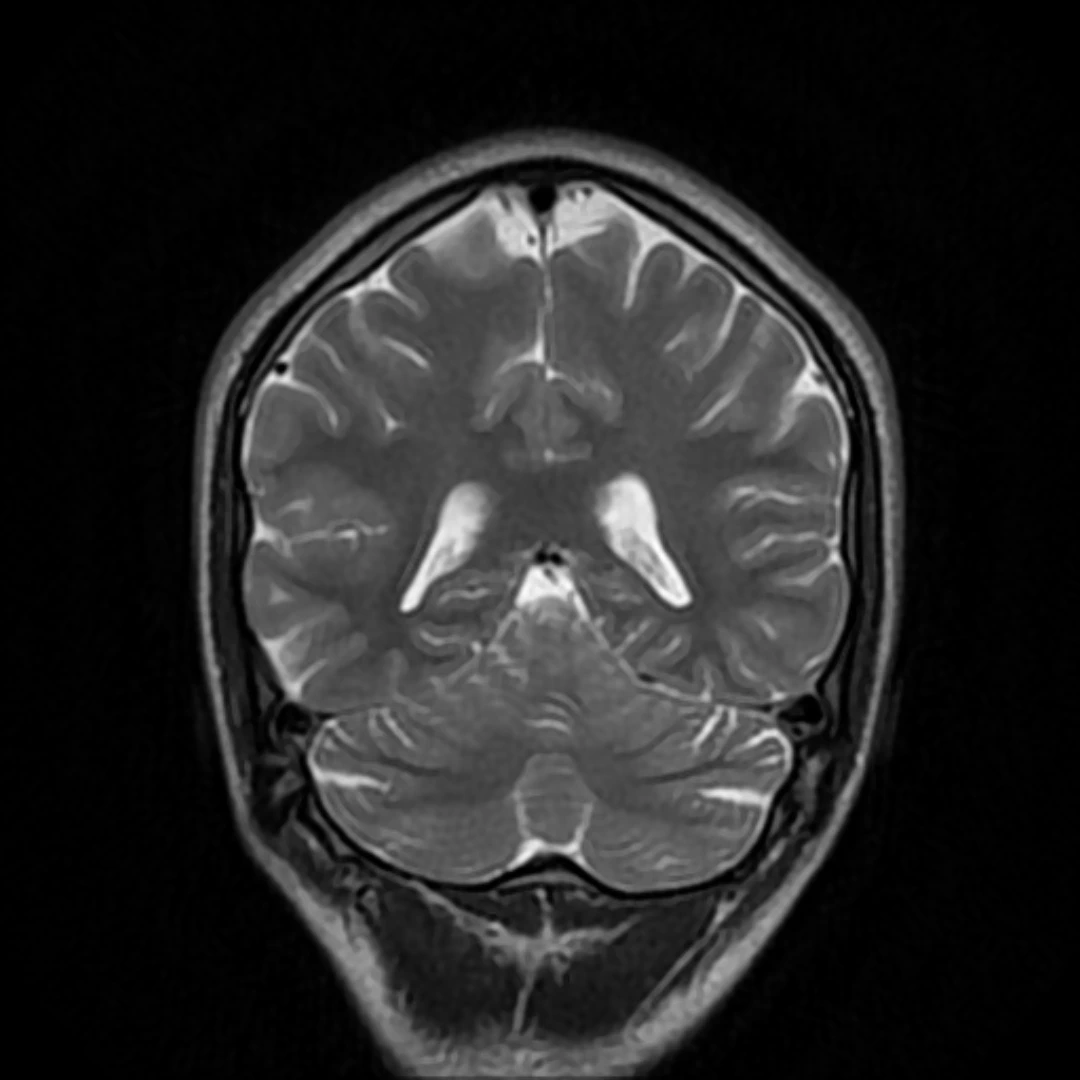
A genuine coronal T2-weighted brain MRI, published by 511KeV in 2024. MRI reveals internal anatomy; this image does not show thoughts or establish a diagnosis here.
511KeV (2024) · Original image and credit
Converted to WebP and resized for responsive delivery by PRESDA. Full composition preserved. The image and its derivatives retain the license linked below.
Image license: CC BY-SA 4.0In 2024, researchers reconstructed a cubic millimetre of human brain tissue using electron microscopy and computational analysis, revealing nearly 150 million synapses. The sample came from tissue removed during surgery, not from scanning an entire living person's brain. Its complexity illustrates both the achievement and the distance still to travel. A connectome maps connections; explaining their changing activity, chemical modulation and relationship to behaviour requires additional evidence. A wiring map is a beginning, not a complete biography of a mind. NIH: human brain structure
The strongest explanations bring methods together. A scan can suggest a relationship, a clinical observation can reveal what happens after damage, and a controlled experiment can test a mechanism. Each has limitations: volunteers may not represent everyone, animal models capture only parts of human conditions, and statistical differences between groups may overlap substantially at the individual level. Large samples, transparent analysis and independent replication help distinguish reliable findings from attractive stories. In neuroscience, an image is evidence only when accompanied by a clear account of how it was produced and what it can legitimately show. The ethical questions surrounding these models are examined in Animal Testing.
The future: restoring function without selling science fiction
Brain-computer interfaces can translate selected neural signals into commands for external devices. In 2025, a Nature Neuroscience study demonstrated streaming speech synthesis from brain activity in a participant with severe paralysis. This is a significant assistive achievement, not unrestricted mind reading or evidence that the system works equally well for everyone. Long-term reliability, training, surgical risks, access and performance outside research settings remain important questions. Nature Neuroscience: a speech neuroprosthesis
Other approaches include stimulation, molecular studies, cell atlases and laboratory models that reproduce selected features of neural development. Deep brain stimulation already helps treat symptoms in selected disorders, but it does not repair every underlying cause. Models and AI tools can identify patterns and guide experiments without becoming complete replicas of a person. As these methods improve, consent, privacy and control over neural data become scientific and social priorities, not issues to postpone until after the technology arrives. NINDS: deep brain stimulation
The deepest questions remain open: how memories stay stable in changing tissue, how biological differences shape individual lives, how damaged networks can recover, and how physical processes support experience. Yet uncertainty need not diminish wonder. The brain's achievement is not that it contains an unexplained magic centre. It is that living cells, sustained by a body and shaped by a world, make understanding possible. Every careful experiment adds another piece to that understanding, including a clearer account of what we still do not know.
FAQ
Frequently Asked Questions
What is this PRESDA article about?
Explore brain anatomy, 86 billion neurons, memory, consciousness, sleep and neuroplasticity, separating discoveries from unanswered questions.
Which category does this story belong to?
This story is part of PRESDA's Science coverage.
Who published this article?
The Human Brain: The Most Complex Organ We Know was published by PRESDA Editorial on PRESDA.
PRESDA Dispatch
Stay Informed. Stay Aware.
A sharp briefing across AI, gaming, sport, business, world affairs, paparazzi, and lifestyle.