Extinct Animals: The Lost Creatures of Our Planet
Explore 20 extinct animals, from Smilodon and megalodon to moa and the Pyrenean ibex, with fossil evidence, extinction causes and licensed images.
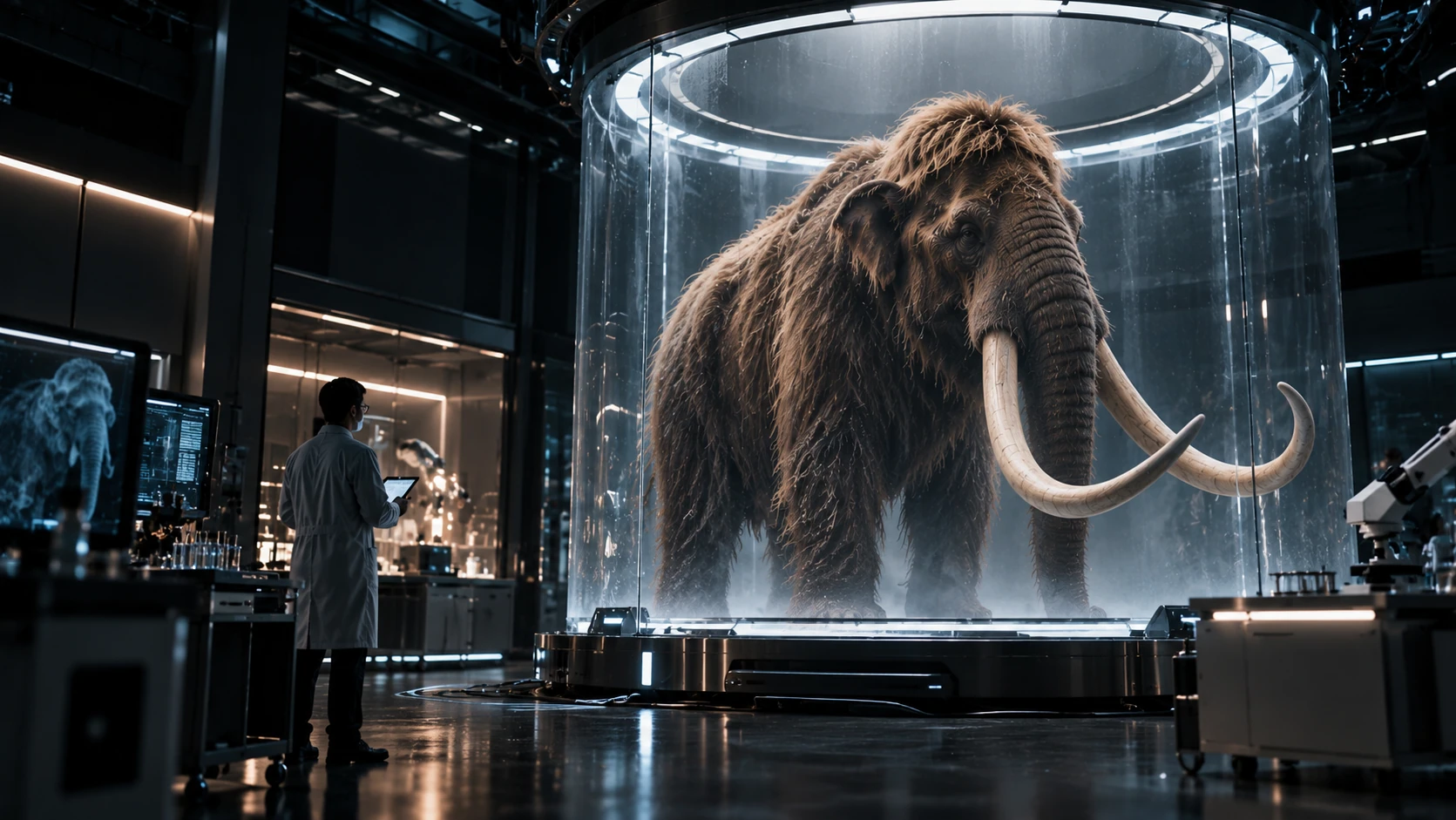
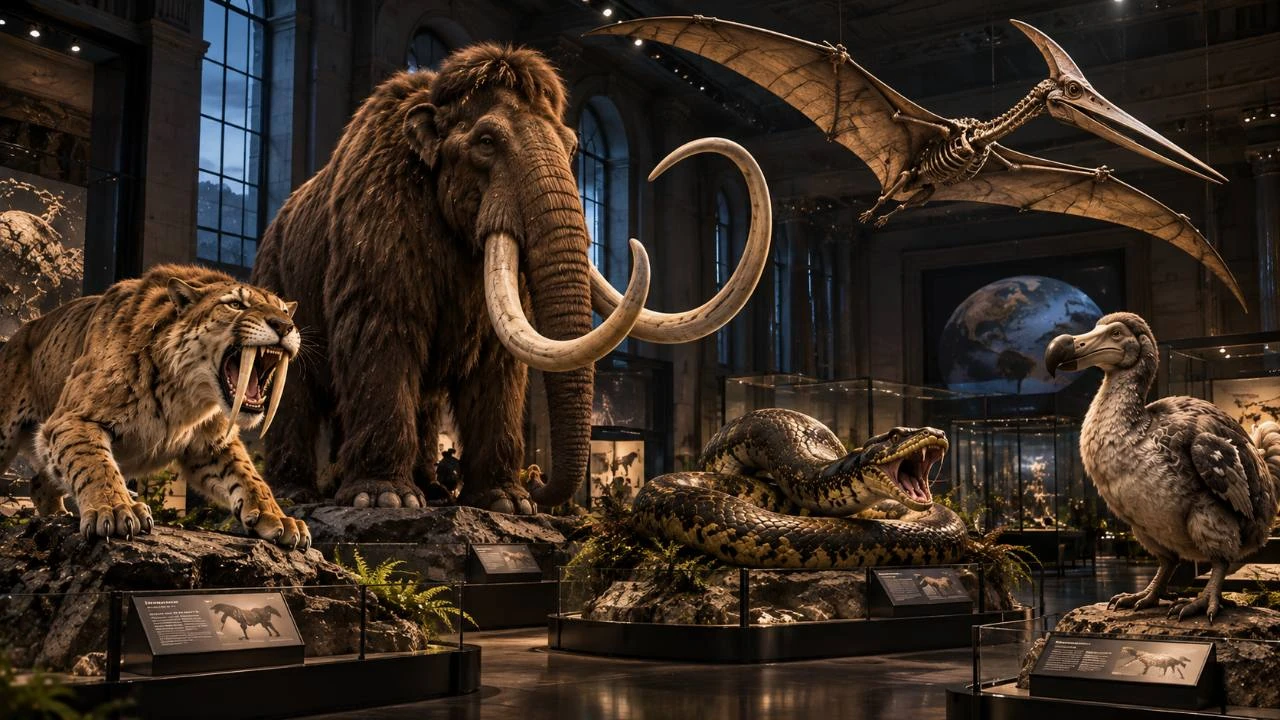
PRESDA AI-generated editorial illustration of extinct animals in an imagined museum. Not a photograph, a scientific reconstruction or a scene of animals that coexisted.
Extinction can leave a tooth, a skeleton, a photograph or a date in a keeper’s notebook. Each is a different kind of witness. Together they reveal a planet repeatedly transformed, sometimes by changes unfolding across geological ages, sometimes by human decisions within a few generations.
These twenty animals did not share one world or one fate. They include ancient genera, individual species and two extinct subspecies. Some vanished millions of years before humans existed. Others survived long enough to be photographed. Their stories show both the power of scientific reconstruction and its limits: finding an animal’s youngest known fossil rarely tells us the day the last individual died.
Reading the evidence
Dates below are approximate unless a documented individual is identified. A fossil occurrence is not automatically an extinction date, and a last captive death may follow the loss of wild populations. Skeletons on display may contain casts or reconstructed elements; historical illustrations record an artist’s interpretation. The images are identified accordingly. Extinction causes range from strongly documented hunting to competing hypotheses about climate, food webs and habitat change. No single explanation fits all twenty.
1. Smilodon
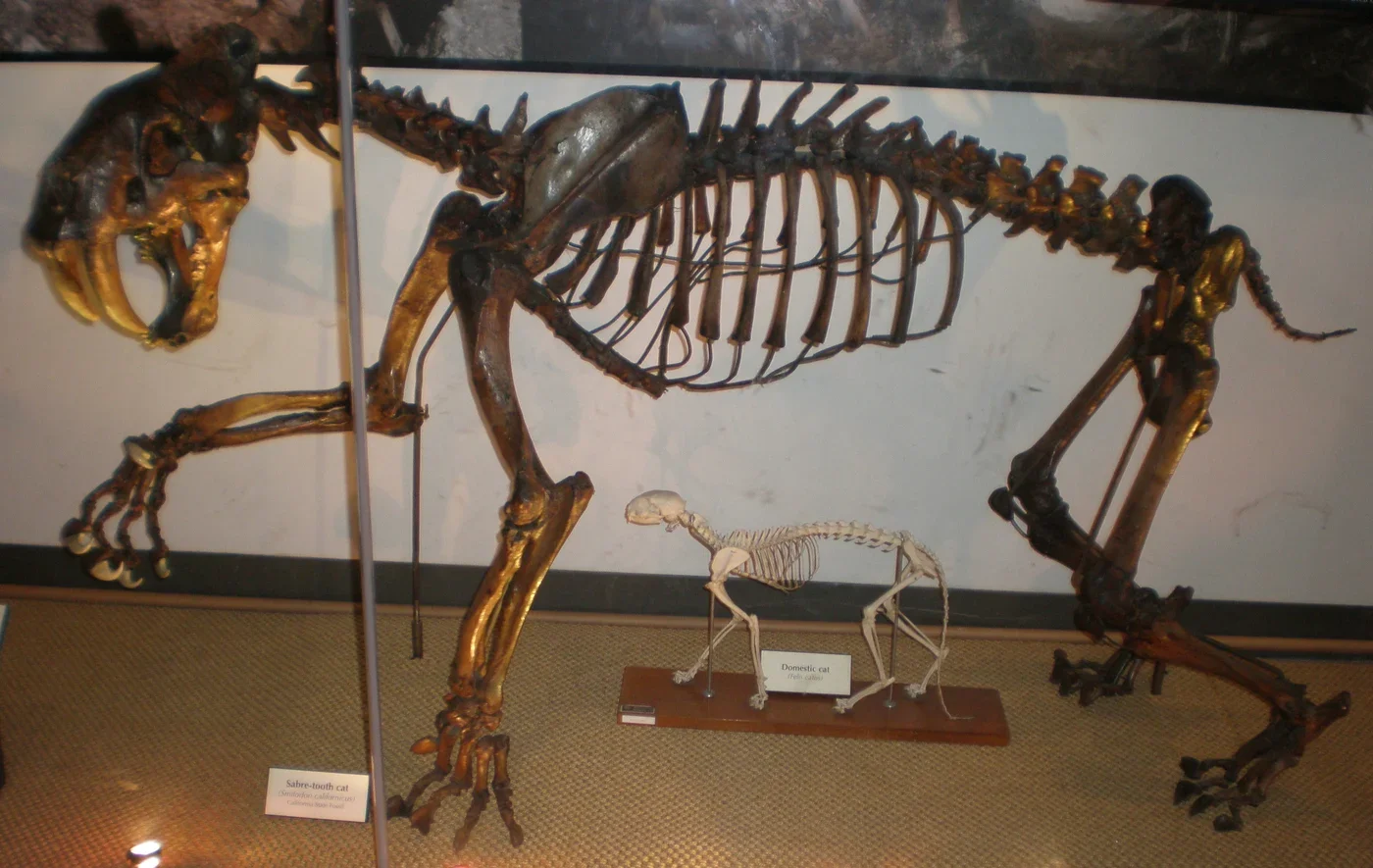
Mounted Smilodon skeleton at UC Berkeley, with a domestic cat skeleton for comparison. The historical label uses Smilodon californicus.
© BrokenSphere / Wikimedia Commons. Source and rights. CC BY-SA 3.0.
Resized and converted to WebP; no cropping or content changes.
Smilodon was a genus of saber-toothed cats, not a tiger. Its best-known species, Smilodon fatalis, inhabited the Americas during the Pleistocene, hunting in landscapes that included grasslands and woodland. The asphalt deposits at La Brea preserve an extraordinary sample of its bones. Powerful forelimbs and elongated upper canines suggest an animal built to restrain large prey before delivering a carefully placed bite. Those teeth were specialized tools, not evidence that it could bite indiscriminately through bone.
Smilodon disappeared near the end of the last Ice Age, broadly around 10,000 to 12,000 years ago, with dates differing among species and sites. Climatic and ecological disruption, losses of prey and human pressures form part of the debate. Fossil injuries that healed have prompted discussion of social support, but they do not establish that every Smilodon population lived in lion-like prides. A skeleton can document anatomy more securely than behavior. La Brea Tar Pits National Park Service
2. Megalodon
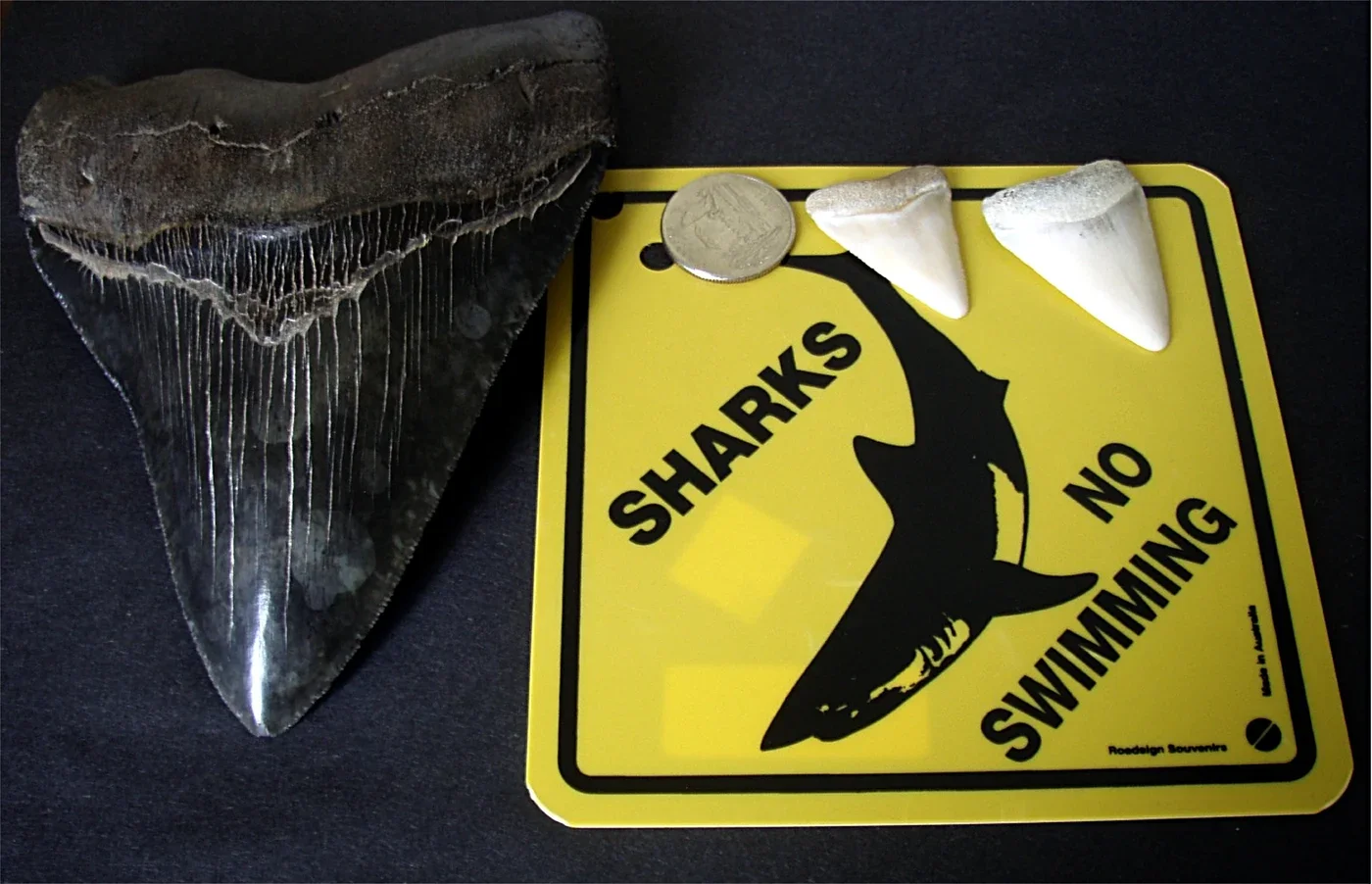
A megalodon tooth beside two great white shark teeth and a coin. This is a comparison of teeth, not complete body sizes.
Brocken Inaglory. Source and rights. CC BY-SA 3.0.
Resized and converted to WebP; no cropping or content changes.
Otodus megalodon was a giant predatory shark of the Miocene and Pliocene oceans. Its enormous teeth occur on several continents, along with rarer vertebral remains. Because a complete skeleton has not been recovered, estimates of its length and body shape depend on anatomical comparisons and models. A dramatic full-body reconstruction should therefore never be mistaken for a complete fossil discovery.
A reassessment of the fossil record placed its disappearance around 3.6 million years ago, earlier than some familiar older estimates. Changes in ocean ecosystems, prey availability and competition are investigated explanations, not a solved murder mystery. It hunted marine animals in seas very different from today’s. There is no credible evidence that living megalodons hide in the deep ocean. Its scientific fascination lies in reconstructing an extinct predator from fragmentary evidence, not in pretending that extinction never happened. PeerJ fossil-record reassessment
3. Titanoboa
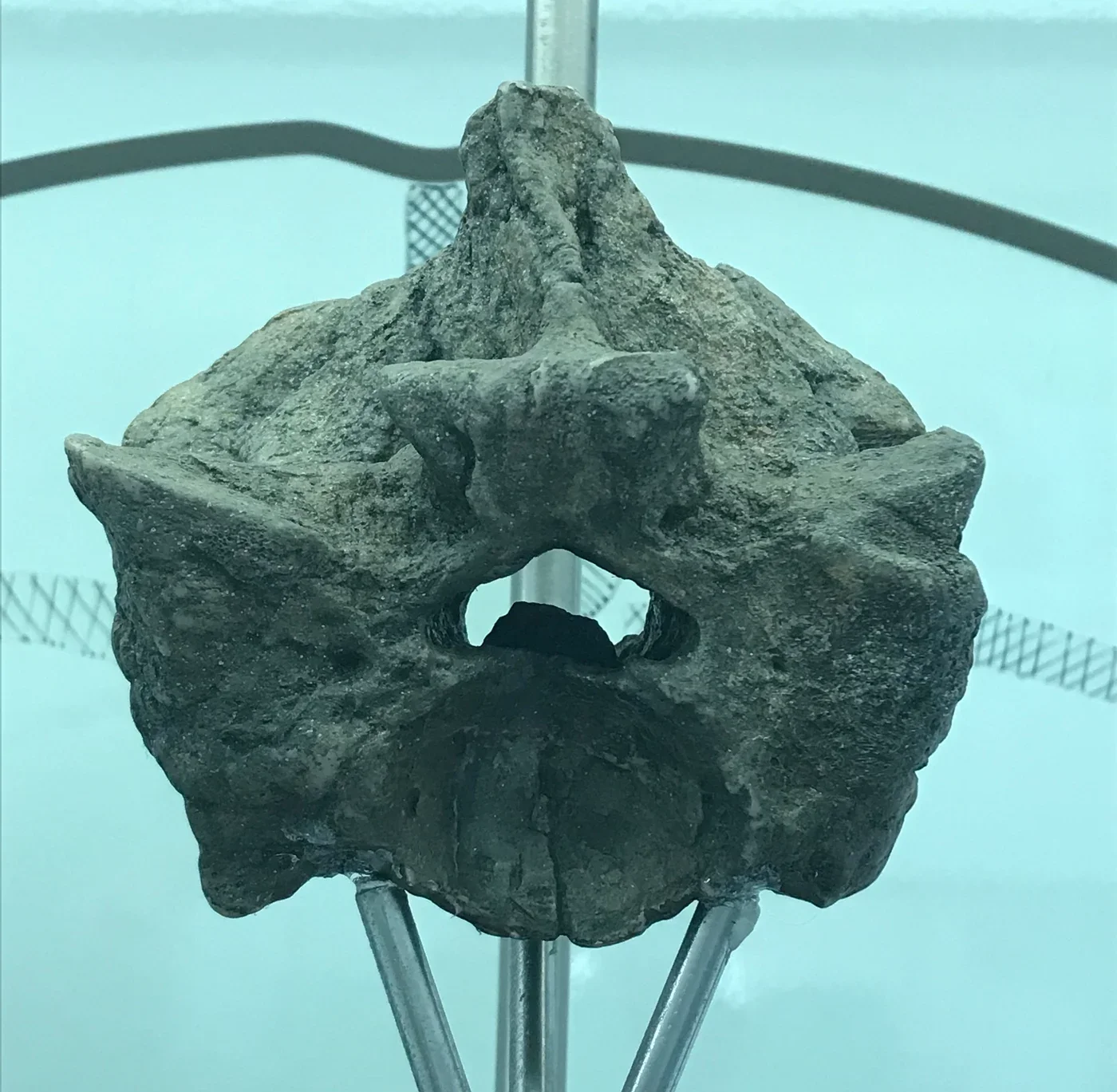
Titanoboa vertebra displayed at the José Royo y Gómez Geological Museum in Bogotá.
Anfecaro. Source and rights. CC0.
Resized and converted to WebP; no cropping or content changes.
Titanoboa cerrejonensis inhabited tropical environments in what is now Colombia roughly 58 to 60 million years ago, during the Paleocene. Fossils from the Cerrejón coal deposits include immense vertebrae. Comparisons with living snakes led researchers to estimate an animal around thirteen metres long, although reconstructions carry uncertainty. Its world was a warm, wet landscape with rivers, turtles and crocodile relatives, not a Jurassic scene populated by giant dinosaurs.
The bones also illuminate early tropical ecosystems after the end-Cretaceous extinction. Body size has been used to explore relationships between reptile biology and ancient temperature, but a snake is not a simple fossil thermometer. Crucially, the age of the known deposits is not an established date for Titanoboa’s extinction. Its precise disappearance and cause remain unresolved. That uncertainty belongs in the story alongside its extraordinary dimensions. Smithsonian discovery report
4. Megatherium
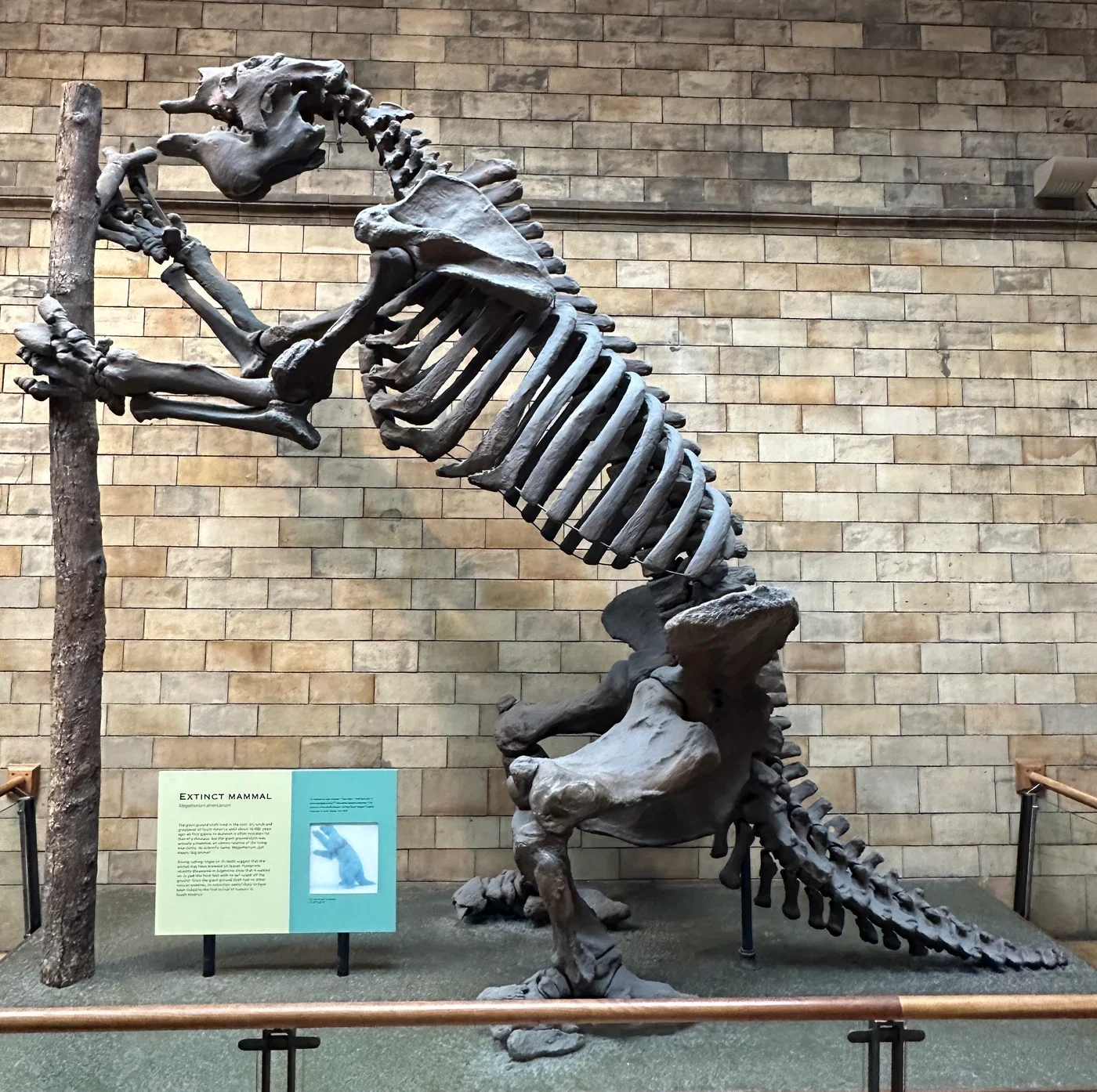
Mounted Megatherium americanum skeleton, Natural History Museum, London.
APK. Source and rights. CC BY 4.0.
Resized and converted to WebP; no cropping or content changes.
Megatherium americanum was an immense ground sloth of Pleistocene South America. Unlike living tree sloths, it moved on the ground, with a heavy skeleton, powerful limbs and large claws. It occupied open and wooded environments and fed on vegetation. Its bones helped nineteenth-century naturalists recognize that the world had once contained mammals fundamentally unlike those still alive around them.
Ground sloth fossils collected during Darwin’s voyage became part of that transformation in natural history. Megatherium disappeared around the transition from the Pleistocene to the Holocene, roughly 12,000 to 10,000 years ago. Human activity and changing environments are considered in explanations of South American megafaunal losses, but their relative contributions require evidence at particular sites. The great claws should not be read as proof of carnivory: structures used to obtain or manipulate plants can look formidable. Reconstructed posture and feeding movements remain testable biomechanical questions. Natural History Museum fossil research
5. Deinosuchus
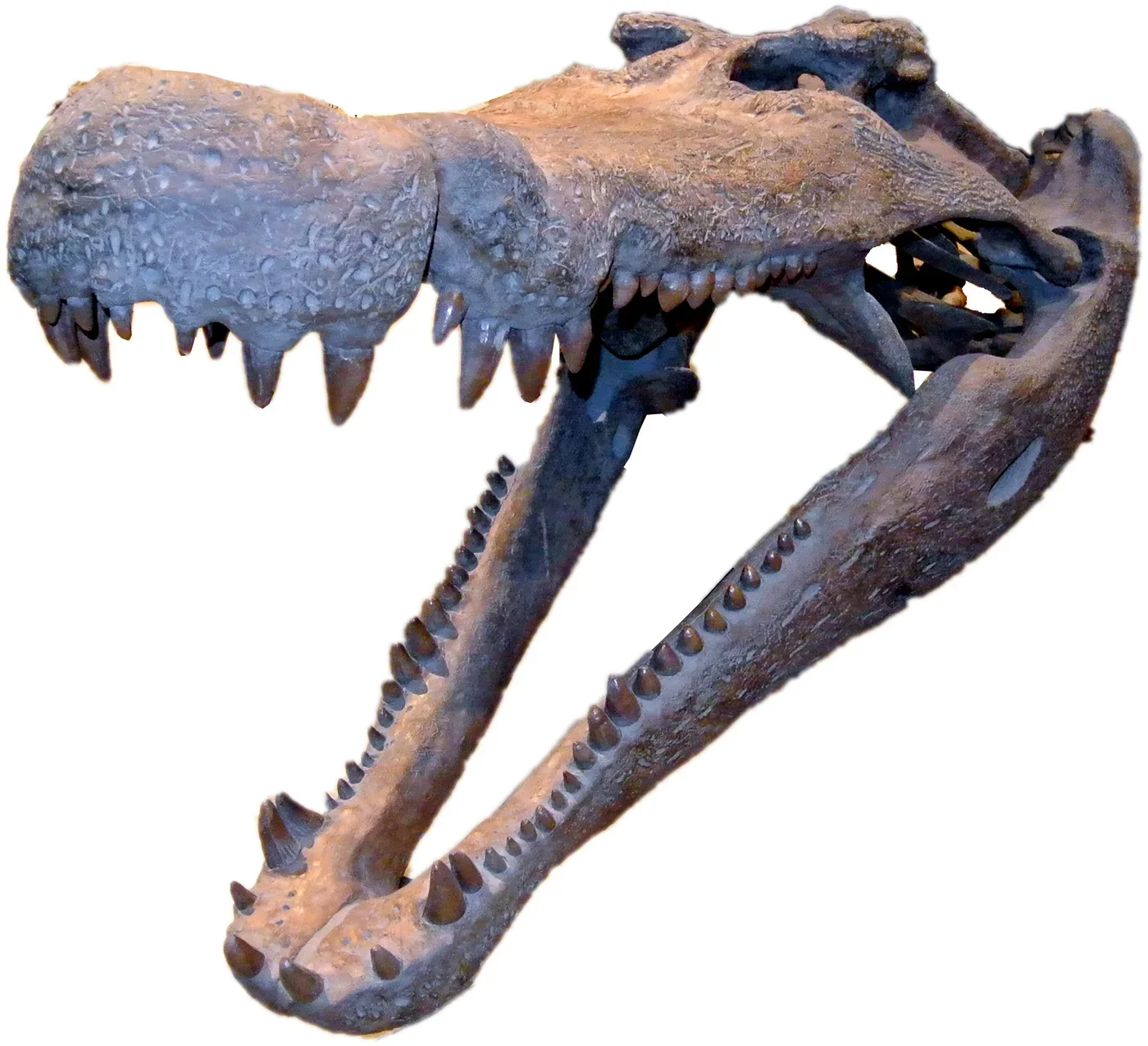
Deinosuchus hatcheri skull exhibit, Natural History Museum of Utah. Museum mounts may include restored elements.
Wilson44691. Source and rights. CC0.
Resized and converted to WebP; no cropping or content changes.
Deinosuchus was a giant crocodilian relative living along North American waterways and coastal environments during the Late Cretaceous. Its fossils include substantial skull material, teeth and armored skin bones called osteoderms. Different species have been recognized, including Deinosuchus hatcheri. Bite marks on other animals’ bones help establish its place in a food web that included dinosaurs, although a bite mark alone cannot always distinguish hunting from scavenging.
Its known record extends through part of the Campanian, approximately 82 to 75 million years ago. It should not automatically be assigned to the asteroid extinction 66 million years ago: its youngest known fossils are substantially older. The circumstances of its disappearance remain uncertain. Large reconstructed skulls also contain interpretive choices, which is why modern systematic revisions matter. They reassess the identity and relationships of specimens rather than simply making prehistoric predators larger. Peer-reviewed fossil study
6. Quetzalcoatlus
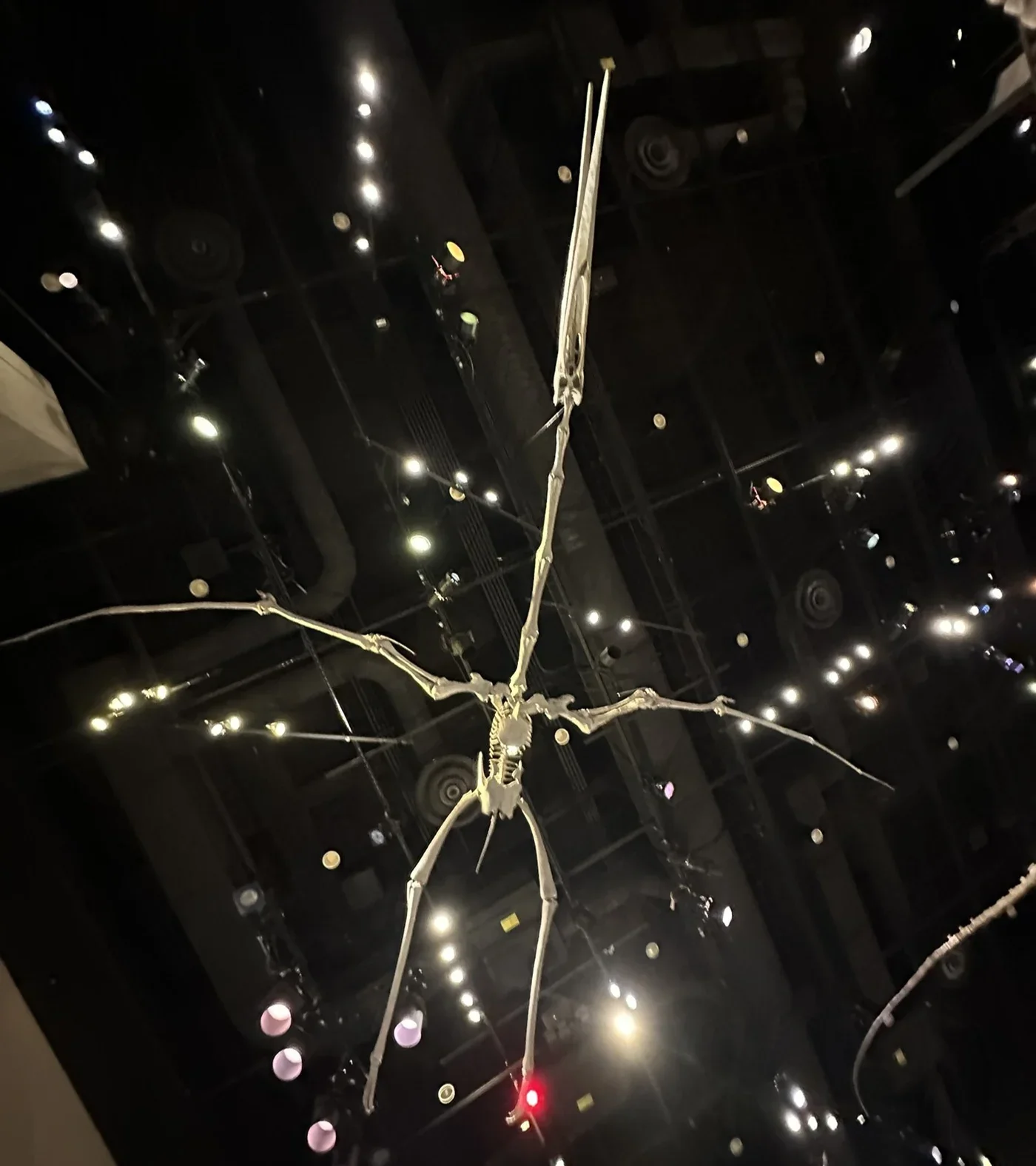
Quetzalcoatlus skeletal cast viewed from below at the Perot Museum. A reconstructed mount, not a complete original fossil.
Geekgecko. Source and rights. CC BY 4.0.
Resized and converted to WebP; no cropping or content changes.
Quetzalcoatlus northropi was an enormous azhdarchid pterosaur from the latest Cretaceous of North America. A pterosaur was a flying reptile, not a dinosaur or a bird. Fossils discovered in Texas in 1971 became the basis for one of paleontology’s most striking reconstructions: a long-necked animal with an estimated wingspan of about ten metres. The giant species is incompletely known, so comparisons with smaller, better-represented relatives are important.
Research on Quetzalcoatlus examines walking, feeding and launch mechanics, including how such a large animal could become airborne. Reconstructions suggest activity in terrestrial and wetland settings rather than a life spent exclusively soaring above the sea. The genus lived near the end of the Cretaceous, around 68 to 66 million years ago, and belongs to the pterosaur lineages lost at that period’s mass extinction. A museum mount makes an anatomical hypothesis visible; it does not remove the gaps in the fossil record. University of Texas research
7. Thylacine
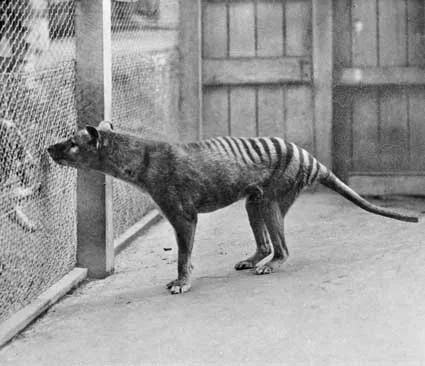
Historical photograph of a living thylacine at Hobart Zoo, 1933.
(Series relates to Australian Information Bureau and successor agencies). Source and rights. Public domain.
Resized and converted to WebP; no cropping or content changes.
Thylacinus cynocephalus, often called the Tasmanian tiger, was a carnivorous marsupial. Its stripes and dog-like outline concealed an evolutionary history quite separate from cats and dogs. Fossils show a former distribution beyond Tasmania, but the island became its final refuge. Historical photographs, film, skins and preserved specimens provide evidence unavailable for most prehistoric animals.
The last known captive thylacine died at Hobart’s Beaumaris Zoo on 7 September 1936. That is a documented death, not proof that every wild individual vanished on the same day. Persecution, including bounty hunting, played a central role in its decline; habitat disruption and other pressures also mattered. Persistent reported sightings have not established a surviving population. Its story is especially painful because people recorded the animal’s movements and appearance while failing to secure its future. Protection arrived when the population was already catastrophically depleted. National Museum of Australia
8. Dodo
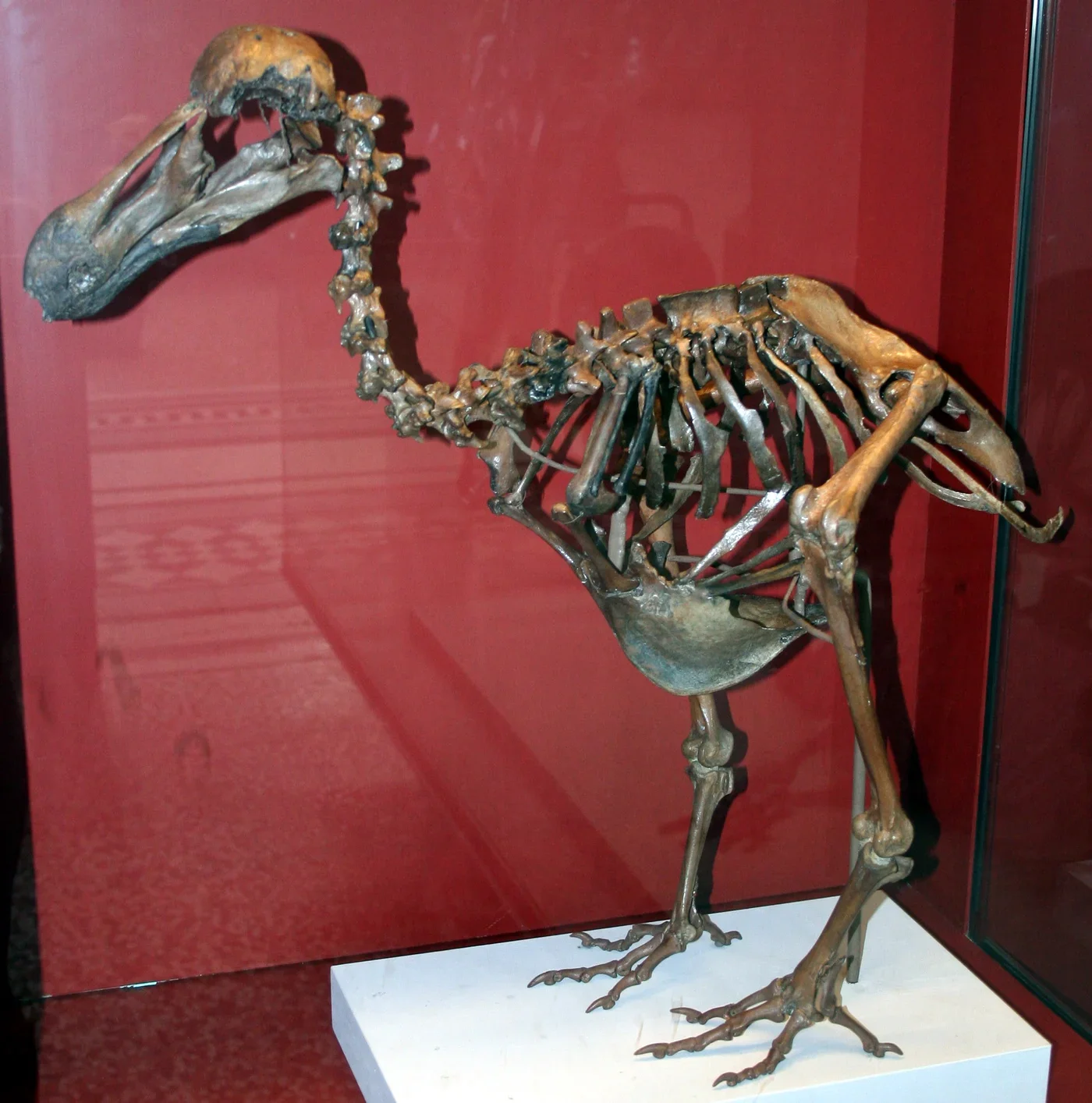
Dodo skeletal display, Natural History Museum, London. A museum skeleton, not a photograph of the living bird.
Heinz-Josef Lücking. Source and rights. CC BY-SA 2.5.
Resized and converted to WebP; no cropping or content changes.
Raphus cucullatus was a large flightless pigeon endemic to Mauritius. It evolved in an island ecosystem without the mammalian predators later introduced by people. Bones from deposits such as Mare aux Songes, early descriptions and historical artwork help reconstruct its anatomy and environment. Images vary, and the familiar overweight caricature should not be treated as an exact portrait of every living dodo.
The bird disappeared in the seventeenth century, with 1662 commonly cited as the last widely accepted sighting. The precise extinction year is uncertain. Hunting, introduced animals and disruption of its island habitat combined to make survival increasingly difficult. Calling the dodo foolish substitutes a moral judgment for ecology: behavior that had worked in one environment became dangerous in another. Its loss illustrates how rapidly an endemic species can disappear when people transform an island’s relationships among predators, prey and plants. Natural History Museum
9. Great Auk
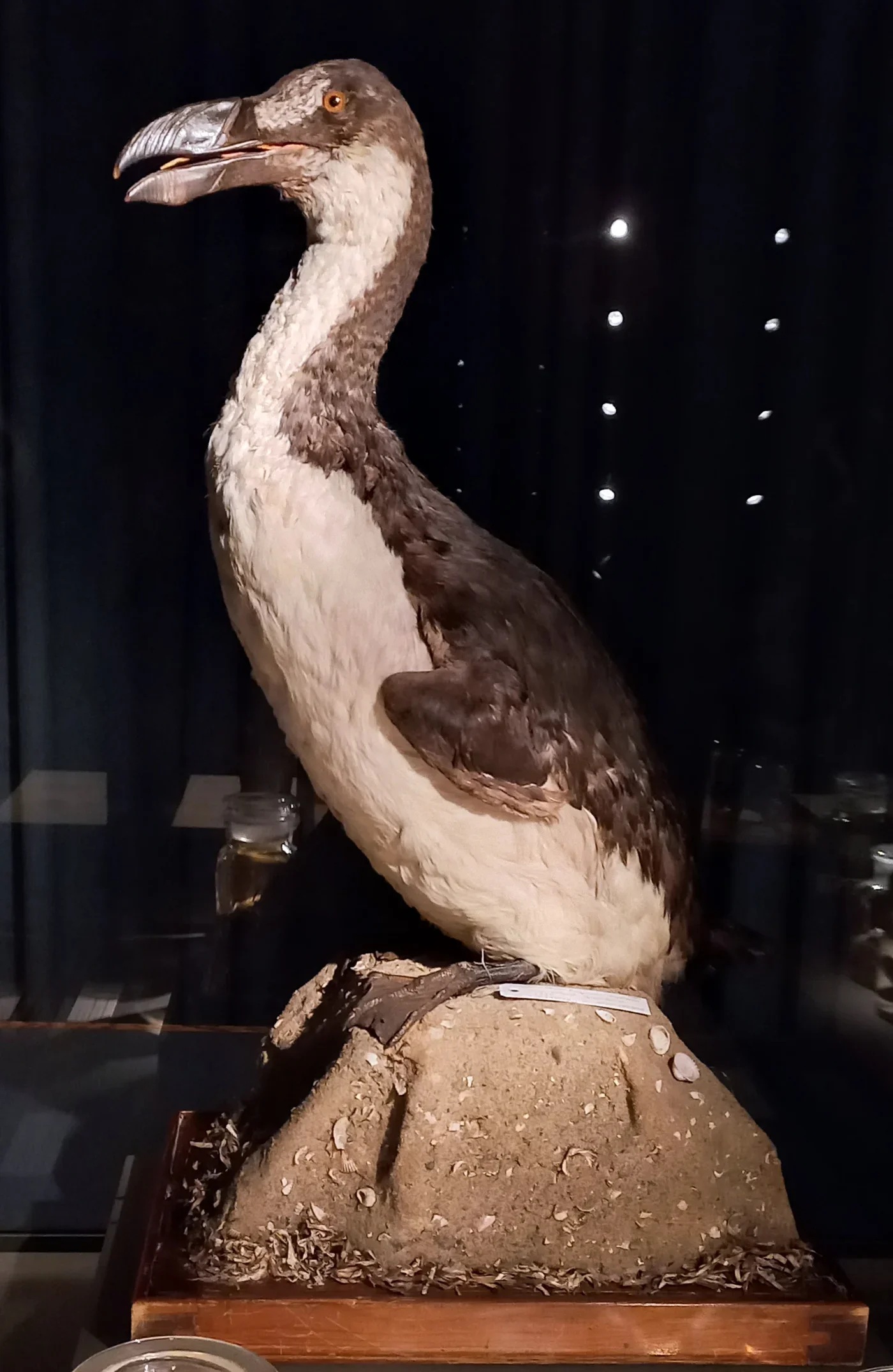
Preserved great auk in winter plumage, collected in Greenland in 1815; Natural History Museum of Denmark.
FunkMonk. Source and rights. CC BY-SA 4.0.
Resized and converted to WebP; no cropping or content changes.
Pinguinus impennis was a flightless seabird of the North Atlantic, adapted to swimming rather than flying. It bred on rocky islands and came ashore to reproduce, making dense breeding colonies accessible to hunters. Bones, eggs, skins and historical accounts document a bird sometimes confused with penguins, despite belonging to a different lineage in the Northern Hemisphere.
The last confirmed breeding pair was killed on Eldey, off Iceland, in 1844. Later reports complicate the exact date of final disappearance, but not the conclusion that the species is extinct. Exploitation for meat, feathers and other products depleted its populations. As rarity increased, demand for specimens and eggs added another pressure. Collecting could preserve evidence of an animal while helping destroy its living population. The great auk’s museum presence is therefore both a scientific resource and a record of how scarcity can make wildlife more vulnerable. Natural History Museum
10. Passenger Pigeon
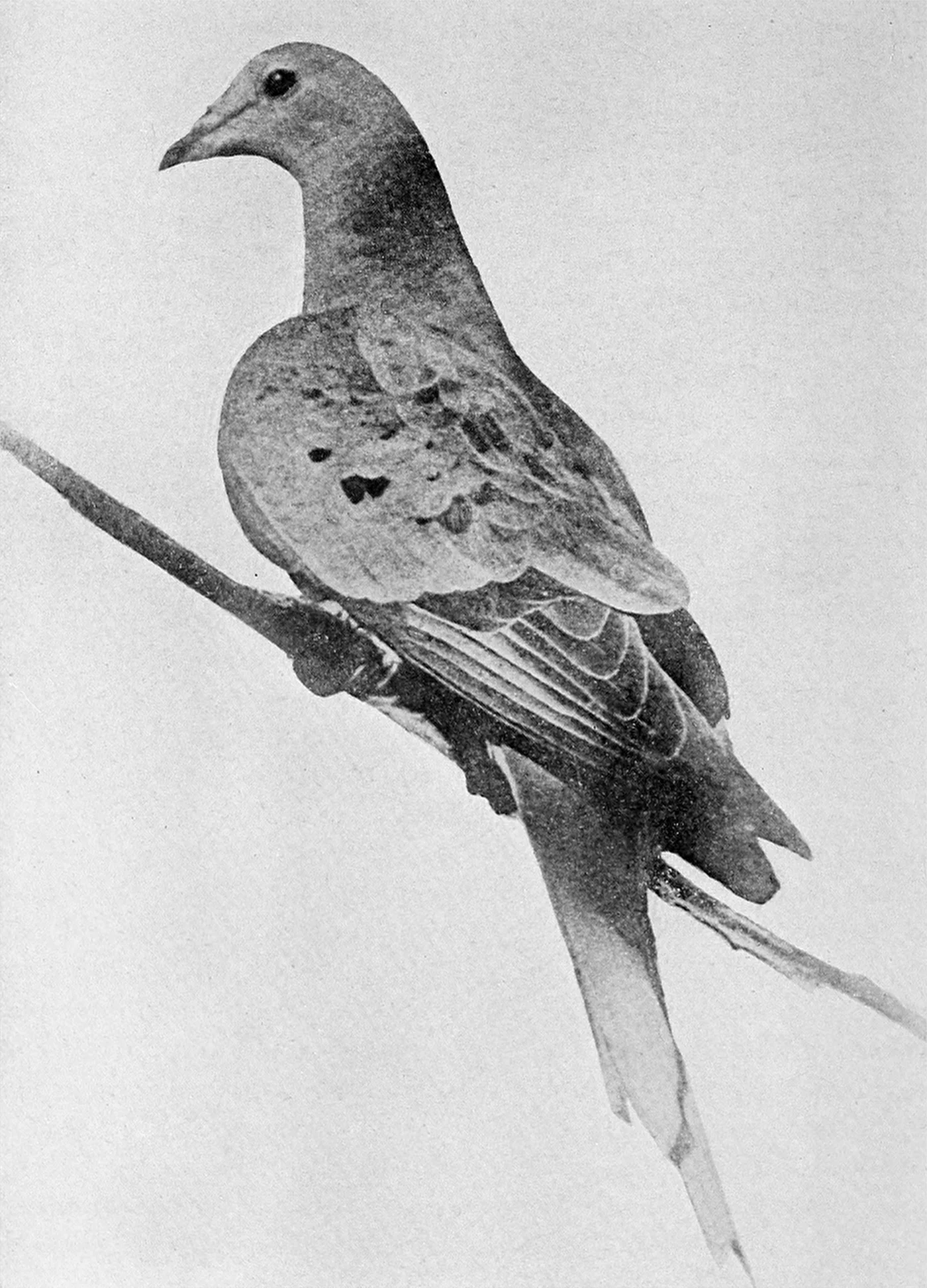
Martha, the last known passenger pigeon, photographed in 1912 by Enno Meyer.
Enno Meyer. Source and rights. Public domain.
Resized and converted to WebP; no cropping or content changes.
Ectopistes migratorius once formed immense flocks in North American forests. Its abundance made disappearance seem implausible, yet commercial hunting and forest clearance dismantled the conditions supporting those flocks. This was a highly social bird; conserving a few isolated individuals could not simply reproduce the ecological circumstances of its former colonies.
Martha, the last known passenger pigeon, died at Cincinnati Zoo on 1 September 1914. Her preserved body became a Smithsonian specimen. Here the archive contains an individual name and a precise date, but the larger event was the preceding collapse of wild populations and their reproductive networks. Historic descriptions of abundance deserve attention without turning every dramatic numerical estimate into a census. The central lesson needs no inflated statistic: a widespread species can decline beyond recovery when exploitation outpaces reproduction and its habitat is simultaneously reduced. Smithsonian Institution
11. Steller’s Sea Cow
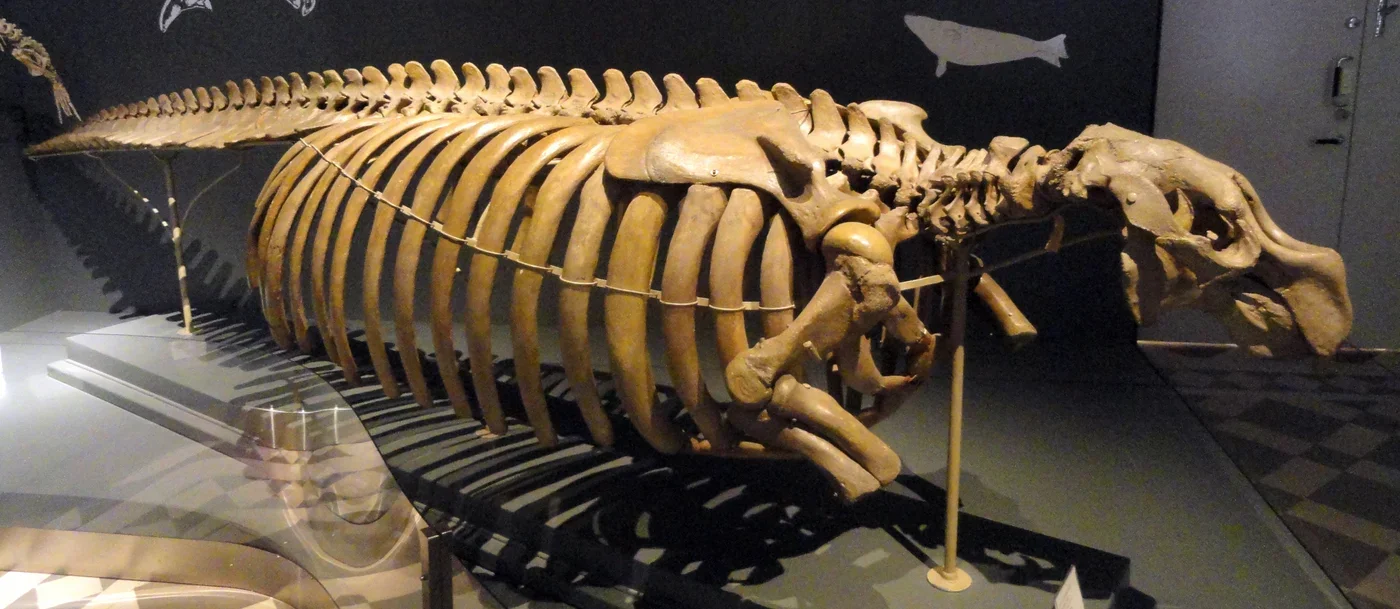
Steller’s sea cow skeletal display, Finnish Museum of Natural History, Helsinki.
Daderot. Source and rights. CC0.
Resized and converted to WebP; no cropping or content changes.
Hydrodamalis gigas was a huge herbivorous marine mammal related to living dugongs and manatees. By the time Georg Wilhelm Steller described it in 1741, a remnant population occupied coastal waters around the Commander Islands in the North Pacific. It fed in shallow marine environments associated with kelp. Skeletons and Steller’s observations are especially important because its living anatomy was poorly documented.
The last generally accepted records date to 1768, only twenty-seven years after the European encounter. Hunting by maritime expeditions was devastating. Research has also considered ecological interactions and the vulnerability of an already restricted population. The earlier fossil record indicates a broader history than those final islands alone suggest. Its extinction was not the inevitable fate of a cumbersome animal: exploitation reached a population with limited capacity to replace losses. Preserved ribs and skulls now stand in for a marine presence that human observers barely had time to study. Extinction-modeling research
12. Quagga
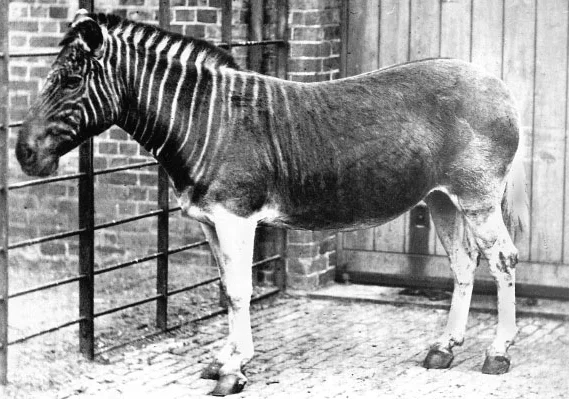
Historical photograph of a living quagga mare at London Zoo.
Frederick York (d. 1903). Source and rights. Public domain.
Resized and converted to WebP; no cropping or content changes.
Equus quagga quagga was a southern African subspecies of the plains zebra, with strong striping toward the front and a much less striped hindbody. Its grassland habitat overlapped with expanding pastoral and colonial economies. Hunting for products and competition with livestock contributed to its destruction. Historical photographs make its distinctive appearance tangible, although photographs cannot capture the full genetic diversity of a vanished population.
The last captive quagga died in Amsterdam in 1883. Other plains zebra subspecies survive, an essential distinction when discussing its extinction. DNA research helped establish its close relationship to them. Selective breeding can produce living zebras with quagga-like coat patterns, but recreating a visible trait is not the same as restoring the original extinct population, its entire genetic heritage and its ecological history. The animal is a useful reminder that names, ancestry and resemblance answer different biological questions. Quagga Project background and taxonomy
13. Irish Elk
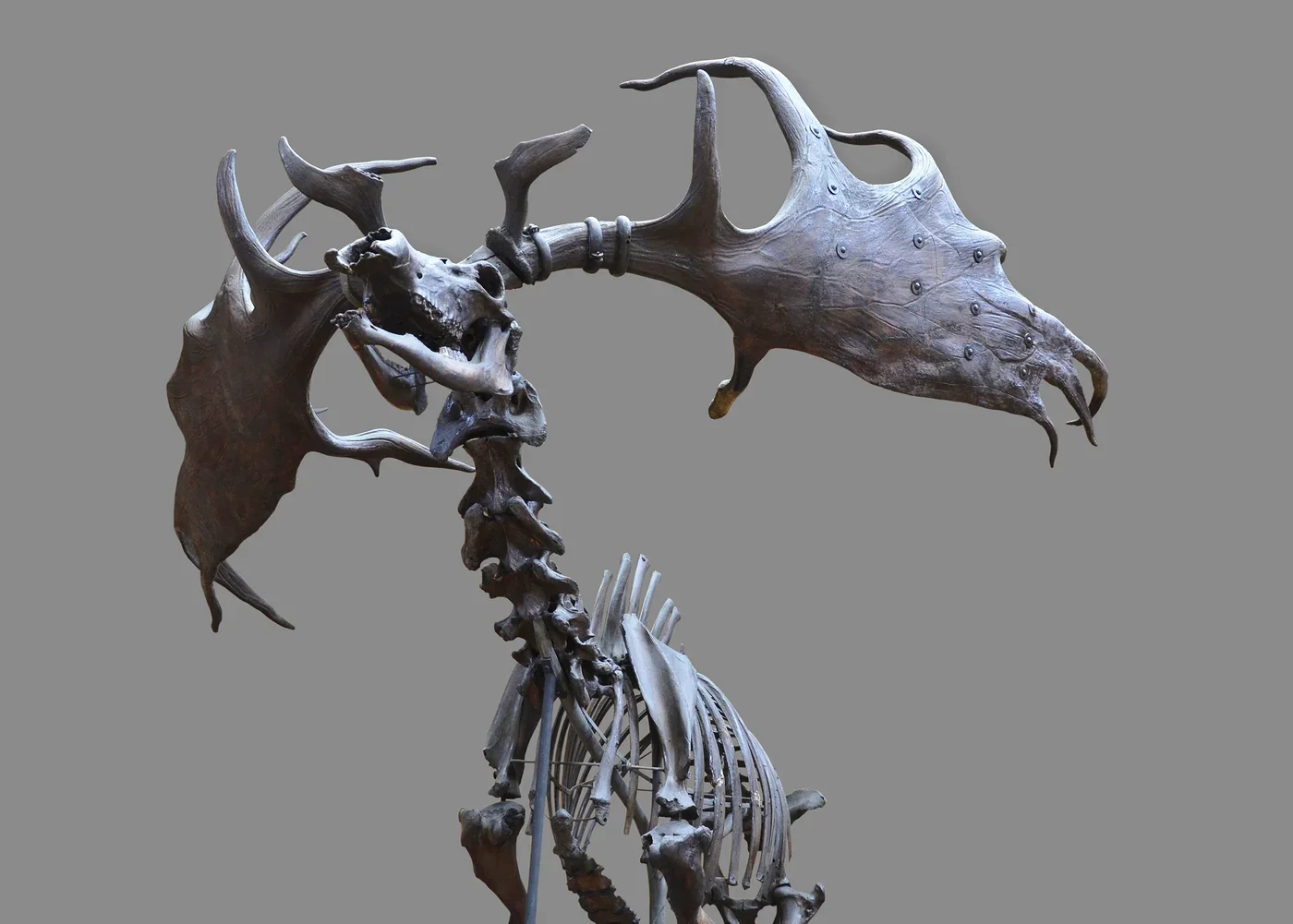
Detail of a Megaloceros giganteus skeletal mount in Paris, showing the skull and broad antlers.
Vassil. Source and rights. CC0.
Resized and converted to WebP; no cropping or content changes.
Megaloceros giganteus was a giant deer distributed across much of Eurasia, not an animal confined to Ireland and not an elk in the strict taxonomic sense. Males carried exceptionally broad antlers, sometimes spanning about 3.5 metres. Skeletons, teeth, ancient DNA and cave art provide complementary evidence of its body, diet and relationships. It inhabited grassland and open woodland landscapes.
Many European populations disappeared around 12,000 years ago, but later remains show survival in Russia until roughly 8,000 years ago. Changing vegetation and climate likely altered food availability and suitable habitat; human pressures may also have contributed. The simplistic idea that its antlers merely grew too large misses the ecological context. Antlers were renewed seasonally and demanded resources, so their costs depended on environmental conditions. Its uneven disappearance across regions demonstrates why one local last fossil should not be used as a global extinction date. Natural History Museum
14. Arthropleura
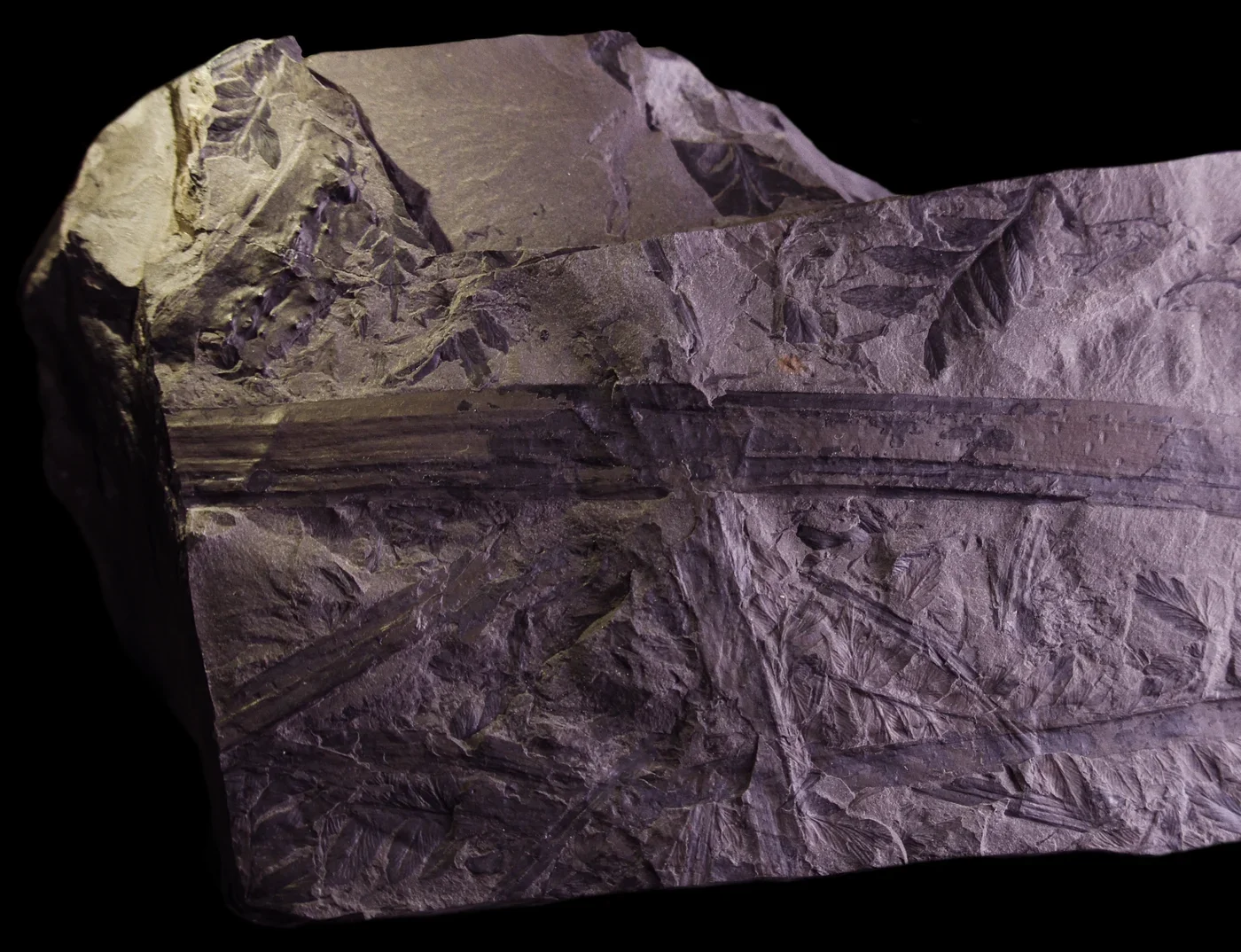
An Arthropleura dorsal plate fossil from Carboniferous Poland, surrounded by plant impressions. Not a complete animal.
Prehistorica CM. Source and rights. CC BY 4.0.
Resized and converted to WebP; no cropping or content changes.
Arthropleura was a genus of giant many-legged arthropods from the Carboniferous and early Permian, roughly 346 to 290 million years ago. Fossils and trackways from Europe and North America reveal animals far larger than living terrestrial millipedes. Some size estimates exceed two metres, but they depend on incomplete remains. It occupied vegetated terrestrial environments during a period of profound change in land ecosystems.
Newly studied juvenile head fossils have clarified its combination of anatomical features and relationships within the millipede-centipede branch. Diet remains debated; it should not automatically be illustrated as a giant carnivorous centipede. Nor is elevated atmospheric oxygen a complete explanation of its size. Its eventual disappearance is associated with a changing geological world, but no single demonstrated extinction mechanism is established. A small fossil head can transform understanding of an enormous animal more effectively than a spectacular unsupported reconstruction. Science Advances anatomical study
15. Dunkleosteus
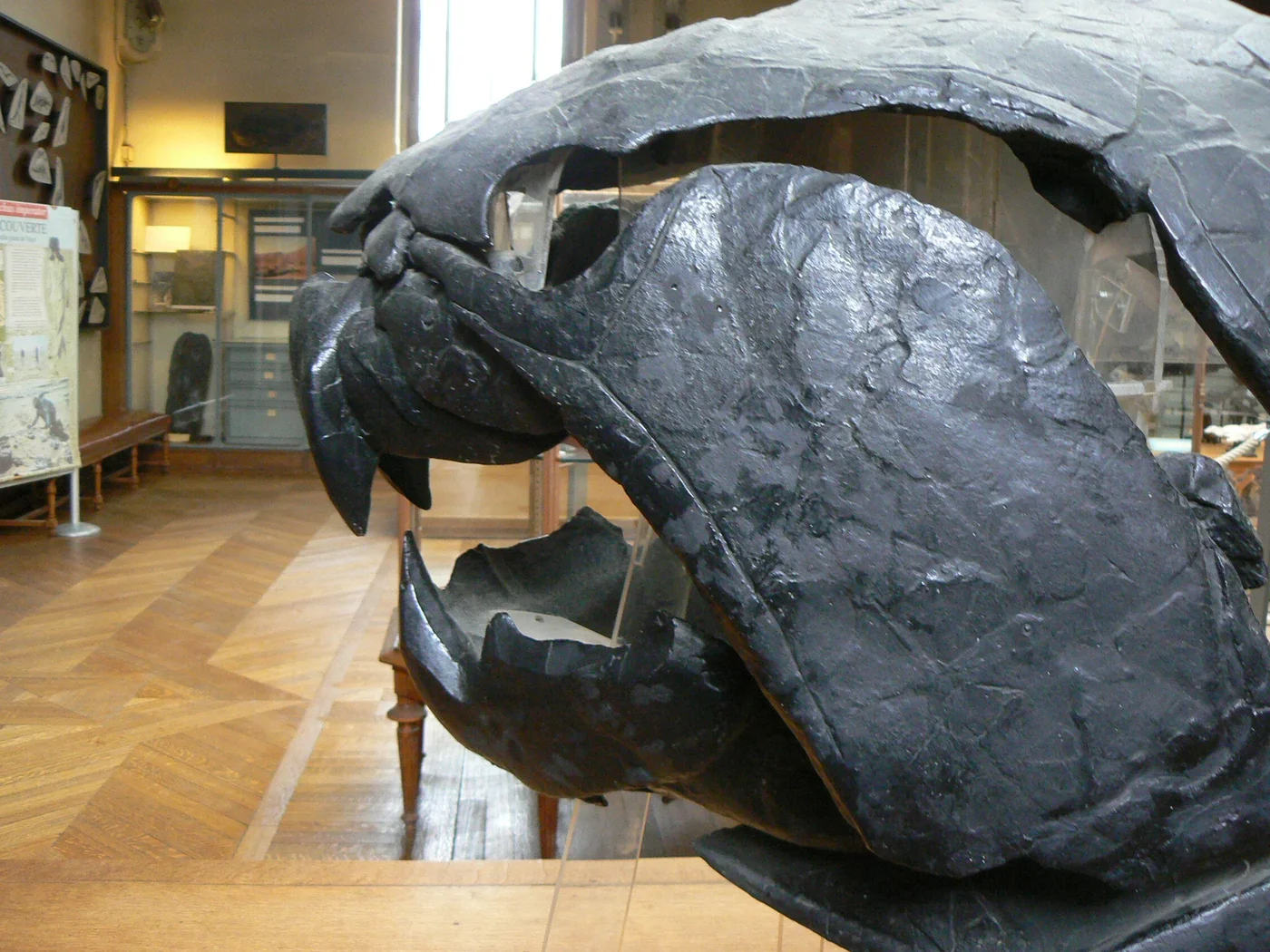
Side view of a Dunkleosteus skull exhibit, showing the armored head and cutting jaw edges.
LadyofHats. Source and rights. Public domain.
Resized and converted to WebP; no cropping or content changes.
Dunkleosteus terrelli was an armored placoderm fish of Late Devonian seas, around 360 million years ago. Its fossil head and thoracic armor are particularly well represented in the Cleveland Shale of Ohio. Sharp bony jaw edges performed cutting work rather than rows of ordinary shark-like teeth. The heavily armored front of the body is much better known than the soft tissues and tail behind it.
That imbalance matters. A 2023 anatomical study proposed substantially shorter, stockier body proportions than many familiar reconstructions, showing how uncertain total-length estimates can be when based chiefly on skulls. It disappeared during the Late Devonian interval of major marine ecological disruption. Environmental changes, including oxygen-poor seas, are investigated in that wider crisis, but the final death of this species cannot be reconstructed as a witnessed event. Its fame survives scientific revision: a more defensible body estimate makes it better understood, not less remarkable. Case Western Reserve University
16. Helicoprion
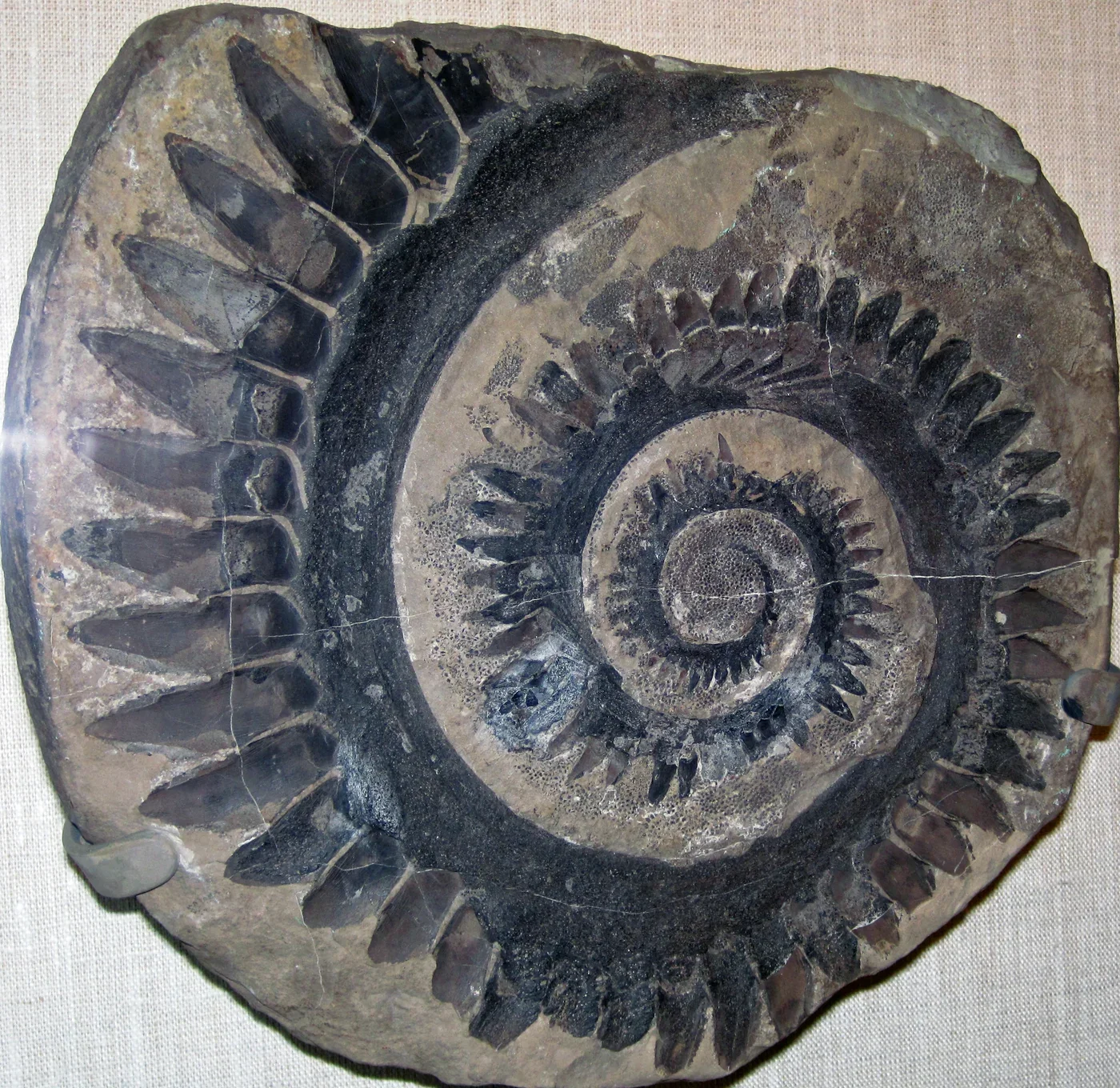
Helicoprion tooth whorl from Permian Idaho, displayed at the Utah Field House of Natural History.
James St. John. Source and rights. CC BY 2.0.
Resized and converted to WebP; no cropping or content changes.
Helicoprion was a Permian cartilaginous fish whose spiral tooth whorl baffled researchers for generations. Species such as Helicoprion bessonowi are known largely from these durable dental structures, with important material from regions including Idaho. It lived in marine environments roughly 290 to 270 million years ago. Despite frequent use of the word shark, its evolutionary position is closer to the lineage containing living chimaeras than to modern sharks.
Imaging of rare specimens helped place the whorl in the lower jaw, replacing older reconstructions that put it in improbable positions. As new teeth formed, older ones remained within the expanding spiral. Feeding mechanics are reconstructed from anatomy, not observed behavior. The sparse record does not provide an exact extinction date or a securely identified cause, and its disappearance should not casually be equated with the much later end-Permian mass extinction. A puzzling tooth structure became an example of how scientific interpretations can be corrected by better evidence. Idaho Museum of Natural History
17. Woolly Rhinoceros
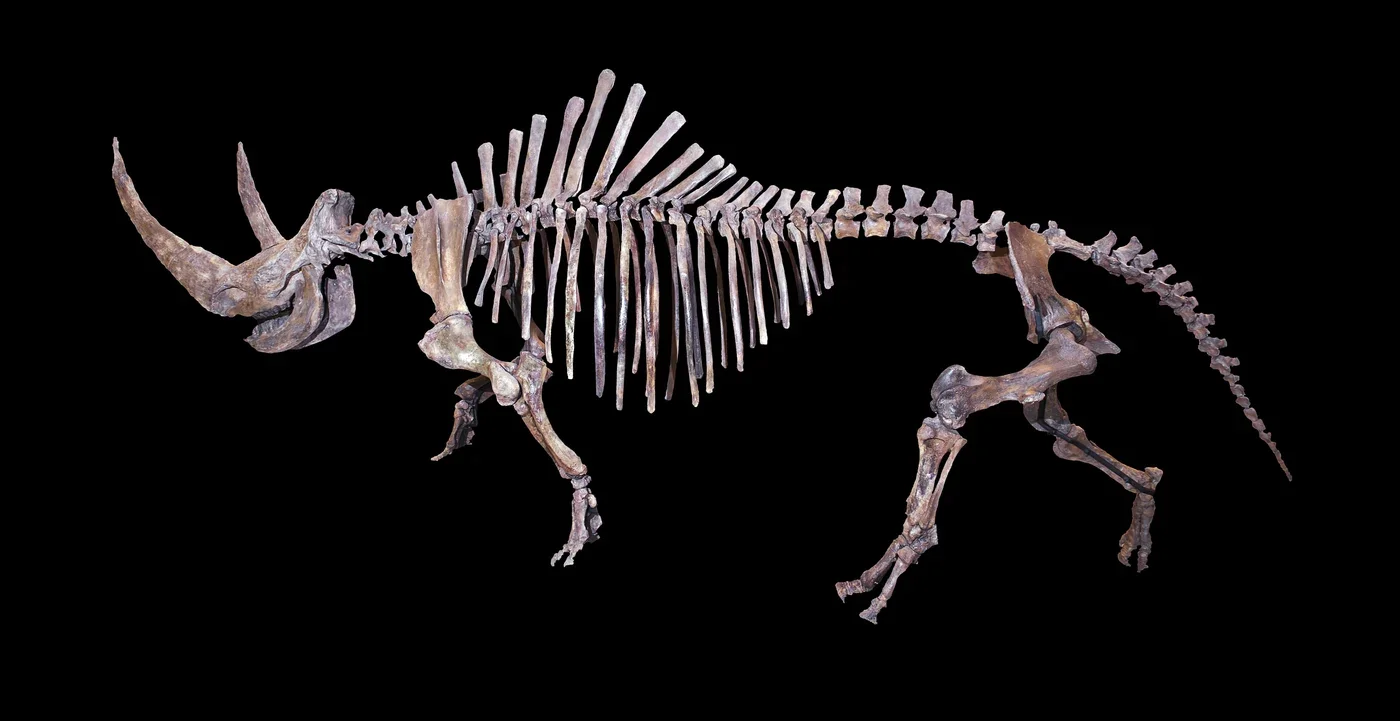
Woolly rhinoceros skeletal mount, Muséum de Toulouse.
Didier Descouens. Source and rights. CC BY-SA 4.0.
Resized and converted to WebP; no cropping or content changes.
Coelodonta antiquitatis was a cold-adapted rhinoceros of Pleistocene Eurasia. Its thick coat, grazing teeth and substantial horns suited the open environments often called the mammoth steppe. Fossils, frozen remains and prehistoric artwork preserve different aspects of its appearance. Ancient DNA adds information about population history that bones alone cannot provide.
It disappeared around 14,000 years ago. A genomic study found evidence of demographic stability until relatively close to extinction, challenging a simple narrative of a long, continuous decline caused only by people. Rapid warming and resulting habitat changes are important explanations, while the interaction with hunting continues to be examined. Neither a genome nor a climate curve is a complete account of every population. The woolly rhinoceros demonstrates the value of combining evidence: dating, habitat reconstruction and genetics can test explanations that a dramatic extinction scene merely assumes. Current Biology genomic study
18. Haast’s Eagle
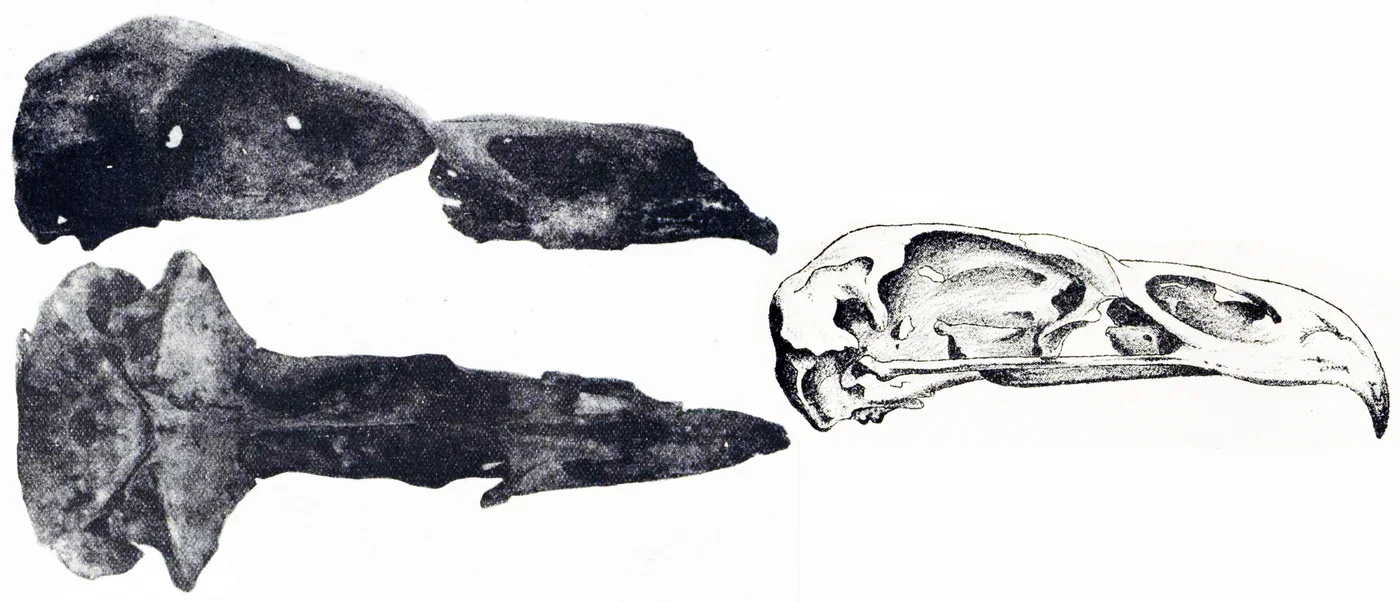
Historical scientific plate of Haast’s eagle skull material, published in Transactions of the Royal Society of New Zealand in 1892.
Transactions and Proceedings of the Royal Society of New Zealand. Source and rights. Public domain.
Resized and converted to WebP; no cropping or content changes.
Hieraaetus moorei, also known in older literature as Harpagornis moorei, was the giant eagle of New Zealand’s South Island. Bones and powerful talons reveal a predator adapted to attacking large birds, including moa. Its importance lies not simply in size but in the unusual ecological setting of an island where birds occupied roles filled elsewhere by terrestrial mammals.
It disappeared approximately five to six centuries ago, broadly alongside the loss of moa after human settlement. The removal of major prey and changes to habitat offer compelling explanations, although the final population was not monitored. Fossil injuries and anatomy help reconstruct predatory behavior without justifying every modern story about it. An eagle and its prey cannot be conserved as unrelated objects: their relationship is part of the ecosystem. Haast’s eagle makes that dependence visible even after both sides of the food web have vanished. New Zealand Birds Online
19. Moa
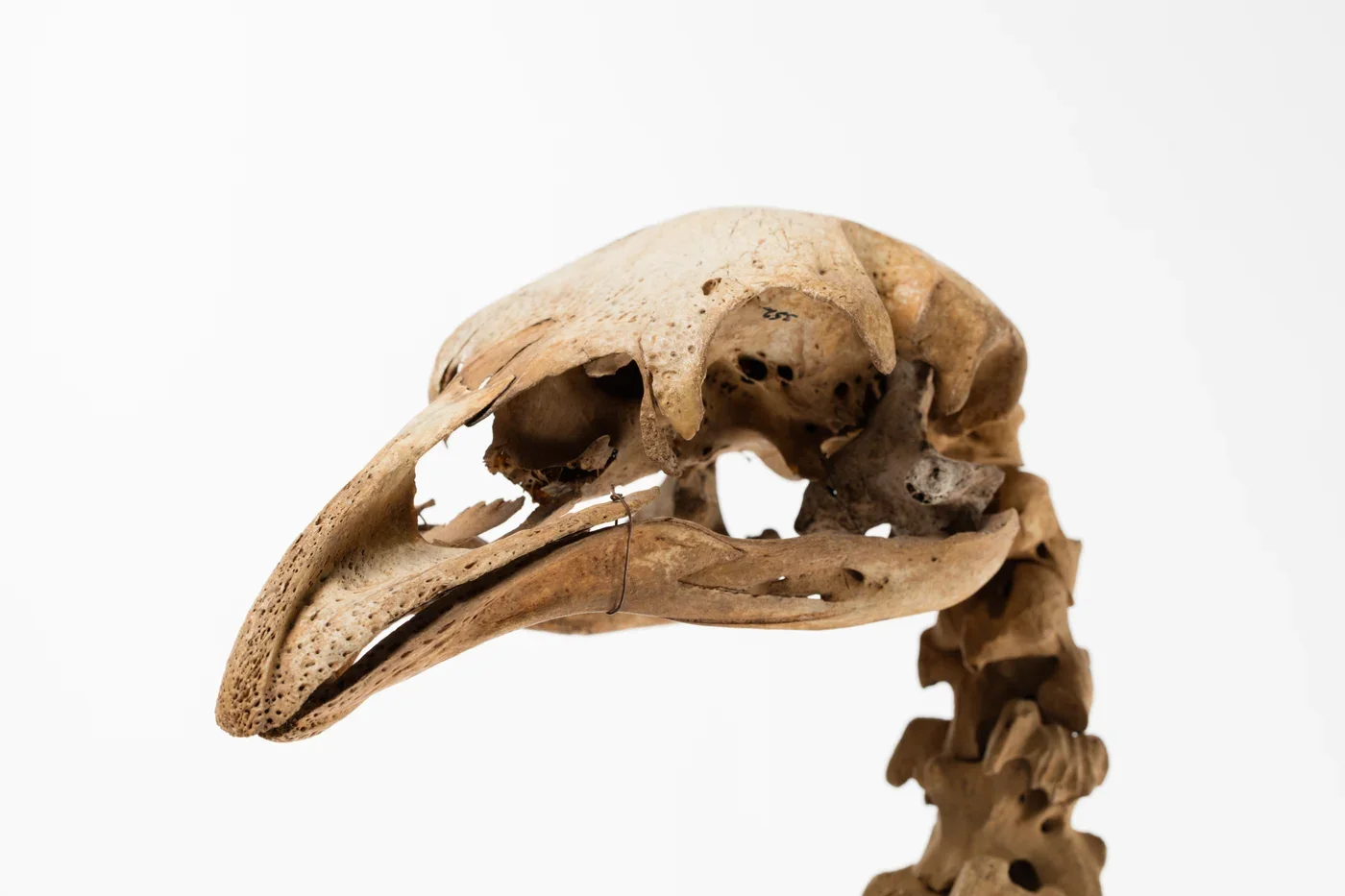
Skull of the South Island giant moa, Dinornis robustus, specimen AM LB723, Auckland Museum. This represents one of nine moa species.
Auckland War Memorial Museum Tāmaki Paenga Hira. Source and rights. CC BY 4.0.
Resized and converted to WebP; no cropping or content changes.
Moa were not a single species. These flightless New Zealand birds comprised nine recognized species in several genera, including Dinornis robustus, the South Island giant moa. They occupied environments from forest to grassland and upland habitats. Bones, eggshell, feathers and preserved dung reveal anatomy, nesting and diets; archaeological deposits also document their exploitation by people.
The various moa disappeared after Polynesian settlement, largely by the fifteenth century, through hunting and habitat change. Species differed greatly in size, so the tallest giant moa should not stand in for every member of the group. Females could be much larger than males, a difference that once complicated classification. Their disappearance transformed vegetation and removed the main prey base of Haast’s eagle. Moa show why extinction is more than subtraction from a species list: it changes browsing, seed movement, predation and the future development of entire landscapes. New Zealand Birds Online
20. Pyrenean Ibex
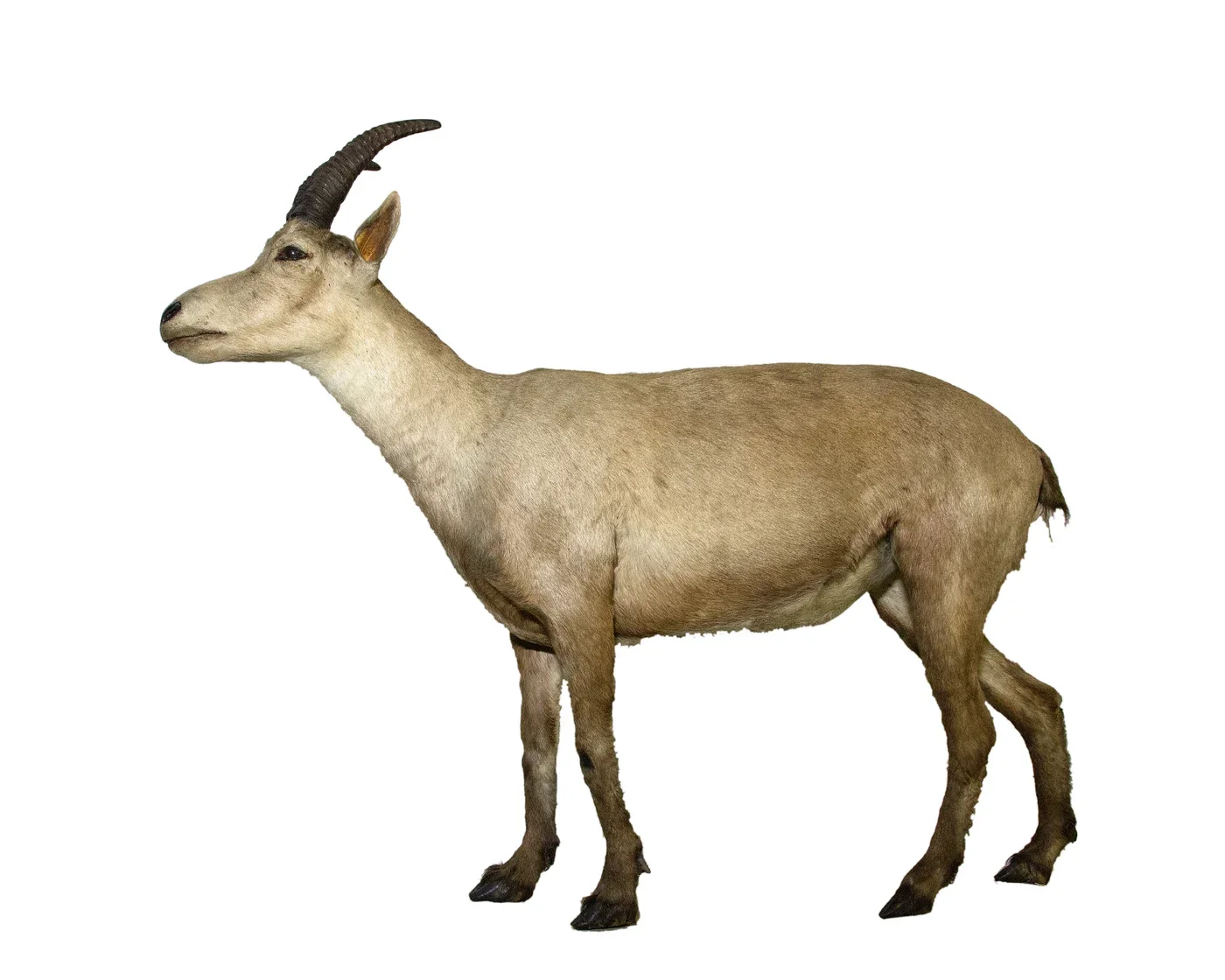
Preserved Pyrenean ibex specimen, Muséum de Toulouse. Not a photograph of Celia or the cloned kid.
Roger Culos. Source and rights. CC BY-SA 4.0.
Resized and converted to WebP; no cropping or content changes.
Capra pyrenaica pyrenaica, the bucardo or Pyrenean ibex, was a mountain-dwelling subspecies of the Iberian ibex. Hunting and the pressures affecting a dwindling population contributed to its decline, although the complete combination of causes remains uncertain. The last known individual, a female called Celia, died in January 2000. Other Iberian ibex populations survive; the loss concerned this particular lineage.
Cells collected before Celia’s death were used in cloning research. A cloned kid was born in 2003 but died within minutes because of a severe lung abnormality. This was a brief live birth, not the restoration of a viable population. The experiment exposes the distance between producing an individual and recovering an animal’s future: reproduction, genetic diversity, welfare and habitat all matter. Preserved biological material can open research possibilities without undoing extinction. Published cloning history
What the lost animals leave behind
The fossils are not mute, but neither do they tell us everything. A tooth can establish presence without proving the animal’s maximum size. A last sighting can identify survival without locating the final death. An experiment can demonstrate technical possibility without delivering conservation success. Those distinctions make these stories more powerful because they keep wonder attached to evidence.
The ancient cases reveal a changing planet; the recent ones reveal choices made by people. Their causes should not be collapsed into one explanation, but together they clarify what extinction removes: organisms, relationships and evolutionary histories. Our feature on de-extinction examines the difficult question of what bringing an animal back could actually mean. Protecting living populations and functioning habitats remains a different task from reconstructing the lost.
FAQ
Frequently Asked Questions
What is this PRESDA article about?
Explore 20 extinct animals, from Smilodon and megalodon to moa and the Pyrenean ibex, with fossil evidence, extinction causes and licensed images.
Which category does this story belong to?
This story is part of PRESDA's Science coverage.
Who published this article?
Extinct Animals: The Lost Creatures of Our Planet was published by PRESDA Editorial on PRESDA.
PRESDA Dispatch
Stay Informed. Stay Aware.
A sharp briefing across AI, gaming, sport, business, world affairs, paparazzi, and lifestyle.