DINOSAURS: THE RISE AND FALL OF THE GIANTS THAT RULED EARTH
For more than 160 million years, dinosaurs evolved into giants, hunters, feathered forms and living birds. Fossils reveal their lost worlds and the catastrophe that ended the non-avian dinosaurs.
The history of dinosaurs is not a short story about monsters that appeared, roared and vanished.
It is one of the longest and most successful chapters in the history of life on land.
Dinosaurs first appeared during the Triassic Period, more than 230 million years ago. Non-avian dinosaurs disappeared at the end of the Cretaceous, about 66 million years ago, a boundary tied to the Chicxulub impact evidence. That means dinosaurs existed for more than 160 million years before the catastrophe that transformed Earth.
Humans have existed for only a tiny fraction of that time.
We never lived with non-avian dinosaurs.
Everything we know about them comes from evidence left behind: bones, teeth, eggs, nests, footprints, skin impressions, feathers, stomach contents, coprolites, microscopic bone structure, rock layers and chemical traces in the Earth itself.
The fossil record is incomplete. It preserves only a small and uneven sample of the life that once existed.
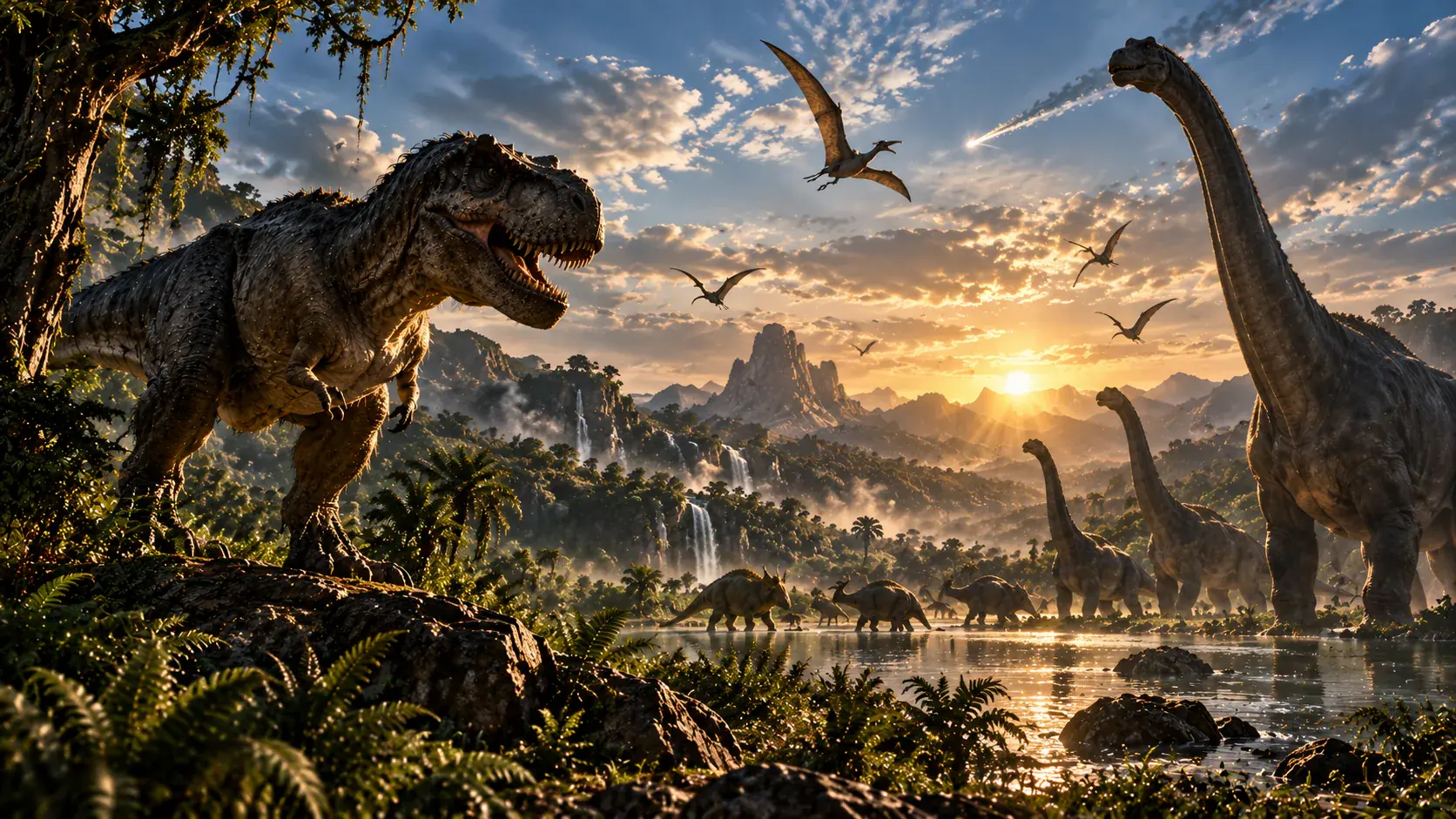
But even that incomplete record reveals an astonishing world: small agile hunters, armored herbivores, horned giants, duck-billed herds, feathered theropods, colossal sauropods and the bird lineage that survived the end of the age of dinosaurs.
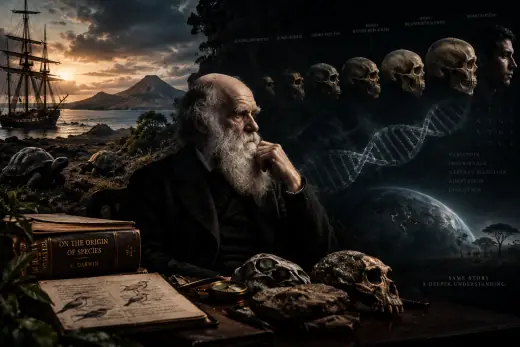
For more PRESDA science context, read Charles Darwin and evolution, how humans learned to speak and Carl Sagan's journey through the universe.
Not Every Prehistoric Reptile Was a Dinosaur
The word dinosaur is often used casually for almost any ancient reptile.
That is scientifically wrong.
Dinosaurs were a particular group of reptiles with distinctive anatomical features, including limbs positioned more directly under the body than in many sprawling reptiles.
Pterosaurs were flying reptiles, but they were not dinosaurs. Marine reptiles such as ichthyosaurs, plesiosaurs and mosasaurs lived at the same broad time as dinosaurs, but they were not dinosaurs either.
Crocodile relatives, early mammals, turtles, lizards and many other animals shared Mesozoic ecosystems with dinosaurs.
The dinosaur story is therefore not the story of all prehistoric life.
It is the story of one extraordinary lineage that dominated many land ecosystems while other reptiles ruled the air and sea.
The First Dinosaurs in the Triassic
The earliest dinosaurs appeared in the Triassic Period, after the devastating Permian-Triassic mass extinction had reshaped life on Earth.
They were not immediately the largest or most dominant animals on land.
Early dinosaurs were generally smaller, more lightly built and part of ecosystems that included many other reptile groups. Over time, they diversified into major lineages that would later produce the familiar giants of the Jurassic and Cretaceous.
Scientists divide dinosaurs into two broad groups based on hip structure: saurischians and ornithischians. The names can be confusing because birds evolved from saurischian theropods, not from the group called ornithischians.
By the end of the Triassic, environmental upheavals and extinctions opened ecological space.
Dinosaurs were ready to expand.
Jurassic Expansion
During the Jurassic Period, dinosaurs became dominant in many terrestrial ecosystems.
The world was warmer, continents were separating and ecosystems were changing. Dinosaurs evolved into larger and more diverse forms.
Sauropods, the long-necked giants, became among the most spectacular animals ever to walk on land. Theropod predators diversified as hunters and scavengers. Stegosaurs and other herbivores occupied important ecological roles.
The Jurassic also saw the rise of early birds from small feathered theropod dinosaurs.
The world of the Jurassic was not a static lost paradise.
It was an evolving planet filled with competition, extinction, adaptation and change.
The Biggest Dinosaurs
The biggest dinosaurs were sauropods.
These long-necked, long-tailed herbivores included animals such as Diplodocus, Brachiosaurus, Patagotitan and Argentinosaurus, though exact size rankings remain debated because many giant species are known from incomplete fossils.
Some sauropods likely reached lengths greater than 30 meters and masses of many tens of tonnes.
Their bodies were engineering marvels.
Long necks allowed them to reach vegetation efficiently. Air-filled spaces in their bones helped reduce weight. Column-like limbs supported enormous mass. Teeth and skulls were often adapted for stripping vegetation rather than chewing it in the way many mammals do.
Sauropods show that dinosaur evolution repeatedly explored extremes of size.
But bigger was not automatically better.
Large bodies required food, growth, reproduction and ecosystems capable of supporting them.
Predators and T. rex
Theropods were the main predatory dinosaur lineage, though not all theropods were large predators.
Some were small. Some were feathered. Some became birds. Some ate meat, insects, fish or mixed diets depending on the group.
Tyrannosaurus rex lived late in the Cretaceous, close to the end of non-avian dinosaur history.
It did not live with Stegosaurus, which belonged to a much earlier Jurassic world. That time gap is larger than the gap between T. rex and humans.
T. rex became famous because it combined huge size, powerful jaws, sharp teeth, strong senses and a dramatic fossil record.
But the real animal is more interesting than the movie monster.
T. Rex: What Science Actually Knows
T. rex was one of the largest known terrestrial predators.
Its skull and teeth indicate an extraordinary bite force capable of crushing bone. Fossil evidence shows healed injuries, growth patterns and variation between individuals.
Scientists continue to debate details of its life.
Was it primarily an active predator, a scavenger or both? Most paleontologists now reject the false either-or. Large carnivores today can hunt and scavenge, and T. rex likely exploited available food in more than one way.
How fast could it run? Estimates vary, but modern studies generally treat extreme movie-style sprinting with caution because of the stress on such a massive body.
Did it have feathers? Close relatives and earlier tyrannosauroids show feather evidence, but adult T. rex skin impressions include scaly textures. The safest answer is that some tyrannosauroids had feathers, while the exact covering of adult T. rex remains debated and may have varied across the body and life stages.
Science does not make T. rex smaller by removing exaggeration.
It makes it more real.
Fossils, Footprints and Eggs
Dinosaurs are known from many kinds of evidence.
Bones and teeth reveal anatomy, growth, injury and relationships. Footprints preserve movement, speed estimates, group behavior and ancient surfaces. Eggs and nests show reproduction, brooding and development. Skin impressions and feathers reveal body covering. Coprolites, fossilized feces, can preserve diet clues.
Trace fossils are especially valuable because they record behavior rather than only bodies.
A footprint trackway can show an animal walking across mud at a specific moment more than 100 million years ago.
A nest can suggest reproductive strategy.
A bonebed can raise questions about herding, drought, floods or mass death.
Each fossil is a clue.
No fossil is the whole story.
How Do We Know?
Paleontology works by connecting fossils to rocks, anatomy, chemistry and evolutionary relationships.
Scientists date rocks using methods such as radiometric dating and stratigraphy. They compare bones across species. They use CT scanning to examine internal structures. They study microscopic bone tissue to estimate growth. They analyze teeth for diet and wear. They map footprints to infer movement.
Cladistics helps researchers test evolutionary relationships by comparing shared anatomical traits.
Modern technology has expanded the field. Computer models can test biomechanics. Isotopes can suggest aspects of diet and environment. Synchrotron imaging and high-resolution scanning can reveal structures too delicate to prepare by hand.
But paleontology remains careful because evidence is fragmentary.
A new fossil can overturn an old reconstruction.
That is not failure.
That is how science improves.
The Feather Revolution
One of the biggest changes in dinosaur science came from feathered dinosaur fossils, especially from deposits in China and elsewhere.
These discoveries showed that many theropod dinosaurs had feathers or feather-like structures.
Feathers did not evolve only for powered flight.
They may have helped with insulation, display, brooding, camouflage or balance before some lineages used them for flight.
The feather revolution changed public imagination.
Dinosaurs were not all gray, scaly, sluggish reptiles.
Many were active, visually complex animals. Some may have been colorful. Some brooded eggs. Some had display structures.
Not all dinosaurs had feathers.
Large sauropods, many armored dinosaurs and many ornithischians are not imagined as fully feathered in the same way small theropods often are.
The accurate picture is varied: scales, feathers, filaments, skin, armor, horns and display features across different dinosaur groups.
Birds Are Living Dinosaurs
Birds are not merely descended from dinosaurs in a vague sense.
Birds are living theropod dinosaurs.
The evidence comes from anatomy, fossils, feathers, eggs, nesting behavior and evolutionary relationships.
Archaeopteryx, discovered in the 19th century, showed a mixture of bird-like and reptile-like features: feathers and wings alongside teeth, claws and a long bony tail.
Later discoveries made the connection even stronger.
Small feathered theropods reveal the gradual assembly of features associated with birds. Flight did not appear in one magical leap. It emerged from bodies that already had feathers, lightweight skeletons, wishbones, air sacs and complex movement.
This means the dinosaur extinction has an important qualification.
Non-avian dinosaurs disappeared at the K-Pg boundary.
Avian dinosaurs survived.
Every bird alive today is part of the dinosaur legacy.
Dinosaur Behavior and Unresolved Questions
Behavior is harder to reconstruct than bones.
A skeleton can show anatomy. It cannot directly preserve a roar, a social hierarchy or a parental bond.
Still, fossils provide clues.
Trackways may suggest group movement. Nesting sites can show repeated use of breeding grounds. Bonebeds can suggest mass death or social grouping, though interpretations must be cautious. Injuries can reveal conflict or survival after trauma. Growth rings in bones can show how quickly animals matured.
Some dinosaurs cared for eggs. Some moved in groups. Some had display structures such as crests, horns, frills or feathers. Some likely used sound, color, posture and movement in social behavior.
Many questions remain debated.
How intelligent were different dinosaurs? What sounds did they make? How colorful were they? How social were large predators? How much parental care did different species provide?
The best answer often begins with humility.
We know more than ever.
We do not know everything.
Flowering Plants and Changing Ecosystems
During the Cretaceous Period, flowering plants spread and transformed ecosystems.
This did not happen all at once, and dinosaurs did not simply switch from one world to another overnight. But flowering plants changed landscapes, insect relationships, food webs and habitats.
Hadrosaurs, ceratopsians and other herbivores thrived in Cretaceous ecosystems. Predators evolved alongside them. Birds diversified. Mammals remained generally small but ecologically varied.
The final Cretaceous world was rich and complex.
It was not a dying planet waiting passively for an asteroid.
Dinosaurs were still diverse in many regions near the end, though diversity patterns varied by group and geography.
Then Earth was hit by a cosmic event.
The Final Cretaceous World
In the Late Cretaceous, familiar dinosaurs included Tyrannosaurus, Triceratops, Ankylosaurus, Edmontosaurus and many others.
The continents were arranged differently from today. Sea levels, coastlines and climates differed. Western North America, for example, had been shaped by inland seas during parts of the Cretaceous.
Ecosystems contained dinosaurs, birds, mammals, crocodilians, turtles, lizards, insects, plants and many marine organisms.
The end-Cretaceous extinction did not affect only dinosaurs.
It was a mass extinction event that transformed oceans and continents alike.
To understand it, scientists look beyond bones to a global geological signal.
The Day the Asteroid Hit
About 66 million years ago, an asteroid or comet struck what is now the Yucatan Peninsula of Mexico.
The impact structure is known as Chicxulub.
The evidence is strong: a global layer enriched in iridium, shocked minerals, impact glass, tsunami deposits, crater geology and timing that matches the Cretaceous-Paleogene boundary.
The impact released enormous energy.
It blasted material into the atmosphere, triggered fires in some regions, generated tsunamis, disturbed the climate and darkened the sky with dust, aerosols and soot.
Photosynthesis would have been disrupted. Food webs would have collapsed. Temperatures and chemistry changed. The oceans were affected. Land ecosystems were thrown into crisis.
This was not simply a big rock killing animals by impact alone.
It was a planetary environmental disaster.
Deccan Volcanism and Scientific Debate
The Chicxulub impact is strongly supported as the principal cause of the K-Pg mass extinction.
But scientists also study Deccan volcanism in what is now India.
The Deccan Traps produced enormous volcanic eruptions around the end of the Cretaceous. Volcanism could have affected climate and ecosystems through gases, warming, cooling, acid rain and ocean chemistry changes.
The current scientific discussion is not usually impact or volcanism in a cartoon sense.
It is about timing, interaction and relative importance.
Did volcanic activity stress ecosystems before the impact? Did the impact trigger or modify volcanic activity? How much did each process contribute to environmental change?
The safest summary is this: Chicxulub is the best-supported main trigger of the sudden K-Pg extinction, while Deccan volcanism and broader environmental change remain relevant to understanding the full context.
The K-Pg Mass Extinction
The K-Pg extinction marks the boundary between the Cretaceous and Paleogene periods.
It eliminated the non-avian dinosaurs along with many marine reptiles, ammonites, plankton groups and other organisms.
Extinction was not evenly distributed.
Some lineages vanished. Others survived. Survival depended on factors such as body size, diet, habitat, reproduction, metabolism, shelter and ecological flexibility.
Small animals that could burrow, live in water, eat seeds or detritus, or survive on more flexible food sources may have had advantages in the post-impact world.
Large land animals depending on fresh plant productivity and complex food chains were especially vulnerable.
Non-avian dinosaurs had ruled land ecosystems for more than 160 million years.
Then the rules of the planet changed faster than they could adapt.
Why Non-Avian Dinosaurs Disappeared
Non-avian dinosaurs disappeared because the post-impact environment destroyed the ecological systems that supported them.
Large herbivores needed plants. Large carnivores needed herbivores. Eggs and young needed stable conditions. Populations needed food chains that could recover quickly enough.
The impact winter and related environmental shocks likely reduced sunlight and plant growth, collapsing food webs from the bottom upward.
Some dinosaurs may already have been under regional pressures, and the fossil record does not preserve every local pattern.
But the global disappearance of non-avian dinosaurs at the K-Pg boundary points to a sudden worldwide crisis.
They did not fail because they were obsolete.
They vanished because Earth changed catastrophically.
Why Birds Survived
Birds survived the K-Pg extinction, but not all birds survived.
Many ancient bird lineages disappeared too.
The birds that made it through were likely helped by combinations of small body size, flexible diets, rapid reproduction and ecological habits that allowed survival in damaged environments.
Some may have eaten seeds, aquatic food sources or other resources available when forests and large food webs collapsed.
Researchers continue to study why certain bird lineages survived while others did not.
What is clear is that the dinosaur lineage did not end completely.
It flew into the future.
The sparrow on a roof, the crow in a city, the eagle over a mountain and the chicken in a farmyard are all living reminders that dinosaurs are not only fossils.
They are still here.
Dinosaur Myth vs Reality
Myth: Humans lived with non-avian dinosaurs.
Reality: Non-avian dinosaurs died out about 66 million years ago. Modern humans appeared much later.
Myth: All dinosaurs were giant.
Reality: Some were enormous, but many were small, including bird-like theropods not much larger than modern animals.
Myth: All dinosaurs were scaly.
Reality: Many dinosaurs had feathers or feather-like structures, especially among theropods, though not all dinosaurs were feathered.
Myth: Flying reptiles were dinosaurs.
Reality: Pterosaurs were close relatives within the broader archosaur world, but they were not dinosaurs.
Myth: The asteroid is only a guess.
Reality: The Chicxulub impact is supported by strong geological evidence and is widely considered the principal trigger of the K-Pg extinction.
Myth: Dinosaurs were evolutionary failures.
Reality: Dinosaurs dominated many land ecosystems for more than 160 million years, and birds remain living dinosaurs today.
Dinosaur Legacy Today
Dinosaurs changed how humans think about time.
Their fossils revealed that Earth was far older and stranger than many earlier societies imagined. They showed that entire worlds could disappear. They helped make extinction, evolution and deep time visible.
Dinosaur science also keeps changing.
A dinosaur mounted in a museum today may look very different from one mounted a century ago. Tails no longer drag in the same old reconstructions. Feathers appear where scales once dominated imagination. CT scans reveal skull interiors. Growth studies reshape ideas of age and size. New fossils redraw family trees.
Dinosaurs are not just ancient animals.
They are an active scientific frontier.
The Giants That Still Rule Imagination
The rise and fall of dinosaurs is a story of evolutionary success, not just extinction.
They began as relatively modest Triassic animals. They expanded through the Jurassic. They produced the largest land animals in history, some of the most powerful predators, intricate nesting behaviors, feathers, flight and birds.
Then an asteroid changed the planet.
The non-avian giants disappeared, but their world did not vanish without leaving evidence.
Bones remained in rock.
Footprints hardened in mud.
Eggs fossilized in nests.
Feathers left shadows in stone.
A crater remained beneath Mexico.
A thin global boundary layer marked the end of an age.
And birds carried the lineage forward.
The dinosaur story is therefore not only about death.
It is about life changing form across unimaginable time.
The giants ruled Earth for more than 160 million years.
Their descendants still cross the sky.
FAQ
Frequently Asked Questions
How long did dinosaurs exist?
Dinosaurs first appeared in the Triassic Period more than 230 million years ago, and non-avian dinosaurs disappeared about 66 million years ago, meaning they existed for more than 160 million years.
Did humans live with dinosaurs?
Humans never lived with non-avian dinosaurs. Modern humans appeared tens of millions of years after non-avian dinosaurs went extinct.
Are birds dinosaurs?
Yes. Birds are living theropod dinosaurs, descended from feathered dinosaur ancestors that survived the K-Pg extinction.
Did all dinosaurs have feathers?
No. Many theropod dinosaurs had feathers or feather-like structures, but dinosaur body coverings varied widely across groups.
What caused dinosaur extinction?
The Chicxulub asteroid impact about 66 million years ago is strongly supported as the principal cause of the K-Pg extinction, while Deccan volcanism and environmental change remain scientifically relevant context.
Was T. rex only a scavenger?
Probably not. Most paleontologists treat T. rex as a large carnivore that could both hunt and scavenge, rather than fitting only one behavior.
Were pterosaurs dinosaurs?
No. Pterosaurs were flying reptiles related to dinosaurs, but they were not dinosaurs themselves.
PRESDA Dispatch
Stay Informed. Stay Aware.
A sharp briefing across AI, gaming, sport, business, world affairs, paparazzi, and lifestyle.