LANGUAGE: HOW DID HUMANS LEARN TO SPEAK?
Every human society uses language, but scientists cannot identify the first spoken words. The story of language begins before writing, inside bodies, brains, gestures, cooperation and culture.
The evolution of human language is one of the most important unsolved stories in science.
Every known human society uses language. People speak, sign, sing, joke, argue, teach, pray, trade, remember and imagine through systems of meaning that children can learn with astonishing speed.
But no one knows exactly when the first word was spoken.
There is no fossil of a sentence.
There is no recording of the first story.
There is no ancient inscription from the beginning of speech because spoken language almost certainly existed for a very long time before writing.
What scientists can study is indirect evidence: human fossils, brain evolution, vocal anatomy, genetics, archaeology, child development, sign languages, comparative animal communication, historical linguistics and the oldest writing systems.
The result is not one simple answer.
It is a careful reconstruction of how humans became animals who could share ideas across minds.
For more PRESDA science context, read why we dream, Charles Darwin and evolution and depression and the brain.
Communication Before Complex Language
Communication is older than humans.
Animals warn, display, gesture, sing, mark territory, coordinate movement and signal emotional states. Birds sing. Primates call and gesture. Whales communicate with complex sounds. Bees use movement to indicate food sources.
Human language, however, is different in several powerful ways.
It can describe things that are not present. It can combine smaller units into new meanings. It can refer to yesterday, tomorrow, fiction, mathematics, law, gossip, gods, recipes, contracts and impossible worlds.
Before complex language, human ancestors almost certainly communicated with gestures, facial expressions, vocal calls, body posture and shared attention.
The difficult question is not whether early humans communicated.
They did.
The question is how communication became language: a flexible system capable of producing limitless meanings from learned sounds or signs.
Homo Sapiens and the Long Human Background
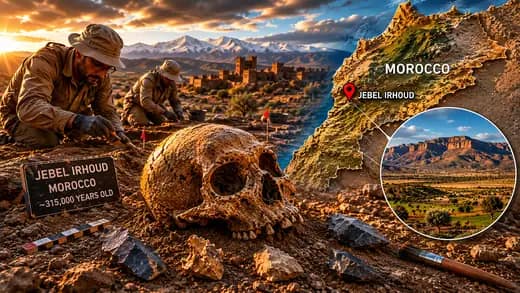
Modern Homo sapiens evolved in Africa.
Fossil and genetic evidence show that our species emerged through a long evolutionary process rather than a sudden moment when fully modern language appeared fully formed.
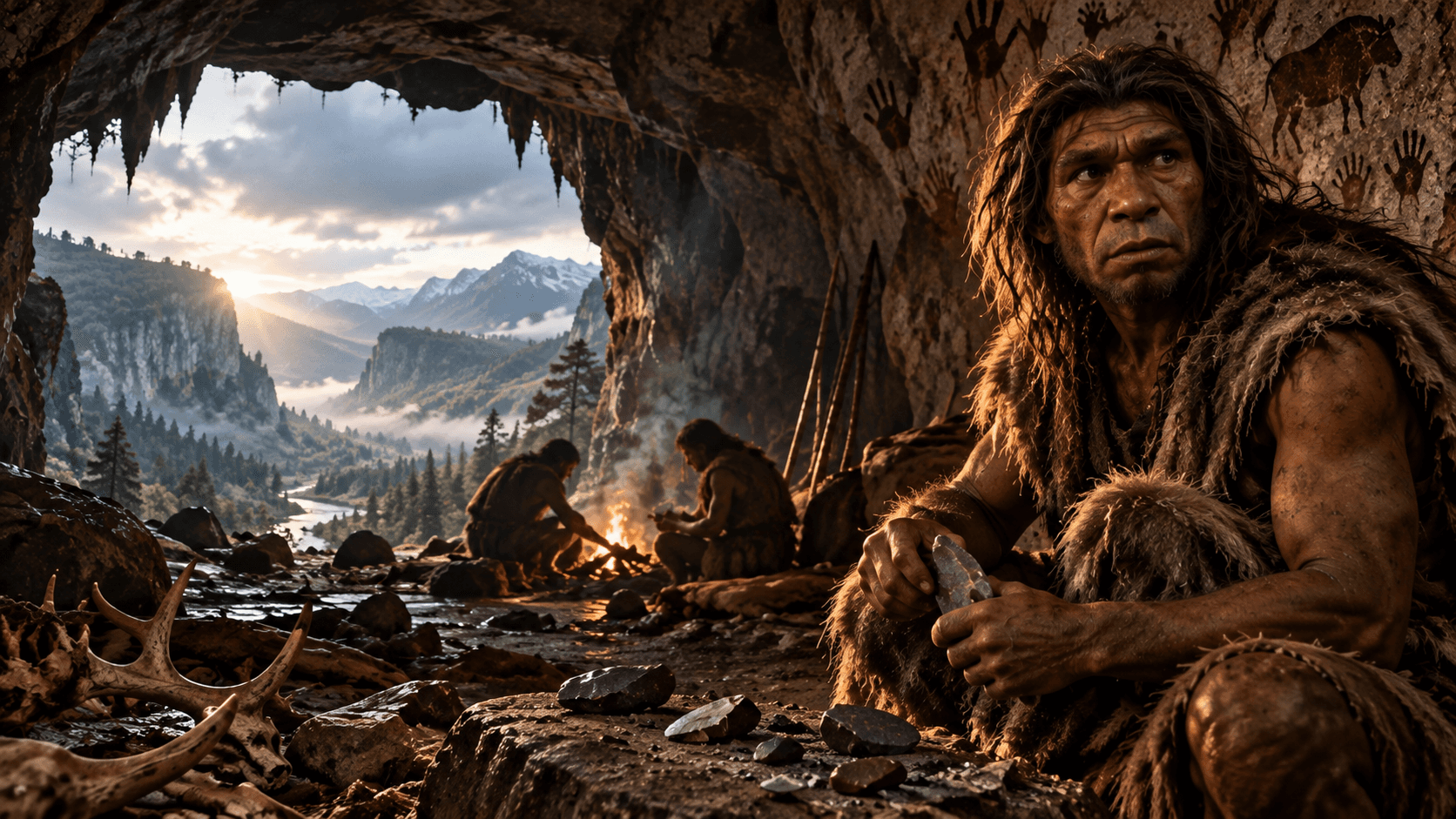
Other human relatives also had complex lives. Neanderthals made tools, used fire, buried some of their dead, produced symbolic objects in some contexts and shared ancestry with modern humans. Whether Neanderthals had language comparable to ours remains debated, but the old idea of silent, unintelligent relatives is no longer credible.
Homo sapiens developed bodies, brains and cultures that made complex communication increasingly powerful.
By the time modern humans expanded widely beyond Africa, they were capable of long-distance cooperation, symbolic behavior, teaching, planning and adaptation to many environments.
Language almost certainly helped.
But scientists cannot point to one fossil and say: here is the first speaker.
The Brain and Language
Language depends on the brain, but it is not stored in one tiny language box.
Speech production, comprehension, grammar, sound processing, meaning, memory, motor control and social interpretation involve distributed networks across the brain.
Classical language areas such as Broca's area and Wernicke's area remain important in neuroscience, but modern research shows a more connected system involving temporal, frontal, parietal and subcortical regions.
The brain must connect sounds or signs to meaning. It must sequence words. It must track who did what to whom. It must infer intention, context and emotion.
This is why language is not only a dictionary in the head.
It is a living cognitive system.
It lets one mind shape another mind without touching it.
The Body: Breath, Mouth and Vocal Tract
Spoken language also depends on anatomy.
Humans control breathing, vocal fold vibration, tongue movement, lips, jaw and soft palate with extraordinary precision. Speech turns airflow into structured sound.
The human vocal tract can produce a wide range of vowels and consonants. Fine motor control allows rapid sequences of sound. Hearing allows children to tune themselves to the speech patterns around them.
No single anatomical feature explains language by itself.
A descended larynx, flexible tongue, breathing control, neural circuits, hearing, social learning and cultural transmission all matter.
Language is not just a mouth making noise.
It is anatomy coordinated with cognition and culture.
Genes and the FOXP2 Caution
The gene FOXP2 became famous because mutations in it can affect speech and language abilities.
That discovery was important, but it is often oversimplified.
FOXP2 is not a magic language gene.
Language depends on many genes, developmental processes and environments. FOXP2 is involved in neural and motor functions relevant to speech, but no responsible scientist treats it as the single switch that created human language.
Genetics can help show that speech and language have biological foundations.
It cannot yet tell us the exact date of the first spoken word.
Gesture and Speech
One major question in language evolution is whether language began mainly with speech, gesture or a combination of both.
The gesture-first hypothesis points to the importance of hands, pointing, imitation and shared attention. Human communication still uses gesture constantly. Even fluent speakers move their hands, faces and bodies while speaking.
Speech has other advantages. It works in the dark, leaves the hands free, can reach around obstacles and can be produced rapidly.
Many researchers now think the most realistic story may not be gesture versus speech.
It may be gesture and speech together.
Early humans likely used faces, hands, posture, rhythm, vocalizations and eventually more structured sound systems in increasingly coordinated ways.
Language did not have to begin as a perfect grammar.
It could have grown from social communication becoming more symbolic, more combinable and more teachable across generations.
Why We Cannot Identify the First Spoken Language
People often ask what the first human language was.
Science cannot answer that question directly.
The first spoken languages left no written record. Sound disappears unless recorded, and recording technology is extremely recent. Writing appeared only a few thousand years ago, while spoken language is much older.
Historical linguistics can reconstruct earlier stages of language families by comparing related languages. It can infer forms of languages such as Proto-Indo-European or Proto-Afroasiatic with varying degrees of confidence.
But reconstruction has limits.
It cannot reach back indefinitely to the first human language, if there even was one single first language rather than a gradual emergence of language-like systems among related populations.
The responsible answer is simple:
We do not know the first language.
Claims naming one modern language as the original language of humanity are not supported by linguistic science.
Language and Human Cooperation
Language is powerful because humans are social.
A group that can share detailed information can coordinate hunting, gather food, teach toolmaking, warn about danger, negotiate alliances, pass on myths, organize rituals, raise children cooperatively and remember who can be trusted.
Language also allows absent things to become socially real.
A person can describe a water source beyond the hill. A grandmother can teach a story from before a child's birth. A group can agree on rules, names, kinship, ownership, debts, marriages or sacred places.
This does not mean language evolved only for practical survival.
Human language also carries play, beauty, song, humor and identity.
But cooperation is one reason language became so central to human success.
Words make groups larger than immediate perception.
Migration Out of Africa
As Homo sapiens populations moved within and beyond Africa, languages moved with them.
Those early languages are not directly recoverable. They changed, split, merged, disappeared and transformed over tens of thousands of years.
Migration creates linguistic diversity because separated communities change in different directions.
A pronunciation shifts here. A word changes meaning there. A new term is borrowed from neighbors. Children learn slightly different patterns from the previous generation. Over centuries, dialects become languages. Over millennia, languages can become entire families.
The spread of humans around the world therefore produced a spread of human languages.
No language is primitive.
Languages spoken by small communities can be as grammatically complex and expressive as languages spoken by empires.
Every natural human language is a complete system for human thought and social life.
How Languages Diversify
Languages change constantly because people change constantly.
Sound systems shift. Words are borrowed. Meanings drift. Grammar simplifies in some areas and becomes more complex in others. New technologies require new vocabulary. Contact between communities creates bilingualism, borrowing, pidgins, creoles and mixed linguistic worlds.
Isolation can increase difference.
Trade can spread words.
Empire can spread official languages.
Religion can preserve sacred languages.
Schools can standardize speech.
Migration can create new dialects.
Writing can slow some changes while accelerating others.
A language is not a museum object.
It is a pattern of use carried by living people.
Language Families
A language family is a group of languages descended from a common ancestor.
English, German, Persian, Hindi, Spanish, Greek and Russian, for example, belong to the Indo-European family, though they sit on very different branches.
Arabic, Hebrew and Amharic belong to the Semitic branch of the Afroasiatic family.
Other major families include Sino-Tibetan, Niger-Congo, Austronesian, Dravidian, Turkic, Uralic, Mayan, Quechuan and many more.
Some languages are isolates, meaning they have no proven relationship to other living languages. Basque is a famous example in Europe.
Language families are built from evidence: systematic sound correspondences, shared vocabulary, grammar and historical records.
They are not racial categories.
Languages can spread through migration, conquest, trade, prestige, religion, schooling and ordinary family life.
Proto-Indo-European
Proto-Indo-European is one of the most famous reconstructed ancient languages.
No one has found a book written in Proto-Indo-European. It is reconstructed by comparing later Indo-European languages and identifying patterns too systematic to be coincidence.
For example, related words across Sanskrit, Greek, Latin, Germanic, Celtic, Slavic and other branches helped linguists infer older forms.
Scholars debate details about where and when Proto-Indo-European was spoken, with steppe and Anatolian hypotheses among the most discussed frameworks.
The important point is methodological.
Proto-Indo-European shows what historical linguistics can do.
It can reconstruct earlier language stages with evidence.
It cannot reconstruct the first human language.
Ancient Documented Languages
The oldest documented languages are not the oldest spoken languages.
They are simply the oldest languages preserved in writing.
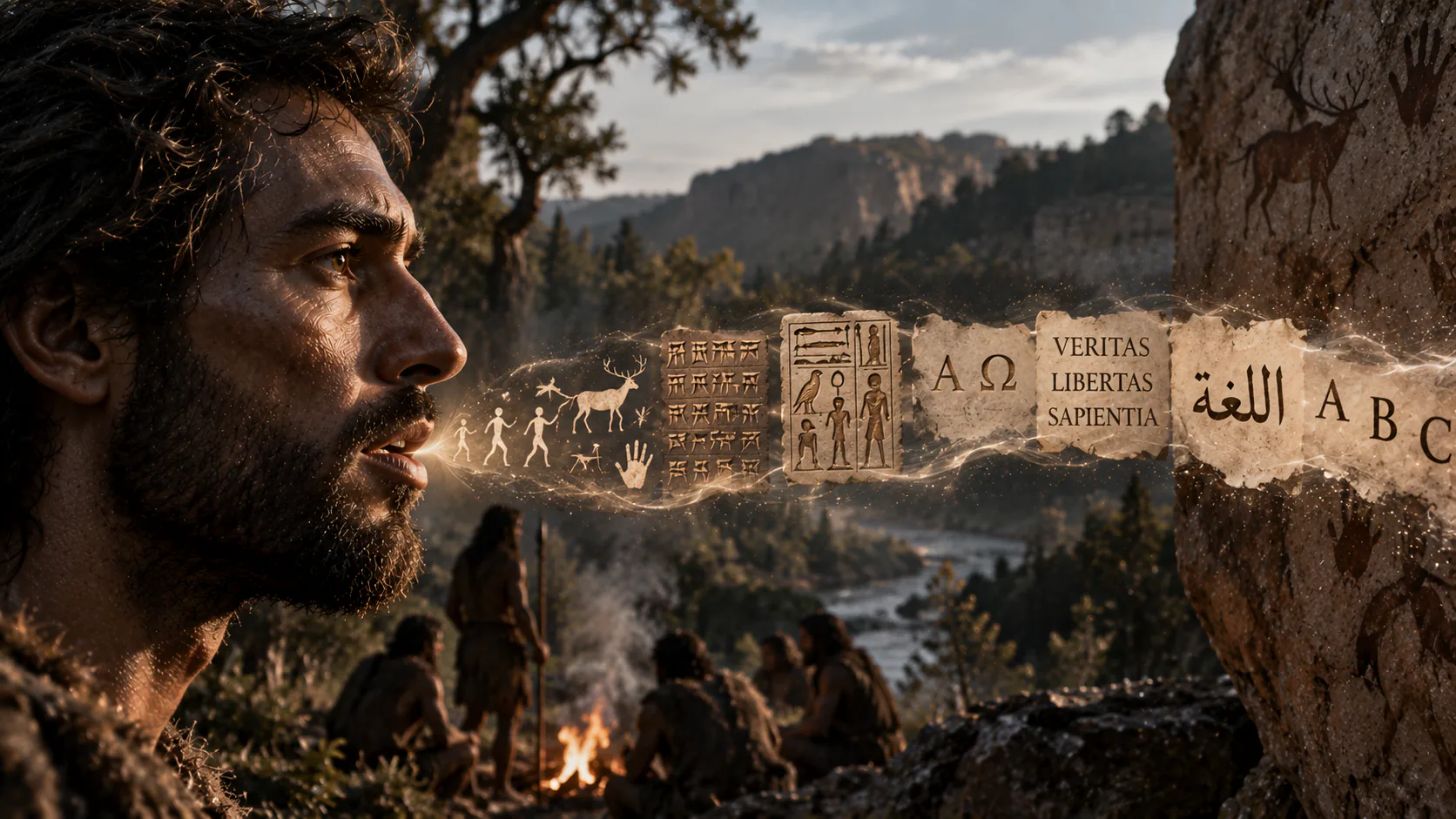
Sumerian appears in some of the earliest cuneiform writing in Mesopotamia. Egyptian is preserved through hieroglyphic and other scripts. Akkadian, an ancient Semitic language, became a major written language of Mesopotamia and diplomacy.
Later ancient languages such as Greek, Latin, Sanskrit, Classical Chinese, Hebrew, Aramaic and others developed rich written traditions.
Writing allows languages to outlive the voices that spoke them.
But it also creates a historical bias.
Languages without writing can vanish from the record even if they were spoken by millions of people over centuries.
Silence in the archive does not mean silence in life.
Writing in Mesopotamia and Egypt
Writing emerged independently in more than one place.
In Mesopotamia, early cuneiform developed from administrative marks, accounting and recordkeeping before expanding into literature, law, diplomacy and scholarship.
In Egypt, hieroglyphic writing developed early and became linked with royal, religious and administrative life.
Writing was revolutionary because it allowed information to travel beyond a speaker's body.
A record could outlive a witness.
A law could be copied.
A debt could be tracked.
A poem could cross centuries.
But writing did not create language.
It created a new technology for representing language.
Human beings were speaking long before they were writing.
Alphabets
Early writing systems could be complex, using hundreds of signs or combinations of signs for words, syllables and sounds.
Alphabetic systems changed the history of literacy by using a smaller set of signs to represent speech sounds.
The history of alphabets is connected to West Asian and Mediterranean writing traditions, including Egyptian influence, Semitic scripts, Phoenician writing, Greek adaptation and later Latin scripts.
The Greek alphabet added important vowel notation to an inherited consonantal framework.
The Latin alphabet, adapted through Etruscan and Roman use, eventually spread widely through Roman power, Christianity, European colonialism, printing, schooling and modern technology.
Alphabets are not inherently superior to other scripts.
They are one family of writing technologies that proved extremely portable.
Greek and Latin
Greek became one of the great languages of philosophy, drama, history, science and early Christian writing.
It connected the Aegean, Hellenistic kingdoms, Roman intellectual life and Byzantine scholarship.
Latin became the language of Roman law, administration, literature and later Western Christianity. After the Roman Empire changed and fractured, spoken Latin evolved into the Romance languages: Spanish, Portuguese, French, Italian, Romanian and others.
Greek and Latin mattered not because they were more fully developed than other languages.
They mattered because institutions preserved, taught and transmitted them across long periods.
Prestige can make a language historically visible.
It does not make other languages less human.
Arabic and Other Major Language Traditions
Arabic became a major language of religion, literature, law, science, philosophy and administration across large regions after the rise of Islam.
Classical Arabic and later written standards linked communities across North Africa, the Middle East and beyond, while spoken Arabic varieties developed rich regional diversity.
Sanskrit shaped religious, philosophical, literary and scientific traditions in South Asia. Classical Chinese carried administration, literature and scholarship across East Asia. Persian, Turkish, Hebrew, Aramaic, Ge'ez, Tamil, Mayan languages, Nahuatl and many others preserve deep intellectual worlds.
A world history of language cannot be told through Europe alone.
Human beings everywhere built languages capable of law, poetry, memory, mathematics, theology, humor and love.
Printing and Standard Languages
The printing press changed language by multiplying texts.
Printed books made spelling, grammar and vocabulary more visible and more standardized. Religious texts, dictionaries, grammars, newspapers and schoolbooks helped certain dialects become national standards.
Printing also strengthened vernacular languages.
People who once relied heavily on elite languages for formal writing could increasingly read and write in languages closer to everyday speech.
Standard languages can help administration and education.
They can also suppress minority languages and dialects when schools, governments or media treat one variety as the only correct way to speak.
Language standardization is never only technical.
It is cultural and political.
Modern Global Languages
Today, some languages have global reach because of empire, trade, religion, migration, technology and media.
English became globally powerful through British imperial history, American economic and technological power, science, aviation, entertainment and the internet.
Spanish, Arabic, French, Portuguese, Mandarin Chinese, Hindi, Bengali, Russian and others connect hundreds of millions of people across regions and diasporas.
Global languages can create opportunity.
They can also create pressure on smaller languages.
When parents believe a dominant language is the only path to education or work, children may stop learning ancestral languages at home.
That shift can happen quietly within one or two generations.
Endangered Languages
UNESCO and linguists warn that many of the world's languages are endangered.
A language becomes endangered when children no longer learn it as a normal part of community life.
Language loss is not only the loss of words.
It can mean the loss of oral history, ecological knowledge, place names, songs, jokes, rituals, family memory and identity.
Some communities are revitalizing languages through immersion schools, dictionaries, recordings, media, apps and intergenerational teaching.
The key point is respect.
Small languages are not failed versions of large languages.
They are complete human systems whose survival depends on social conditions, community choice and political support.
How Children Acquire Language
Children learn language with astonishing speed, but not by memorizing a dictionary first.
They absorb patterns from interaction.
Babies begin by tuning into the sounds, rhythms and social cues around them. They babble, gesture, point, imitate, experiment and gradually connect words or signs to meaning.
Children learn grammar without being formally taught most rules. They often make creative mistakes that reveal pattern learning, such as overgeneralizing regular forms.
Language acquisition depends on the brain, social interaction, hearing or visual access, caregivers, community and time.
Children can acquire spoken languages, signed languages or multiple languages when exposed to them naturally.
A child does not need a dominant world language to become fully linguistic.
They need access to a real human language.
Sign Languages
Sign languages are full natural languages.
They are not pantomime, universal gestures or simplified versions of spoken languages.
American Sign Language, British Sign Language, French Sign Language, Brazilian Sign Language, Moroccan Sign Language and many others have their own grammars, histories, communities and expressive power.
Sign languages show that language is not identical to speech.
The human brain can build language through the hands, face, body and eyes as well as through the voice and ears.
This matters for the origin of language because it reminds us that the deep capacity is symbolic communication with structure.
Speech is one major channel.
It is not the only possible channel.
Language and the Brain Today
Modern neuroscience studies language through brain imaging, lesion studies, electrophysiology, computational modeling and clinical work.
Researchers examine how the brain recognizes sounds, processes syntax, retrieves words, interprets meaning and coordinates speech movement.
Brain injuries can produce aphasia, a disorder affecting language production or comprehension. Some people may speak fluently but produce little meaningful content; others may understand more than they can say.
These conditions show that language has biological organization.
They also show that language is distributed and resilient. People can sometimes recover functions through therapy, compensation and neuroplasticity.
The speaking mind is not one organ inside the brain.
It is a networked process.
Do Animals Have Language?
Animals communicate in sophisticated ways.
Some primates use calls and gestures. Birds learn songs. Dolphins and whales produce complex vocalizations. Dogs respond to human signals. Parrots can learn meaningful vocal labels in experimental settings. Apes taught signs or symbol systems have shown impressive abilities in some studies.
But human language remains unusual in its open-ended grammar, symbolic flexibility, cultural accumulation and ability to express abstract ideas across unlimited contexts.
The boundary is not that animals are silent and humans speak.
The boundary is that human language can generate endlessly new meanings from shared rules and symbols.
Animal communication research is valuable because it helps scientists ask which building blocks of language are shared with other species and which became especially developed in humans.
Language Online
Language did not stop evolving when dictionaries were printed.
The internet has made language change visible in real time.
Memes, emojis, abbreviations, voice notes, hashtags, livestreams, comments, subtitles, translation tools and AI systems all shape how people communicate.
Online language can cross borders quickly. A phrase can become global in a day. Communities can create slang, remix dialects and build identities through shared style.
Technology also changes power.
Major languages often receive better search, translation, speech recognition and AI support than smaller languages. That can widen digital inequality.
At the same time, communities can use digital tools to document, teach and revive endangered languages.
Language evolves wherever humans gather.
Today, that includes screens.
What We Know and What We Do Not
Science knows that human language depends on evolved brains, bodies, social learning and culture.
It knows that spoken language predates writing by a very long period.
It knows that all human societies use complex language and that signed languages are full languages.
It knows that languages change, split, merge, borrow and sometimes disappear.
It can reconstruct some ancient language families.
It cannot identify the first word.
It cannot name one modern language as the original language of humanity.
It cannot turn cave paintings directly into sentences.
That uncertainty is not a weakness.
It is the honest boundary between evidence and imagination.
The Human Voice Across Time
At some point in the deep past, human ancestors became able to share meanings with a richness no other species has matched.
They named things.
They warned one another.
They taught children.
They remembered the dead.
They planned journeys.
They told stories.
Later, some of their descendants pressed signs into clay, carved marks into stone, painted symbols, copied manuscripts, printed books, broadcast voices, sent texts and trained machines to process language.
The first spoken word is lost.
The process it began is not.
Every conversation continues it.
Every child learning a language repeats it.
Every endangered language kept alive protects part of it.
Human beings learned to speak, sign and write because meaning became one of our greatest tools.
Language did not simply help us describe the world.
It helped us build one together.
FAQ
Frequently Asked Questions
When did humans first learn to speak?
Scientists do not know the exact date. Spoken language almost certainly predates writing by a very long period, but speech leaves no direct fossil record.
What was the first human language?
No first human language has been identified. Historical linguistics can reconstruct some ancient language families, but it cannot recover the original beginning of human speech.
Did language begin with speech or gestures?
Researchers debate speech-first, gesture-first and multimodal hypotheses. Many scientists consider it likely that early communication involved both vocal and gestural systems.
Did writing create language?
No. Writing is a technology for representing language. Humans were speaking or signing long before the earliest writing systems appeared.
Are sign languages real languages?
Yes. Natural sign languages have their own grammar, vocabulary, history and communities. They are fully developed human language systems.
Are some languages more primitive than others?
No. All natural human languages are complete systems capable of expressing complex thought, culture, emotion and social life.
Do animals have language?
Animals communicate in sophisticated ways, but human language is unusual for its open-ended symbolic structure, grammar and ability to express unlimited abstract meanings.
PRESDA Dispatch
Stay Informed. Stay Aware.
A sharp briefing across AI, gaming, sport, business, world affairs, paparazzi, and lifestyle.