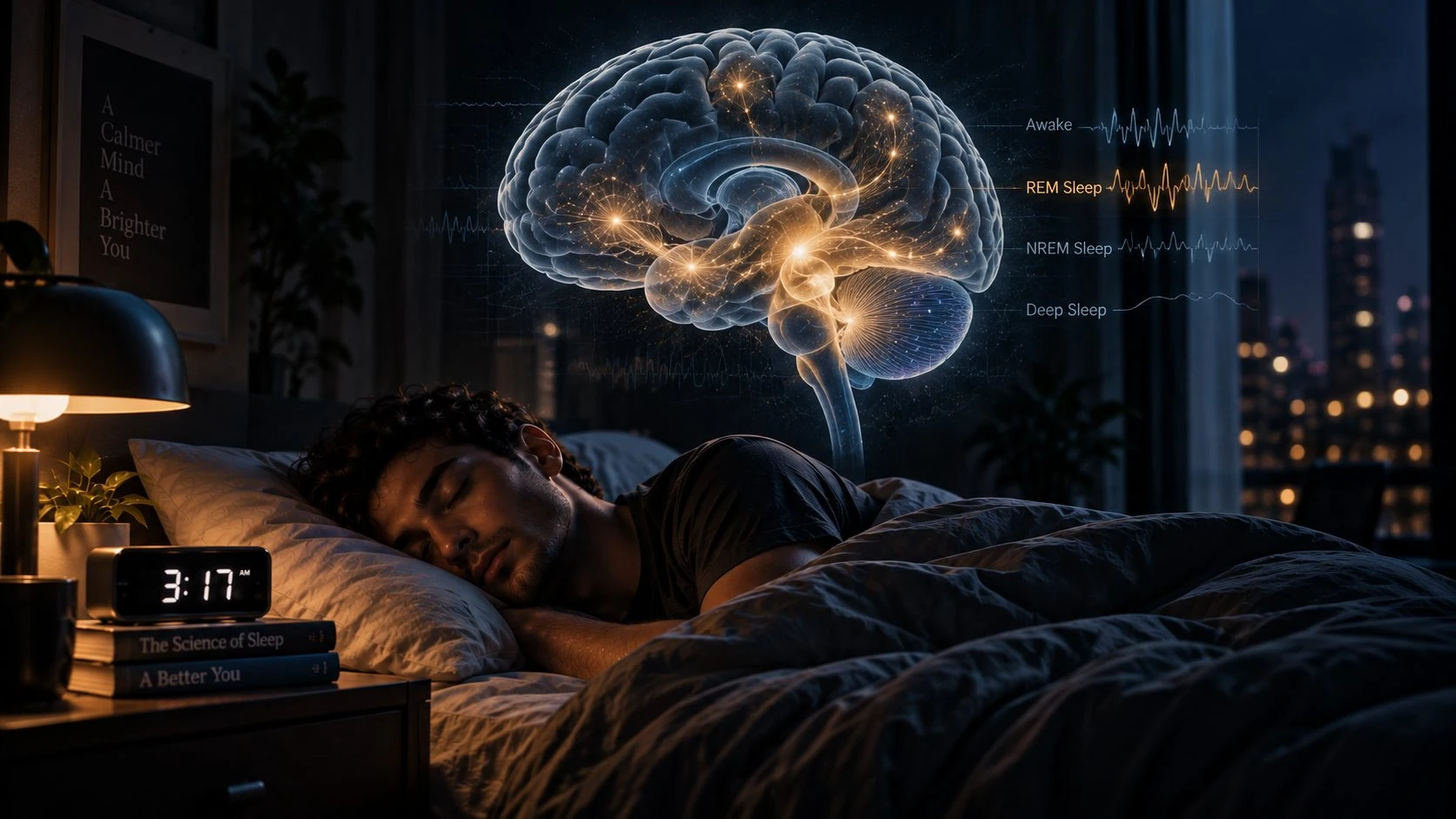
Why Do We Dream? The Science Behind the Sleeping Mind
Why do we dream? Explore what neuroscience knows about dreams, REM sleep, memory, emotions, nightmares and the theories behind the dreaming mind.
Every night, the human brain creates worlds that do not exist.
We see people who may be thousands of kilometers away. We return to places from childhood. We run, fall, fly, argue, escape and sometimes experience events that would be impossible while awake.
Then we wake up, and much of it disappears within minutes.
Dreaming is one of the most familiar yet mysterious experiences of human life. Science can now observe what happens in the sleeping brain with remarkable detail, but one fundamental question remains surprisingly difficult: why do we dream?
For more PRESDA science coverage, read our guides to anti-aging and longevity science and whether zodiac signs are scientifically proven.
What Is A Dream?
A dream is a sequence of thoughts, images, emotions and sensations experienced during sleep.
Dreams can occur during different stages of sleep, but vivid and elaborate dreaming is strongly associated with rapid eye movement, or REM, sleep.
During a normal night, the brain cycles repeatedly through REM and non-REM sleep.
These stages are not periods in which the brain simply switches off. Sleep involves complex and changing patterns of brain activity.
What Happens During REM Sleep?
REM sleep is named after the rapid movements of the eyes that occur during this stage.
Brain activity becomes relatively intense, while most skeletal muscles are temporarily inhibited, a mechanism known as REM atonia.
This helps prevent people from physically acting out most dreams.
REM periods generally become longer later in the night, which is one reason vivid dreams are often remembered when a person wakes in the morning.
But REM sleep and dreaming are not identical. Research shows that dreams can also occur during non-REM sleep.
So Why Do We Dream?
There is no single scientifically proven explanation.
Instead, researchers have developed several overlapping theories.
Dreaming may not have one purpose at all. It could emerge from multiple processes occurring while the brain sleeps.
Among the most studied possibilities are memory processing, emotional regulation, simulation and the brain's attempt to organize internally generated activity.
Dreams And Memory
Sleep plays an important role in memory.
During sleep, the brain processes information acquired during waking life and contributes to the consolidation and reorganization of memories.
Dreams frequently contain fragments of recent experiences mixed with older memories.
But dreams are rarely perfect replays.
A person from yesterday might appear inside a childhood home. A recent conversation may combine with an event from years earlier.
This strange mixture may reflect the sleeping brain reactivating and reorganizing information rather than deliberately producing a coherent story.
Scientists continue to investigate whether dreaming itself performs an essential memory function or whether dreams are partly a subjective experience accompanying broader memory processes during sleep.
Dreams And Emotion
Dreams can be intensely emotional.
Fear, anxiety, happiness, embarrassment and grief may feel completely real while dreaming.
Brain regions involved in emotion and memory remain active during sleep, leading researchers to investigate whether dreaming contributes to emotional processing.
Experiences from waking life can reappear in altered forms during dreams, particularly when they carry emotional importance.
However, the idea that every dream contains a hidden psychological message is not established scientific fact.
Why Are Dreams So Strange?
While dreaming, the brain does not operate exactly as it does during waking consciousness.
Areas and networks involved in emotion, imagery and memory can be highly active, while aspects of executive control and critical reasoning function differently.
That may help explain one of the strangest features of dreams: we often accept impossible events without questioning them.
A dead relative may suddenly be alive.
A city may transform into a school.
One moment we are at home, and seconds later we are in another country.
The dreaming brain can build a convincing reality without obeying the normal rules of waking life.
Why Do We Forget Dreams?
People dream far more than they remember.
Dream memories can disappear extremely quickly after waking.
One reason may be that the neurochemical and cognitive conditions involved in forming durable memories differ during sleep.
Waking during or close to a dream also increases the chance of remembering it.
This is why someone may vividly remember a dream immediately after opening their eyes but struggle to reconstruct it later that morning.
What Causes Nightmares?
Nightmares are vivid disturbing dreams associated with emotions such as fear, anxiety or distress.
Occasional nightmares are common.
Stress, traumatic experiences, sleep disruption and some medications can influence nightmare frequency.
Recurrent severe nightmares can also occur alongside certain sleep or mental-health conditions and may require professional assessment.
Researchers have studied nightmares particularly closely in relation to post-traumatic stress disorder, where distressing dreams can become persistent.
What Are Lucid Dreams?
Sometimes a person realizes that they are dreaming while the dream is still happening.
This is known as lucid dreaming.
In some lucid dreams, people can influence parts of the experience.
Laboratory experiments have provided evidence that some lucid dreamers can communicate with researchers during REM sleep using predetermined eye movements and, in certain experiments, respond to simple questions while remaining asleep.
Lucid dreaming therefore provides scientists with an unusual window into consciousness during sleep.
Can Dreams Predict The Future?
There is no reliable scientific evidence that dreams can predict future events through paranormal means.
Humans experience enormous numbers of dreams, most of which are forgotten.
Occasionally, a later event may resemble something from a remembered dream.
Coincidence, selective memory and the human tendency to notice meaningful patterns can make such experiences feel extraordinary.
That does not demonstrate that information traveled from the future into a sleeping brain.
Freud And The Meaning Of Dreams
Sigmund Freud helped make dreams a major subject of popular psychology.
In The Interpretation of Dreams, published around the turn of the 20th century, Freud proposed that dreams could reveal disguised wishes and unconscious conflicts.
His ideas had enormous cultural influence.
Modern neuroscience, however, does not treat Freud's universal dream interpretations as established scientific explanations.
Dream research today relies increasingly on sleep laboratories, neuroimaging, electrophysiology, cognitive experiments and clinical studies.
The Mystery Is Not Solved
Science has learned an extraordinary amount about sleep.
Researchers can identify sleep stages, measure brain activity, study memory consolidation and even interact experimentally with some lucid dreamers.
Yet the ultimate function of dreaming remains debated.
Dreams may participate in memory processing.
They may interact with emotional regulation.
They may simulate experiences.
Or they may partly emerge as the conscious experience of a brain performing several processes simultaneously during sleep.
The answer may eventually turn out to be a combination of these ideas.
Every night, billions of human brains disconnect from the external world and begin generating experiences of their own.
We understand more about that process than ever before.
But the simple question, why do we dream, remains one of neuroscience's most fascinating mysteries.
FAQ
Frequently Asked Questions
Why do we dream?
There is no single proven answer. Scientists study several overlapping ideas, including memory processing, emotional regulation, simulation and the brain's organization of internally generated activity during sleep.
Do dreams only happen during REM sleep?
No. Vivid and elaborate dreams are strongly associated with REM sleep, but research shows that dreaming can also occur during non-REM sleep.
Why do we forget dreams so quickly?
Dream memories may fade quickly because sleep has different neurochemical and cognitive conditions from waking memory formation. Waking during or near a dream makes recall more likely.
Are nightmares normal?
Occasional nightmares are common. Recurrent or highly distressing nightmares can be linked to stress, trauma, disrupted sleep or health conditions and may require professional assessment.
What is lucid dreaming?
Lucid dreaming happens when a person realizes they are dreaming while the dream is still taking place. Some laboratory studies have shown communication with lucid dreamers during REM sleep.
Can dreams predict the future?
There is no reliable scientific evidence that dreams predict future events through paranormal means. Coincidence, selective memory and pattern recognition can make some dreams feel predictive.
PRESDA Dispatch
Stay Informed. Stay Aware.
A sharp briefing across AI, gaming, sport, business, world affairs, paparazzi, and lifestyle.