Left-Handed People: The Science Behind Being Left-Handed
Why are some people left-handed? Explore prevalence, genetics, brain lateralization, childhood, everyday challenges and myths about creativity and IQ.
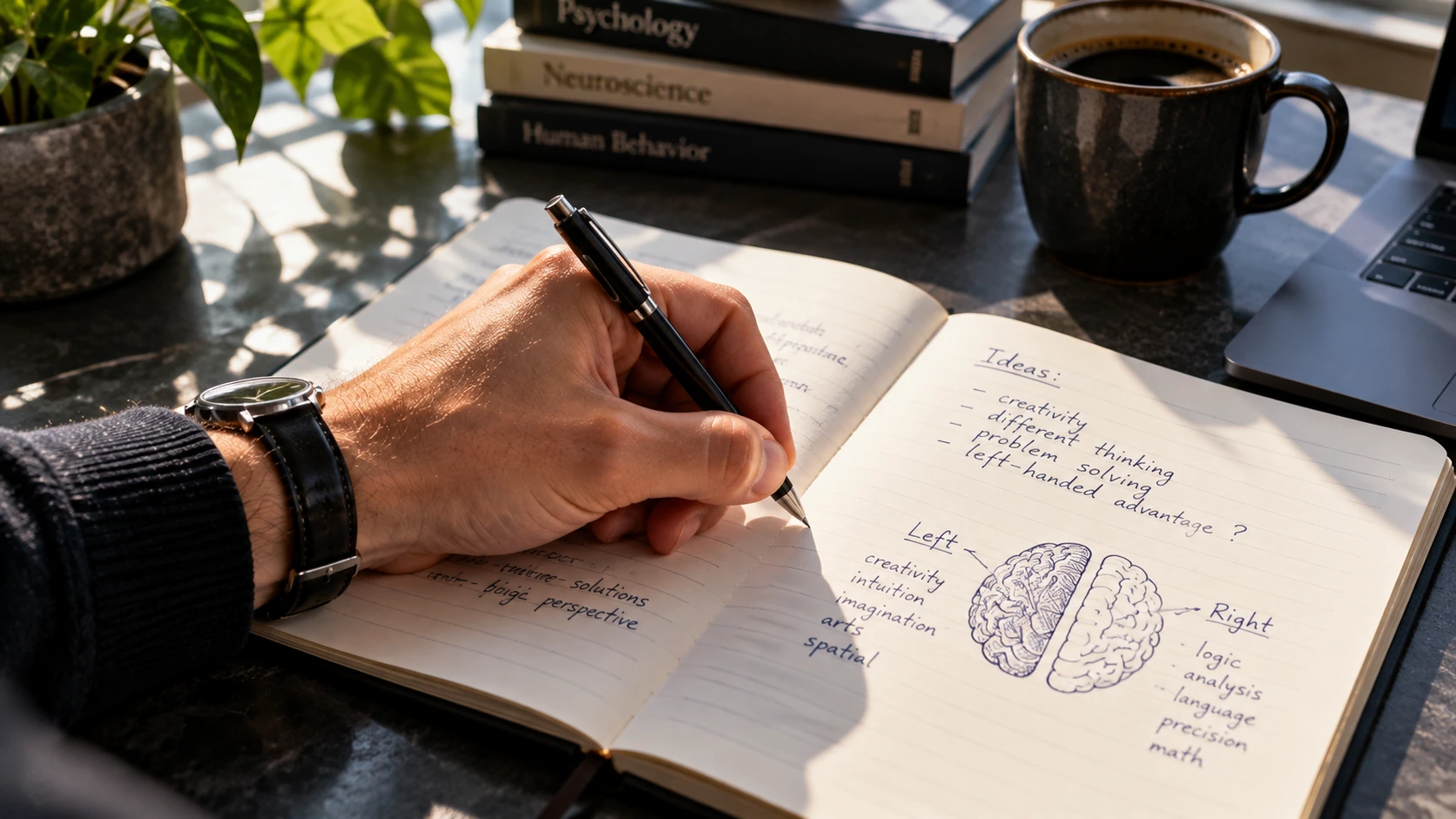
PRESDA AI-generated editorial illustration, supplied and approved. The notebook's creativity, logic and hemisphere labels are illustrated stereotypes, not established neuroscience. Handedness does not determine intelligence or creativity.
A pair of scissors can make a surprisingly good introduction to neuroscience. In one hand, the blades meet cleanly and the cutting line stays visible. In the other, the same tool can feel awkward. The difference says something about the person using it, but also about a world designed around the majority.
Left-handedness is a normal variation in human development, shaped by multiple biological and environmental influences. It is neither a defect nor a certificate of exceptional talent. Its scientific interest lies in a deeper question: how does a broadly symmetrical body develop such persistent preferences, and why do people differ? Understanding that question takes us from chromosomes and childhood to classrooms, concert stages and the networks connecting the two halves of the brain.
How many people are left-handed?
A major 2020 meta-analysis estimated left-handedness at about 10.6 percent, roughly one person in ten. That is a useful population estimate, not a universal constant. The answer changes with the definition: asking which hand someone writes with is different from measuring preferences across several activities. Researchers must also distinguish left-handedness from the broader category of non-right-handedness. Human handedness: a meta-analysis
Preference and performance are related but different measurements. Someone may write with the left hand, throw with the right and use either hand for some household tasks. Mixed-handedness describes such variation across activities; ambidexterity usually implies unusually similar ability with both hands. A questionnaire cannot simply substitute for a timed dexterity test. Those distinctions matter whenever a headline claims that one group has a special brain or a particular advantage.
Genes influence handedness without dictating it
Hand preference often runs in families, but there is no single dominant or recessive switch that neatly predicts a child's writing hand. MedlinePlus describes a complex trait influenced by genetics and other factors. Left-handed parents can have right-handed children, and right-handed parents can have left-handed children. Even an identical genetic starting point does not guarantee identical handedness. MedlinePlus on handedness
A 2020 genome-wide study identified 41 genetic associations with left-handedness and seven with ambidexterity. Associations point toward biological processes worth investigating; they do not reveal an individual child's destiny or establish that every associated variant directly causes the trait. Brain development involves many interacting pathways. The useful picture is of shifting probabilities, not a hidden genetic label dividing humanity into two fixed types. Large-scale genetic study
Childhood: observe the preference, do not impose it
Young children explore objects with both hands, and consistency develops over time. One hand may become the skilled actor while the other stabilizes the paper or holds a container. This teamwork is part of useful motor development, not evidence that the supporting hand has become unimportant. Children's occupational therapy guidance advises against forcing a particular hand and instead encourages opportunities to develop a comfortable preference. NHS guidance on preparing to write
Adults can place materials within easy reach and watch what the child chooses across activities, rather than repeatedly moving a pencil to the “correct” hand. Difficulty with writing deserves attention to posture, grip, coordination and teaching, without assuming that left-handedness is the problem. Hand preference alone is not a diagnosis. If a child is struggling, individualized advice is more useful than forcing a timetable based on what siblings or classmates do.
The brain is lateralized, but people are not half-brained
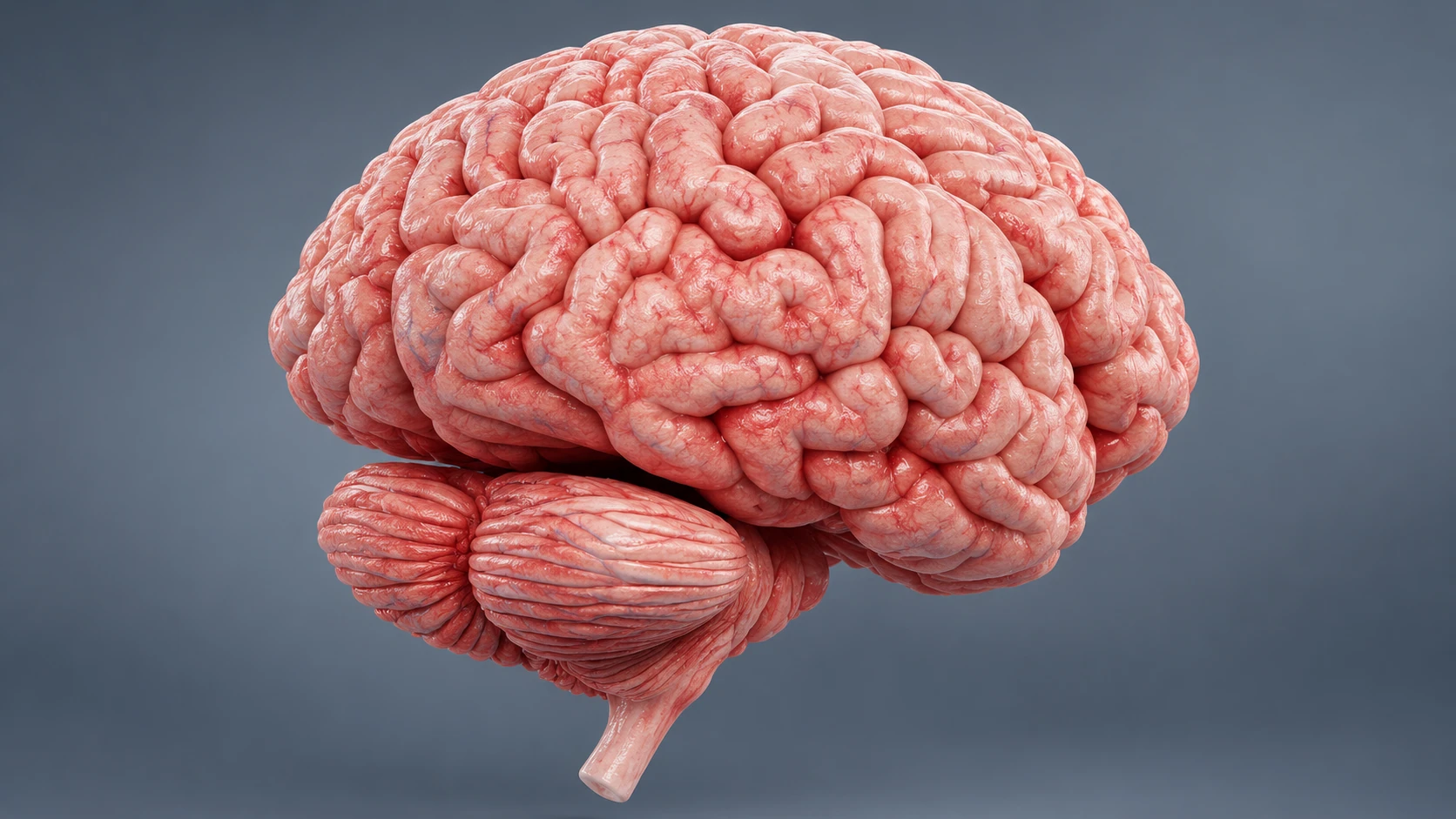
Motor pathways largely connect each cerebral hemisphere with the opposite side of the body. That does not mean a left-handed person thinks entirely with the right hemisphere. Language, attention, movement and perception have different patterns of specialization, and the hemispheres continually communicate. The familiar division into a logical half and a creative half collapses a complex network into a misleading personality quiz. Brain lateralization explained
Language illustrates the distinction. A study of healthy volunteers found right-hemisphere language dominance more frequently among strongly left-handed than strongly right-handed participants. Yet left-handedness did not imply a simple reversal of the usual organization. Hand preference is an imperfect clue to language organization, not a substitute for measuring it. This matters particularly when clinicians plan procedures near language networks. Handedness and language dominance
Intelligence and creativity: the evidence behind the myths
Lists of brilliant left-handers are memorable, but they omit the far larger population from which those names were selected. A systematic review and meta-analyses published in 2018 found intelligence differences between handedness groups to be negligible. A very small average difference in some analyses cannot sensibly predict the ability of an individual. The practical conclusion is that a writing hand is not an intelligence test. Review of handedness and IQ
A 2025 review, supported by meta-analyses, likewise found no overall evidence that left-handed or mixed-handed people are more creative than right-handed people. Results can vary across tests and professions, and creativity itself is difficult to capture in a single score. That uncertainty does not justify turning an appealing stereotype into a fact. Original work depends on skills, knowledge, motivation, opportunity and collaboration, none of which can be read from the hand holding a pen. Handedness and creativity: facts and fictions
A history of pressure to become right-handed
For many people, the important difference was social rather than neurological. Schools and families sometimes treated left-handed writing as a habit to correct. A brain-imaging study of adults who had been made to change hands documented participants' recollections of being forced by teachers and parents to write right-handed during their first school year. Their histories reveal why writing hand alone can conceal a more complicated lifelong preference. Study of converted left-handers
Such experiences should not be generalized into one identical story for every country or generation. Social rules, educational practices and willingness to report left-handedness differ. Nor does the existence of coercion validate every later claim about its medical consequences. The defensible lesson is simpler: an ordinary variation became a target for unnecessary correction. Inclusive teaching should remove that pressure without replacing stigma with extravagant claims of superiority.
What a right-handed environment feels like
Many daily frustrations are design problems in disguise. A right-handed pair of scissors can obstruct the cutting line; a desk with a writing arm on only one side can leave the other forearm unsupported. A shared meal may require a small seating adjustment to avoid colliding elbows. Instruments, control panels and specialized tools can demand either adaptation or a version that better fits the user. The inconvenience is real even when each individual example seems minor.
For handwriting, paper position, a relaxed wrist and a grip that keeps the writing visible can matter more than buying a supposedly magical pen. Lighting should avoid casting the writing hand's shadow across the page. The details vary with writing direction and individual posture, so advice designed for English should not be copied mechanically into Arabic handwriting. Occupational therapy guidance can help find a workable setup. NHS guidance for left-handed writers
Why rarity may help in some sports
In a fast exchange, an unfamiliar angle can matter. Opponents usually gain more practice against right-handed players, making a left-handed delivery or stroke harder to anticipate. Research on elite interactive sports has found that advantages vary with the task and time pressure. Some striking and interception sports show overrepresentation of left-handers; this is not a universal advantage across athletics, nor proof of faster brains in everyday life. Research on interactive sports
Evolutionary explanations sometimes propose a related frequency-dependent benefit: being unusual can help in competition, and the benefit may shrink as the unusual trait becomes common. This is a hypothesis about why variation might persist, not a settled explanation for every left-handed person. Human evolution involves cooperation, development and many competing pressures. Modern sports offer a useful test of particular ideas, but a tournament ranking cannot by itself reconstruct prehistoric selection. Evolutionary perspectives on handedness
Famous left-handers, without the mythology
Leonardo da Vinci provides a well-documented historical example. The Royal Collection's account of his anatomical work describes his left-handedness and habitual mirror writing. His surviving pages are evidence of how he worked, not proof that handedness produced his achievements. Paul McCartney offers a modern example: his official account of the early Höfner bass discusses the practical problem of playing a borrowed instrument left-handed. Royal Collection on Leonardo McCartney's account of his bass
Both stories become more interesting when stripped of the claim that talent follows automatically from laterality. They show people learning techniques and selecting tools. Celebrity lists are especially vulnerable to mistakes when a photograph is reversed, an actor performs a role, or a musician's playing hand differs from their writing hand. A recognizable name can illustrate an experience; it cannot replace a representative study or establish a biological law.
What researchers still need to learn
The central questions remain open at several levels. How do genetic influences interact with early development? Why are preferences strongly consistent in some people but dependent on the task in others? Which differences in brain organization reflect initial development, and which reflect years of practice? Studies that record only “left” or “right” risk losing the detail required to answer those questions. Our feature on the human genome explains why biological traits rarely reduce to one gene. Human DNA
Researchers also need samples that represent more than one culture, age group or educational background, and clearer distinctions between preference, skill and past switching. When handedness is associated with another trait, that association alone cannot establish cause or predict an individual's health. Longitudinal work and transparent methods are more informative than sensational claims based on small groups. The same caution applies to broad claims about multilingual minds. Bilingual brains
A better question than “Are left-handers special?”
Left-handed people are not a separate neurological species. They are part of the range through which human brains organize movement and learning. That range is scientifically valuable precisely because it resists an easy binary. The brain can be specialized without being divided into competing personalities, and a person can prefer one hand without fitting a package of psychological traits. The human brain
The useful practical response is neither correction nor mythmaking. Offer children appropriate tools, let adults choose comfortable equipment, and treat scientific averages as averages. The scissors at the beginning of this story need not become a test of perseverance. Sometimes a better design is all that is required, leaving the person holding it free to get on with the much more interesting business of making something.
FAQ
Frequently Asked Questions
What is this PRESDA article about?
Why are some people left-handed? Explore prevalence, genetics, brain lateralization, childhood, everyday challenges and myths about creativity and IQ.
Which category does this story belong to?
This story is part of PRESDA's Science coverage.
Who published this article?
Left-Handed People: The Science Behind Being Left-Handed was published by PRESDA Editorial on PRESDA.
PRESDA Dispatch
Stay Informed. Stay Aware.
A sharp briefing across AI, gaming, sport, business, world affairs, paparazzi, and lifestyle.