PETER AND MARGARET: THE DOLPHIN EXPERIMENT THAT SHOCKED THE WORLD
In the 1960s, Margaret Howe Lovatt lived alongside a dolphin named Peter in an extraordinary attempt to bridge the communication gap between humans and another species. What happened inside Dolphin House became one of the strangest and most controversial stories in animal research.
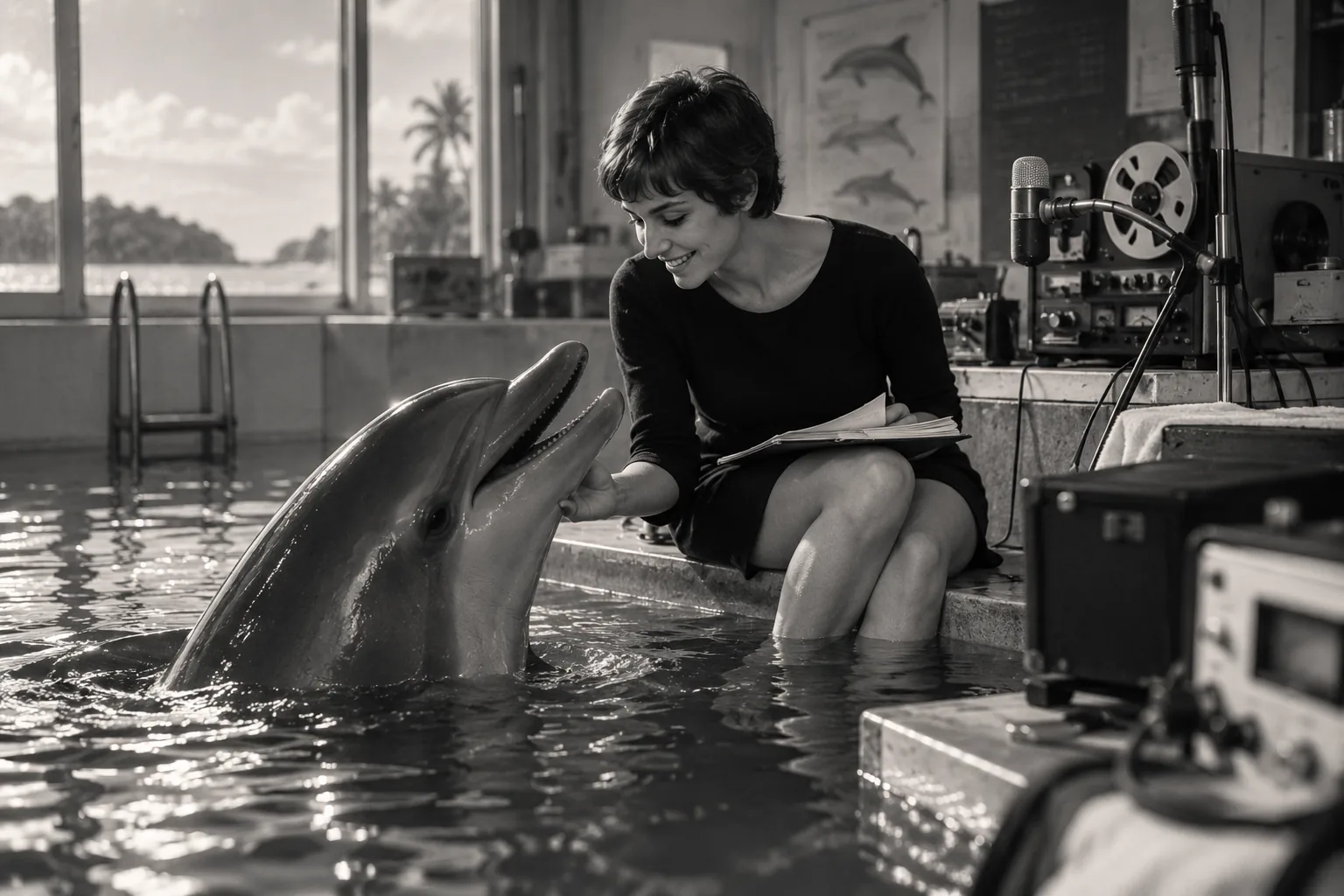
In 1965, inside a partly flooded laboratory on St. Thomas in the U.S. Virgin Islands, a young woman was living beside a bottlenose dolphin.
Her name was Margaret Howe Lovatt.
The dolphin was named Peter.
The goal sounds almost unbelievable today: could a dolphin learn to reproduce human speech?
This was not an internet legend. It was a real research project, attached to one of the strangest chapters in the history of animal communication science.
It began with curiosity about intelligence.
It ended with controversy, ethical questions, sensational headlines and a dolphin whose death became wrapped in myth.
The truth is more interesting than the myth.
The Strange Experiment
Dolphin House was an unusual laboratory built around an unusual question.
Researchers were not merely asking whether dolphins were smart. They were asking whether humans could cross the communication gap between species.
Peter was a young male bottlenose dolphin. Margaret Howe Lovatt was not a conventionally trained scientist, but she became central to the project because of her patience, observational ability and willingness to spend extraordinary amounts of time with the animals.
The setting was radical: a human living area adapted so a dolphin could move through water while Margaret worked, slept, recorded sounds and carried out vocal lessons.
The aim was to see whether repeated close contact could help Peter imitate human sounds.
It was a real attempt at interspecies communication.
It was also an experiment that would not look acceptable, rigorous or ethically simple by many modern standards.
John C. Lilly And The Dream Of Talking To Dolphins
The intellectual force behind the project was John C. Lilly, an American neuroscientist, physician and researcher fascinated by dolphin intelligence.
Lilly was drawn to dolphin brains, vocal ability and social behavior. His 1961 book Man and Dolphin argued that meaningful communication between humans and dolphins might eventually be possible.
That idea landed in a particular cultural moment.
The early 1960s were shaped by the space age, cybernetics, psychology, Cold War science funding and a growing fascination with intelligence beyond the human species.
If humans might one day encounter intelligent extraterrestrial life, some researchers wondered, could we first learn to communicate with another intelligent species already living on Earth?
Dolphins seemed like ideal candidates: social, acoustic, large-brained and visibly responsive to human interaction.
Why NASA And SETI Were Interested
Lilly's work attracted support from NASA and other U.S. sources because it touched a serious intellectual problem: communication with non-human intelligence.
Researchers interested in extraterrestrial intelligence, including figures such as Frank Drake and Carl Sagan, saw a conceptual connection between dolphin communication and future contact with alien intelligence.
That connection should be described carefully.
NASA did not design the infamous sexual details later associated with Peter and Margaret. Nor was NASA responsible for Lilly's later LSD experiments with dolphins.
The link was broader and more scientific: if humans could not learn to understand an intelligent mammal on Earth, what did that say about communication with life elsewhere?
This sits beside a wider PRESDA theme explored in our article on how humans learned to speak: language is not just sound. It is shared meaning.
Margaret Arrives At Dolphin House
Margaret Howe Lovatt first visited Lilly's laboratory in 1964 while living on St. Thomas.
According to Christopher Riley's detailed Guardian feature, Margaret impressed anthropologist Gregory Bateson with her observations of the dolphins and became increasingly involved in the research.
The laboratory housed dolphins named Peter, Pamela and Sissy.
Peter, a young male, became the focus of Margaret's vocalization work.
Margaret was in her early twenties and did not fit the traditional profile of a senior laboratory researcher.
But the experiment depended less on formal lectures and more on daily patience: listening, repeating sounds, documenting behavior and creating a relationship in which a dolphin might attempt human-like vocal imitation.
Living With Peter
Margaret proposed an extraordinary change.
Instead of repeatedly separating human and dolphin, she wanted to share a space with Peter for extended periods.
The upper level of the laboratory was waterproofed and partially flooded. Water covered the floor. A desk was suspended. A sleeping area and recording equipment were arranged around the wet environment.
Peter could move through the space while Margaret worked with him.
The idea was to remove the constant interruption of moving between human and dolphin worlds.
Peter spent six days a week with Margaret and periodically returned to the other dolphins.
The arrangement was intimate in the original scientific sense: close, continuous and observational.
It was also fragile.
The more the experiment depended on one human-dolphin relationship, the harder it became to separate data from attachment, training from companionship and observation from interpretation.
Could Peter Speak?
Margaret carried out repeated vocal lessons with Peter.
She tried to encourage him to imitate human sounds and phrases, including the famous attempt to shape something like 'Hello Margaret.'
Dolphins are capable acoustic learners. They can imitate some sounds and learn vocal patterns.
But Peter did not learn English.
He did not demonstrate human language.
That distinction is essential.
Vocal imitation means producing a sound that resembles another sound.
Language involves symbolic meaning, flexible use, grammar, shared reference and open-ended communication.
Peter's attempts were remarkable as vocal behavior, but they were not evidence that a dolphin had acquired English.
The experiment therefore sits between wonder and failure.
Something unusual happened. The original goal was not achieved.
The Part Of The Story That Became Infamous
The most sensational part of the Peter and Margaret story concerns sexual behavior.
Peter was a sexually maturing male dolphin. During the live-in study, he sometimes directed sexual behavior toward Margaret.
At first, Margaret would interrupt the lessons and take him to the female dolphins.
She later explained that repeatedly stopping the work became disruptive. According to her recollections reported by The Guardian, she sometimes manually relieved Peter's arousal so the lessons could continue.
Margaret described this as non-sexual on her part.
PRESDA is including this because it became central to public retellings of the experiment, not because it should define the whole project.
The detail later overwhelmed the actual communication research in popular coverage.
A difficult animal-behavior problem became a lurid headline.
The result is that many people know Dolphin House only through sensational fragments rather than through the scientific question that produced it.
LSD And John Lilly
Lilly's work became more controversial as he grew increasingly interested in LSD research.
He administered LSD to some dolphins while studying their responses.
The crucial distinction is Peter.
Margaret opposed giving LSD to Peter and said Lilly agreed not to administer it to him.
Therefore, the article should not say Peter was given LSD.
Lilly's broader LSD work contributed to controversy around his scientific reputation and the laboratory's direction.
The dolphin communication project had begun as an ambitious question about intelligence.
By the mid-1960s, parts of the work were moving into territory that many scientists considered uncontrolled, unconventional and ethically troubling.
The Experiment Ends
Funding eventually faded and Dolphin House closed.
Peter and the other dolphins were transferred to Lilly's facility in Miami.
The new environment was reportedly smaller and less stimulating than the flooded living space Peter had shared with Margaret.
That move ended the central relationship on which the experiment had depended.
It also revealed a weakness in the project design.
When research becomes so dependent on one unusual environment and one human-animal bond, it becomes hard to reproduce, verify or continue elsewhere.
Dolphin House had been built around an extraordinary setup.
When that setup disappeared, the experiment effectively disappeared with it.
What Happened To Peter?
Peter died only weeks after being transferred to Miami.
Margaret later recalled receiving a call from Lilly in which he described Peter's death as suicide.
There is a biological basis behind why people made that claim: dolphins are conscious breathers. They must actively surface to breathe rather than breathing automatically in the same way sleeping humans do.
But the evidence distinction matters.
We cannot scientifically establish Peter's subjective intention from the available evidence.
Claims that he deliberately killed himself because Margaret left him, or died of a broken heart, are interpretations made by people associated with the story and repeated in later media.
They are not established scientific conclusions.
A careful account can say Peter died soon after transfer and that Lilly described the death as suicide.
It should not state as fact that Peter chose death from heartbreak.
Did The Experiment Fail?
In one sense, yes.
Peter never learned human language. Lilly's most ambitious goal was not achieved.
The methodology would not meet many expectations of rigorous modern behavioral science: controlled conditions, reproducibility, independent measurement, stronger welfare protocols and clearer separation between observation and interpretation.
In another sense, the episode exposed a serious question that science still cares about.
How sophisticated is dolphin communication?
Do dolphins use individual signals?
How much do they learn socially?
Can we understand animal communication without forcing it into a human-language frame?
Dolphin House failed to teach a dolphin English.
It did not end the study of dolphin intelligence.
What Science Knows About Dolphin Communication Today
Modern dolphin research no longer depends on teaching dolphins to sound like humans.
Scientists increasingly study dolphin communication on its own terms.
Bottlenose dolphins use signature whistles: individually distinctive vocal signals often compared loosely to names. Research published in Proceedings of the Royal Society B showed that dolphins can respond to signature whistles copied from familiar individuals.
Dolphins are sophisticated acoustic learners.
They show complex social behavior, long-term social bonds and flexible vocal learning.
They also use echolocation, producing clicks and interpreting returning echoes to build an acoustic picture of their environment.
None of this means dolphins possess English-like language.
It means dolphin communication is complex, meaningful in dolphin social life and worthy of study without turning dolphins into failed humans.
That is a better question than the one Dolphin House tried to answer.
Could AI Finally Help Us Understand Dolphins?
A modern PRESDA angle is unavoidable: AI may give animal communication research new tools.
Machine learning can analyze huge quantities of recordings, detect patterns across time and compare vocalizations with behavior in ways humans could not do manually.
Computational bioacoustics is already being used to study whales, birds, primates, bats and dolphins.
But caution is essential.
AI has not translated dolphin language.
A model can find patterns. It cannot automatically tell us what those patterns mean.
Meaning requires context: who produced the sound, who heard it, what happened before, what happened after and whether the signal changes behavior.
The future may not be teaching dolphins English.
It may be using data to understand what dolphins are already communicating to each other.
In that sense, the technology Lilly dreamed about may arrive through analysis rather than imitation.
Science, Ethics And The 1960s
Dolphin House belongs to a different ethical era.
Modern researchers would ask sharper questions about animal welfare, captivity, experimental design, human-animal boundaries, drug experimentation and consent in human research roles.
Peter's live-in study blurred categories that today would receive intense scrutiny.
Lilly's LSD experiments with dolphins would face serious ethical and scientific criticism.
The captivity environment itself would be questioned by many animal-welfare researchers and advocates.
At the same time, history should be handled carefully.
The people involved were working inside the scientific and cultural assumptions of their time.
Some were genuinely trying to understand non-human intelligence.
The lesson is not that curiosity was wrong.
The lesson is that curiosity needs structure, welfare standards and humility.
Myth Vs Reality
MYTH: Peter learned to speak English.
REALITY: Peter attempted vocal imitation, but he did not acquire human language.
MYTH: Peter was given LSD.
REALITY: Lilly administered LSD to other dolphins, but Margaret said Peter was excluded.
MYTH: NASA created a bizarre dolphin-sex experiment.
REALITY: The project concerned dolphin communication. Peter's sexual behavior emerged during Margaret's live-in study and later dominated sensational coverage.
MYTH: Scientists proved Peter committed suicide because Margaret left.
REALITY: Lilly described the death as suicide, but Peter's intent and emotional state cannot be scientifically established from the available evidence.
The Legacy Of Peter And Margaret
The experiment did not teach a dolphin English.
Instead, it became a strange chapter in the history of attempts to understand non-human intelligence.
Its legacy is uncomfortable because it contains several truths at once.
The research question was fascinating.
The method was flawed.
The human-dolphin relationship was extraordinary.
The popular retelling became sensational.
Modern dolphin science moved in a better direction by asking what dolphin signals mean inside dolphin life. PRESDA's wider Science coverage also looks at how humans learned to speak and why dreams happen, two questions that show how communication and consciousness remain difficult to explain.
Today, scientists are less interested in asking whether dolphins can learn to speak like humans and more interested in understanding what dolphins may already be communicating to one another.
Perhaps the biggest mistake of Dolphin House was not believing dolphins could communicate.
It was assuming that, to prove it, they needed to communicate like us.
FAQ
Frequently Asked Questions
What is this PRESDA article about?
In the 1960s, Margaret Howe Lovatt lived alongside a dolphin named Peter in an extraordinary attempt to bridge the communication gap between humans and another species. What happened inside Dolphin House became one of the strangest and most controversial stories in animal research.
Which category does this story belong to?
This story is part of PRESDA's Science coverage.
Who published this article?
PETER AND MARGARET: THE DOLPHIN EXPERIMENT THAT SHOCKED THE WORLD was published by PRESDA Editorial on PRESDA.
PRESDA Dispatch
Stay Informed. Stay Aware.
A sharp briefing across AI, gaming, sport, business, world affairs, paparazzi, and lifestyle.