Why Crocodiles Survived the Asteroid That Killed Dinosaurs
Warm refuges, freshwater food webs and low energy needs may explain crocodile survival. What a 2026 study adds, and why not all relatives survived.
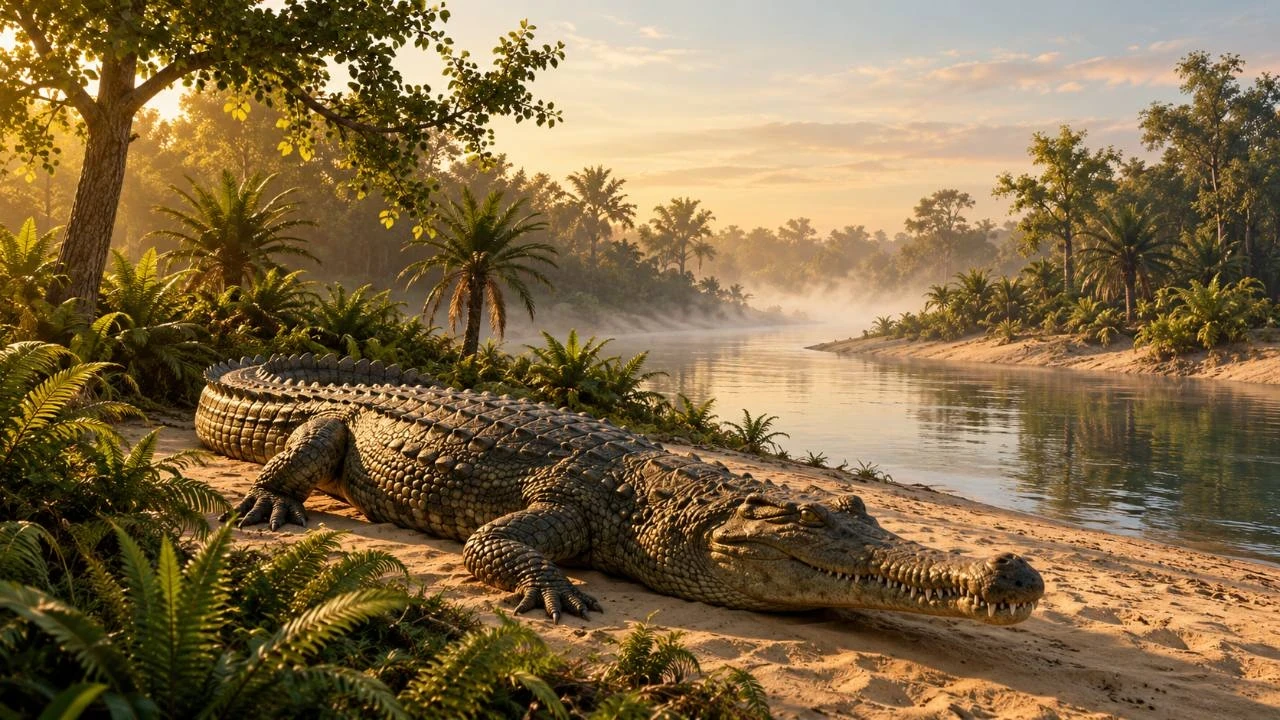
AI editorial illustration of a crocodilian in a river habitat, not fossil evidence or a precise reconstruction of a species or location at the end-Cretaceous extinction. Credit: PRESDA.
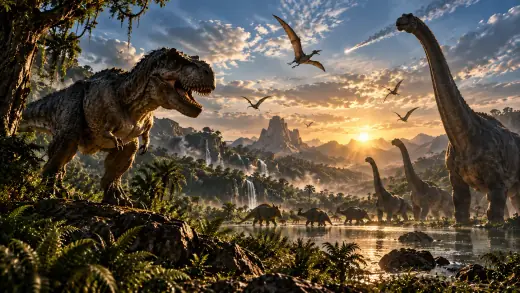
The asteroid that struck Earth about 66 million years ago did not leave crocodile relatives untouched. Some lineages disappeared, while others survived a catastrophe that ended the reign of non-avian dinosaurs. The question is therefore not why an indestructible animal escaped extinction. It is why particular branches of a diverse group persisted when so much of the surrounding world collapsed. Birds, themselves dinosaurs, survived too. Natural History Museum overview
The most plausible answer combines habitat, food supply, energy requirements and geography. A new study published in Science Advances on 21 October 2026 adds a specific argument: suitable warm refuges may have remained available to crocodile-line archosaurs even during severe post-impact cooling. It is evidence for one part of the explanation, not proof that temperature alone decided who lived. University of Bristol publication record
What did the new crocodile study find?
The researchers examined more than 7,000 fossil and living occurrence records covering over 400 species across roughly 245 million years. They combined evolutionary relationships with climate reconstructions to investigate how the group's environmental preferences changed through time. The work suggests a persistent association with warm climates, with geographic ranges shifting as suitable conditions moved. The study concerns crocodile-line archosaurs, a much broader historical group than the crocodiles alive today. UCL research summary
A climate preference is not evolutionary immobility
In this context, a climatic niche means the temperature and rainfall conditions associated with a lineage. Conservatism means some preferences remain relatively stable over evolutionary time. It does not mean crocodile relatives stopped evolving, always looked alike or occupied identical habitats. The study identifies long-term structure in those preferences while also recording changes. A stable environmental tendency can coexist with substantial differences in anatomy, diet and way of life. Study abstract and publication details
That distinction changes the familiar image of a living fossil. A modern crocodile is not a specimen that has waited unchanged since the dinosaurs. It belongs to a surviving evolutionary branch, with its own history. Looking only at living species also hides the diversity that extinction removed. Survival and continuity are real, but they are not the same as biological stasis.
Could warmth survive an impact winter?
Dust and other material injected into the atmosphere after the Chicxulub impact reduced incoming sunlight and disrupted ecosystems. In the new study's simulations, scenarios with 5% and 10% reductions in sunlight still left suitable warm regions, whereas a 15% reduction did not. These are model sensitivity scenarios, not direct measurements of how much sunlight was lost everywhere after the impact. The analysis concerns conditions over subsequent decades and centuries, rather than survival of the immediate blast. UCL explanation of the simulations
The value of that result is conditional. If sufficiently warm areas remained, temperature need not have eliminated the whole group. But a place can be warm enough and still lack food, oxygen or breeding opportunities. Climate suitability therefore identifies a possible refuge, not a complete functioning ecosystem. The difference between those two ideas is where much of the extinction problem remains.
Why freshwater food webs may have helped
A separate body of research examines why freshwater environments suffered less severe proportional losses than many marine ecosystems at the boundary. A 2013 impact-winter study described several possible buffers, including food webs supported by detritus, dormancy and local thermal refuges. When sunlight-dependent production falls, organic material already stored in soils and sediments can help sustain parts of the food chain. Impact winter model in Journal of Geophysical Research: Biogeosciences
Detritus feeds a system, not necessarily its largest predator
This does not mean crocodile ancestors survived by eating dead leaves. Decomposing material can support organisms that in turn sustain larger consumers. The ecological argument concerns the food web as a whole. Freshwater habitats also varied: flowing water, groundwater connections and local conditions could change the risks. No single river or lake can stand in for every aquatic environment, and water was not an automatic shield against extinction.
The 2013 paper offered a framework for explaining patterns, not a record of individual animals finding shelter. Its proposed mechanisms help connect physical disruption to ecological survival. They also explain why the simple contrast between animals on land and animals in water is inadequate: marine communities could be devastated even though they, too, were submerged. Freshwater and marine extinction analysis
Lower energy needs could buy time
Ectothermic animals rely heavily on external heat and generally need less food than similarly sized endotherms. That can matter when prey becomes scarce, although cold also constrains activity. The authors of the new study identify low energy requirements, flexible diets and semi-aquatic habits among the factors that probably worked alongside climate. None is a universal survival certificate. An advantage in one environment can become a limitation in another. Researchers' interpretation and caveats
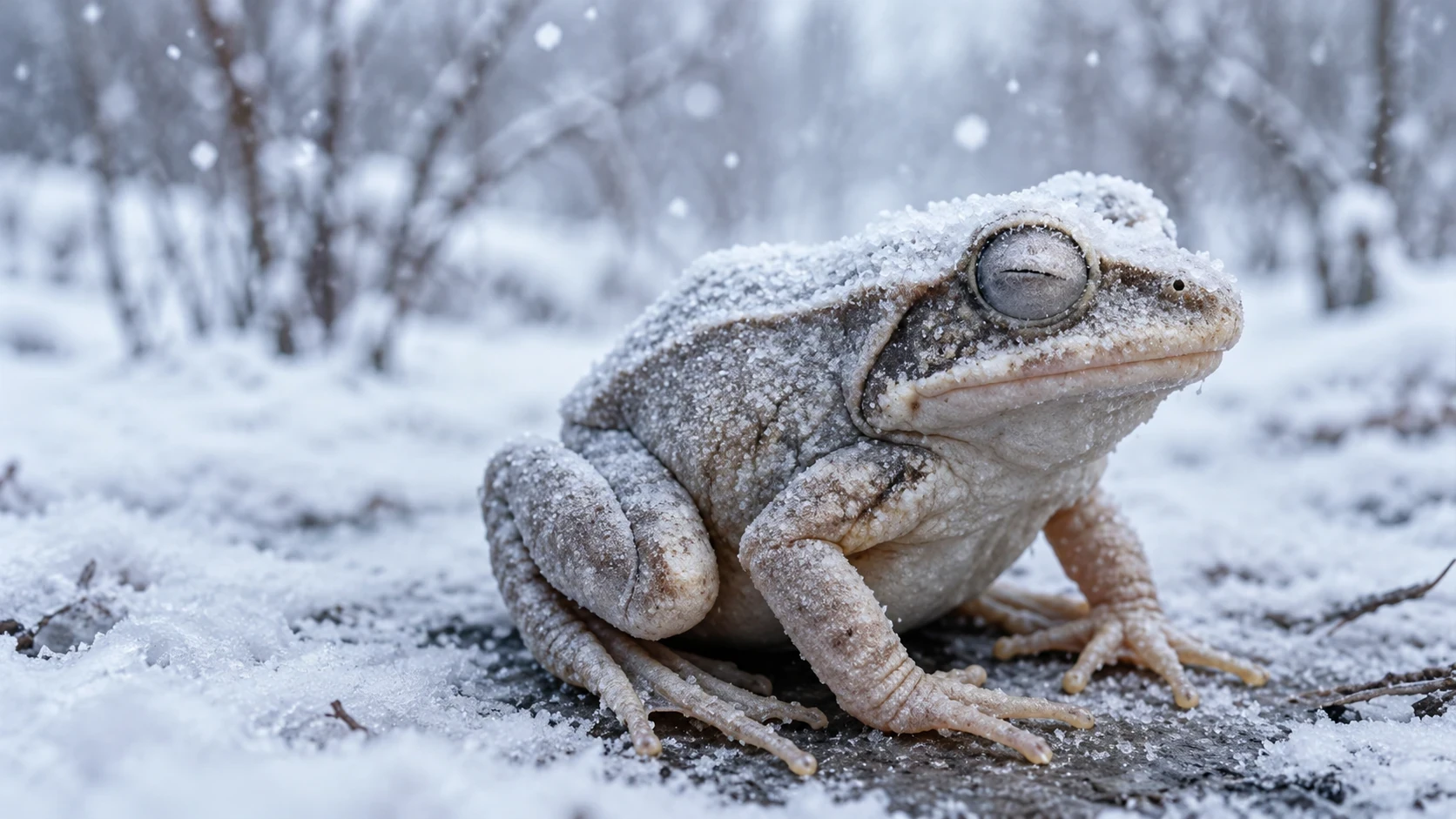
PRESDA's explanation of frogs that survive freezing describes a very different physiological strategy. The comparison is useful precisely because it prevents a false equivalence: cold tolerance in some frogs does not show that crocodiles could freeze and recover. Species survive environmental stress through specific mechanisms, not a generic reptile or amphibian toughness.
Not all crocodile relatives survived
Research published in Nature Communications in 2015 shows that climate shaped crocodylian diversity over long timescales and that extinction removed multiple crocodile-relative lineages. The end-Cretaceous boundary was a filter, not a clean division between doomed dinosaurs and untouched crocodiles. Different branches had different geographic ranges and ecologies, so the fate of one cannot be assigned to the whole group. Climate and crocodylian evolutionary history
The broader story is covered in PRESDA's account of dinosaurs, fossils and extinction. Fossils reveal which animals existed and where they have been found, but the record is incomplete. Preservation and sampling affect what researchers can reconstruct. Climate models add another kind of evidence, with their own assumptions. Agreement between different approaches strengthens an explanation without making every detail certain.
What remains unresolved?
Researchers still have to connect global climate scenarios with local food webs, surviving populations and the uneven fossil record. The 2026 work makes warm refuges a testable part of that discussion. It does not establish one cause that explains every survivor, nor does ancient survival guarantee protection from today's habitat loss. Crocodiles endured because some lineages found a viable combination of conditions. Understanding that combination is more revealing than imagining an animal immune to catastrophe.
FAQ
Frequently Asked Questions
What is this PRESDA article about?
Warm refuges, freshwater food webs and low energy needs may explain crocodile survival. What a 2026 study adds, and why not all relatives survived.
Which category does this story belong to?
This story is part of PRESDA's Science coverage.
Who published this article?
Why Crocodiles Survived the Asteroid That Killed Dinosaurs was published by PRESDA Editorial on PRESDA.
PRESDA Dispatch
Stay Informed. Stay Aware.
A sharp briefing across AI, gaming, sport, business, world affairs, paparazzi, and lifestyle.