The Frogs That Freeze and Come Back to Life
Wood frogs survive ice in their bodies through extraordinary winter adaptations. Explore glucose, urea, Alaskan research and the limits of freeze tolerance.
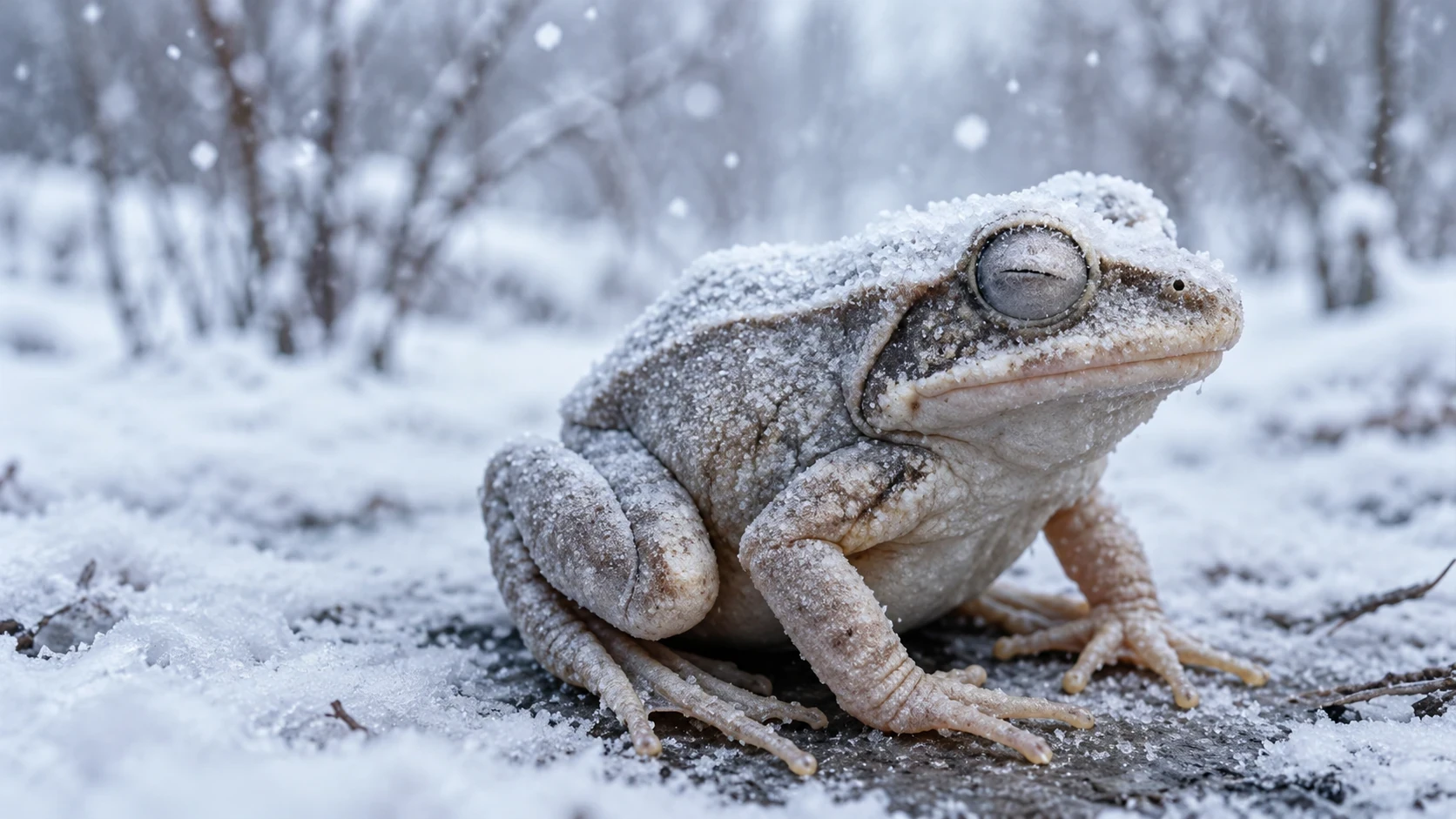
PRESDA · AI-generated editorial illustration, not a field photograph or a species-identification reference. Wood frogs normally overwinter beneath forest litter and snow.
Some frogs can survive the formation of ice inside their bodies and resume activity after thawing. The wood frog, commonly called Rana sylvatica or Lithobates sylvaticus in scientific literature, is the best-known example. Its winter survival is an adaptation called freeze tolerance, not death followed by resurrection. Colorado Parks and Wildlife: wood frog
The phrase “come back to life” captures the drama but obscures the mechanism. A motionless animal with no detectable heartbeat looks very different from a living frog hopping through spring leaves. Yet appearances are not a biological definition of death. The remarkable achievement is keeping essential cellular systems recoverable while the familiar outward signs of life disappear.
What freezes, and what must remain protected?
Ice outside cells is different from ice inside them
The crucial distinction is where ice develops. In freeze-tolerant frogs, ice forms outside cells while protective mechanisms help preserve the liquid interior and limit damage. Minnesota's wildlife agency describes overwintering wood frogs whose breathing and heartbeat stop while they shelter beneath fallen leaves. Minnesota DNR: winter adaptation
Freezing also draws water away from cells, creating a dehydration problem. A 2009 study explains how concentrated glucose helps maintain liquid within cells and a minimum cell volume as extracellular ice grows. Survival therefore requires more than a substance that simply lowers the freezing point. Research on wood-frog glucose and blood proteins
Think of the challenge as preserving an organized system, not merely a shape. A thawed body would be useless if its membranes and proteins had suffered irreversible injury. This is why a frost-covered animal in a photograph cannot establish freeze tolerance, and why putting an ordinary frog into a freezer is not an experiment to imitate.
How do sugar and urea help?
A coordinated winter response
Research identifies glucose and urea as important cryoprotectants. Glucose production increases after freezing starts; urea can accumulate beforehand. Their effects include limiting ice formation and cellular water loss. These are complementary defenses, not proof that all body fluids remain unfrozen. Costanzo and colleagues: cryoprotectants in Alaskan wood frogs
The seasonal preparation is substantial. A 2013 comparison found that Alaskan wood frogs accumulated greater protective reserves than frogs from southern Ohio and survived lower experimental temperatures. “Wood frog” names a species, but it does not promise identical cold tolerance in every population. Journal of Experimental Biology: northern adaptation
A 2016 experiment tested repeated freezing and thawing. Glucose concentrations rose across successive cycles in the tissues examined. The result helps explain why a single laboratory cooling event may not reproduce the protection built during a fluctuating autumn outdoors. Larson and Barnes: repeated freeze-thaw cycles
The comparison matters beyond frogs. To understand a biological limit, researchers must specify the starting condition, the rate of cooling and the previous history of the animal. A dramatic temperature without those details can turn a measured result into a misleading superpower.
What did researchers actually find in Alaska?
A 2014 field study followed 18 wood frogs in natural winter shelters. All survived; they remained frozen for an average of 193 consecutive days. Recorded minimum temperatures ranged from −8.9°C to −18.1°C. Those numbers describe the monitored group and its conditions, not a universal safe limit. Larson and colleagues: field study
The shelter is part of the survival system
Forest litter and snow provide insulation, so conditions around a frog need not match the coldest air temperature reported by a weather station. University of Alaska Fairbanks reporting describes shallow overwintering depressions protected by leaves, twigs and snow. Habitat and physiology work together. UAF: wood frogs in the north
The winter refuge is easy to overlook because it lacks the obvious architecture of a den. Leaves on the ground can appear untidy to a person and function as shelter for an animal. Looking for the frog therefore means looking at the forest floor as habitat, rather than as material waiting to be cleared.
Are all frogs able to do this?
No. A review in Physiological Reviews describes freeze tolerance in several species, including gray tree frogs and spring peepers, but the degree of tolerance varies. It also distinguishes results from temperate populations and the exceptional endurance recorded in Interior Alaska. Review: molecular physiology of freeze tolerance
Even within one population, season matters. A study comparing winter and spring Alaskan wood frogs found sharply reduced tolerance after hibernation. The same animal's biological state can change the outcome, so a winter record should not be applied to a frog encountered in another season. Costanzo and colleagues: seasonal differences
What happens when spring returns?
After thawing, wood frogs resume activity and reproduce in aquatic habitats. Tennessee's wildlife agency describes early breeding, often before pond ice has entirely disappeared, and a distinctive call resembling a harsh quack. Winter survival is one stage in a life cycle that still depends on suitable breeding water. Tennessee Wildlife Resources Agency
Climate can alter that timing. The US National Park Service describes research on shifts in wood-frog calling as conditions change in Alaska. Cold tolerance does not make an animal independent of its environment: the timing of thaw, reproduction and habitat availability still matters. NPS: climate and wood-frog calls
Does this mean humans could be frozen and revived?
It does not establish that. Studies of frog cryoprotectants address particular tissues, species and conditions. Turning those findings into safe preservation of a complex human organ, let alone a person, would require separate evidence. The distinction between a useful research model and a validated medical procedure is essential.
The wood frog's achievement is impressive without a resurrection story. It shows how survival can depend on chemistry, timing and a sheltered patch of ground. PRESDA's account of the world's oldest living trees explores another case in which a striking biological claim becomes more interesting when its definitions are made precise.
FAQ
Frequently Asked Questions
What is this PRESDA article about?
Wood frogs survive ice in their bodies through extraordinary winter adaptations. Explore glucose, urea, Alaskan research and the limits of freeze tolerance.
Which category does this story belong to?
This story is part of PRESDA's Science coverage.
Who published this article?
The Frogs That Freeze and Come Back to Life was published by PRESDA Editorial on PRESDA.
PRESDA Dispatch
Stay Informed. Stay Aware.
A sharp briefing across AI, gaming, sport, business, world affairs, paparazzi, and lifestyle.