SCIENTISTS DISCOVER A DINOSAUR THAT ATE FRUIT
Meet Infernogallus jamesi, a small dinosaur with unusual jaws. Discover why scientists infer a fruit-rich diet and what its fossil skull actually reveals.
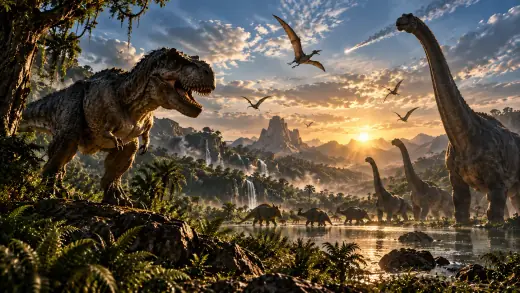
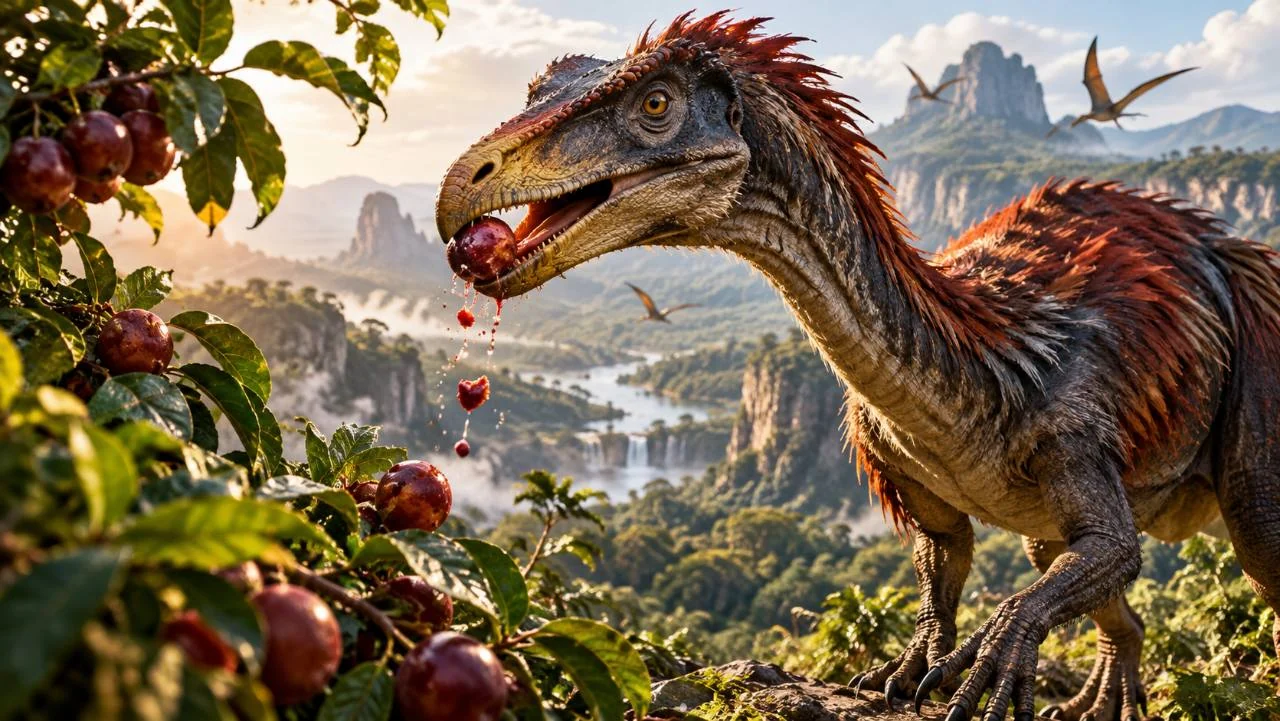
Conceptual illustration, not an anatomical reconstruction of Infernogallus. Its teeth, fruit, colours and scenery are imagined; the actual dinosaur belonged to a toothless group. Editorial image supplied for PRESDA. Original creator and reuse licence not provided.
A dinosaur’s menu is rarely preserved. Usually, palaeontologists have to reconstruct it from the tools left behind: teeth, beaks, jaws and the places where muscles attached. For Infernogallus jamesi, an unusually complete skull has opened a window onto an unexpected feeding strategy: processing soft fruit. The evidence is anatomical, not a fossilised meal caught in the act.
What did scientists discover?
The new species is a small caenagnathid, part of the oviraptorosaur branch of theropod dinosaurs. Its nearly complete articulated skull reveals an unusual arrangement of jaw muscles and surfaces consistent with extensive processing of soft plant food. The researchers’ 2026 Nature Communications paper identifies fleshy fruit as a likely major component of its diet. Funston et al., Nature Communications (2026)
The fossils came from the Hell Creek Formation in the United States. The Royal Ontario Museum describes the adult as roughly turkey-sized and about 12 kilograms, with a toothless, feathered family background. The name Infernogallus means “hell chicken”. That memorable nickname should not disguise the real discovery: a specialised feeding system in a small dinosaur. Royal Ontario Museum, discovery announcement (28 October 2026)
A beak that could do more than snap shut
CT-based reconstruction showed changes in the palate that redirected some chewing muscles. The proposed movement allowed the lower jaw to slide forwards and backwards, helping to mash soft material. Comparable organisation in fruit-eating parrots strengthens the functional interpretation. Similarity supplies a useful test of an idea, rather than proof that an extinct animal ate exactly like a living parrot. Stony Brook University, skull and feeding mechanics (2026)
This distinction is the difference between evidence and reconstruction. Bone preserves geometry; muscle action and diet must be inferred. A convincing dietary argument brings several clues together and asks whether an alternative explains them better. It does not need a perfectly preserved fruit in the mouth, but it should not be presented as if such a fruit had been found.
Did dinosaurs help plants spread?
Fruit eating raises another question: what happened to the seeds? An animal can carry plant material away from its source, potentially affecting dispersal. Yet identifying a fruit-adapted jaw does not demonstrate how far seeds travelled, whether they survived or which plants benefited. The new work makes that ecological relationship more plausible, while leaving its scale unresolved.
This is also not the first evidence of fruit consumption anywhere in the dinosaur family tree. A 2022 study of the early bird Jeholornis used skull comparisons and preserved seeds to support fruit eating. Birds are living dinosaurs. Infernogallus adds a different, non-avian example, so “first” needs a precise definition rather than an unrestricted headline claim. Hu et al., eLife (2022)
Reading the fossil without mistaking the illustration for it
The hero is a supplied conceptual illustration, not a scientific reconstruction of Infernogallus. Its teeth, colours, fruit and scenery are imagined. The actual discovery concerns a toothless dinosaur’s skull and the feeding mechanics inferred from it. Our broader dinosaur history explains how fossils help reconstruct an animal’s place in deep time.
Related reading: The rise and fall of the dinosaurs.
FAQ
Frequently Asked Questions
Which fruit-eating dinosaur was identified?
Infernogallus jamesi, a small caenagnathid oviraptorosaur from the Hell Creek Formation. Its jaw anatomy supports a diet rich in soft plant foods, especially fleshy fruit.
Was a fruit found in its mouth?
The reported argument is based on skull anatomy and reconstructed feeding mechanics, not a fruit preserved in the mouth.
Does the hero show its verified appearance?
No. It is conceptual editorial artwork. Infernogallus belonged to a toothless group, unlike the toothed animal in the supplied illustration.
PRESDA Dispatch
Stay Informed. Stay Aware.
A sharp briefing across AI, gaming, sport, business, world affairs, paparazzi, and lifestyle.