WHY ARE ZEBRAS BLACK AND WHITE?
Why do zebras have stripes? Explore the strongest evidence for biting-fly defence, the limits of camouflage and cooling theories, and what remains uncertain.
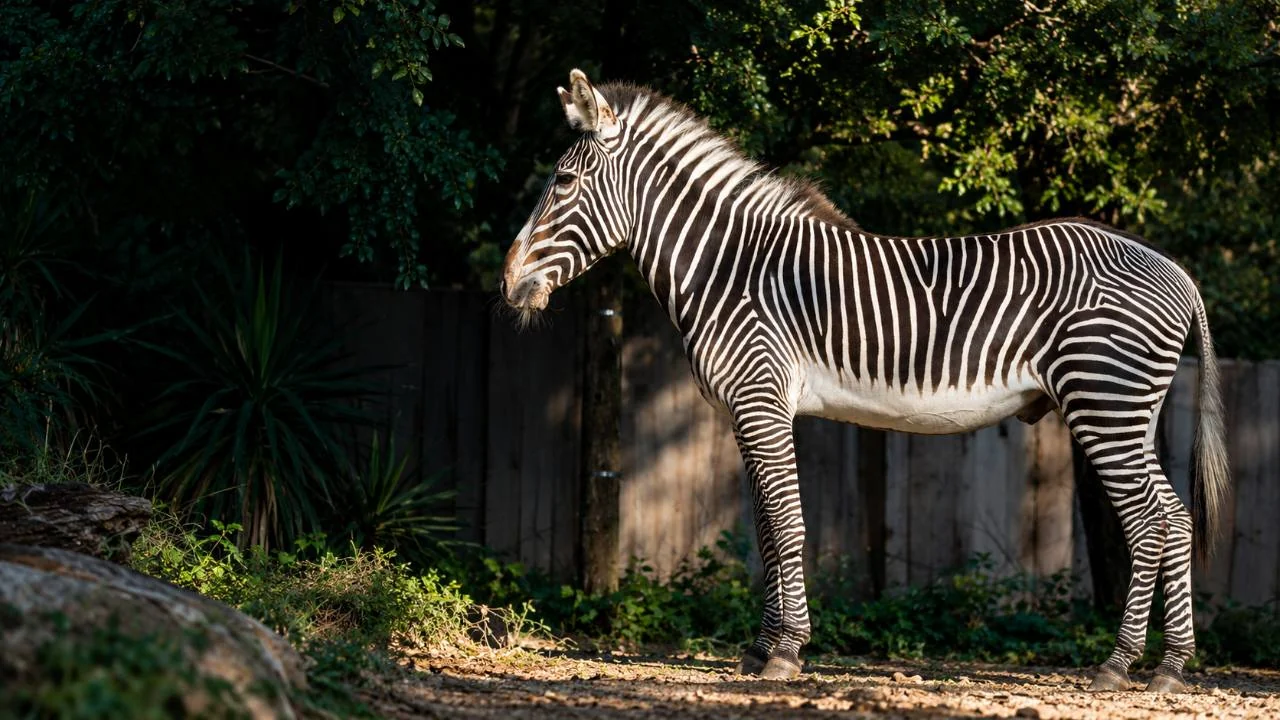
Illustrative scene, not a research photograph. AI-generated editorial illustration supplied for PRESDA. Original creator and reuse licence not provided.
A zebra seems to advertise itself. Against grass, dust or trees, its stripes look almost impossible to miss. Yet an evolutionary explanation has to answer a harder question than why the pattern looks striking to us: what advantage could it give the animal wearing it?
The short answer: stripes interfere with biting flies
The strongest experimental explanation is that stripes reduce successful landings by biting flies, especially horseflies. In a 2019 study, flies approached zebras and horses, but landed less often on zebras. Striped coats placed on horses also reduced landings on the covered areas. This is protection against landing, not an invisible shield against every insect. Caro et al., PLOS ONE (2019)
The coats are a crucial part of the experiment. Comparing a horse with a zebra leaves differences in smell, movement and temperament. Changing the pattern worn by the same kind of animal helps isolate the visual effect. The useful question becomes whether a fly can complete its final approach, rather than whether it notices a zebra at all.
Why the landing mechanism is still being tested
Experiments reported in 2023 found fewer landings on strongly contrasting patterns with small dark elements. The results did not support several proposed visual-illusion mechanisms under the conditions tested. Researchers can therefore be more confident that pattern matters than that one particular optical explanation has solved the whole problem. University of Bristol, experiments on stripe patterns (2023)
There is also a difference between showing a benefit today and reconstructing its evolutionary origin. A comparative study published in 2014 found associations between striping and biting-fly pressure across equids. That geographical evidence complements the experiments, but a correlation alone cannot identify every selective force in the past. Caro et al., Nature Communications (2014)
What about camouflage and cooling?
Camouflage sounds intuitive until we ask who is looking. A 2016 study modelled how zebra stripes would appear through the visual systems of predators and zebras. Its results challenged the idea that stripes provide effective background camouflage. These were visual estimates, however, not a field trial measuring lions’ hunting success. Melin et al., PLOS ONE (2016)
Cooling is another attractive hypothesis because dark and light surfaces absorb sunlight differently. A 2018 experiment using water-filled barrels covered with hides did not find a cooling advantage for stripes. Such models test a proposed physical effect; they cannot reproduce every feature of a living, sweating animal. The result limits a claim rather than ending every temperature question. Horváth et al., Scientific Reports (2018)
A spectacular pattern, a careful answer
The best answer is therefore neither “nobody knows” nor “every mystery is solved”. Biting-fly avoidance has unusually direct experimental support. The precise landing mechanism, the balance of evolutionary pressures and possible additional functions require further work. A pattern can have a well-supported benefit without every detail of its history being settled.
The zebra’s appeal is a reminder that an obvious feature need not have an obvious explanation. Good animal science turns a familiar sight into competing predictions, then asks which survive a fair test. That is a more interesting story than a single clever explanation repeated as certainty.
Related reading: Animal intelligence and Alex the parrot.
FAQ
Frequently Asked Questions
What is the leading explanation for zebra stripes?
Experimental evidence most strongly supports reduced landings by biting flies. The exact visual mechanism remains under investigation.
Do stripes stop all insect bites?
No. Fewer successful landings in experiments do not establish complete protection against every insect or disease.
Is zebra cooling scientifically settled?
No. Barrel experiments found no striped cooling advantage under their conditions, but did not reproduce all processes in living animals.
PRESDA Dispatch
Stay Informed. Stay Aware.
A sharp briefing across AI, gaming, sport, business, world affairs, paparazzi, and lifestyle.