Wild Tiger Mothers Reveal Surprising New Behavior
PBS footage from Nepal shows a tigress apparently caring for another mother's cubs. What was observed, what remains uncertain and why it matters.
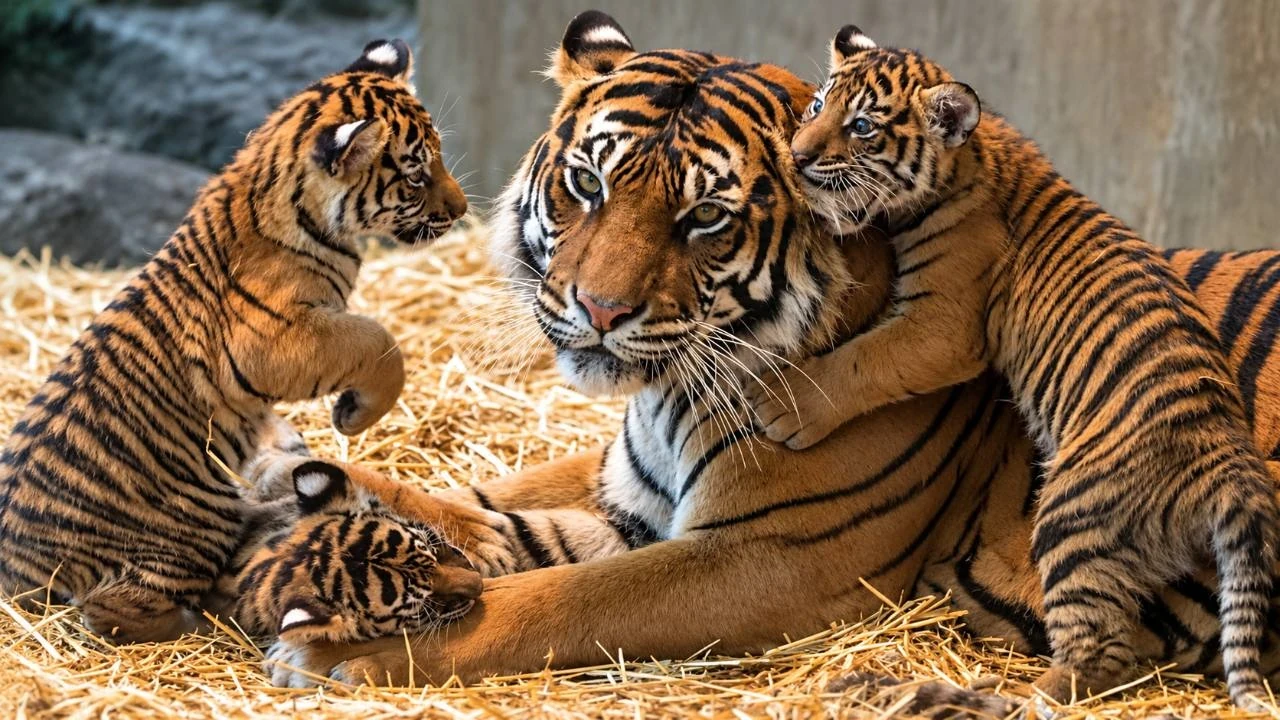
User-supplied editorial image of a tiger with cubs in an enclosure. It does not depict the documented encounter in Nepal. Photographer and original location have not been independently verified.
Wild tiger mothers have been filmed appearing to look after one another's cubs in western Nepal. The observation, presented in PBS Nature's 2026 documentary Tiger Island, adds detail to an animal too often described simply as solitary. It does not establish that shared childcare is common across wild tiger populations. What it offers is a rare opportunity to see a familiar species behaving in a less familiar way. PBS Nature: Tiger Island
What did the cameras actually record?
In a clip released by PBS, the filming team identifies a tigress named Goma accompanied by four cubs, although she has two of her own. Another female, Jugini, is nearby. The programme interprets the scene cautiously: Goma appears to be looking after Jugini's young. That wording matters. The published footage supports an observation of association and apparent care, rather than a demonstration of a permanent arrangement between the mothers. PBS Nature: the encounter and transcript
Calling the scene a tiger nursery is an appealing shorthand, but it can smuggle in assumptions. Human childcare involves arrangements, expectations and communication that the sequence cannot establish in tigers. The scientifically useful question is narrower: under what circumstances will an adult female tolerate, accompany or protect young that are not her own?
A documentary observation, not a population study
The evidence reviewed for this article is documentary footage and its accompanying account, not a new peer-reviewed experiment measuring the frequency or benefits of shared maternal care. A rare encounter can suggest a research question without answering it. Demonstrating a recurring pattern would require repeated observations, reliable identification of individuals and a record of what happens before and after the apparently unusual event.
Why solitary does not mean socially indifferent
Tigers normally live and hunt without the permanent group structure associated with lions. Yet mothers and dependent cubs already form sustained social units. Smithsonian's National Zoo describes young learning to hunt successfully at roughly 18 to 24 months, with full independence developing over two to three years. Female offspring often settle nearer their mother's territory than males do. There is therefore a substantial social chapter within a broadly solitary life. Smithsonian: tiger social structure and development
This distinction helps explain why the new images are interesting without overturning everything previously known. A species can be mostly solitary and still show flexibility in particular relationships. The error would be to make either label absolute: all tigers cooperate, or no tigers ever do.
The long work of raising a cub
Maternal care involves much more than feeding. Young must survive while gradually becoming competent predators. The IUCN Cat Specialist Group places independence at approximately 18 to 28 months and describes a range of dangers, including floods, fire and infanticide. Its account of long-term work in Chitwan identifies infanticide as an important cause of cub mortality. Those findings concern particular monitored populations, not a universal forecast for every litter. IUCN Cat Specialist Group: tiger ecology
Against that background, the presence of another tolerant adult becomes a meaningful observation. It is reasonable to ask whether it could offer protection or let a mother feed. It would be premature to say the film proves either advantage. To test a survival benefit, researchers would need to compare outcomes, while accounting for prey, habitat, relatedness and the presence of other adults.
A different view of the forest
Tiger Island follows two mothers using aerial filming and thermal cameras, extending observation into places and hours that are difficult for people to monitor. PBS also describes footage of cubs swimming and hunting together, and an adult male, female and cubs spending time together. The two-part programme premiered on October 21 and 28, 2026. These are the broadcaster's descriptions of the recorded encounters, not a claim that every sequence represents a behavior never previously seen anywhere. PBS Nature: production and episode context
New viewpoints change what observers can notice. They do not remove sampling limitations. A camera may reveal a previously hidden interaction while missing hundreds of ordinary hours elsewhere. Knowing how long the team watched, which animals it followed and how often the interaction recurred would help turn a striking sequence into a stronger behavioral account.
What this means for conservation
Tiger conservation still depends on prey, connected habitat and protection from killing. WWF identifies poaching, retaliation and habitat loss as continuing threats. It also emphasizes the wider consequences of losing a breeding female: dependent cubs can die with her. Observations of unusual tolerance do not make those risks disappear or justify assuming another mother will take over. WWF: threats to tigers
For readers, the most useful response is curiosity with restraint. Watch the source footage, distinguish what is visible from what is inferred, and resist turning an individual animal into a representative of every tiger. The same discipline applies to reports about orangutan mothers and social play and to the wider questions of wildlife tourism and conservation.
Has tiger motherhood been rewritten?
Not yet. The footage broadens the questions researchers can ask about maternal flexibility. Its significance lies in showing that a useful general description, solitary, is not a complete biography. The next step is to discover when these encounters happen, how long they last and whether they change the prospects of the young.
FAQ
Frequently Asked Questions
What is this PRESDA article about?
PBS footage from Nepal shows a tigress apparently caring for another mother's cubs. What was observed, what remains uncertain and why it matters.
Which category does this story belong to?
This story is part of PRESDA's Science coverage.
Who published this article?
Wild Tiger Mothers Reveal Surprising New Behavior was published by PRESDA Editorial on PRESDA.
PRESDA Dispatch
Stay Informed. Stay Aware.
A sharp briefing across AI, gaming, sport, business, world affairs, paparazzi, and lifestyle.