THE UNITED STATES: FROM REVOLUTION TO GLOBAL SUPERPOWER
The United States grew from thirteen British colonies into a continental republic and global power through constitutional experiments, industrialization, war and technological change, while carrying the lasting legacies of slavery, Indigenous dispossession and inequality.
The United States became a global superpower through a long and contested process. Thirteen British colonies declared independence in 1776, created a constitutional federal republic, expanded across North America, industrialized at extraordinary speed and emerged from two world wars with unmatched economic and military capacity. That history also includes the enslavement of millions, the dispossession of Indigenous nations, racial segregation, overseas intervention and persistent inequality. The United States was never a single, uninterrupted project with one meaning for everyone who lived within its borders.
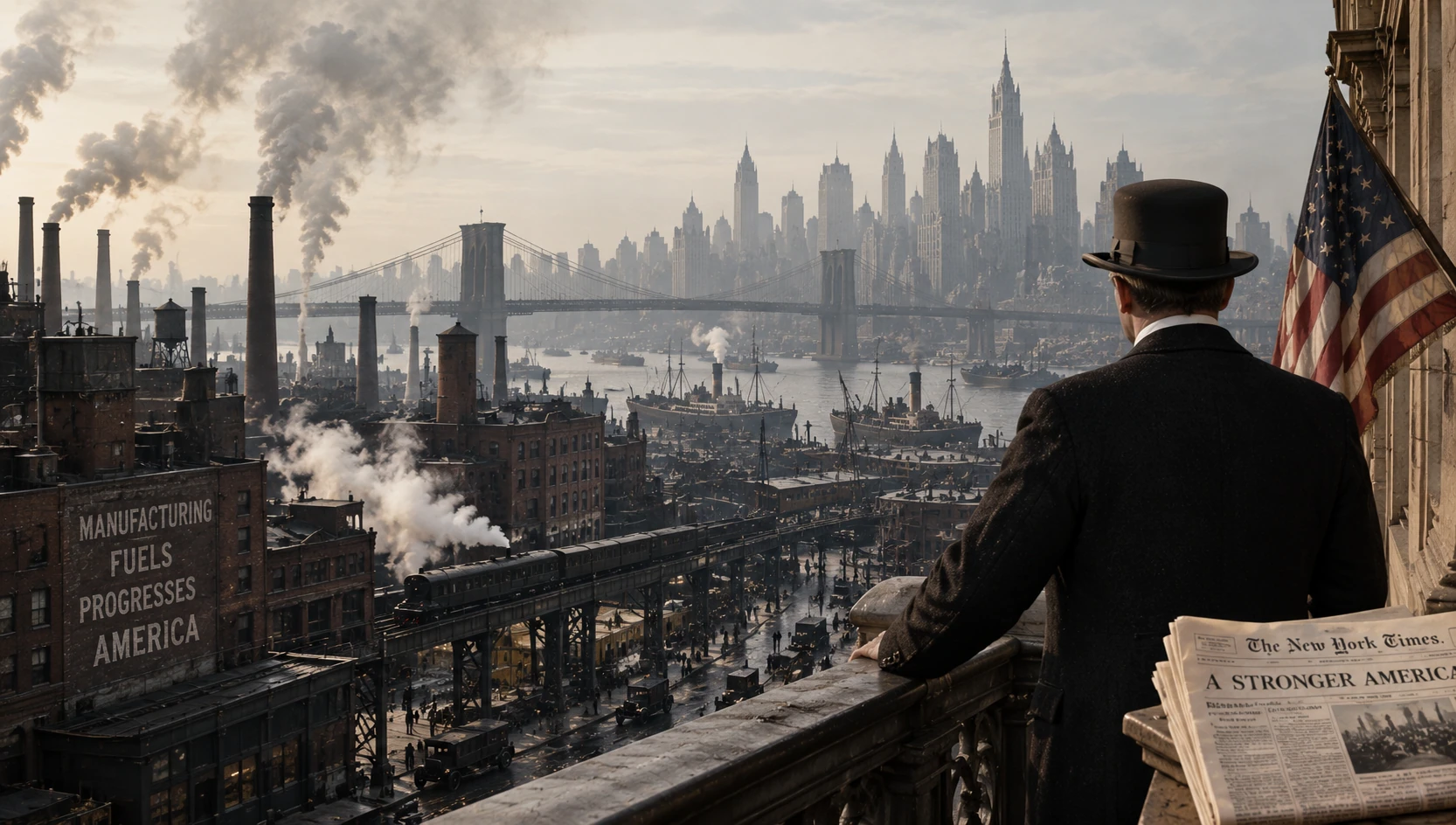
The supplied hero image is an editorial reconstruction of industrial-era America. It combines a New York harbor, factories, railways and civic architecture as a visual symbol of economic growth, not as a documentary photograph of one historical moment.
COLONIES, INDIGENOUS NATIONS AND ATLANTIC EMPIRES
Before the United States existed, North America contained many Indigenous nations with their own governments, economies, diplomatic systems and religious traditions. Cahokia and the wider Mississippian world demonstrate that large urban centers and regional networks flourished long before European colonization. The history of Native American societies cannot be reduced to a prelude to the republic. See PRESDA's Cahokia history and Native American civilizations for fuller coverage.
European colonies developed along the Atlantic coast within a wider world of Indigenous diplomacy, African labor, Caribbean slavery and imperial rivalry. England's thirteen mainland colonies differed in economy and social structure. New England towns mixed farming, commerce and maritime trade; the middle colonies had grain, ports and religious diversity; Chesapeake and southern colonies relied heavily on plantation agriculture and enslaved labor. Each colony was governed through its own charter, assembly and local institutions while remaining within the British Empire.
Spain, France, the Netherlands and Britain contested North American territory and Atlantic trade. Spanish Florida and the borderlands, French Canada and the Mississippi valley, and Dutch and Swedish settlements created overlapping imperial geographies. Indigenous nations remained decisive actors, trading, forming alliances and resisting colonial expansion. PRESDA's Spanish Empire history explains the larger Atlantic system in which these colonies developed.
The colonies were not democracies in the modern sense. Political participation was usually restricted by sex, property, race and status. Enslaved Africans and their descendants were excluded from political rights, while Indigenous people were treated as external nations when useful and as obstacles when colonial authorities wanted land. Colonial societies contained ideals of self-government alongside coercive labor systems and imperial violence.
REVOLUTION AND INDEPENDENCE
The Seven Years' War left Britain with heavy debts and a stronger determination to make its American colonies contribute to imperial defense. Parliament imposed new taxes and regulations, including the Stamp Act and Townshend duties. Colonists objected that they were being taxed without elected representation in Parliament. The dispute was not initially a demand for complete independence, but a conflict over sovereignty, constitutional rights and the limits of imperial authority.
Protests, boycotts and political organizing escalated after the Boston Massacre in 1770 and the Boston Tea Party in 1773. Britain's Coercive Acts punished Massachusetts and prompted the First Continental Congress. Fighting began at Lexington and Concord in April 1775. The Continental Congress created an army and appointed George Washington commander. The war became a civil conflict within the empire as well as a struggle between American revolutionaries and Britain. Loyalists, enslaved people, Indigenous nations and European powers made choices that did not fit a single patriotic narrative.
On July 4, 1776, Congress adopted the Declaration of Independence after voting for independence on July 2. Thomas Jefferson drafted the document with a committee, drawing on Enlightenment arguments and earlier colonial rights traditions. Its claim that all men are created equal coexisted with slavery and the exclusion of women, Indigenous people and many poor men. The Declaration was both a statement of revolutionary legitimacy and an unfinished promise later movements would invoke. National Archives: Declaration timeline
Washington's army survived a long war through persistence, local support, French military and financial aid and British strategic difficulties. The American victory at Yorktown in 1781 forced negotiations, and the Treaty of Paris in 1783 recognized independence. The new United States controlled territory to the Mississippi River, but Indigenous nations living there had not surrendered their sovereignty simply because Britain ceded its claims. The republic's western future was contested from its first day.
CONSTITUTION AND THE EARLY REPUBLIC
The Articles of Confederation created a weak central government that struggled to raise revenue, regulate interstate trade and manage disputes over western lands. Delegates met in Philadelphia in 1787 and drafted a Constitution that established a stronger federal system with executive, legislative and judicial branches. Ratification was contested by Federalists and Anti-Federalists. The latter feared centralized authority and demanded protections for individual liberties. The Bill of Rights was added in 1791. National Archives: Constitution history
The Constitution contained compromises that protected slavery, including rules concerning representation and the return of enslaved people. It created a republic but did not establish equal citizenship. George Washington became the first president, while Alexander Hamilton's financial program built federal credit, assumed state debts and established a national bank. Thomas Jefferson's election in 1800 demonstrated that power could change parties without abolishing the constitutional order, although political conflict remained intense.
The early republic faced conflict with Britain, France and Indigenous nations. The Northwest Indian War ended with the Treaty of Greenville in 1795, which forced large land cessions from Native nations. The War of 1812 grew from maritime disputes, impressment and imperial rivalry. It did not create American independence, but it strengthened national identity and encouraged industrial and transport development. The republic's institutions expanded while its leaders continued to claim Indigenous lands.
LOUISIANA, REMOVAL AND CONTINENTAL EXPANSION
The Louisiana Purchase of 1803 transferred a vast French claim west of the Mississippi to the United States. President Jefferson authorized the Lewis and Clark expedition to survey routes, resources and diplomatic possibilities. The purchase doubled the republic's claimed territory, but it did not settle Indigenous ownership. Federal officials negotiated treaties under pressure, encouraged settlement and used military force when Native nations resisted.
Cotton agriculture and slavery expanded into the Deep South. The United States outlawed the transatlantic slave trade in 1808, but domestic slave trading and forced migration grew. Enslaved people were sold from the Upper South to plantations in the lower Mississippi valley and beyond. Cotton exports connected American plantations to British and global industry, while enslaved labor generated wealth for planters, merchants, insurers and banks. The National Museum of American History describes slavery as deeply woven into the nation's economic and political development. Smithsonian: Slavery in America
The Indian Removal Act of 1830 authorized the federal government to negotiate removal treaties with Southeastern nations. The Cherokee, Muscogee, Chickasaw, Choctaw and Seminole peoples resisted through courts, diplomacy and war. The Supreme Court recognized aspects of Cherokee sovereignty, but federal and state authorities did not consistently honor those decisions. The forced removals of the 1830s, including the Cherokee Trail of Tears, caused thousands of deaths from disease, hunger and exposure. Removal was a deliberate state policy, not an unavoidable migration. Smithsonian National Museum of the American Indian: removal history
The ideology of Manifest Destiny framed expansion as providential, but expansion required war, treaty coercion and the transfer of people. Texas won independence from Mexico in 1836 and was annexed by the United States in 1845. The Mexican-American War began in 1846 after disputes over Texas and the location of its southern boundary. The Treaty of Guadalupe Hidalgo in 1848 transferred present-day California, Nevada, Utah and parts of several other states to the United States. Mexico lost roughly half its territory, while the new lands intensified the argument over slavery.
SLAVERY, SECTIONAL CRISIS AND CIVIL WAR
The question was not only whether slavery would continue where it already existed, but whether it would expand into western territories. Congress repeatedly attempted compromise, including the Missouri Compromise, the Compromise of 1850 and the Kansas-Nebraska Act. Violence in Kansas, the Dred Scott decision and John Brown's 1859 raid showed that constitutional negotiation was failing. Enslaved people resisted through escape, work slowdowns, family preservation and rebellion, while abolitionists challenged slavery's moral and political legitimacy.
Abraham Lincoln won the 1860 presidential election without carrying most Southern states. Eleven slave states seceded and formed the Confederate States of America. The Civil War began when Confederate forces attacked Fort Sumter in April 1861. The conflict was a war over the Union and slavery. The Union's initial war aims emphasized preserving the nation, but emancipation became central as enslaved people fled to Union lines and the federal government recognized that the Confederacy's labor system sustained its war effort.
The Emancipation Proclamation took effect on January 1, 1863, declaring enslaved people in areas under Confederate control to be free. It did not immediately end slavery everywhere, but it transformed the war's meaning and authorized Black military service. Nearly 200,000 Black soldiers and sailors served the Union. Union victory at Gettysburg and Vicksburg in 1863, followed by campaigns led by Ulysses S. Grant and William T. Sherman, weakened Confederate capacity. Robert E. Lee surrendered at Appomattox in April 1865.
The Thirteenth Amendment abolished slavery in 1865. Lincoln was assassinated days later, and the country entered Reconstruction under President Andrew Johnson and then a Republican Congress. The Fourteenth Amendment established birthright citizenship and equal protection, while the Fifteenth prohibited racial discrimination in voting for men. Freedpeople built churches, schools and political organizations, but white supremacist violence and federal retreat undermined these gains.
Reconstruction ended after the disputed election of 1876 and the Compromise of 1877. Southern states imposed segregation, disfranchisement and racial terror. The Supreme Court's Plessy v. Ferguson decision in 1896 approved separate but equal doctrine. Jim Crow laws denied Black citizens equal access to schools, transport, employment and the ballot. The postwar constitutional amendments remained powerful legal resources, but for decades federal enforcement was inconsistent and often absent.
INDUSTRIALIZATION AND THE GILDED AGE
From the 1870s to the early twentieth century, the United States underwent rapid industrialization. Railroads linked agricultural regions to ports and factories, steel production expanded, oil refining transformed energy markets and electricity reshaped cities and communications. Immigration supplied labor and built neighborhoods, while urbanization created new forms of culture and political organization. Growth produced extraordinary wealth but also dangerous workplaces, pollution, housing shortages and stark inequality.
Andrew Carnegie built a steel empire through vertical integration and aggressive cost control, then became a major philanthropist. John D. Rockefeller's Standard Oil consolidated refining and distribution, creating a corporation that became a symbol of monopoly power. J. P. Morgan reorganized railroads and financed industrial mergers. Their achievements reflected managerial innovation and access to capital, but also low wages, labor conflict and market concentration. The era's famous industrialists were neither solitary inventors nor the only sources of American growth.
Workers organized through the Knights of Labor, the American Federation of Labor, miners' unions and countless local associations. The Great Railroad Strike of 1877, the Haymarket affair in 1886, the Homestead strike in 1892 and the Pullman strike in 1894 revealed the conflict between corporate authority and labor rights. Courts and federal troops often favored employers. Reformers responded with antitrust laws, workplace regulation and progressive campaigns, but industrial power remained concentrated.
New York became the republic's leading financial and cultural metropolis. Wall Street connected American capital to European investors, while the port handled immigration, commodities and manufactured goods. Chicago, Pittsburgh, Detroit and other cities also became industrial centers. By 1900 the United States possessed a large internal market, abundant resources, expanding railways and a growing workforce. Economic power increasingly supported military and diplomatic ambitions beyond North America.
OVERSEAS POWER AND WORLD WAR I
The Spanish-American War of 1898 marked a new phase of overseas influence. The United States defeated Spain and acquired Puerto Rico and Guam, while Cuba became formally independent under strong American influence. The United States annexed the Philippines after a brutal war with Filipino nationalists. Hawaii was annexed in 1898. These actions created an overseas empire and naval network, even as American leaders described expansion in the language of liberation and civilization.
Theodore Roosevelt promoted naval power, arbitration and an assertive role in the Caribbean and Pacific. The Panama Canal, opened in 1914, shortened routes between oceans and demonstrated the strategic reach of American engineering and finance. Intervention in Latin America became recurrent. The United States was not yet a global hegemon, but it had become a major industrial state with growing influence over the Western Hemisphere and Pacific trade.
World War I began in Europe in 1914. The United States initially remained neutral, trading with the Allies and debating whether intervention served national interests. German submarine warfare and the Zimmermann Telegram contributed to the decision to enter in April 1917. American troops arrived in large numbers in 1918 and helped strengthen the Allied position. President Woodrow Wilson proposed a League of Nations, but the Senate rejected membership. The war expanded U.S. influence while leaving unresolved debates about isolation, empire and race.
THE 1920s, CRASH AND NEW DEAL
The 1920s brought mass production, consumer credit, radio, cinema, automobiles and new forms of popular culture. Economic gains were uneven. Farmers faced falling prices, Black Americans confronted segregation and racial violence, and immigrants were targeted by restrictive quotas. The decade's prosperity rested partly on fragile finance and unequal distribution of income. The stock market crash in October 1929 exposed those weaknesses and helped trigger the Great Depression.
Industrial output collapsed, banks failed and unemployment reached roughly one quarter of the workforce at the depression's worst point. Franklin D. Roosevelt's election in 1932 led to the New Deal, a collection of relief, recovery and reform programs. The Emergency Banking Act, public works, Social Security and labor protections changed the relationship between citizens and the federal government. The New Deal did not end the Depression by itself, and many programs excluded agricultural and domestic workers, disproportionately affecting Black Americans. World War II mobilization ultimately restored full employment. Library of Congress: Great Depression and World War II
WORLD WAR II AND THE POSTWAR BOOM
Japan attacked Pearl Harbor on December 7, 1941, and the United States entered World War II. Federal agencies coordinated an enormous industrial mobilization. Factories produced ships, aircraft, vehicles and ammunition, while women and minority workers entered jobs previously reserved for white men. Japanese Americans were incarcerated under Executive Order 9066, a major wartime violation of civil liberties. The war economy ended mass unemployment and made the United States the leading industrial power among the Allies.
American forces fought in Europe, North Africa and the Pacific. The D-Day landings in Normandy on June 6, 1944 opened a western front against Germany, while Soviet armies carried the main burden of the war in Europe. In the Pacific, island campaigns and submarine warfare brought U.S. forces toward Japan. The United States used atomic bombs against Hiroshima and Nagasaki in August 1945. Japan surrendered soon afterward. Historians continue to debate the military necessity, diplomatic context and moral consequences of the bombings, while the destruction of Japanese cities and civilian lives is beyond dispute.
The postwar United States combined industrial capacity, the dollar, a large consumer market and new international institutions. The Marshall Plan aided European recovery, NATO linked the United States to Western European security and the United Nations created a forum for global diplomacy. Veterans' benefits expanded education and home ownership for many white Americans, but discriminatory lending and segregation excluded many Black families. Suburban growth, highways and mass consumption coexisted with racial inequality.
COLD WAR, CIVIL RIGHTS AND THE SPACE RACE
The Cold War divided international politics between the United States and the Soviet Union. Both powers built nuclear arsenals and competed for allies, scientific prestige and ideological influence. The Korean War ended in an armistice in 1953 rather than a peace treaty. In Vietnam, U.S. intervention expanded through military advisers, bombing and ground troops, but the war ended with communist victory in 1975. Cold War policies also supported authoritarian governments abroad and generated domestic fear through loyalty investigations and McCarthyism.
The civil rights movement challenged segregation and racial citizenship at home. Black activists used litigation, boycotts, mass marches, voter registration drives and community organizing. The Supreme Court's Brown v. Board of Education decision in 1954 rejected school segregation, while the Civil Rights Act of 1964 prohibited discrimination in public accommodations and employment. The Voting Rights Act of 1965 strengthened federal protection of voting. Martin Luther King Jr. became a prominent leader, but the movement depended on thousands of organizers, including Ella Baker, Fannie Lou Hamer and local activists.
Legal segregation ended in major areas, but equality remained incomplete. Housing discrimination, unequal schools, policing, employment gaps and wealth inequality continued. The movement also inspired Chicano, Native American, Asian American, women's and disability rights campaigns. Federal law changed more quickly than social structures, and the meaning of equal citizenship remained contested.
The Space Race turned scientific competition into public spectacle. The Soviet Union launched Sputnik in 1957 and sent Yuri Gagarin into orbit in 1961. The United States created NASA and invested in education, engineering and research. Apollo 11 landed astronauts on the Moon on July 20, 1969. The achievement reflected public science and technical collaboration, but it depended on government funding, military research and thousands of workers whose names were rarely known.
REAGAN, THE END OF THE COLD WAR AND TECHNOLOGY
Ronald Reagan's presidency in the 1980s emphasized tax cuts, deregulation, military expansion and opposition to the Soviet Union. The administration also negotiated arms reductions with Mikhail Gorbachev. The Cold War ended through a combination of economic pressure, reform in the Soviet Union, popular movements in Eastern Europe and long-term diplomatic engagement. The Berlin Wall fell in 1989, and the Soviet Union dissolved in 1991. The United States emerged as the most powerful military and financial state, but victory did not erase global conflict.
The technology revolution transformed the economy and culture. Federal research, university laboratories and defense contracts helped create the conditions for Silicon Valley's semiconductor and software industries. Personal computers, the internet and mobile communications connected markets and communities. Venture capital and platform companies generated enormous wealth, while manufacturing employment declined in many regions. Digital power expanded American influence but also created privacy concerns, labor insecurity, misinformation and dependence on privately controlled infrastructure.
9/11, WAR AND FINANCIAL CRISIS
On September 11, 2001, al-Qaeda carried out attacks that killed nearly 3,000 people in New York, Washington and Pennsylvania. The United States invaded Afghanistan to remove the Taliban government that had hosted al-Qaeda and to destroy the organization's base. The war became a long counterinsurgency and state-building campaign, ending with the Taliban's return in 2021. Civilian casualties, detention practices, surveillance and the limits of military reconstruction shaped debates about the war's consequences.
The United States invaded Iraq in 2003 after the administration of George W. Bush argued that Saddam Hussein's government possessed weapons of mass destruction and had links to terrorism. Those claims were not substantiated as presented. The invasion toppled the Ba'athist regime but produced insurgency, sectarian conflict, state collapse and extensive civilian suffering. The war showed the limits of superior military technology when political legitimacy and postwar institutions are weak.
In 2008 a financial crisis originating in the housing and credit markets spread through banks and the global economy. The federal government and Federal Reserve rescued major institutions, provided emergency liquidity and supported the auto industry. Unemployment and home foreclosures caused deep hardship. Recovery eventually resumed, but wealth inequality widened and public trust in financial and political institutions declined. The crisis also accelerated debates about regulation, austerity and the power of large corporations.
THE UNITED STATES IN THE TWENTY-FIRST CENTURY
The United States remains a constitutional federal republic with a large economy, global military alliances, major universities, powerful technology firms and extensive cultural influence. The dollar remains central to international finance, while American companies shape entertainment, software, aviation, medicine and consumer markets. Military power is supported by a worldwide network of bases and alliances, but it faces limits from rival states, public opinion, fiscal costs and the difficulty of translating force into stable political outcomes.
The country is also more diverse than the political order of the eighteenth or nineteenth centuries. Immigration, the civil rights movement, women's activism, Indigenous sovereignty campaigns and changing ideas of citizenship have reshaped national life. Yet the legacies of slavery, segregation, land seizure and unequal wealth remain visible in housing, education, health and political representation. Economic growth and democratic inclusion have never advanced at the same speed.
The history of American power is therefore a history of capacity and contradiction. Federal institutions survived civil war and economic crisis; industry and science produced remarkable abundance; social movements expanded rights. At the same time, expansion depended on dispossession, slavery and war, and global influence has often imposed costs beyond the country's borders. Understanding how the United States became a superpower requires holding these dimensions together rather than replacing evidence with celebration or condemnation.
FREQUENTLY ASKED QUESTIONS
**When did the United States become independent?**
Congress adopted the Declaration of Independence on July 4, 1776, and Britain recognized independence in the Treaty of Paris in 1783.
**Did westward expansion occur across empty land?**
No. Indigenous nations governed the continent, and expansion involved treaties, coercion, war and forced removal.
**What caused the Civil War?**
Slavery was the central cause of secession and the conflict. Related disputes over federal power and western expansion were inseparable from slavery.
**Did the New Deal end the Great Depression?**
It provided relief, regulation and reform, but full employment came with World War II mobilization.
**How did the United States become a global superpower?**
Industrial scale, a large internal market, scientific research, finance, alliances and World War II victory combined to produce exceptional global reach.
SOURCES AND FURTHER READING
For connected histories, read PRESDA's Native American civilizations, Cahokia and Spanish Empire articles. The site's wider world-history coverage also places U.S. industrialization and wars alongside other imperial and modern transformations.
> American power grew through revolution, constitutional government, industrial scale and global war, but its history cannot be separated from slavery, dispossession and unequal citizenship.
FAQ
Frequently Asked Questions
When did the United States become independent?
Congress adopted the Declaration of Independence on July 4, 1776, and Britain recognized independence in the Treaty of Paris in 1783.
Did westward expansion occur across empty land?
No. Indigenous nations governed the continent, and expansion involved treaties, coercion, war and forced removal.
What caused the Civil War?
Slavery was the central cause of secession and the conflict. Related disputes over federal power and western expansion were inseparable from slavery.
Did the New Deal end the Great Depression?
It provided relief, regulation and reform, but full employment came with World War II mobilization.
How did the United States become a global superpower?
Industrial scale, a large internal market, scientific research, finance, alliances and World War II victory combined to produce exceptional global reach.
PRESDA Dispatch
Stay Informed. Stay Aware.
A sharp briefing across AI, gaming, sport, business, world affairs, paparazzi, and lifestyle.