NATIVE AMERICANS: THE PEOPLE WHO LIVED IN AMERICA BEFORE AMERICA EXISTED
Long before the United States existed, hundreds of Indigenous nations lived across North America with their own languages, governments, trade networks and ways of life.
Before there was an America, there was no United States, no New York, no Washington, no border with Canada or Mexico.
Yet North America was not empty.
Across forests, deserts, coasts, plains, river valleys and Arctic landscapes lived diverse Indigenous societies with languages, governments, economies, religions, alliances, rivalries and trade networks.
The history of Native Americans is not simply the story of what happened after Europeans arrived. It is the history of peoples who had already been shaping the continent for thousands of years.
And they are still here.
Terminology matters. This article uses Native Americans, Indigenous peoples, Indigenous nations, American Indians where official or historical context makes it appropriate, and specific nation names where possible. Preferences differ among Indigenous people and communities.
The phrase Red Indians is outdated and offensive in modern English except when explaining historical language.
Who Were The First People In The Americas?
The first peoples of the Americas arrived long before written colonial records.
Current archaeology and genetics point to deep connections with ancient populations of northeast Asia and Beringia, the Ice Age land and coastal region that once connected Siberia and Alaska. But the exact timing, routes and number of movements remain debated.
The old simple Clovis First model, which treated the Clovis culture around 13,000 years ago as the beginning of human presence in the Americas, is no longer sufficient. Sites and genetic evidence increasingly support human presence before the traditional Clovis date, though some early claims remain debated.
Coastal migration hypotheses matter because Ice Age shorelines are now often underwater. People may have moved along Pacific coastal routes as well as through inland corridors when conditions allowed.
Indigenous origin traditions should be treated respectfully. They are not archaeological datasets, but they are living cultural histories that should not be dismissed as if only European-style evidence has meaning.
America Was Never Empty
The empty wilderness myth is one of the most damaging myths in American history.
Indigenous peoples actively shaped environments through agriculture, controlled burning, hunting, irrigation, settlement, trade and land management. Forests, grasslands, river systems and fields were not simply untouched nature waiting for Europeans.
This does not mean every acre was densely populated or managed in the same way. It means the continent was already human history.
The idea of emptiness later made conquest easier to justify. If land was imagined as unused, taking it could be described as settlement rather than dispossession.
There Was No Single Indian People
There was never one Native American people, culture, language or civilization.
Haudenosaunee, Cherokee, Diné, Lakota, Dakota, Nakota, Comanche, Apache peoples, Pueblo peoples, Hopi, Muscogee, Choctaw, Chickasaw, Seminole, Ojibwe, Cree, Blackfeet, Nez Perce, Inuit, Yupik and many others had distinct histories and identities.
They differed in language, government, housing, food, religion, diplomacy, warfare, economy and environment.
Some lived in towns. Some built longhouses. Some farmed river valleys. Some developed horse cultures later on the Plains. Some lived in Arctic environments. Some organized confederacies. Some lived in pueblos, earth lodges, plank houses or dispersed settlements.
The word Native American is therefore a broad political and historical category, not a single culture.
The Myth Of Tipis, Horses And Feathered Headdresses
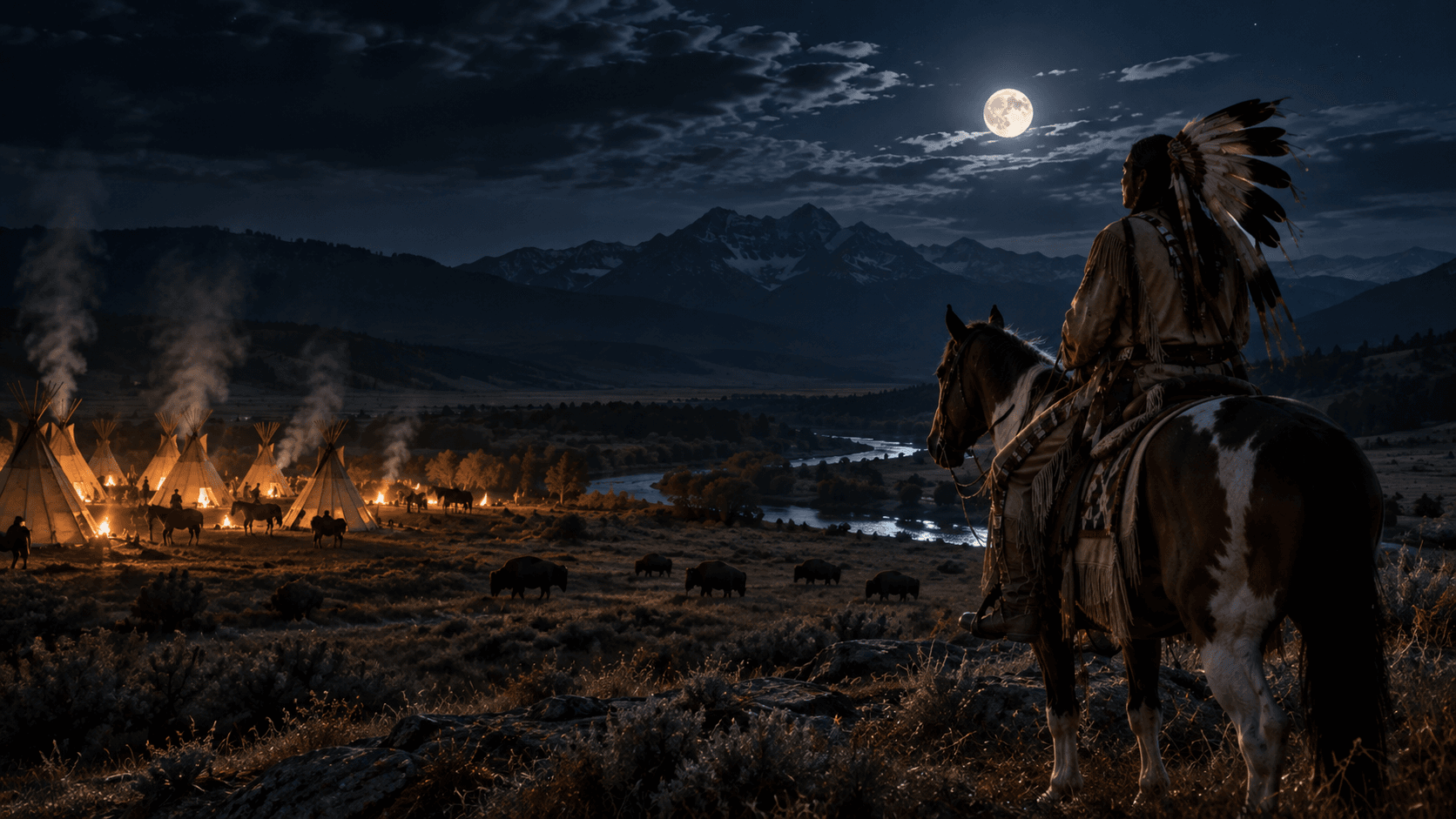
The supplied hero image uses Plains imagery. That visual world is important, but it is not universal.
Tipis and horse cultures are strongly associated with particular Plains peoples and historical periods. They do not represent all Indigenous North Americans.
Other Indigenous societies lived in longhouses, pueblos, earth lodges, wooden houses, complex towns, Arctic dwellings and other forms of architecture shaped by climate, materials and culture.
Feathered warbonnets also require care. They were not universal Native clothing. In many Plains cultures, they carried ceremonial, political or military meaning and were earned or granted within specific traditions.
Hollywood turned one regional image into a continent-wide costume. History is much larger than that.
The Horse Changed The Plains, But It Came Later
Horses evolved in North America in deep prehistory, but they disappeared from the continent thousands of years ago.
Domesticated horses were reintroduced by Europeans after 1492. Indigenous nations then transformed horse culture dramatically.
For Comanche, Lakota and other Plains peoples, horses changed mobility, hunting, warfare, trade and political power. Horse cultures became central to some Plains societies, but they were historically specific, not timeless.
This is why a mounted Plains scene can be historically meaningful and still not represent every Native nation.
The Buffalo World
Bison were central to many Plains peoples.
They provided food, hides, robes, sinew, bone, horn, tools, shelter materials, trade goods and ceremonial meaning. Bison hunting was economic, social and spiritual.
But not every Native American society depended on buffalo. Coastal peoples, agricultural towns, desert communities, Arctic hunters and eastern woodland nations lived in different food worlds.
The buffalo world was powerful, but it was not the whole Indigenous world.
Cities Before Columbus
Long before European colonization, substantial urban centers existed north of Mexico.
Cahokia, near present-day St. Louis, was the largest known Mississippian city. Monks Mound remains one of the most imposing earthen structures in North America.
Population estimates vary, but Cahokia's scale, plazas, mounds, agriculture, craft production and trade show political complexity and urban life.
Its existence breaks the stereotype that Indigenous North America was only small wandering bands.
Farmers, Engineers And Traders
Indigenous societies cultivated maize, beans, squash, sunflowers and other crops. Pueblo communities developed agriculture in difficult environments. Irrigation, storage, architecture and trade linked people across long distances.
Copper, shells, obsidian, stone, pigments, foodstuffs and ceremonial goods moved through trade networks.
The Americas were not isolated villages scattered in silence. They were connected worlds.
The Haudenosaunee Confederacy
The Haudenosaunee Confederacy, often called the Iroquois Confederacy in older sources, developed a sophisticated political system rooted in the Great Law of Peace.
Member nations traditionally include the Mohawk, Oneida, Onondaga, Cayuga and Seneca, with the Tuscarora joining later.
Its council governance and diplomacy impressed many observers. Claims that it directly caused the US Constitution should be presented carefully. Some scholars and political figures have argued influence; others emphasize differences and caution against a simple one-line origin story.
The safest statement is that Haudenosaunee political thought was sophisticated in its own right and part of the broader world of diplomacy in northeastern North America.
1492: The World Changes
Christopher Columbus did not reach what is now the continental United States on his 1492 voyage.
His voyages did, however, open sustained transatlantic contact that transformed the Americas, Europe and Africa.
Spanish, French, English, Dutch and Russian colonization unfolded differently across regions. Contact was not one event. It was centuries of encounters, violence, exchange, alliance, settlement, enslavement, missionization, trade and disease.
For Indigenous nations, the impact depended on place, time and political context.
Did Columbus Discover America?
For Europeans, Columbus's voyages opened sustained transatlantic contact.
But the Americas were already inhabited by millions of people whose ancestors had lived there for millennia.
So discovery is Eurocentric when used without context. It describes European awareness, not the beginning of American history.
A continent cannot be discovered by people arriving in lands already filled with nations, languages and ancestors.
The Deadliest Invaders Were Often Invisible
European contact brought smallpox, measles, influenza and other diseases to populations with no previous exposure and therefore no inherited or community immunity to those pathogens.
Epidemics devastated many communities, sometimes before direct European settlement reached them.
Population and mortality estimates remain debated because evidence is uneven, written records were limited, and epidemics often occurred before colonial observers counted people.
The point does not require one dramatic percentage. Disease was one of the central forces of conquest, alongside violence, displacement, starvation, labor exploitation and political upheaval.
How Many People Lived In The Americas Before Columbus?
There is no single universally accepted number.
Scholars distinguish the Americas overall, North America, and the areas that later became the United States. Estimates vary because of archaeology, ecology, later census gaps, epidemic timing and different definitions of geography.
Responsible history does not choose the biggest number for drama or the smallest number to minimize loss.
What matters is that the Americas were heavily and diversely inhabited, and population collapse after contact was catastrophic in many regions.
Contact Was Not One-Sided
Indigenous peoples were political actors.
They negotiated, traded, fought, adopted useful technologies, formed alliances and sometimes used European rivalries strategically.
The Columbian exchange moved foods, animals, diseases, crops, metals, knowledge and people across oceans. Indigenous foods such as maize, potatoes, tomatoes, beans, cacao and many others transformed global diets.
Native nations were not passive figures waiting for history to happen to them. They made choices under increasingly violent and unequal conditions.
Indigenous Nations Fought Each Other Too
Pre-contact societies were not utopias of perfect peace.
There were alliances, rivalries and wars before and after Europeans arrived. European empires often entered existing political landscapes rather than creating all conflict from nothing.
This nuance matters because romanticizing Indigenous peoples as naturally peaceful is another stereotype. It replaces real human societies with a fantasy.
European Empires Used Indigenous Alliances
Colonial wars often depended on Indigenous alliances.
In the Seven Years' War, known in North America as the French and Indian War, Native alliances shaped strategy and survival. Spanish borderlands, British colonies, French trade networks and Dutch commerce all involved Indigenous diplomacy.
Native nations sometimes allied with Europeans to defend their own interests, fight enemies, secure trade or resist expansion.
Those alliances could decide military outcomes, but they also exposed Indigenous nations to shifting imperial betrayals.
The Birth Of The United States Changed Everything
After independence, US expansion increasingly collided with Indigenous sovereignty.
The United States made treaties, demanded land cessions, encouraged settlement and used military power. Treaties were agreements between political entities, not casual land purchases.
Many treaties promised boundaries, payments, services, recognition of rights or protection. Many were later violated, reinterpreted or undermined.
The conflict was not simply settlers moving west. It was a new republic expanding into lands where other nations already existed.
What Did The US Government Promise In Treaties?
Treaties could promise land boundaries, annuities, services, hunting and fishing rights, peace, protection or recognition of tribal authority.
They also often came after coercion, military pressure, fraud or impossible circumstances.
Treaty rights remain legally important today. They are not gifts. They are reserved rights rooted in agreements between governments.
When treaty promises were broken, the damage was not only historical. It affected land, food systems, law, culture and sovereignty.
The Indian Removal Act
The Indian Removal Act of 1830, signed by President Andrew Jackson, authorized the federal government to pursue removal of Indigenous nations from lands east of the Mississippi River.
Southeastern nations historically labeled the Five Civilized Tribes included the Cherokee, Muscogee, Seminole, Chickasaw and Choctaw.
That historical label is problematic because it judged Indigenous societies by European-American standards of civilization. These nations were politically sophisticated before, during and after the label was used.
Removal was not voluntary migration. It was a federal policy of dispossession.
The Trail Of Tears
The Cherokee removal is one of the best-known examples of forced removal, but it was not the only one.
Cherokee Nation v. Georgia, Worcester v. Georgia, the Treaty of New Echota and federal enforcement all formed part of the legal and political crisis.
The Treaty of New Echota was signed by a minority faction and rejected by many Cherokee leaders, yet it was used to justify forced removal.
Thousands of Cherokee people died during removal and its related conditions, though exact numbers are debated. Choctaw, Muscogee, Chickasaw, Seminole and other Indigenous peoples also suffered removal, death and dispossession.
The Trail of Tears should not be reduced to one sad march. It was a policy world.
Andrew Jackson: Hero To Some, Destroyer To Others
Andrew Jackson remains celebrated in some narratives as a symbol of expanded white male democracy, frontier politics and resistance to elite power.
He is condemned in other narratives for slavery, violence and especially his role in Indigenous removal.
Both memories come from evidence. Jackson's democratic image depended on a definition of democracy that excluded many people. His removal policies helped open land for settlers while destroying Indigenous homelands.
History becomes clearer when we ask: democracy for whom?
Manifest Destiny
Manifest Destiny was the belief that US expansion across the continent was natural, righteous or providential.
It connected settlement, railroads, mining, farmland, military campaigns and political ideology.
But what happens when one nation calls expansion its destiny while other nations already live on the land?
For Native nations, Manifest Destiny often meant treaty violation, war, removal and confinement.
The Great Plains Wars
The Plains conflicts were not one war but many struggles over land, migration routes, gold, railroads, treaties, buffalo, sovereignty and survival.
Lakota, Cheyenne, Arapaho, Comanche and other nations faced expanding settler pressure and US military campaigns.
The US Army did not simply bring order to empty territory. It enforced an expanding colonial state in places where Indigenous nations still defended land and political independence.
Little Bighorn
In 1876, Lakota, Northern Cheyenne and Arapaho forces defeated George Armstrong Custer and elements of the 7th Cavalry at the Battle of the Little Bighorn.
Sitting Bull and Crazy Horse became central figures in the memory of the conflict, though Hollywood often simplified events into a Custer-centered myth.
The Native victory was significant, but it did not ultimately stop US expansion. The military and political response intensified pressure on Plains nations.
A battlefield victory could not alone defeat the machinery of a continental state.
The Destruction Of The Bison
The 19th-century collapse of bison populations devastated many Plains societies.
Commercial hunting, railroads, hide markets, settler expansion, sport killing and military attitudes all contributed. Some US officials and military figures understood that destroying the bison would weaken Plains resistance.
Historians debate how centrally organized federal extermination policy was, and evidence should be handled carefully.
What is beyond dispute is that the destruction of the bison shattered food systems, economies and ceremonial worlds for many Plains peoples.
Wounded Knee
In 1890, US troops killed Lakota men, women and children near Wounded Knee Creek in South Dakota during a disarmament crisis connected to the Ghost Dance movement and federal fear of Native resistance.
Authoritative modern sources, including the National Park Service, describe Wounded Knee as a massacre.
It has often been treated as a symbolic end point of the Indian Wars, though Indigenous survival and resistance did not end there.
Wounded Knee remains a place of mourning, memory and political meaning.
Reservations: What Were They?
Reservations were not simply free land given to Indians.
In many cases, reservations were remnants of much larger Indigenous territories after treaties, coercion, war or federal action. They represented what Native nations retained after massive land loss.
Reservation systems varied by region and era. Some reservations remain homelands. Some were imposed far from original territories. Some were later broken apart by allotment policies.
Reservations are not independent foreign countries, but many are connected to tribal sovereignty, federal trust responsibilities and complex jurisdictional rules.
Kill The Indian, Save The Man
Assimilation policy tried to destroy Indigenous cultures while claiming to save Indigenous people.
The phrase Kill the Indian, save the man is associated with Richard Henry Pratt, founder of the Carlisle Indian Industrial School.
Boarding schools separated children from families, cut hair, suppressed Native languages, imposed Christianity, assigned labor and punished cultural expression. Abuse occurred in many institutions.
This history extended well into the modern era. It was not ancient history. Some survivors are still living.
The Children Who Never Came Home
The Department of the Interior's Federal Indian Boarding School Initiative has documented hundreds of institutions and reported at least 973 American Indian, Alaska Native and Native Hawaiian child deaths across the system, with burial sites identified at many school locations.
Those figures are not final truth carved in stone. They are official findings within an ongoing historical investigation.
The subject should be handled without sensationalism. These were children separated from families under federal and religious assimilation systems.
Memory here is not abstract. It is family history.
Could Native People Practice Their Religions Freely?
For much of US history, Indigenous religious practices were restricted, criminalized or disrupted through federal policy, missionary pressure and control of ceremonies.
The American Indian Religious Freedom Act of 1978 recognized the need to protect Native religious practices, sacred sites, access to objects and ceremonial freedom.
Disputes continue over sacred lands, human remains, ceremonial objects, environmental damage and federal land management.
Religious freedom did not arrive equally for everyone at the founding of the United States.
When Did Native Americans Become US Citizens?
Some Native people became US citizens before 1924 through treaties, marriage, military service, allotment or other legal pathways.
The Indian Citizenship Act of 1924 granted US citizenship to Native Americans born within the territorial limits of the United States.
Citizenship did not immediately guarantee equal voting access everywhere. States continued to use barriers and legal arguments to restrict Native voting rights in some places.
Citizenship and sovereignty also coexist in complex ways. A person can be a US citizen and a citizen of a tribal nation.
Native Americans In The US Military
Native Americans have served in the US military at high rates across many conflicts, even while their own communities faced discrimination and broken treaties.
World War II made Indigenous code talkers famous, especially Diné Navajo code talkers in the Pacific. There were also code talkers from other Native nations.
The irony is profound: languages once suppressed in schools became valuable to the US military.
Service did not erase injustice, but it became part of Native history and national history.
The Navajo Code Talkers
Diné code talkers used Navajo language as the basis for secure military communications in the Pacific during World War II.
Their code was operationally successful because it combined an unwritten Indigenous language unfamiliar to Japanese forces with a specialized military vocabulary.
It should not be described mystically as impossible to break. Its success came from language knowledge, training, speed, secrecy and battlefield discipline.
The code talkers later became symbols of both patriotism and survival.
Termination And Relocation
In the mid-20th century, federal termination policy sought to end the special legal relationship between the federal government and certain tribes.
Relocation programs encouraged Native people to move from reservations to cities for work and assimilation.
These policies disrupted communities, lands and services, though urban Native communities also built new networks of identity and activism.
Termination was later rejected as federal policy, but its damage remains part of modern tribal history.
The Red Power Movement
The Red Power movement demanded sovereignty, treaty rights, cultural survival and political visibility.
The occupation of Alcatraz, the American Indian Movement, the 1973 Wounded Knee occupation and other actions brought national attention to Indigenous rights.
These events were not identical. Alcatraz emphasized land, treaty language and visibility. Wounded Knee in 1973 involved conflict around tribal governance, federal power and historical grievance.
Together they helped reshape public understanding of Native rights in the civil-rights era.
What Does Tribal Sovereignty Mean Today?
Federally recognized tribes are political entities with inherent sovereignty, subject to complex federal law.
Tribal governments may operate courts, police, schools, health systems, natural-resource programs, enrollment systems and elections. Treaty rights can protect hunting, fishing, gathering or land-related rights.
Sovereignty is not absolute independence. Tribes are not foreign countries in the ordinary sense. But they are not simply clubs, charities or ethnic groups either.
They are nations with political status rooted in history, law and survival.
How Many Native Nations Exist Today?
The Bureau of Indian Affairs list published in the Federal Register on January 30, 2026, identifies 575 federally recognized Indian tribes in the contiguous 48 states and Alaska.
Federal recognition affects government-to-government relations, services and legal status. Some communities have state recognition. Some Indigenous communities remain unrecognized by federal or state governments.
Recognition does not create Indigenous identity. It is a legal and political status, not the full measure of a people's existence.
Do Native Americans Pay Taxes?
The blanket claim that Native Americans do not pay taxes is false.
Tax rules depend on income source, residence, reservation status, tribal law, federal law, state law and jurisdiction. Native people pay many federal taxes. State taxation can be more complicated when income is earned by tribal citizens on tribal lands.
Tribal governments also exercise taxing authority in some contexts.
This is a general explanation, not tax advice. The important point is that the internet myth is wrong.
Casinos: The Myth And The Reality
Tribal gaming grew under the Indian Gaming Regulatory Act of 1988, which created a federal framework for gaming connected to tribal sovereignty and economic development.
Gaming has brought major revenue to some tribes, supporting services, jobs, schools, healthcare and cultural programs.
But not every tribe owns a casino. Not every casino is profitable. Not every Native person receives casino money. Gaming wealth varies enormously by location, market access, compact terms and tribal decisions.
The casino stereotype hides the diversity of Native economies.
Are Reservations Poor?
Some reservations face serious poverty, housing shortages, underfunded healthcare, infrastructure gaps, unemployment and environmental challenges.
But Native communities should not be portrayed only through suffering.
Many tribes run successful enterprises, schools, courts, farms, natural-resource programs, language programs, tourism ventures, energy projects and cultural institutions.
The accurate story is structural hardship and active nation-building at the same time.
Who Owns The Land?
Indian land status can include reservation land, trust land, restricted fee land, fee-simple ownership, allotted parcels, tribal land and individual Indian land.
Allotment policies broke up many communal land bases, often transferring huge amounts of Indigenous land to non-Native ownership.
Land restoration today may involve trust acquisition, co-management, settlement acts, purchases, conservation agreements or return of specific sites.
Land law is complex because land loss was complex.
The Land Back Movement
Land Back does not simply mean removing everyone else from America.
It can mean returning specific lands, restoring jurisdiction, co-managing parks, protecting sacred sites, transferring surplus lands, honoring treaty rights or giving Native nations authority over cultural and ecological stewardship.
Concrete examples vary from local land returns to co-management agreements and conservation partnerships.
At its core, Land Back challenges the idea that conquest permanently settled every question of land and law.
Native Languages: What Was Lost, What Survived
North America contained enormous linguistic diversity.
Boarding schools, population loss, relocation and assimilation policies damaged many languages. Some languages lost fluent speakers. Others survived under pressure.
Today communities use immersion schools, master-apprentice programs, digital tools, dictionaries, apps, radio, ceremonies and family teaching to revitalize languages.
A language is not only vocabulary. It is memory, law, humor, place, prayer and worldview.
Native Americans Did Not Disappear
Native people are not characters frozen in the 1800s.
Today Native Americans are teachers, scientists, soldiers, artists, farmers, lawyers, engineers, politicians, athletes, entrepreneurs and tribal leaders.
They live on reservations and in cities. They use smartphones while maintaining ancient traditions. They vote, govern, litigate, teach, create, farm, code, pray, protest and build futures.
Modernity does not make someone less Indigenous.
Why Hollywood Got So Much Wrong
Western films often turned Native people into flat symbols: the nameless Indian, the permanent warrior, the broken-English side character, the universal headdress, the primitive society or the mystical environmental saint.
Those stereotypes harmed public understanding because many viewers learned more Native history from movies than from Native historians.
Indigenous filmmakers, writers, actors and scholars are changing representation by telling stories from inside Native communities rather than using Native people as background for someone else's frontier myth.
Indian, Native American Or Indigenous?
American Indian remains used officially and is preferred by some individuals and communities.
Native American is widely used. Indigenous is broader and can refer to original peoples worldwide. First Nations is commonly used in Canada for many Indigenous peoples there, but it is not a generic US legal category.
Best practice is to use the specific nation when possible: Diné, Cherokee, Lakota, Ojibwe, Haudenosaunee, Muscogee and so on.
Language preferences differ. Respect begins by listening.
Native American Myth Vs Reality
MYTH: Native Americans were one people.
REALITY: Hundreds of distinct nations existed and continue to exist.
MYTH: All Native Americans lived in tipis.
REALITY: Tipis were associated with particular Plains cultures; Indigenous architecture varied enormously.
MYTH: America was empty wilderness before Europeans.
REALITY: Indigenous societies actively populated, farmed, traded and managed landscapes.
MYTH: All Native Americans were nomadic.
REALITY: Many were farmers and lived in permanent settlements and towns.
MYTH: Native peoples disappeared after the Indian Wars.
REALITY: Millions of Indigenous people live in the United States today.
MYTH: Every Native American receives casino money.
REALITY: False.
MYTH: Native Americans pay no taxes.
REALITY: False as a blanket statement.
MYTH: European conquest happened only because Europeans had better weapons.
REALITY: Disease, demographics, alliances, economics, technology and political fragmentation all mattered.
Was It Genocide?
This question requires precision.
The UN Genocide Convention defines genocide through specific acts committed with intent to destroy, in whole or in part, a national, ethnical, racial or religious group.
Scholars, Indigenous nations, governments and legal frameworks have debated or applied the term genocide to particular policies and events involving Indigenous peoples: mass killings, forced removals, destruction of food systems, forced assimilation, child removal and sterilization history where well documented.
It is too vague to collapse centuries of different events into one unsupported legal claim. It is also too evasive to deny that many specific actions fit genocidal patterns or have been described as genocide by serious scholars and communities.
The responsible approach is specificity: which policy, which place, which evidence, which intent, which victims?
How Many Native Americans Died?
There is no single reliable total for all Native American deaths caused by epidemics, wars, forced removal, starvation, enslavement, labor exploitation, boarding schools and social collapse.
The answer depends on geography, time period and cause of death. The Americas overall are different from North America, which is different again from what became the United States.
Clickbait numbers flatten history. They can also turn human lives into a scoreboard.
What can be said with confidence is that Indigenous population loss after European contact was one of the greatest demographic catastrophes in human history, and that Native nations survived despite it.
Why This History Still Matters
Native American history is not only a story of the past.
It shapes land rights, treaty law, water disputes, voting access, environmental policy, museum collections, sacred sites, language revitalization, education and national memory.
It also changes how we understand America itself.
The United States did not rise on empty ground. It rose on lands already named, used, loved, fought over and governed by other peoples.
The People Who Are Still Here
Before there was an America, there were nations.
Some lived in towns. Some followed bison. Some farmed deserts. Some built mounds. Some paddled coasts. Some hunted Arctic waters. Some governed through councils. Some traded across enormous distances.
Then came disease, colonization, war, removal, treaties, boarding schools, allotment, termination and stereotypes.
But disappearance was never the ending.
Native Americans are not a vanished preface to US history. They are peoples with pasts, governments, languages, cultures, arguments, futures and rights.
America did not begin when Europeans named it. And Native nations did not end when the United States began.
FAQ
Frequently Asked Questions
Were Native Americans one people?
No. Native Americans include hundreds of distinct nations with different languages, governments, homelands, histories and cultures.
How many federally recognized tribes are there today?
The Bureau of Indian Affairs list published in the Federal Register on January 30, 2026, identifies 575 federally recognized Indian tribes in the contiguous 48 states and Alaska.
Did all Native Americans live in tipis?
No. Tipis are associated with particular Plains cultures and historical periods. Indigenous architecture included longhouses, pueblos, earth lodges, plank houses, towns and many other forms.
What was the Trail of Tears?
The Trail of Tears refers to forced removals of Indigenous nations from southeastern homelands, especially the Cherokee removal, under US policies tied to the Indian Removal Act.
Do Native Americans pay taxes?
The blanket claim that Native Americans do not pay taxes is false. Tax rules depend on income source, residence, reservation status, federal law, state law and tribal jurisdiction.
PRESDA Dispatch
Stay Informed. Stay Aware.
A sharp briefing across AI, gaming, sport, business, world affairs, paparazzi, and lifestyle.