THE KINGDOMS OF KOREA: FROM GOGURYEO TO JOSEON
Korean history developed through successive kingdoms and dynasties, from Gojoseon and Goguryeo to Goryeo and Joseon, before modern division into North and South Korea.
Korean history is a story of changing kingdoms, dynasties and regional societies, not one state with today's borders stretching unchanged into antiquity. Gojoseon, Goguryeo, Baekje, Silla, Balhae, Goryeo and Joseon governed different territories and interacted with China, Japan, the steppe and neighboring peoples in different ways. Modern North and South Korea emerged only after the twentieth-century division of the peninsula. The older kingdoms belong to the shared history of the Korean peninsula and adjacent regions, not to a simple modern national map.
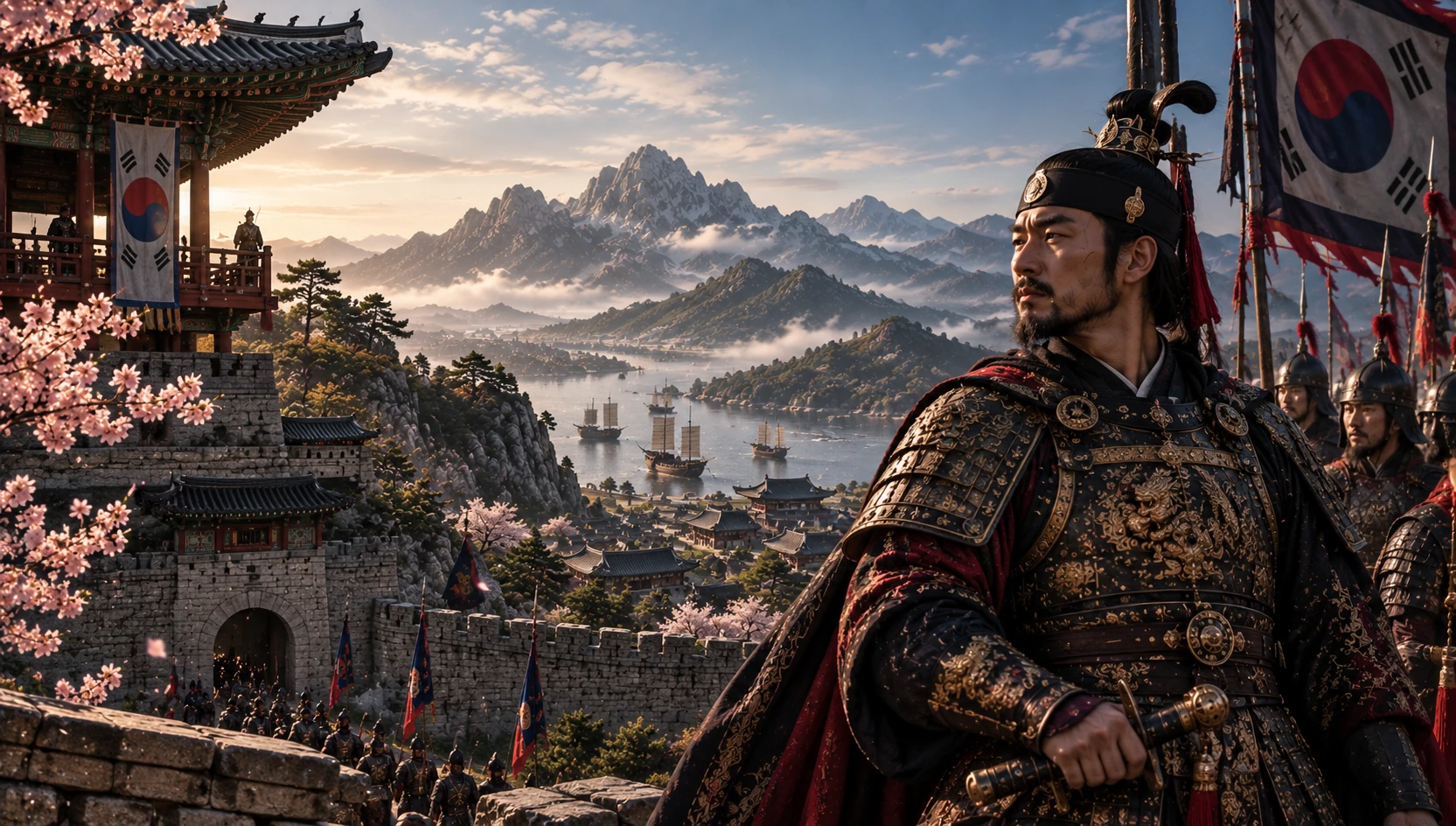
The supplied image is an editorial reconstruction. Its modern South Korean flags are visual references for contemporary audiences and should not be read as flags used by ancient Korean kingdoms.
GOJOSEON AND THE EARLIEST STATES
Korean historical tradition places Gojoseon among the earliest polities of the peninsula and the Liaodong region. The foundation story associated with Dangun combines myth, political memory and later written compilation. Archaeology shows the growth of fortified settlements, bronze-working communities and agricultural societies, but it cannot verify every detail of the legendary chronology. Gojoseon developed in a regional world that included steppe routes, northern China and communities across the peninsula.
The Han dynasty established commanderies in parts of the northern peninsula after defeating Wiman Joseon in 108 BCE. Lelang and other commanderies became centers of trade and administration, while local societies retained their own rulers and institutions. The presence of Chinese commanderies did not make the entire peninsula Chinese, and their geography and longevity remain subjects of historical debate. Korean History: Gojoseon and early polities
THE THREE KINGDOMS
Between the first centuries BCE and the seventh century CE, Goguryeo, Baekje and Silla developed into powerful kingdoms. Gaya confederacies in the Nakdong basin added another important political and cultural zone. The Three Kingdoms competed for river valleys, ports, agricultural land and strategic fortresses. Their rulers adopted Buddhism, Chinese writing and administrative practices while adapting them to local court traditions and languages.
Goguryeo grew from the Yalu and northern mountain regions into a large kingdom whose territory at different times included parts of the Korean peninsula and Manchuria. Its rulers built stone fortresses and maintained a formidable cavalry and infantry army. Goguryeo fought the Sui dynasty in the early seventh century. The campaigns of Emperor Yang ended in disaster for Sui forces, including the major defeat at Salsu in 612. Tang armies later attacked, but Goguryeo resisted for decades before internal conflict and Silla-Tang pressure brought its fall in 668.
Baekje developed around the Han River and later moved its capital south to Ungjin and Sabi. It maintained maritime connections with the Chinese dynasties and the Japanese archipelago. Baekje artisans, monks and scholars contributed to the transmission of Buddhism, writing, architecture and craft techniques to Japan. These exchanges were not one-way cultural borrowing. Baekje elites selected and transformed continental practices within their own political and religious world.
Silla began in the southeast and gradually built a centralized monarchy. Its bone-rank social system, gold crowns and Buddhist institutions expressed a distinctive court culture. Silla allied with Tang China to defeat Baekje in 660 and Goguryeo in 668, then fought the Tang armies that sought to establish their own commanderies. By the late seventh century, Silla controlled much of the peninsula south of the Taedong River, although its unification was not the creation of modern Korea and northern regions remained outside its rule.
UNIFIED SILLA AND BALHAE
Unified Silla developed a sophisticated Buddhist court, a capital at Gyeongju and networks of temples, aristocratic estates and maritime trade. Bulguksa and Seokguram represent the artistic and religious achievements of the period, while the state also faced aristocratic competition, peasant unrest and regional fragmentation. In the north, survivors of Goguryeo and other peoples helped establish Balhae in 698. Balhae governed areas of present-day northeast China, the Russian Far East and northern Korea, but its population and political identity were complex.
Historians debate how to describe Unified Silla and Balhae. Some call them the Northern and Southern States period, while older narratives emphasize Silla's unification. Neither label should be used to erase Balhae or to project present national borders backward. Both states participated in East Asian diplomacy and trade while maintaining their own political cultures.
GORYEO AND THE ORIGIN OF KOREA
Wang Geon founded Goryeo in 918 and reunited the Later Three Kingdoms in 936. The dynasty's name, Goryeo, is the source of the modern word Korea. Goryeo combined Buddhist institutions, aristocratic clans, civil administration and military families. Its capital at Gaegyeong connected the peninsula to maritime routes and diplomacy with the Song, Liao and Jin states.
Goryeo's political order was not a centralized modern bureaucracy. Landholding, hereditary offices, monasteries and military households shaped government. The dynasty sponsored Buddhist rituals and large scripture projects, including the Tripitaka Koreana woodblocks. Celadon ceramics, printing and metalwork flourished, while social status remained unequal and state authority varied between the capital and provinces.
Goryeo faced repeated attacks from the Khitan Liao and later the Jurchen Jin. Diplomatic settlements, fortifications and military reforms helped the dynasty survive. In the thirteenth century, Mongol armies invaded Korea repeatedly. Goryeo eventually accepted Mongol overlordship and supplied ships and troops for the Yuan campaigns against Japan. The court moved between resistance and accommodation, and the dynasty retained a king and Korean institutions while accepting severe external constraints.
Goryeo's location made diplomacy as important as battlefield strength. Its rulers exchanged envoys and gifts with Liao, Jin, Song and later Yuan courts, while merchants moved ceramics, textiles, metals and books through ports on the western and southern coasts. Buddhist monasteries held land and organized labor, but they were also centers of printing, education and art. The dynasty's famous celadon, with its blue-green glaze and inlaid designs, shows how local workshops engaged with wider East Asian tastes without losing a distinctive Korean style.
The Mongol wars caused repeated destruction of farms, towns and temples, yet Goryeo society adapted. Fortresses in mountain valleys sheltered civilians, and court officials negotiated tribute and hostages to preserve the dynasty. The woodblocks of the Tripitaka Koreana were carved during this period as a Buddhist act of protection and remain a major documentary and artistic achievement. Their survival also reminds historians that military defeat did not erase Korean institutions or cultural production.
THE TRANSITION TO JOSEON
By the late fourteenth century, Goryeo faced factional conflict, land concentration and pressure from the Ming and remnants of the Yuan. General Yi Seong-gye opposed a proposed campaign against Ming territory and seized political power in 1388. In 1392 he founded the Joseon dynasty. The transition was presented as a restoration of good government, but it also involved elite realignment, land reform and the construction of a new Confucian political order.
Joseon moved its capital to Hanyang, modern Seoul, and built a state organized around Neo-Confucian ethics, civil examinations and bureaucratic offices. Buddhism lost court privilege, although it remained important among communities and in the mountains. The yangban elite dominated administration and landholding, while commoners, slaves and women occupied unequal positions under law and custom. Joseon society changed across five centuries, so it should not be treated as a single unchanging Confucian system.
KING SEJONG, HANGUL AND JOSEON CULTURE
King Sejong, who ruled from 1418 to 1450, strengthened administration, science and culture. His court sponsored astronomical instruments, calendars, agriculture manuals, medicine and geography. In 1443, scholars completed the alphabet later known as Hangul, proclaimed in the Hunminjeongeum in 1446. The script was designed to represent Korean speech more easily than classical Chinese characters. Its creation did not instantly replace literary Chinese, but it expanded possibilities for education and vernacular writing.
Joseon officials developed legal codes, census systems and agricultural policies while maintaining tributary diplomacy with Ming China. Tribute relations involved hierarchy and ritual, but they did not make Joseon a Chinese province. Korean scholars selected Chinese philosophical and administrative models, adapted them to local institutions and cultivated a distinct literary culture. Printing, painting, ceramics and court ritual reflected both regional exchange and Korean innovation.
Joseon government relied on a capital bureaucracy, provincial governors and magistrates, military garrisons and a tax system based on land, households and labor obligations. Court records such as the Annals of the Joseon Dynasty preserve unusually detailed evidence of policy and daily administration. Outside the capital, village communities managed irrigation, markets and ritual life. Social rank mattered, but wealth, examination success, military service and regional alliances could change a family's position over time.
The dynasty's cultural world was broad. Court musicians and painters served royal ritual, while scholars produced histories, maps and commentaries. Ceramics, woodblock printing and later movable-metal type supported both state and private publication. Neo-Confucian academies trained local elites, Buddhist temples remained active and shamanic practices persisted in popular life. Joseon's culture therefore cannot be reduced to official ideology alone; institutions coexisted with varied beliefs and regional customs.
JAPANESE INVASIONS AND ADMIRAL YI
Japan's invasions of 1592 and 1597, known as the Imjin War, devastated much of Joseon. Toyotomi Hideyoshi sought a route to conquer Ming China and demanded passage through Korea. Joseon armies initially collapsed before Japanese forces captured Seoul and Pyongyang. Ming China intervened, and Korean resistance recovered under commanders on land and sea.
Admiral Yi Sun-sin used careful intelligence, naval organization and local knowledge to defeat Japanese fleets in battles including Hansan Island and Myeongnyang. The turtle ship is associated with his naval forces, although later popular images can exaggerate its design and role. Yi's victories disrupted Japanese supply lines. He was killed at the Battle of Noryang in 1598 as the invasion ended. The war left cities, farms, archives and communities damaged, while captives and artisans were taken to Japan.
MANCHU INVASIONS AND LATE JOSEON
Joseon entered conflict with the rising Later Jin, later Qing, after maintaining ties to the Ming. Manchu armies invaded in 1627 and again in 1636. In the second invasion, King Injo surrendered at Samjeondo and accepted Qing tributary status. Joseon remained internally governed, but the wars reshaped diplomacy and encouraged debates about military preparedness, cultural identity and relations with China.
The eighteenth century brought commercial growth, population change and reform debates. Silhak scholars criticized inherited status and sought practical approaches to agriculture, technology and administration. Markets expanded, but the yangban order and land inequality remained powerful. The nineteenth century brought factional conflict, peasant resistance, Christian missions and pressure from Western states, Japan and Qing China. Joseon leaders faced modernization questions without a stable consensus on how to respond.
ANNEXATION AND MODERN LEGACY
Japan defeated Qing China in 1895 and Russia in 1905, then turned Korea into a protectorate. Japan formally annexed Korea in 1910. Colonial rule reorganized land, industry and education while imposing political repression, cultural controls and economic extraction. Korean resistance took diplomatic, religious, armed and mass forms. The March First Movement of 1919 demonstrated broad opposition, although Japanese rule continued until 1945.
After Japan's defeat in 1945, Korea was divided along the 38th parallel into Soviet and American occupation zones. Separate governments formed in 1948, and the Korean War from 1950 to 1953 hardened the division. North Korea and South Korea are modern states with different political systems. They draw on shared historical kingdoms, but neither state can simply be equated with Goguryeo, Goryeo or Joseon.
The kingdoms of Korea left a layered legacy of cities, fortresses, temples, writing, law, literature and political memory. Goguryeo's northern history remains sensitive because modern Chinese and Korean narratives use ancient territory to support different claims. Archaeology and texts show interaction across borders, shifting populations and changing states rather than a single timeless nation. A careful history recognizes Korean civilization's creativity while acknowledging deep East Asian exchange.
A SHORT TIMELINE
- c. 1st millennium BCE: Gojoseon and other early polities develop in the peninsula and Liaodong region.
- 1st century BCE to 668 CE: Goguryeo, Baekje, Silla and Gaya compete in the Three Kingdoms era.
- 698: Balhae is founded in the north after the fall of Goguryeo.
- 918-936: Wang Geon establishes Goryeo and reunites the Later Three Kingdoms.
- 1231-1259: Mongol invasions force Goryeo into a constrained relationship with the Yuan.
- 1392: Yi Seong-gye founds Joseon.
- 1443-1446: Sejong's court creates and promulgates the Hangul alphabet.
- 1592-1598: Japanese invasions devastate Joseon; Korean and Ming forces resist.
- 1636: Joseon submits to Qing tributary relations after the second Manchu invasion.
- 1910: Japan formally annexes Korea; colonial rule lasts until 1945.
FREQUENTLY ASKED QUESTIONS
**Were Goguryeo, Baekje and Silla one country?**
No. They were rival kingdoms with different territories and institutions. Silla and Tang defeated Baekje and Goguryeo, then Silla fought Tang forces and ruled much of the peninsula south of the Taedong River.
**What is the difference between Goryeo and Korea?**
Goryeo was a dynasty that ruled from 918 to 1392. The modern name Korea derives from Goryeo, but the dynasty's territory and institutions were not identical to either modern Korean state.
**Did Chinese dynasties control Korea?**
Chinese states established commanderies and fought wars in and around the peninsula, while later Korean kingdoms maintained tributary diplomacy. Chinese influence was significant, but Korean rulers and communities adapted institutions and developed their own political and cultural traditions.
**Why is King Sejong important?**
His court sponsored science, administration and the creation of Hangul, an alphabet designed to represent Korean speech more effectively than classical Chinese writing.
**What happened during the Imjin War?**
Japan invaded Joseon in 1592 and again in 1597. Korean and Ming forces resisted, and Admiral Yi Sun-sin's naval victories disrupted Japanese supply lines before the war ended in 1598.
SOURCES AND FURTHER READING
For broader East Asian context, see PRESDA's Jin Dynasty and Majapahit Empire histories.
> Korea's history is a succession of kingdoms and dynasties shaped by regional exchange, military competition and distinctive institutions, not a single unchanged state.
FAQ
Frequently Asked Questions
Were Goguryeo, Baekje and Silla one country?
No. They were rival kingdoms with different territories and institutions. Silla later ruled much of the peninsula south of the Taedong River.
What is the difference between Goryeo and Korea?
Goryeo was a dynasty from 918 to 1392. The modern name Korea derives from Goryeo, but their territories were not identical.
Did Chinese dynasties control Korea?
Chinese states established commanderies and fought wars in the region, while Korean kingdoms used diplomacy and adapted continental institutions without becoming simply Chinese.
Why is King Sejong important?
His court sponsored science and created Hangul, an alphabet designed to represent Korean speech.
What happened during the Imjin War?
Japan invaded Joseon in 1592 and 1597, but Korean and Ming forces resisted and Admiral Yi's naval victories disrupted Japanese supply lines.
PRESDA Dispatch
Stay Informed. Stay Aware.
A sharp briefing across AI, gaming, sport, business, world affairs, paparazzi, and lifestyle.